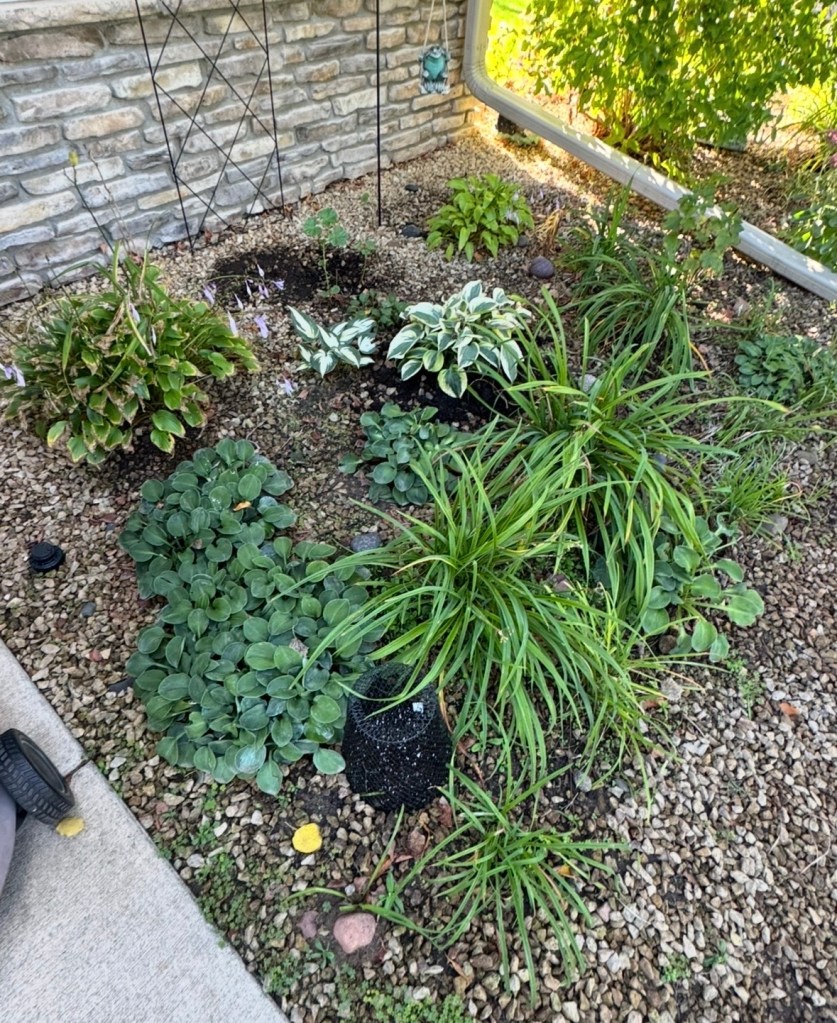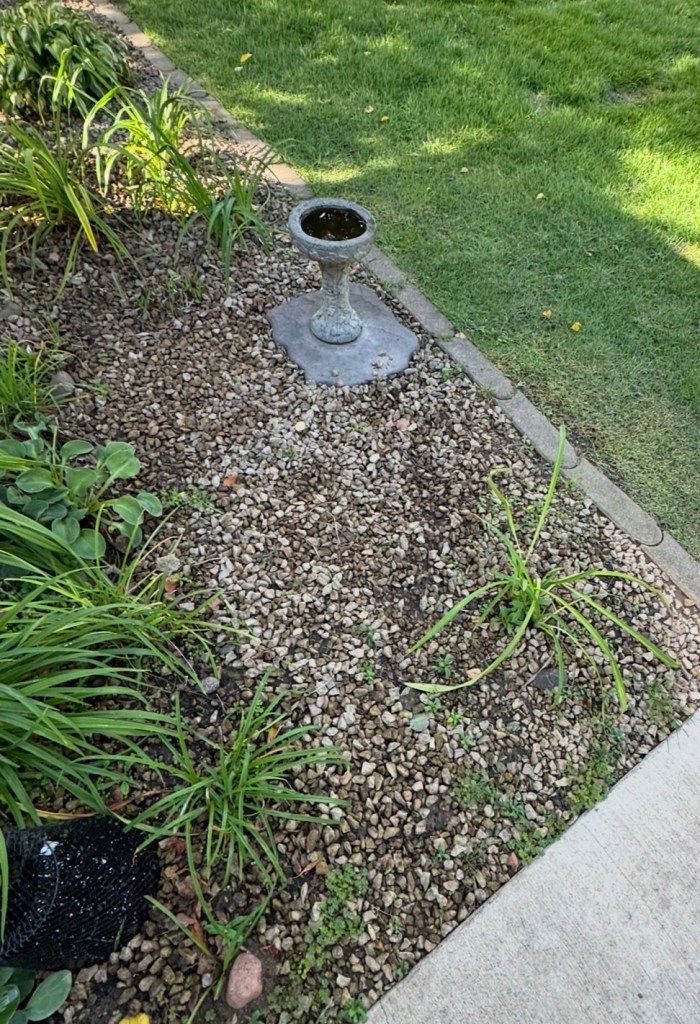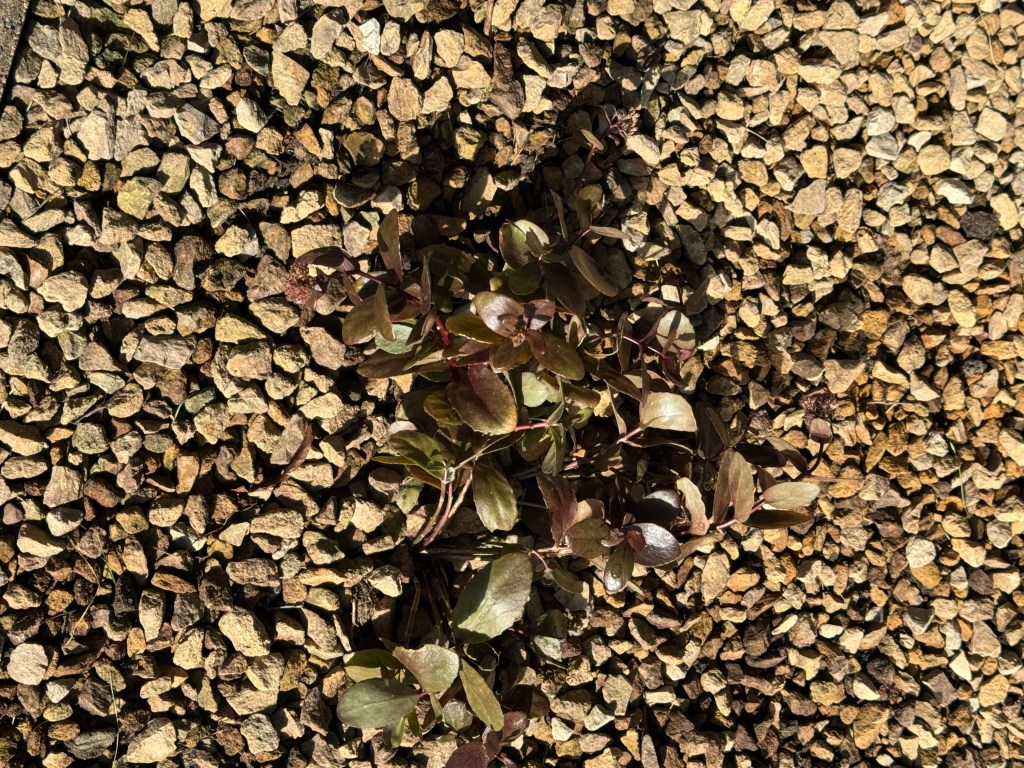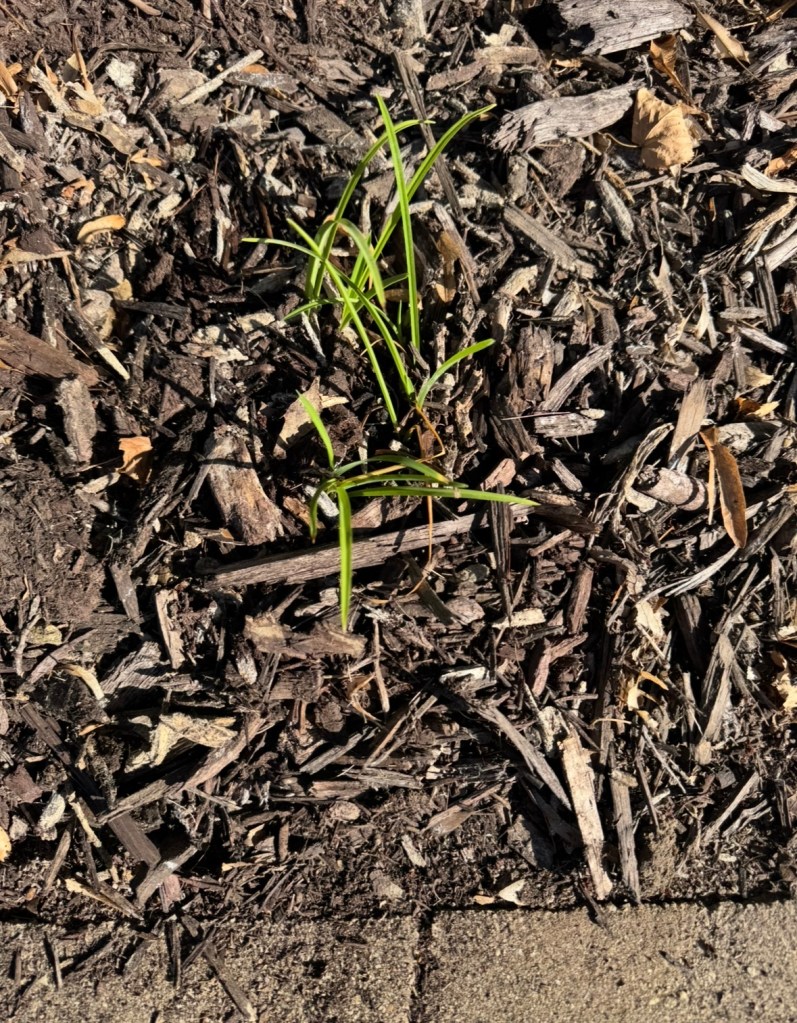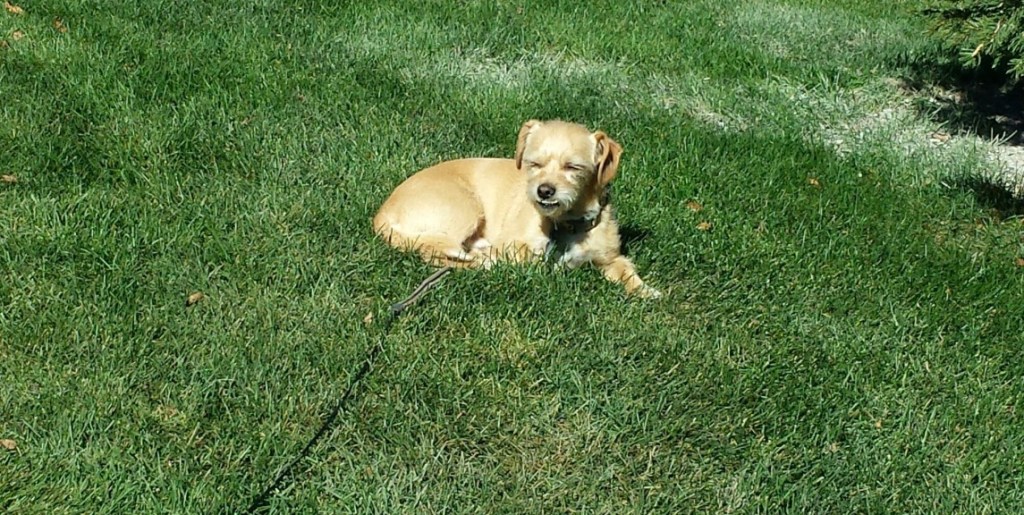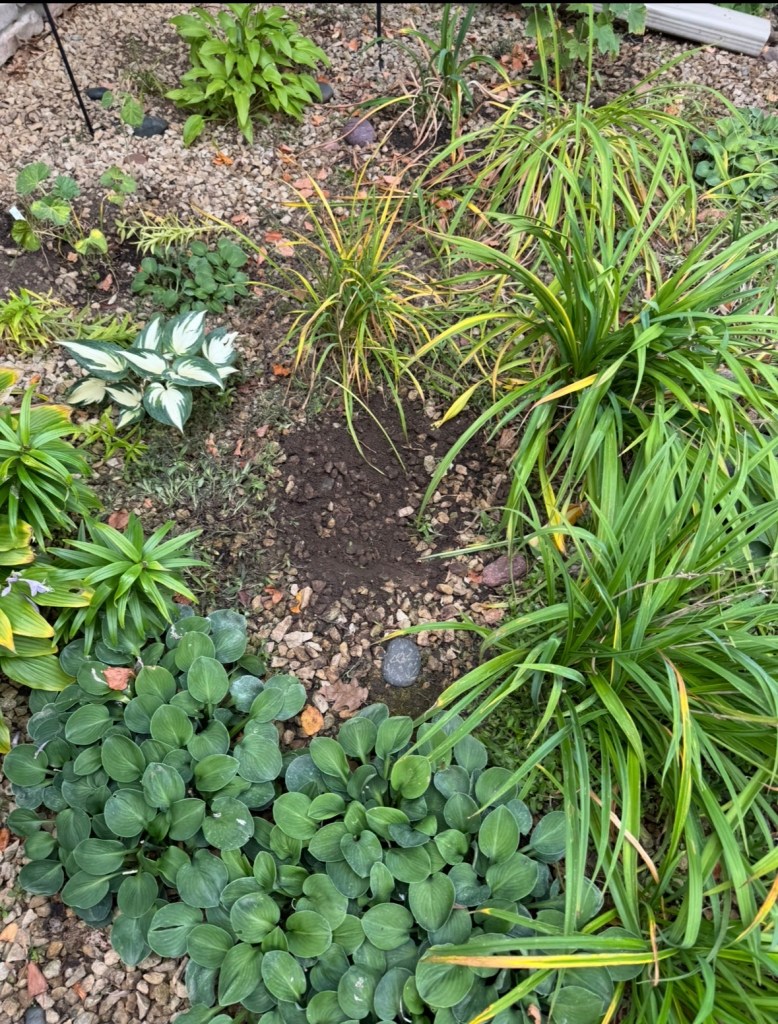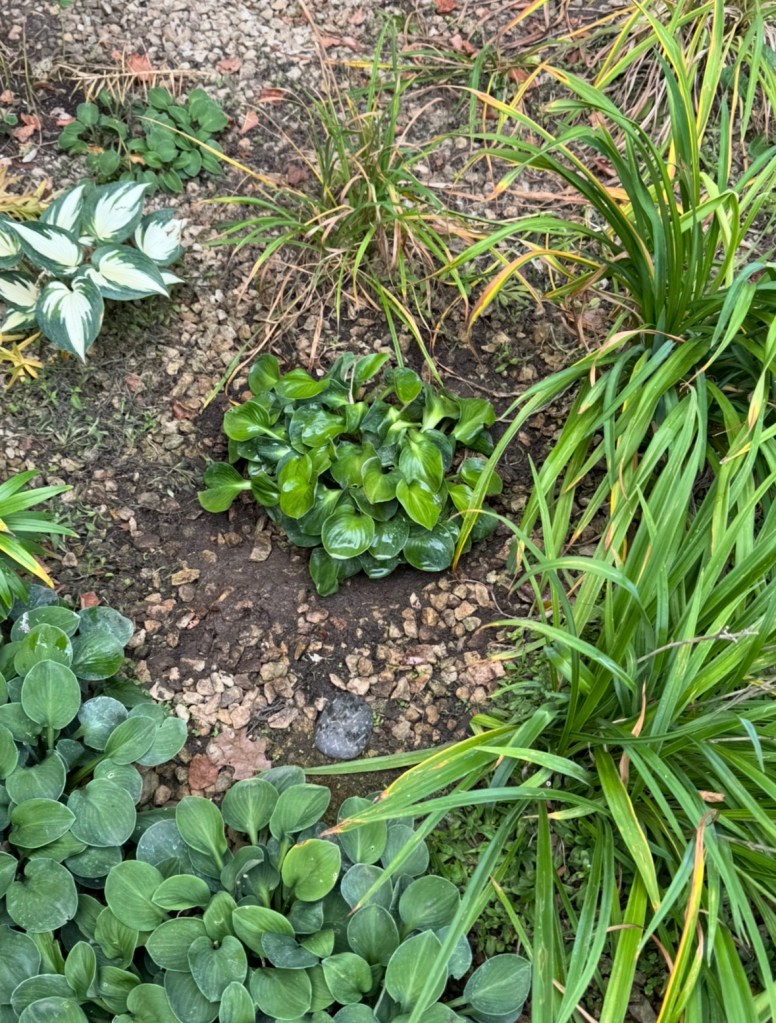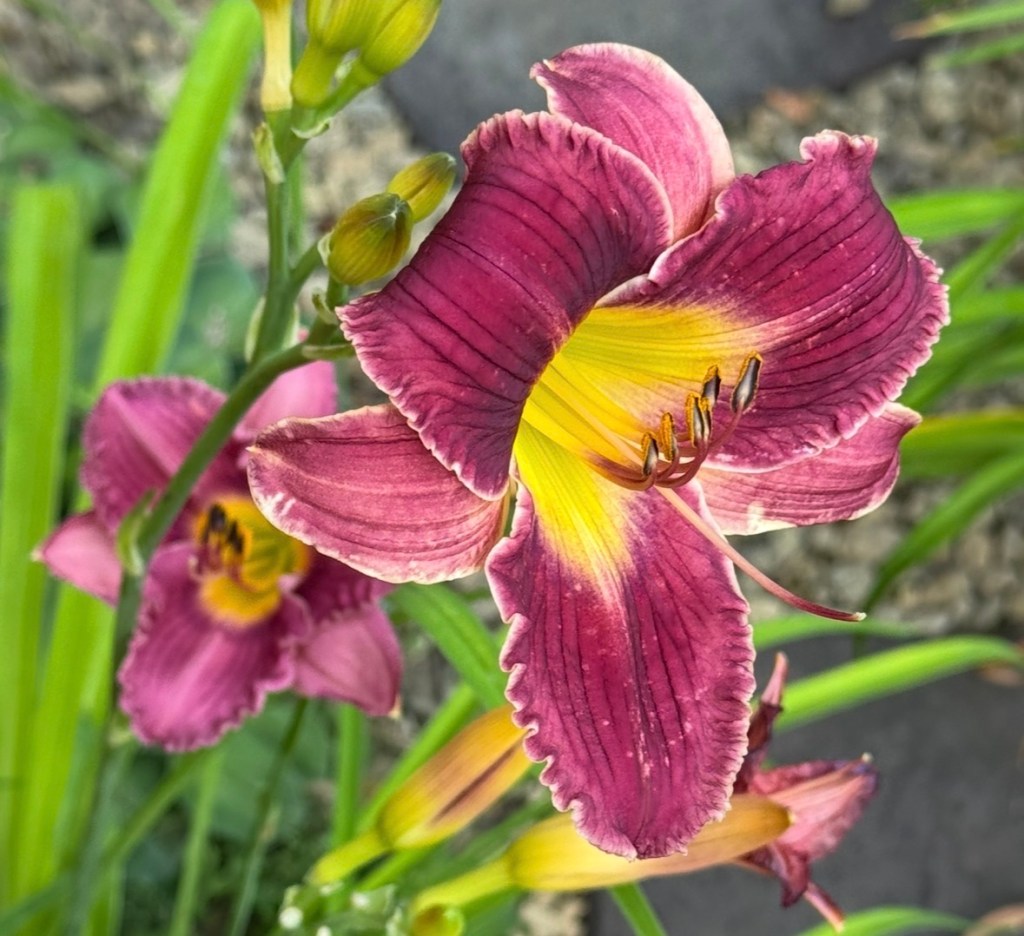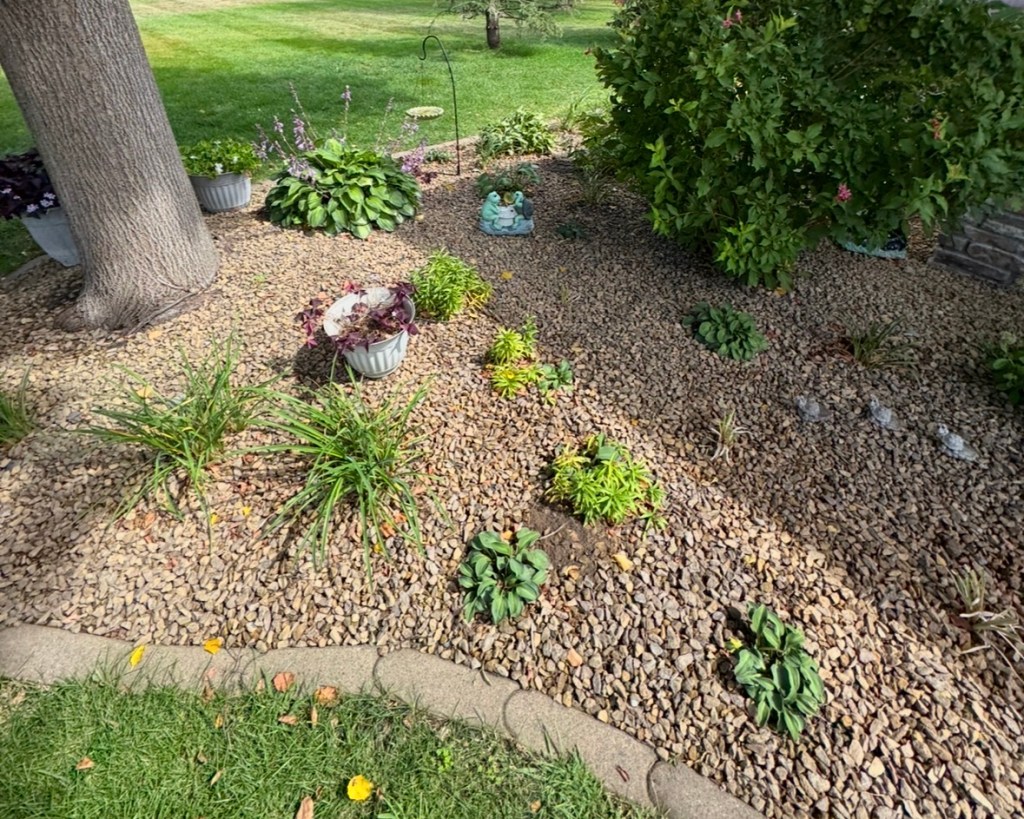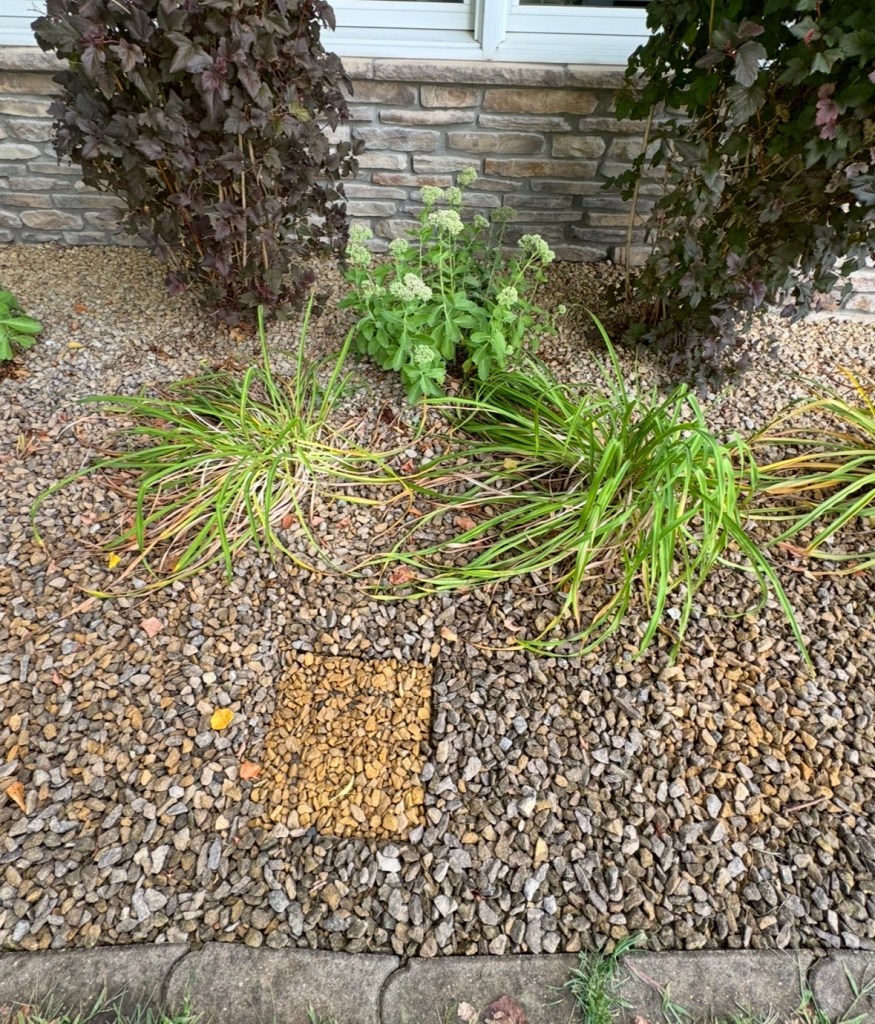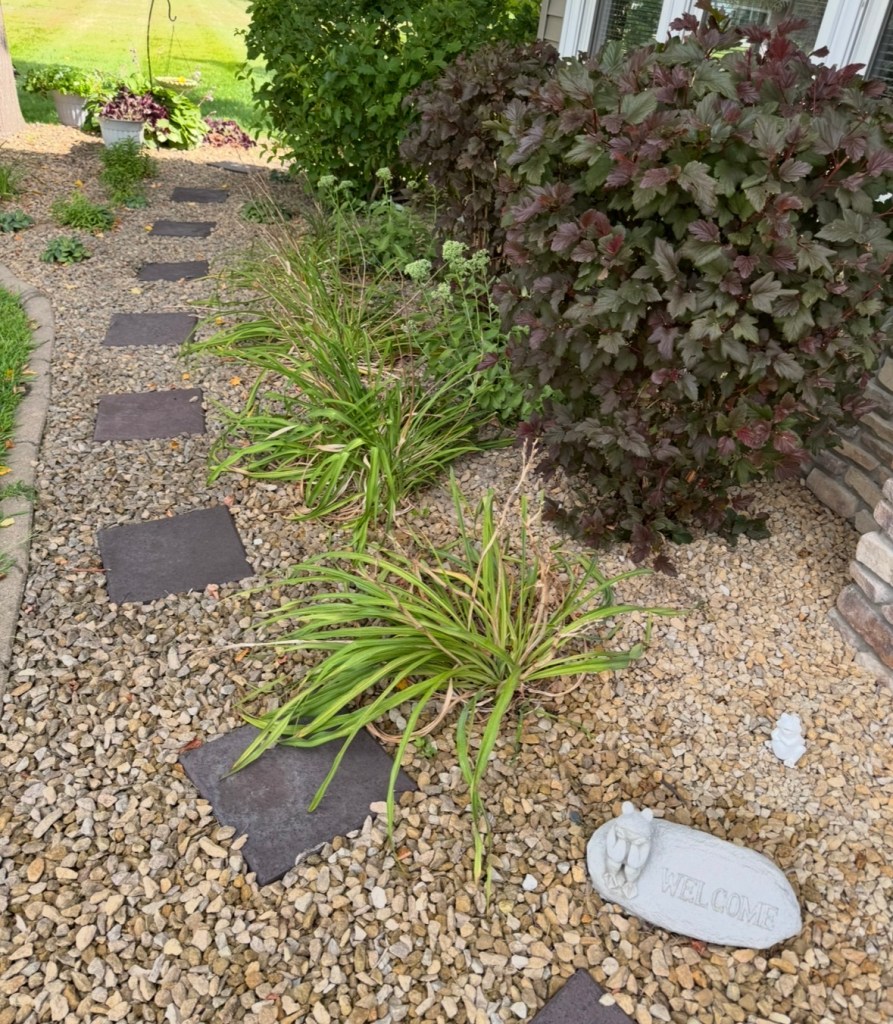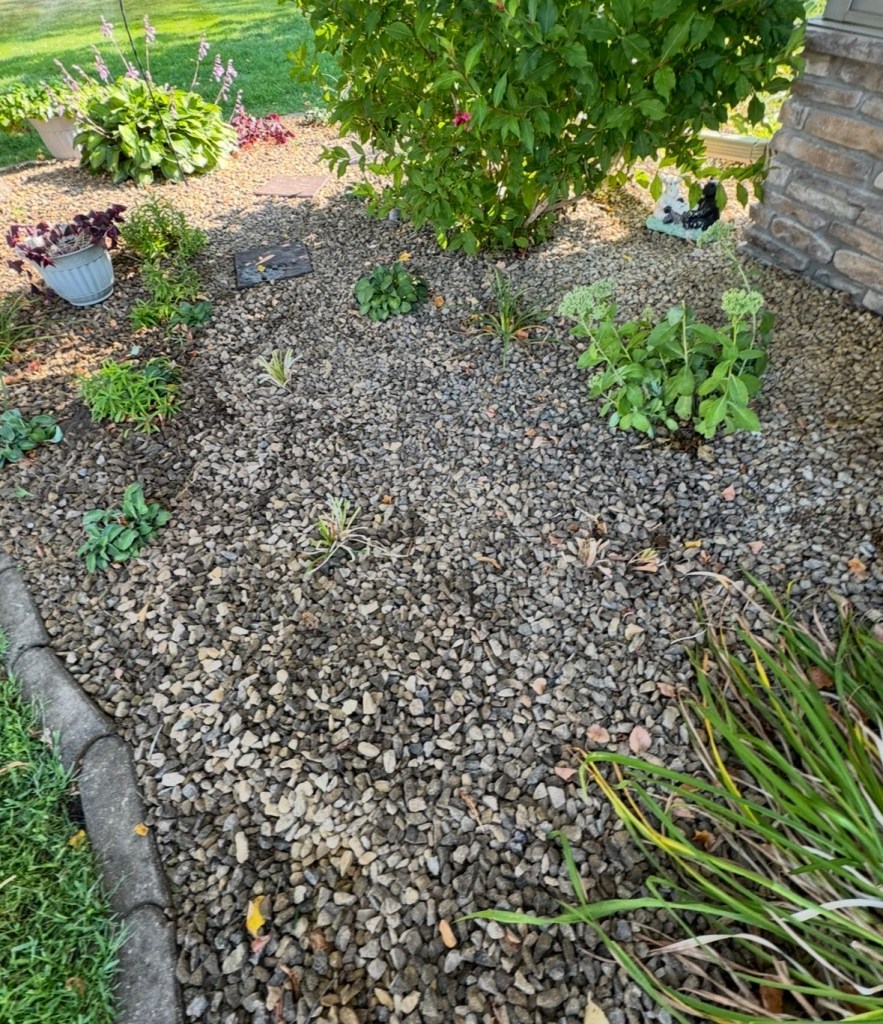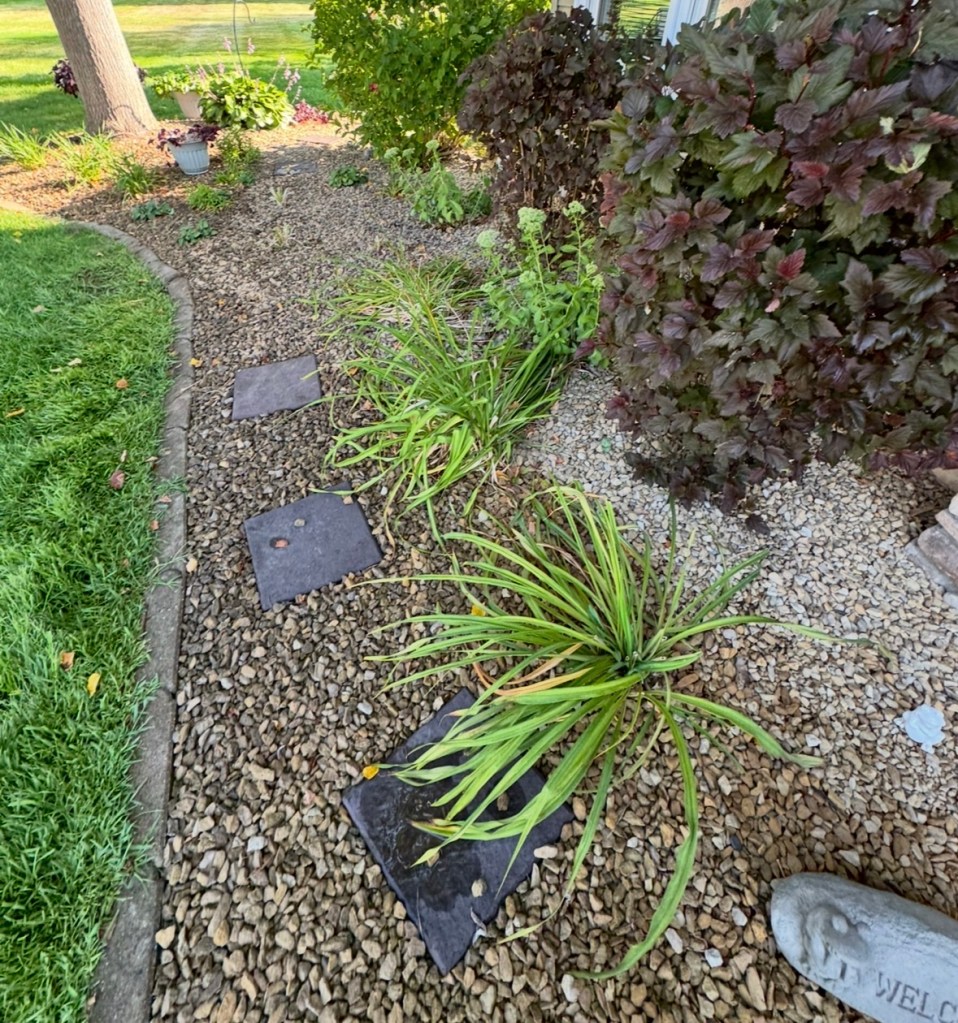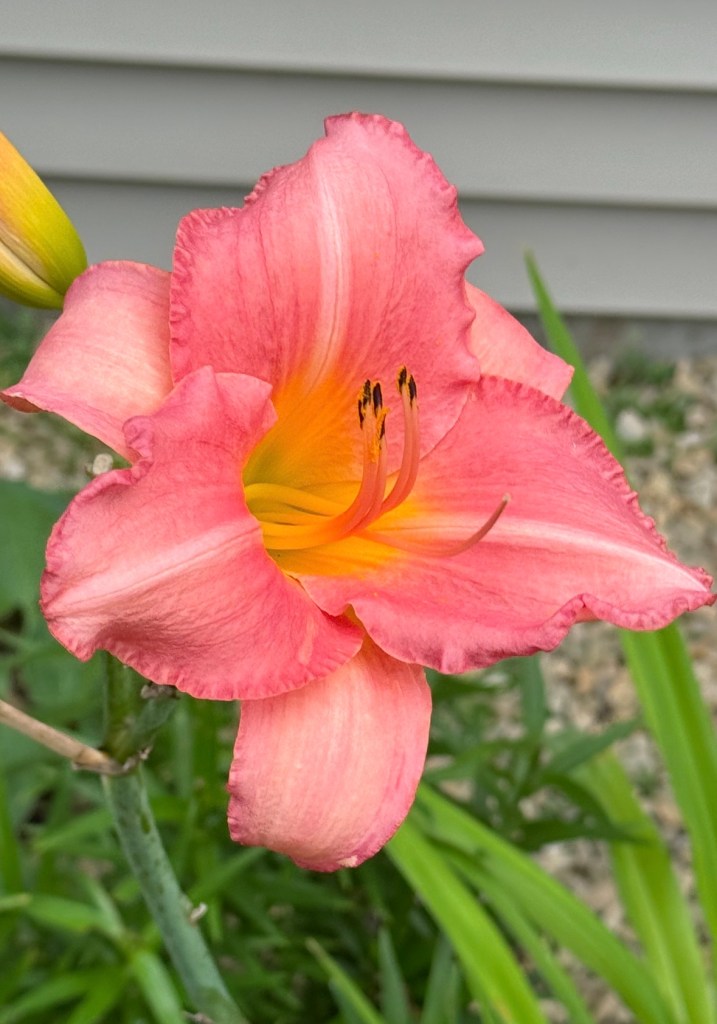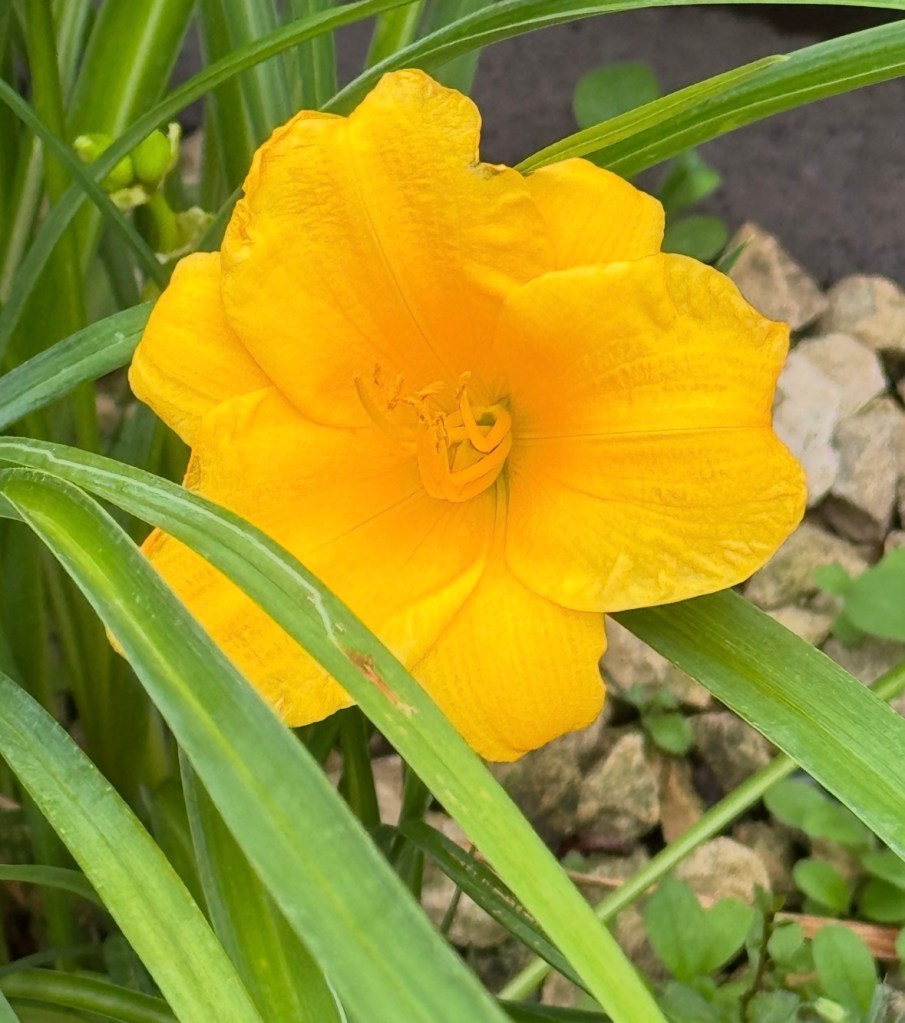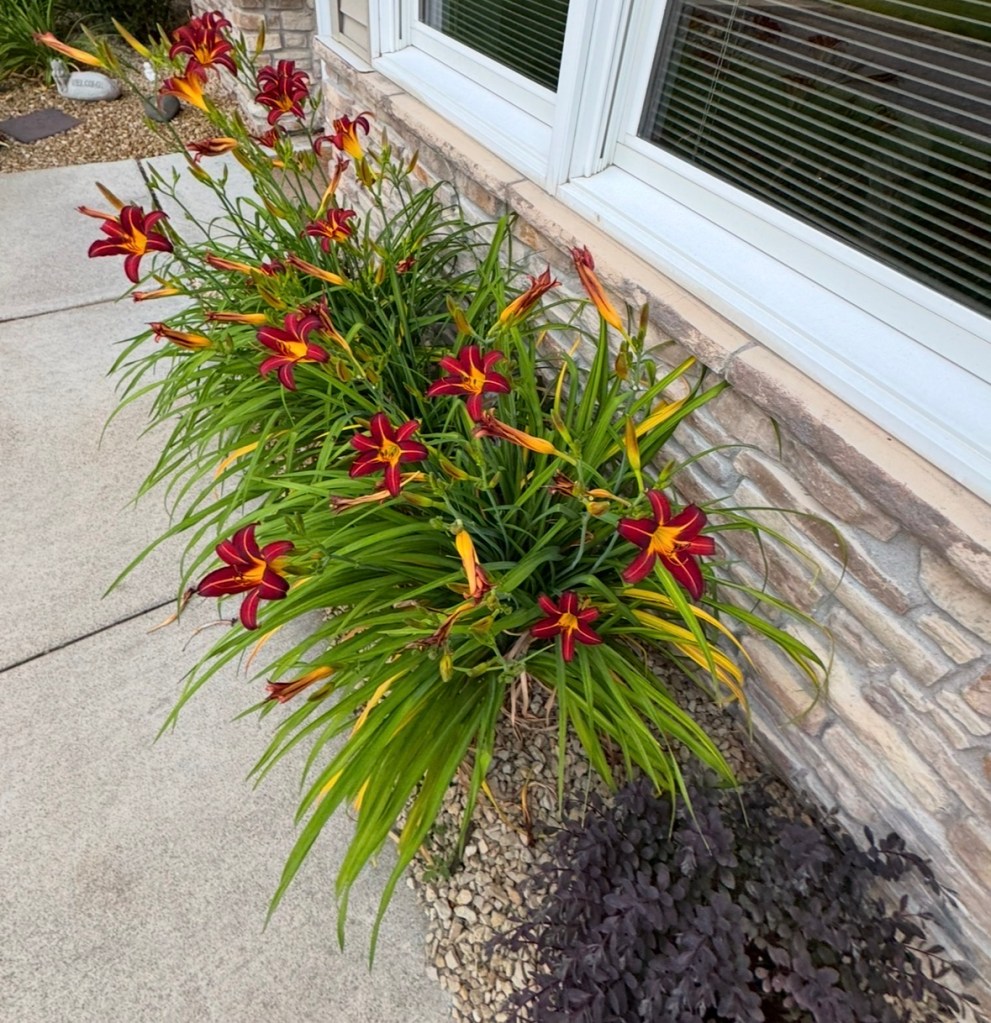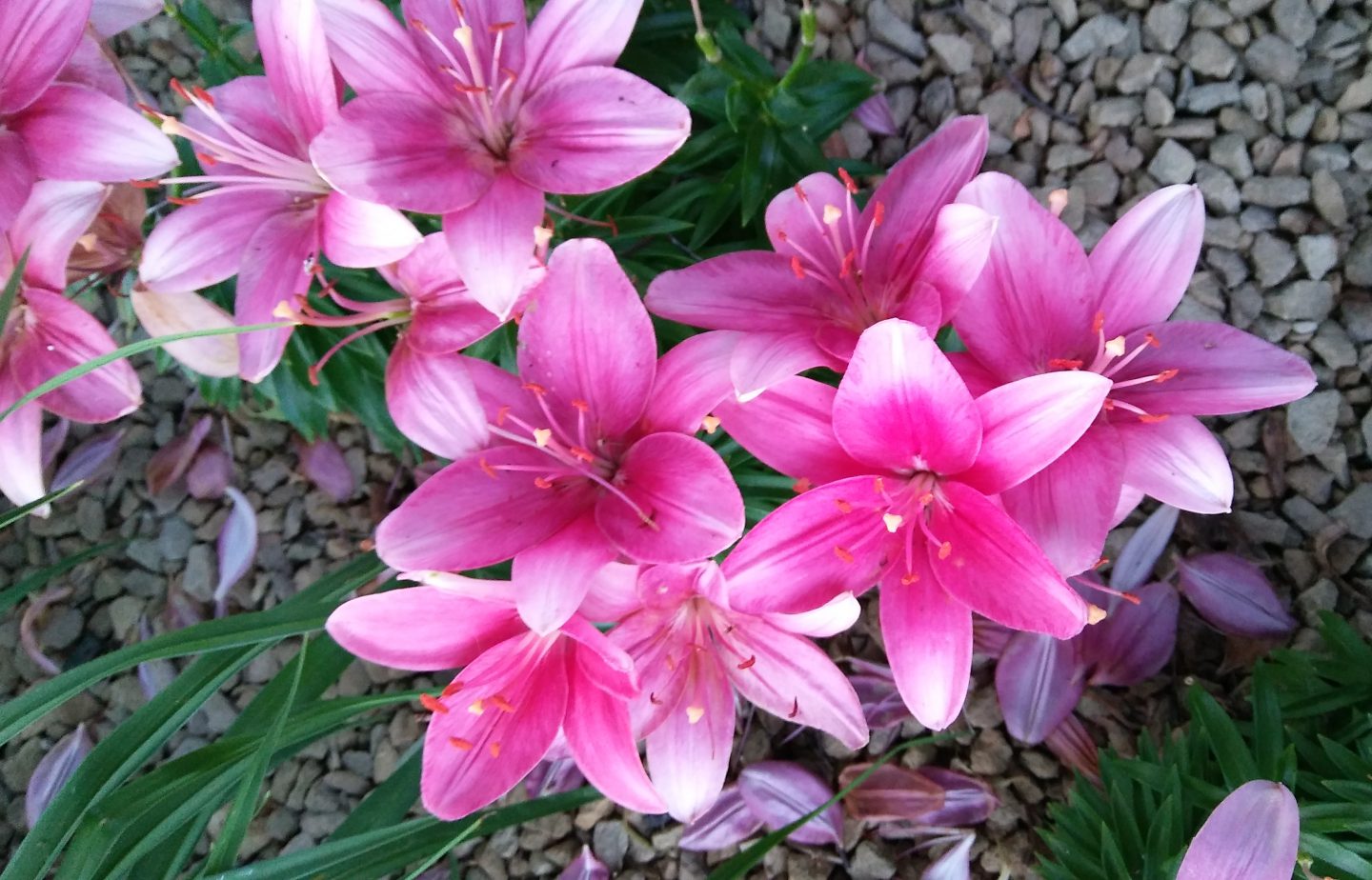
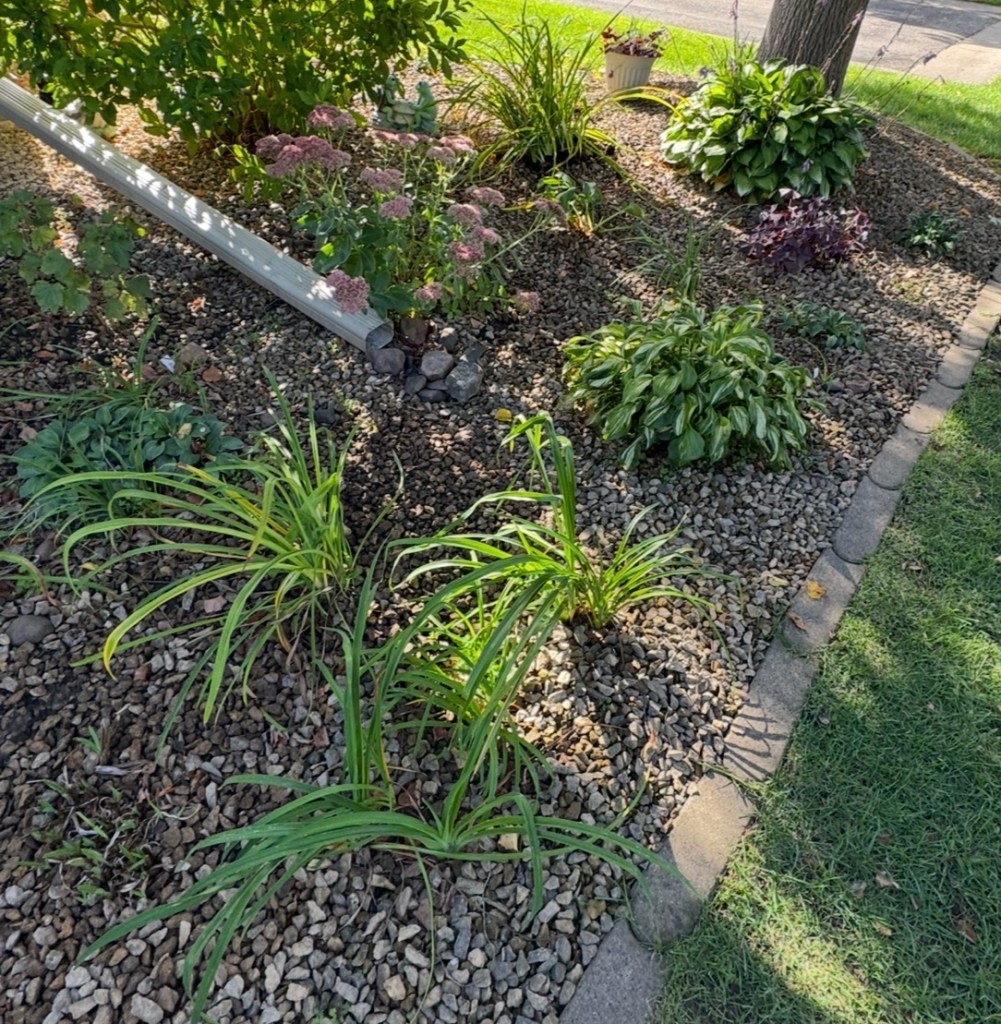
Bonus post. I saw these pictures of 9 and 10 years ago today and had a little laugh. Goodness, thatβs an awful lot of hostas! Most of those are long gone. That exposure was way too much sun for them. I moved them more into the shade and used the space for more daylilies. But the South Seas and Naomi Ruth were there all those years ago π
This daylily has gone from a seedling to a normal sized Autumn Red daylily.
Although that is wonderful, it is a taking a beating from the sprinklers. I am finding blooms on the ground.
The daylilies in that little corner will be transplanted, and shorter daylilies, probably the Marque Moons that need to be transplanted, will go into that space.
The seedlings are growing, and even the seeds that did not germinate in pots, when given a last chance through direct sowing (in the ground), rose to the call.
And now the Sedum will take over. Soon the green will turn to pink, and then to red. If the birds don’t eat them all.
It will probably be a busy transplant season, as always, but way less seeds to harvest and get into storage.
I have really enjoyed narrowing my work on daylily crosses this year. It was, for sure, a discipline, but a good one. From what I can tell I will have 3 maybe 4 intentional cross varieties go to seed, and 6, maybe 7 self-seed varieties go to seed. Two of the self-seed varieties are super exciting to me as they are new this year. One is with Hush Little Baby, a promising historic daylily (diploid) that bloomed in our garden for the first time this year, and one is Pink Moon, one of my own (tetraploid) seedlings that bloomed for the first time this year. But the seed from both of those, if viable, and if it germinates next spring, will not be a blooming daylily for at least 3 years.
Next year my daylily focus will be even more specific. After many years of being the queen of tetraploid hybridization in our gardens, South Seas seems to be waning. I will probably not replace it as I have so many of my own South Seas seedlings now. I plan to turn my focus to working exclusively with my own tetraploid seedlings and then, hopefully, if the three bare root Hyperion I planted this spring bloom next year, Hyperion will be the focus of my diploid work. Hyperion is also the oldest historic daylily in our gardens. Fingers crossed for bloom next year.
And with that, I want to give a heads up that we have some family needs and I will probably not be posting as much. Prayers are always welcome.
Cedar Waxwing is another of our historic daylilies in the townhome gardens.
Like Naomi Ruth, I’m not sure I would plant Cedar Waxwing for naturalizing, but it is an absolute beauty in our Worker Bee garden at the townhome.
Cedar Waxwing was registered in 1979. Its parentage is sdlg x sdlg, so there is not much information on Cedar Waxwing’s parentage that could aid in choosing parentage features for crosses. There is also no info that I can find on its fertility, but it is registered as a tetraploid and I have proved out it is pod fertile with a cross I did with Coral Majority.
Cedar Waxwing may also be pollen fertile, but that has only been proved out with one year’s self-seed in our garden, and I am not even sure it went to seedling. And that Cedar Waxwing self-seed is where the intersection and mystery with Hello Yellow lies.
Hello Yellow is one of my own seedlings.
I have been working hard at identifying Hello Yellow’s parentage. It is a bit of a mystery because back in 2022 and 2023 when Hello Yellow was “born” in our gardens, I was still doing minimal record-keeping. Basically, writing parentage on the envelopes when I stored the seed, and then taking pictures at planting times. Yah. Life was simpler then haha! Luckily, I do have a picture of the envelopes atop the planted pots. So, I kind of know the varieties. More on that in a minute.
When Hello Yellow bloomed only one year after planting, I was delighted. That was uncharacteristically fast for our gardens. When I went to identify what would yield a small yellow bloom, I discovered it was time to get more serious about record-keeping.
Through process of elimination, including ploidy testing and bloom recognition from other known crosses, I think I have narrowed down to two reasonable possibilities. It is either a wacky chance that my early recording practice was not in error, and Hello Yellow is a very rare tetraploid x diploid cross that slipped through, or it is a Cedar Waxwing self-seed seedling. I doubt that I successfully got seed from a Marque Moon (tetraploid) x Pink Tirzah (diploid) cross. I definitely have not been able to replicate it. And I really tried. But maybe. You never know. I have, however successfully crossed Marque Moon x Pink China Doll. It is purple. Turning to Mauve in the strong sun of a long summer day. And kind of tall. Definitely not short. Definitely not yellow.
So, this year I did a Cedar Waxwing x Cedar Waxwing intentional cross. One try. It worked. It has a pod. Now I will see if the pod goes to seed and if the seed germinates (next year). Then if it blooms in 2+ years and it looks like Hello Yellow, by golly, the mystery will be solved. It will go into my personal records as Cedar Waxwing x Cedar Waxwing. If not, I am out of ideas lol and it will remain a mystery.
And that is it for my info on Cedar Waxwing, and for my mini-series on historic daylilies in our gardens. I do have others, and I have done crosses with them, that went to seed and seedling, and they are in our gardens, but the daylilies themselves have either waned or underperformed in our gardens, and, because I have so many seedlings in progress, I am going to just allow those daylilies to live out their natural lives in parts of the garden that I rarely go into for crosses. They can just “be”. Lucky daylilies π
This is historic daylily βTender Loveβ. Tender Love is our third oldest historic daylily in the townhome gardens, and I am not at all hesitant to say I wish I had more than one. With time and patience, they will multiply and need dividing.
Registered in 1970, ‘Tender Love’ is 56 years “old” this year. Remember, though, that registration does not reflect the actual age of the daylily variety. It takes years to get to registration – making the cross, harvesting the seed, bringing it to seedling, then waiting for bloom, and after that waiting to see how it matures (determining consistent characteristics and features it displays).
I purchased ‘Tender Love’ from Oakes Daylilies in 2020. It took a few years to establish. Back then I was planting in fall. I had a number of failures with that approach in our Minnesota gardens and have since shifted to spring planting when I do purchase, which is now pretty uncommon. (I have 29 new seedling varieties due to have first bloom within the next couple years, and that will keep me at capacity for this thing I am calling a “hobby”.)
This year ‘Tender Love’ is looking exceptionally beautiful. It is much more mature than previous years, with four scapes and multiple buds going to bloom per scape.
‘Tender Love’ is a diploid, a late season bloomer, has a beautiful form I very much appreciate, and is nicely fragrant.
On the hybridizing scene, ‘Tender Love’ is both a pod and pollen parent in our gardens. Last year I had two successful crosses that went to seedling – one with ‘Autumn Red’ (yesterday’s featured historic daylily) and one with ‘Pink Tirzah’. Both of those seedling varieties are awaiting bloom in the next couple years. This year I did a re-try of a “Tender Love’ cross that has failed in previous years, with ‘Naomi Ruth’, our fourth oldest daylily in our townhome gardens. TBD on that result.
Naomi Ruth
‘Naomi Ruth’ was registered in 1972. It has one of my favorite forms, it is a diploid, and it is also late blooming. It would not be a daylily I would think of for naturalizing, but it was an excellent pod and pollen parent with ‘Romantic Rose’ and with “Pink Tirzah’ last year producing a plethora of seeds that went to seedling this year. Those blooms should debut in 2027-2028.
‘Romantic Rose’ is not an historic daylily, but it is a long-time part of our gardens.
‘Pink Tirzah’, from what I can gather, is also not an historic daylily. In fact, I cannot find it on garden.org or the AHS site. I bought “Pink Tirzah’ from Park’s many years ago, as a 1-year-old bare-root. ‘Pink Tirzah’ is also pod and pollen parent to multiple years of crosses, including ‘Autumn Red’, yesterday’s featured historic daylily.
Tomorrow we will be on to Cedar Waxwing, and Oh, the story of that one! Just a sneak peek – Cedar Waxwing may hold the key to the Hello Yello mystery.
This year I began my focus on historic daylilies. I am absolutely enamored with how old homesites can have barely ruins of what was once there and still have daylilies coming up.
This year we found some historic daylilies that had naturalized at the historic cemetery. Autumn Reds and Fulvas, so far. AI tells me seeds would not survive birds digestive system. Those Autumn Reds and Fulvas were probably planted there by a loving family member or friend or a volunteer gardener. Can you imagine the stories they could tell?
I got to thinking – those daylilies have probably survived grass cutting and deer munching for decades, maybe longer. Fulva could have been planted when the historic cemetery began. A testament to their endurance.
We had a drought this year. The historic cemetery does not have sprinklers. The garden looks rough. But the daylilies bloomed and even made abundant pods (which I pulled and put in compost). The greens are fine.
And I thought of the Autumn Reds out front at the townhouse. They are not part of the sprinkling pattern. They survive on rain, and even through drought they look beautiful.
I looked at my daylily inventory, and also my own seedling list. A vast majority of the seedling varieties have at least one historic parent. Many have both. Which ones would survive drought and low to no maintenance best? I am guessing the historic ones would fare best.
And I thought to myself, what would happen at the historic cemetery if I replaced fading plants that are not very drought tolerant to historic daylilies? What would it look like in 10, 20, 50 years? Would they still come up and bloom? Would they naturalize if the cemetery volunteer program faded, as has happened various times during the cemetery’s history? I am guessing the daylilies in the garden would be there, blooming away.
Daylilies, Daylilies. Yes, please, more historic daylilies π
It has been a very fun, and at the same time very busy week. After a week and a half of heat warning weather, and quite a few days of heavy smoke from the wildfires up north, it felt really good to get out in the gardens in the cooler weather. One by one, the daylilies are winding down, and it is time to start setting the stage for fall transplanting.
One of the projects on my mind has been to address the failing clematis in the back. Yesterday as I was wrapping up trimming the front bushes and pulling the forget-me-nots that were looking less that enhancing, I ended up at the clematis. You know that moment where you finally decide, and just do it? That’s what happened. So, before I lost my nerve, I decided it was time to let it go. And when I stood back and looked at the now empty space, I could not believe how different it looked. I really like it. It has freed up a nice little path to the back of that garden and solidified my choices on what I want to transplant in and out of that garden.
Now a lot of my garden thoughts are on the daylily transplant succession plan for this fall. I have quite a few daylilies that will need dividing and transplanting. There are also seedlings that I really like that have gotten tall and are getting hit by the sprinklers. They also need to be in the plan.
And, I feel like a little refresh. Not a rehaul, but definitely a spruce up. What that will look like I am not firmed up on, but I am pretty close to the conclusion that Sandy’s garden will be reds, purples, and deep pinks (against the backdrop of the brick) and then the Worker Bee garden will be pastels (against the backdrop of the tan siding).
It is Move it Monday, so a bit of re-moval was planned. Not Weeding Wednesday because the Forget-Me-Not are working plants in our gardens, but for sure, when they start to fade, it is time to remove, before they set a lot of seed.
BeforeAfter
That type of work goes pretty fast, a good thing in the heat we’ve been getting. I think that took about 10 minutes and then I took about 5 minutes more to pull some others in other areas and wrapped it up. I put away the bucket and gloves and grabbed a peach tea π Oh yeah, and took the after picture π
Far more exciting is that Marque Moon bloom has moved back into the garden. More accurately, Marque Moon self-seedling bloom.
In 2022 amid a very busy year, I harvested the seed that made this Marque Moon self-seed daylily. It has gone through a journey, and a move within our townhome gardens, but today it bloomed its first.
The return of Marque Moon bloom is a very nice development. Our legacy Marque Moon daylilies are fading and did not send up scapes this year, so no blooms. In addition, a new Marque Moon I planted in fall of 2024 did not come up the following spring and has not shown since then. I am going to try to move the old Marque Moon daylilies this fall, but I am not optimistic. They are amongst the Linden roots.
So, imagine the wonderful surprise I had this morning when I looked out and saw what looked like a white bloom. As soon as the thunderstorm abated, I just had to get a peek. There it was! A bloom from Marque Moon self-seed! And a first for our gardens as well. Marque Moon self-seed has never made it to bloom in our garden until now.
It usually takes a few blooms or even until the next year to get an idea of what we have in a new daylily. What I am noticing right away, besides the visual similarity, is that it is an Early Morning Opener. That feature is consistent with one of Marque Moon’s parents, Enchanted April. It will be interesting to see how it progresses.
And, on to seed, my test cross with Hush Little Baby (Pink Tirzah x Hush Little Baby) succeeded. There’s a lot of steps that need to go well between pod formation and bloom, but hopefully it will all work and we will be able to enjoy another new variety.
And then, on a fall planning note, I have my first “need to” move for one of my seedlings. Equal Opportunity has gotten pretty big, which is great, but now it is consistently getting hit by the sprinkler. It needs to be moved this fall.
And so, the seedling migration will begin. Significant thinking will be going on. What will look best where? Where do I want things longer term? And what do I want accessible for occassional crosses versus enjoying and just maintaining?
Today was a slow day – a day for a tiny bit of hosta maintenance and a whole lot of enjoying the daylilies.
Today I removed the scapes from the last two Blue Mouse Ears hostas. I think it took 5 minutes. Blue Mouse Ears hostas are super easy to maintain. The scapes don’t need cutting. They snap off.
The spent blooms tend to stick to the leaves, so pulling those by hand is a lot, but a few sprinkler cycles and they should clear.
I am seeing some heat fatigue on the plants, and the hosta by the Blue Mouse Ears pictured above is one of those. That one has been a trooper. I will probably divide and transplant it more into the shade this fall.
The daylilies continue to amaze me.
Pink Moon (one of my own seedlings) is showing some features I really like, especially the outline on the edges.
It also has an interesting look when it is opening up. A cool pattern.
I will be researching a bit more to see what the markings on the open blooms are. I’m guessing they are getting hit by the sprinklers. I may need to move Pink Moon to a better location this fall.
Hush Little Baby bloomed again today. What a welcome addition to the garden!
And what I think is Romantic Rose has an interesting feature around the eyezone today. I don’t remember seeing that in the past, but maybe I just haven’t noticed it. That is a daylily I bought many years ago and transplanted more into the sun just a few years back when we got a larger Traeger and it ended up in mostly shade and was failing. Look at it now! And it has seedlings, yes it does, with Naomi Ruth, both as a pod and pollen parent, so hopefully in 2027 we will see even more beauty!
Just Plum Happy is coming into full bloom now.
And Pink China Doll had 7 blooms today! Very nice!
And as is normal for this time of the season, we are starting to see last blooms per variety. Yesterday Red Volunteer bloomed its last in our townhome garden for the year. I had high hopes for Red Volunteer, but I put it in a bit of a tuck-in spot when I planted it two years ago, and it seemed to get kind of lost as well as be a bit sparse this year – one scape, few buds. I did cross it last year so maybe it is recovering from that, but even so, as beautiful as it is, it is not doing well where I have it. I know Red Volunteer should be more vigorous because I also planted them at the historic cemetery and they look way better there. I am definitely going to move the one at the townhome to another location, but where, I am not yet sure. (Apologies for the not awesome pic – it was a bit awkward to get the front view, as it was obstructed.)
Beyond that, the pods from this year’s successful crosses are maturing. I am going to have such an easy harvest and planting this year. There are only 3 clear successes, and then the one pending from the Pink Tirzah x Hush Little Baby cross. It will be weird compared to other years, but I am looking forward to it. I have so many seedlings in the garden to watch over the next few years I think I will thank myself for putting on the breaks.
I hope you had a great weekend and wish you a great week ahead!
Just a super quick pic – Hush Little Baby bloomed its first ever in our garden today. I planted it in fall of 2024 and it got some greens last year but no scapes.
Besides being beautiful, Hush Little Baby’s bloom coincides with the end of Pink Tirzah’s season. In fact, our Pink Tirzah out back bloomed its last of the season today. I didn’t get to do my planned use of its pollen with Tender Love because Tender Love is very late this year.
Hush Little Baby is a diploid, with very good-looking pollen. Pink Tirzah is a diploid.
I broke my rule not only to be done with crosses for the year but also to not use Pink Tirzah as a pod parent this year.
Very bad me. We shall see what becomes of that decision.