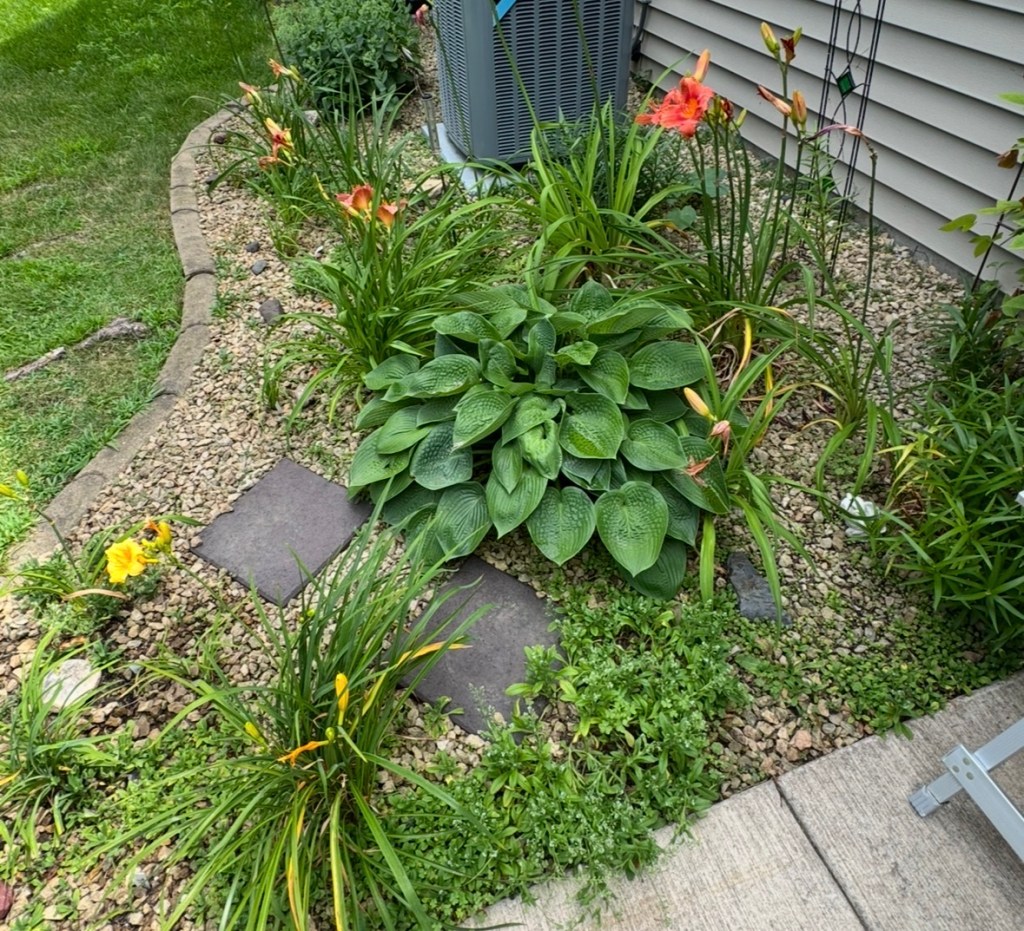
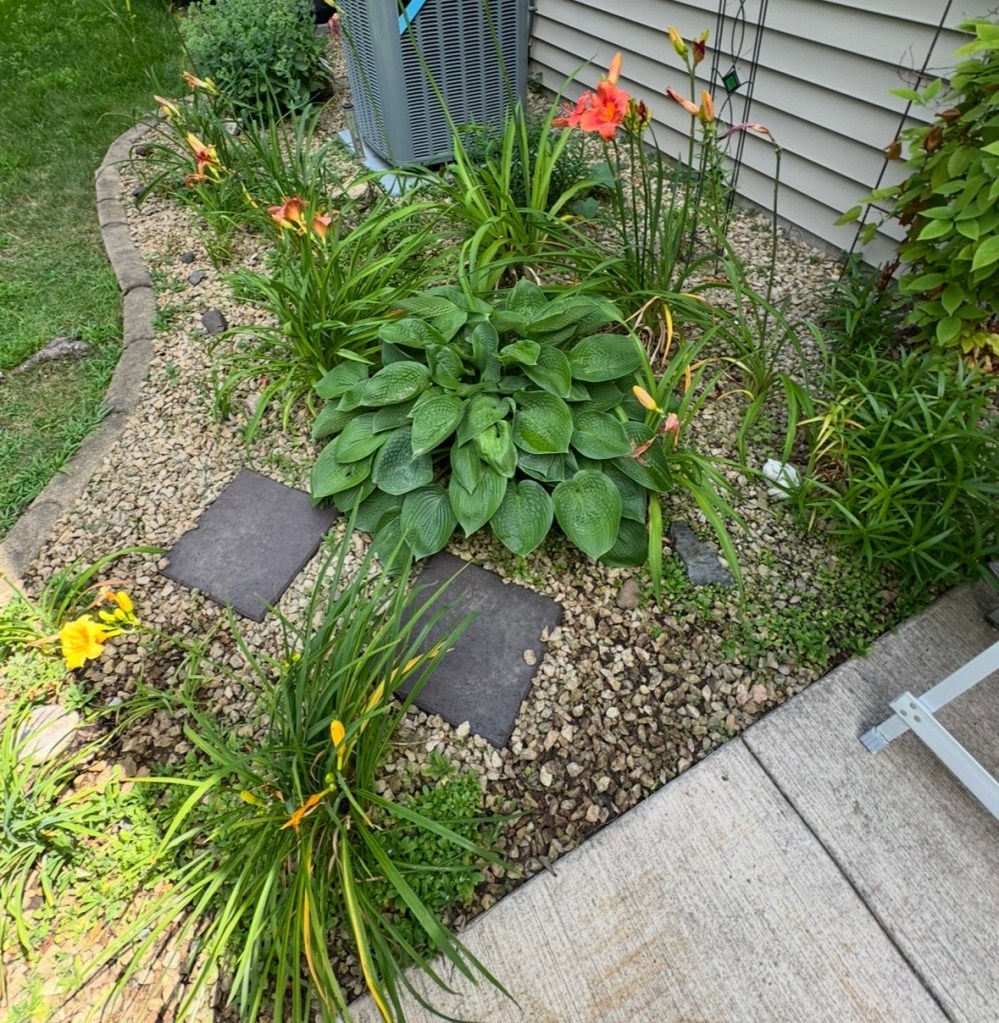
It is Move it Monday, so a bit of re-moval was planned. Not Weeding Wednesday because the Forget-Me-Not are working plants in our gardens, but for sure, when they start to fade, it is time to remove, before they set a lot of seed.
BeforeAfter
That type of work goes pretty fast, a good thing in the heat we’ve been getting. I think that took about 10 minutes and then I took about 5 minutes more to pull some others in other areas and wrapped it up. I put away the bucket and gloves and grabbed a peach tea 🙂 Oh yeah, and took the after picture 😉
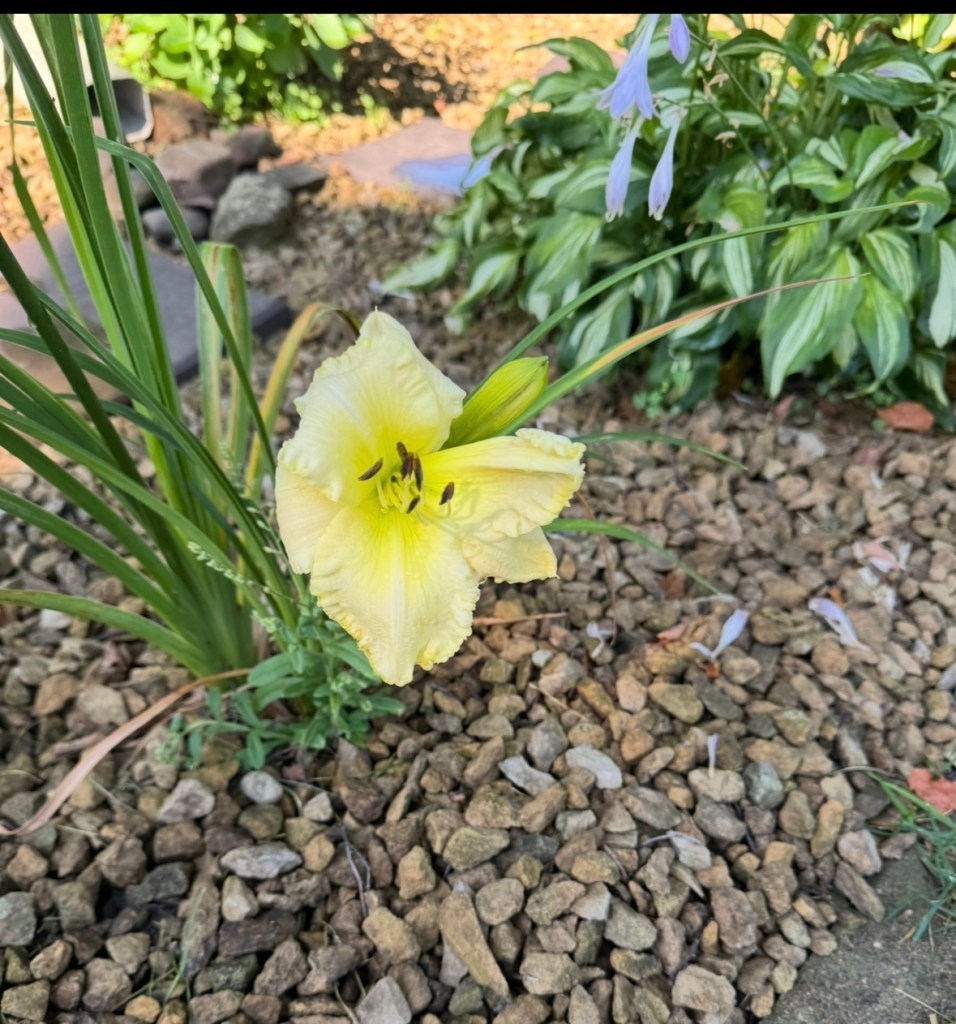
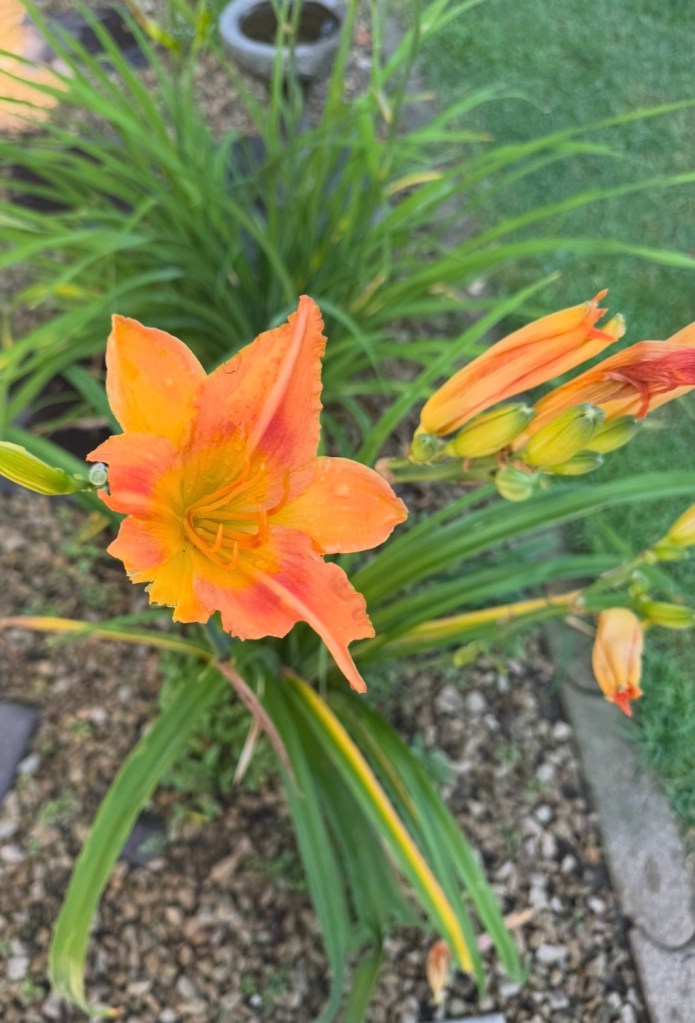
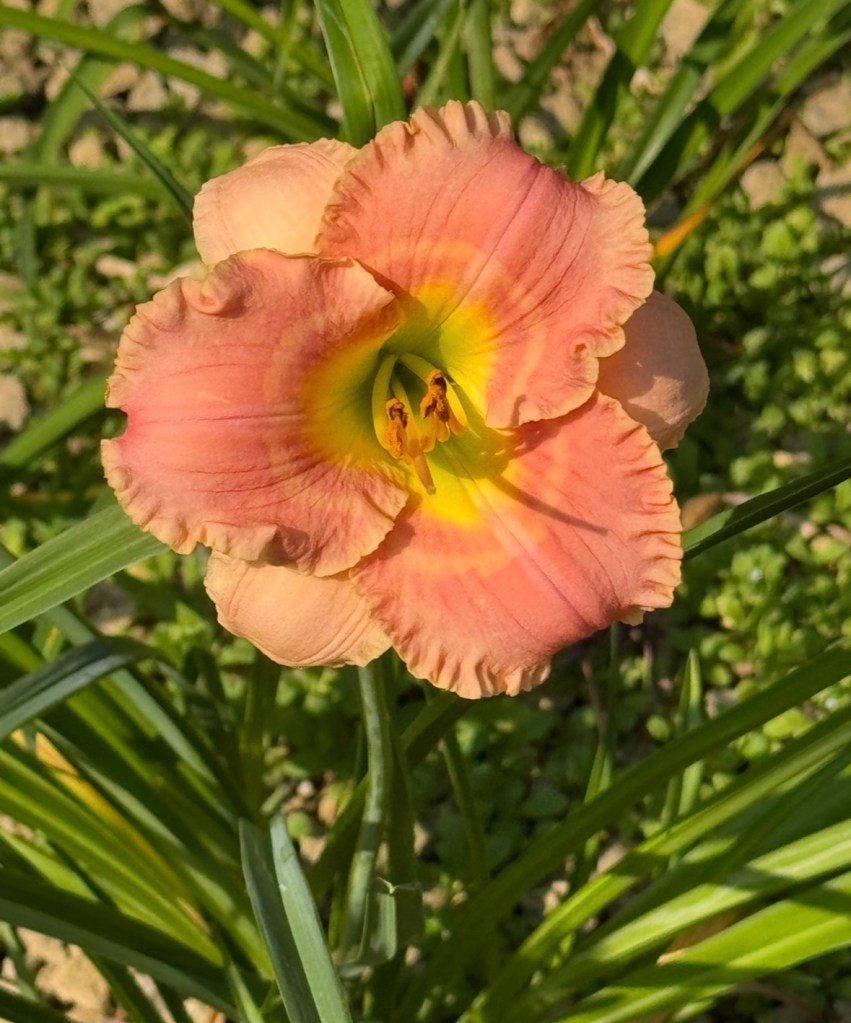
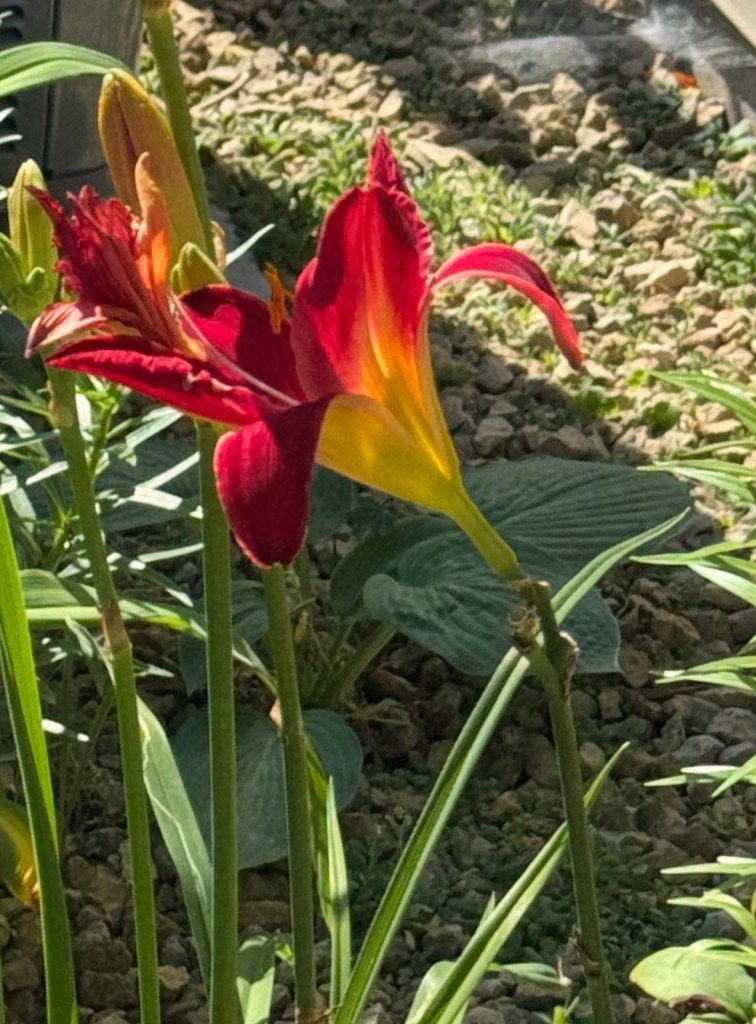
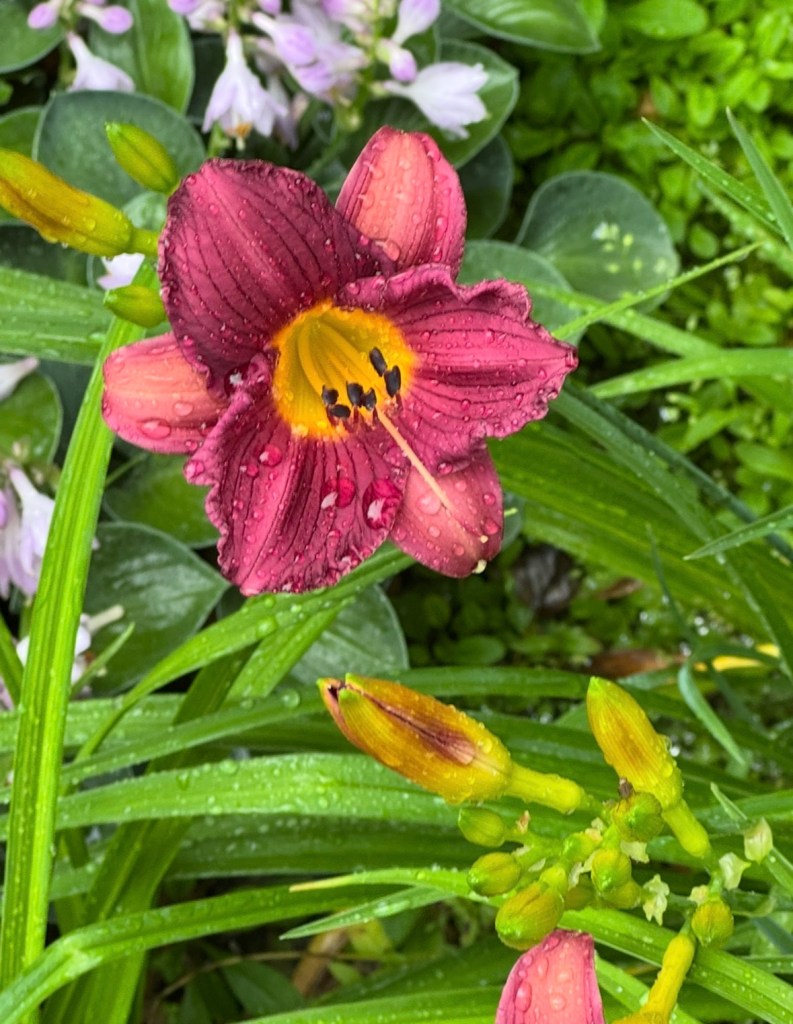
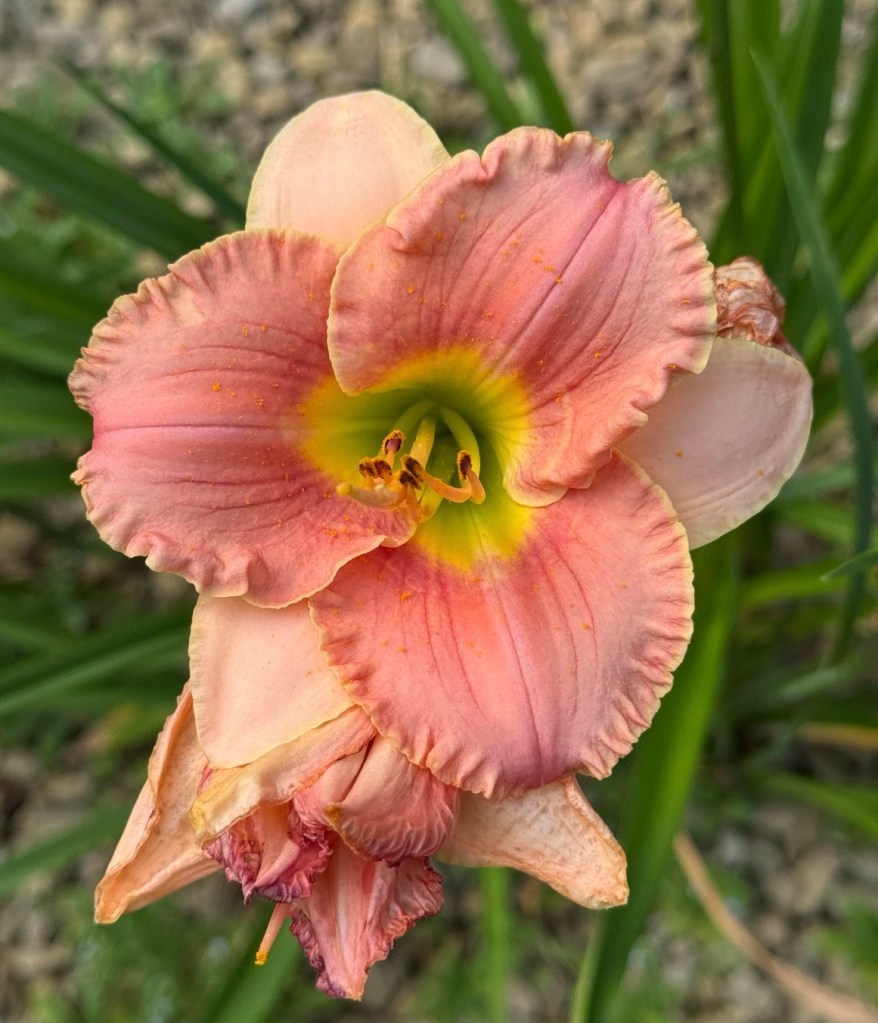
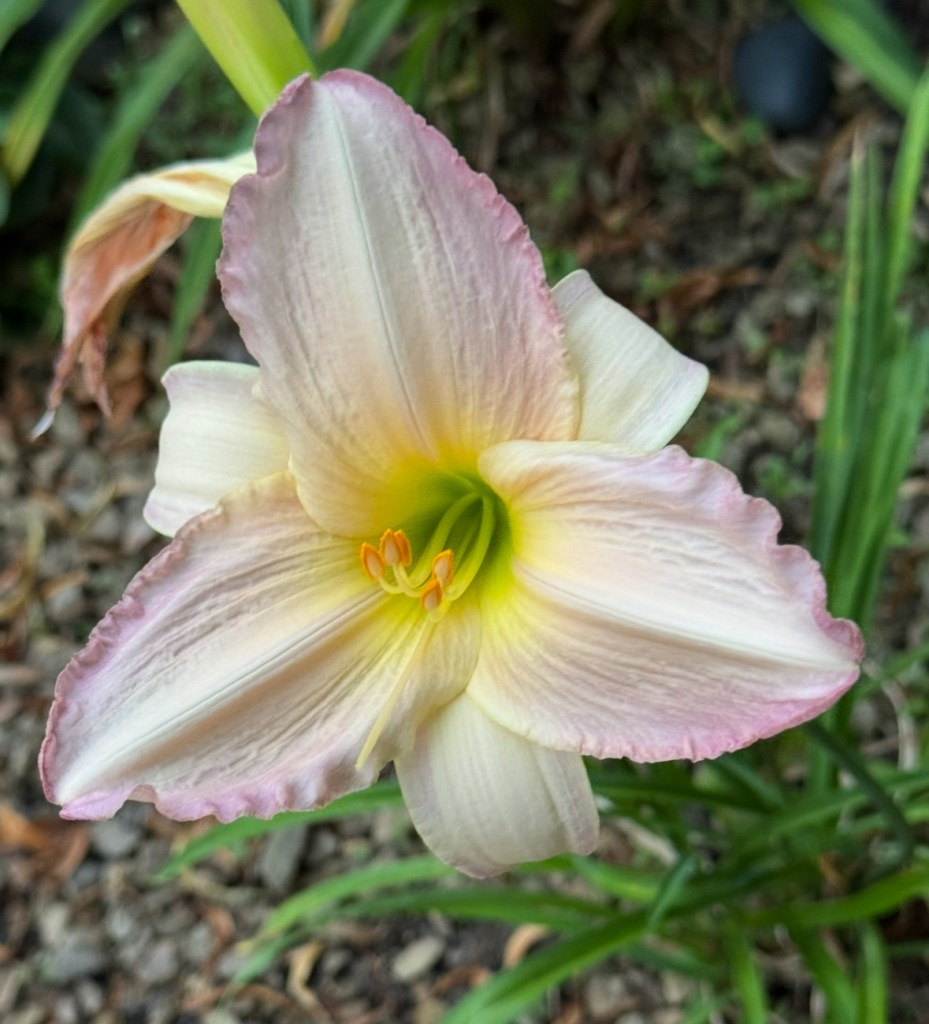
Far more exciting is that Marque Moon bloom has moved back into the garden. More accurately, Marque Moon self-seedling bloom.
In 2022 amid a very busy year, I harvested the seed that made this Marque Moon self-seed daylily. It has gone through a journey, and a move within our townhome gardens, but today it bloomed its first.
The return of Marque Moon bloom is a very nice development. Our legacy Marque Moon daylilies are fading and did not send up scapes this year, so no blooms. In addition, a new Marque Moon I planted in fall of 2024 did not come up the following spring and has not shown since then. I am going to try to move the old Marque Moon daylilies this fall, but I am not optimistic. They are amongst the Linden roots.
So, imagine the wonderful surprise I had this morning when I looked out and saw what looked like a white bloom. As soon as the thunderstorm abated, I just had to get a peek. There it was! A bloom from Marque Moon self-seed! And a first for our gardens as well. Marque Moon self-seed has never made it to bloom in our garden until now.
It usually takes a few blooms or even until the next year to get an idea of what we have in a new daylily. What I am noticing right away, besides the visual similarity, is that it is an Early Morning Opener. That feature is consistent with one of Marque Moon’s parents, Enchanted April. It will be interesting to see how it progresses.
And, on to seed, my test cross with Hush Little Baby (Pink Tirzah x Hush Little Baby) succeeded. There’s a lot of steps that need to go well between pod formation and bloom, but hopefully it will all work and we will be able to enjoy another new variety.
And then, on a fall planning note, I have my first “need to” move for one of my seedlings. Equal Opportunity has gotten pretty big, which is great, but now it is consistently getting hit by the sprinkler. It needs to be moved this fall.
And so, the seedling migration will begin. Significant thinking will be going on. What will look best where? Where do I want things longer term? And what do I want accessible for occassional crosses versus enjoying and just maintaining?
Today was a slow day – a day for a tiny bit of hosta maintenance and a whole lot of enjoying the daylilies.
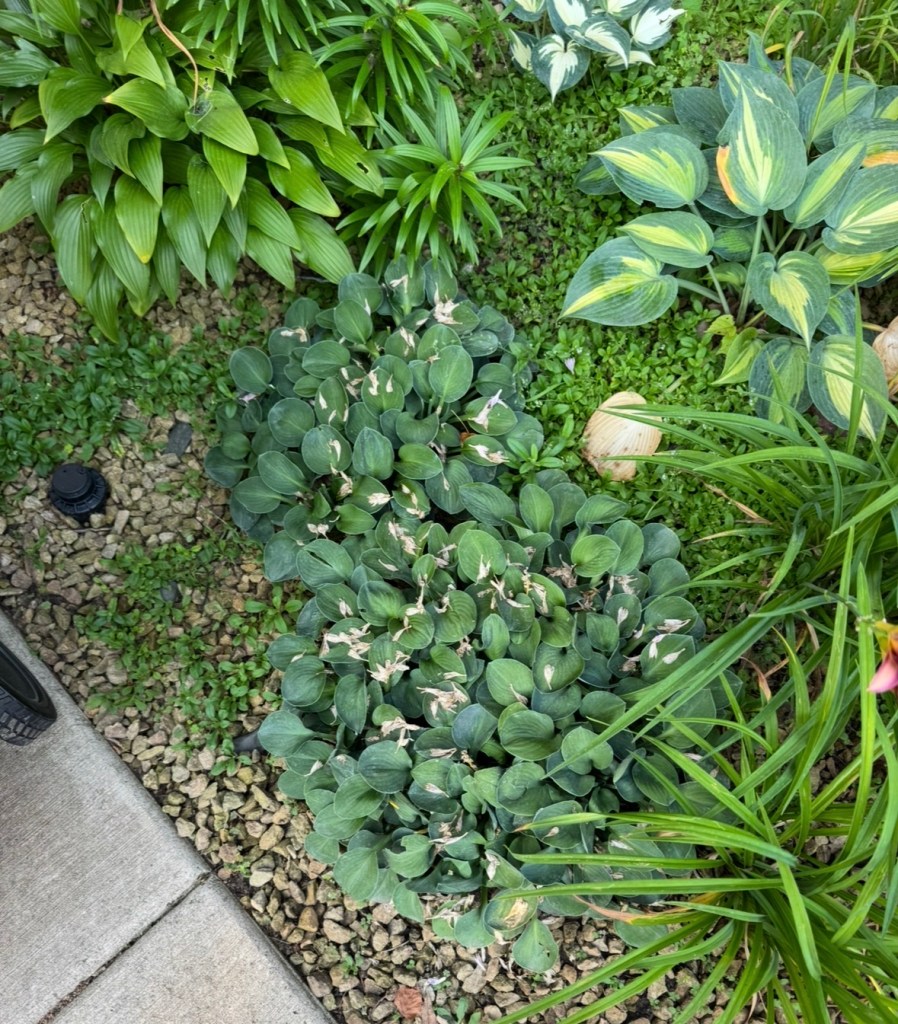
Today I removed the scapes from the last two Blue Mouse Ears hostas. I think it took 5 minutes. Blue Mouse Ears hostas are super easy to maintain. The scapes don’t need cutting. They snap off.
The spent blooms tend to stick to the leaves, so pulling those by hand is a lot, but a few sprinkler cycles and they should clear.
I am seeing some heat fatigue on the plants, and the hosta by the Blue Mouse Ears pictured above is one of those. That one has been a trooper. I will probably divide and transplant it more into the shade this fall.
The daylilies continue to amaze me.
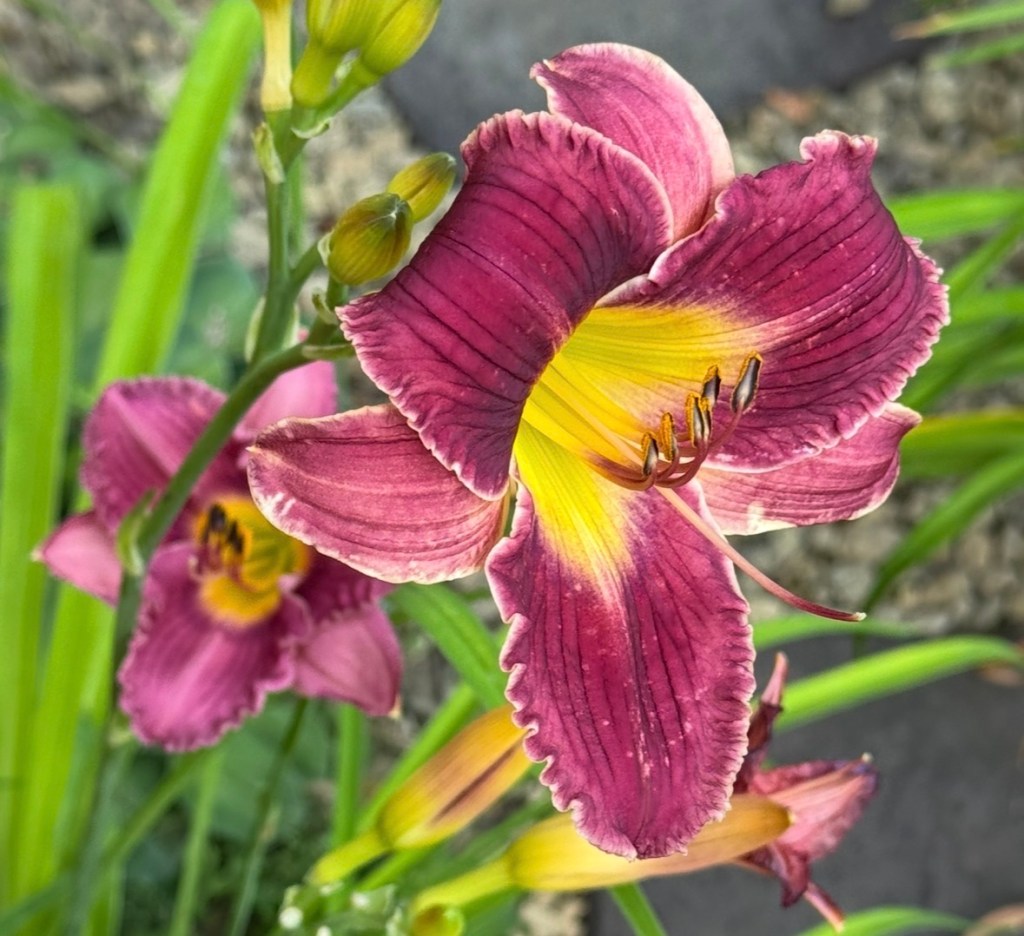
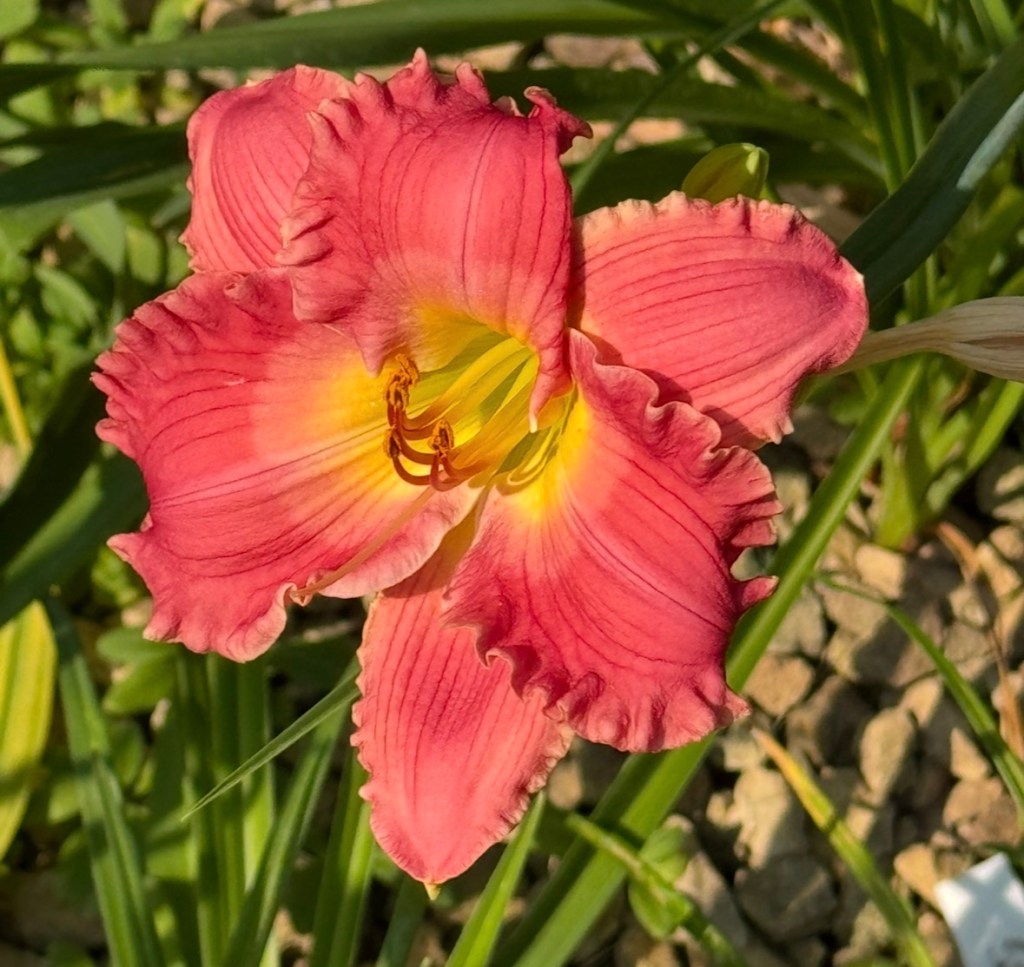
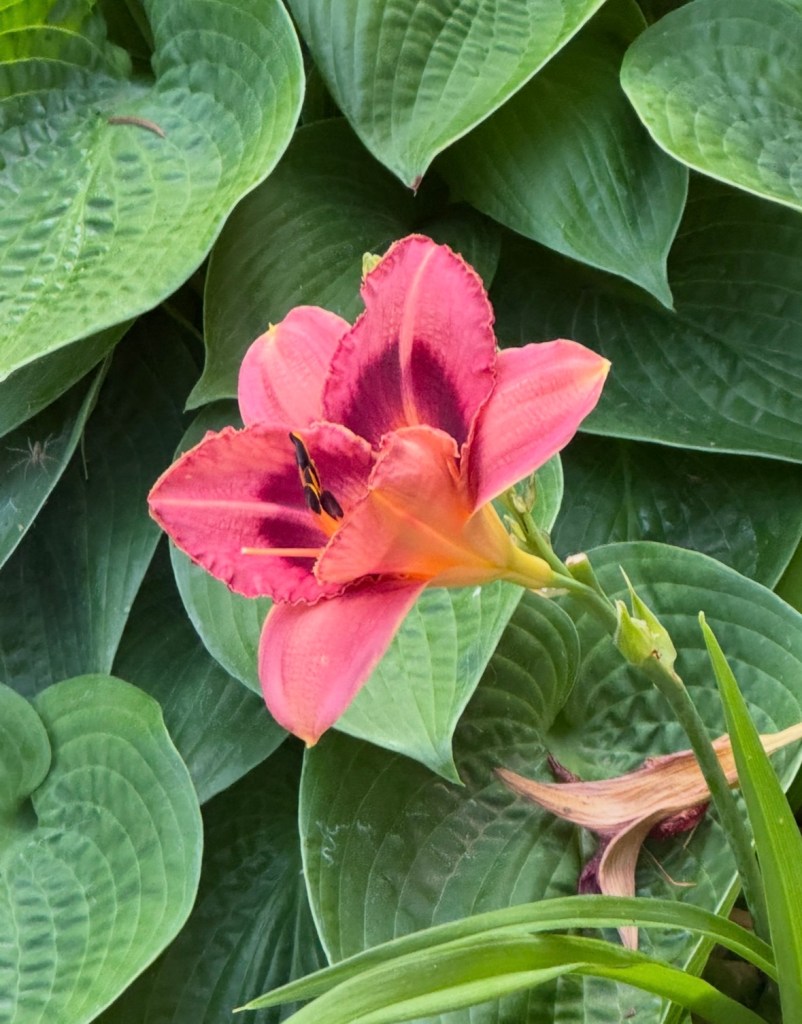
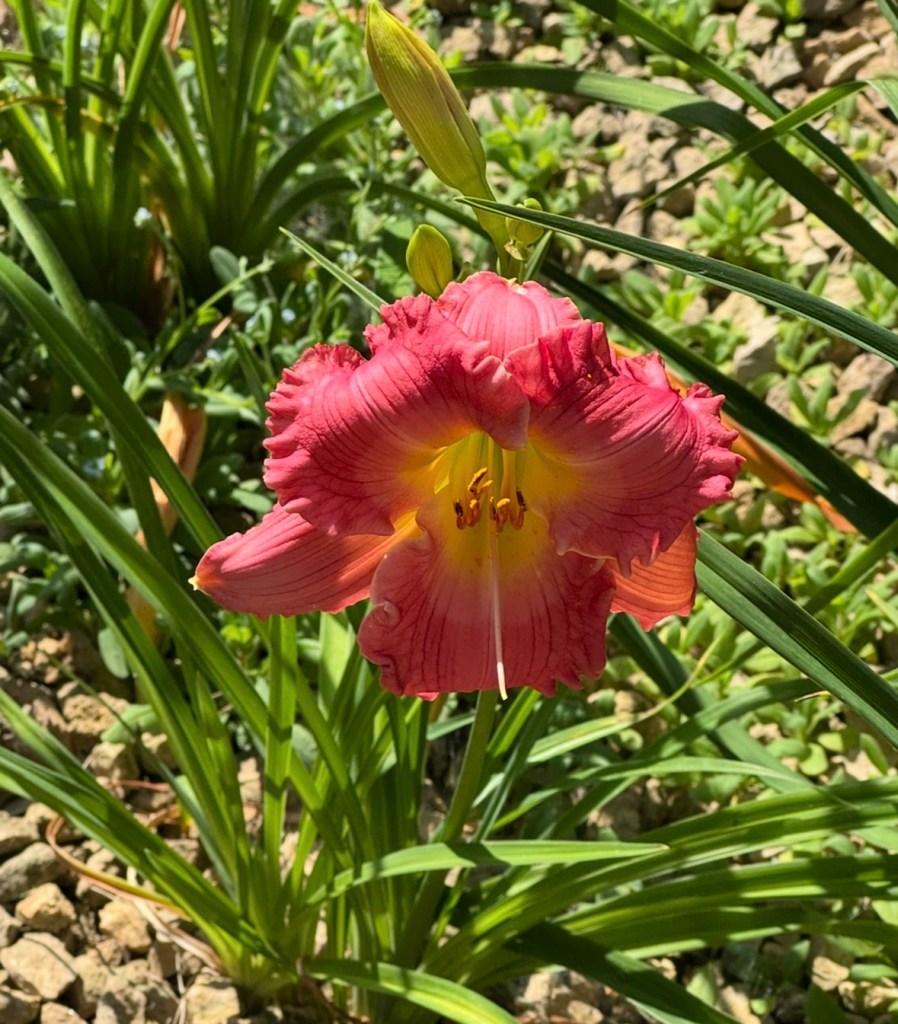
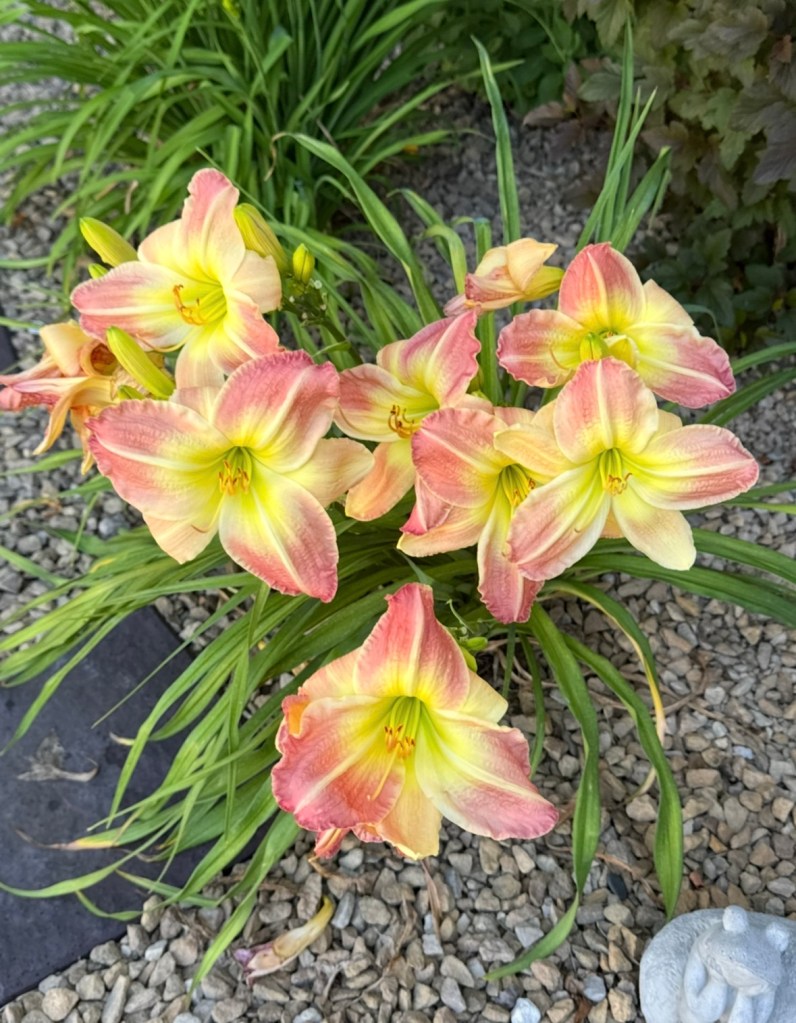
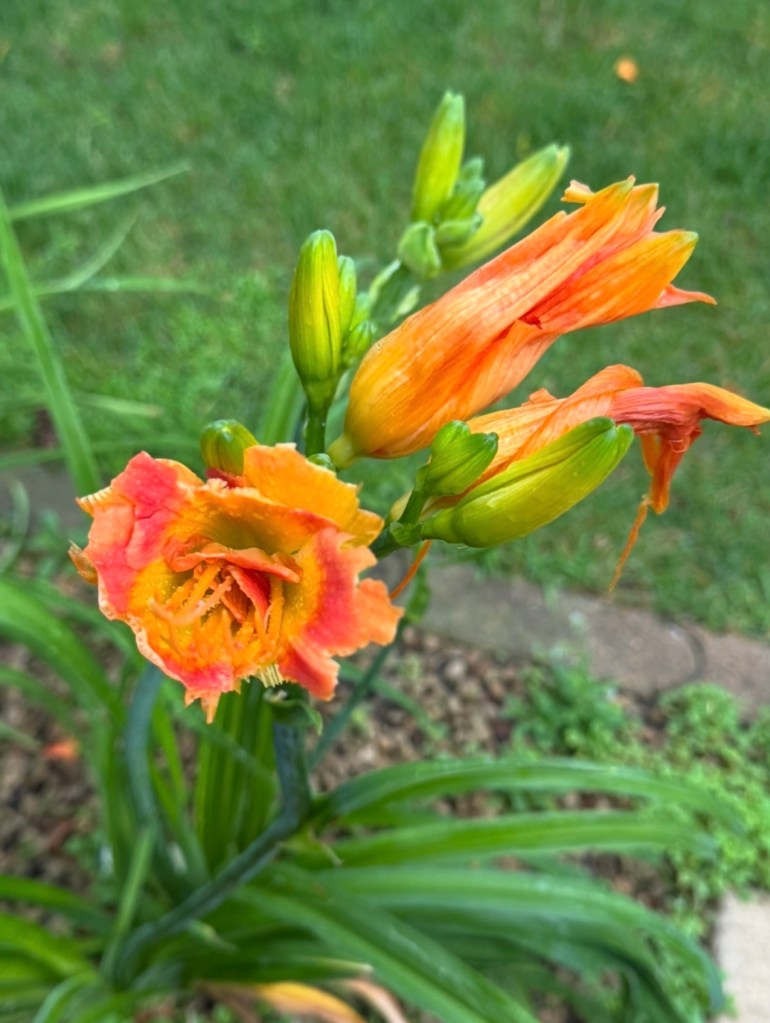
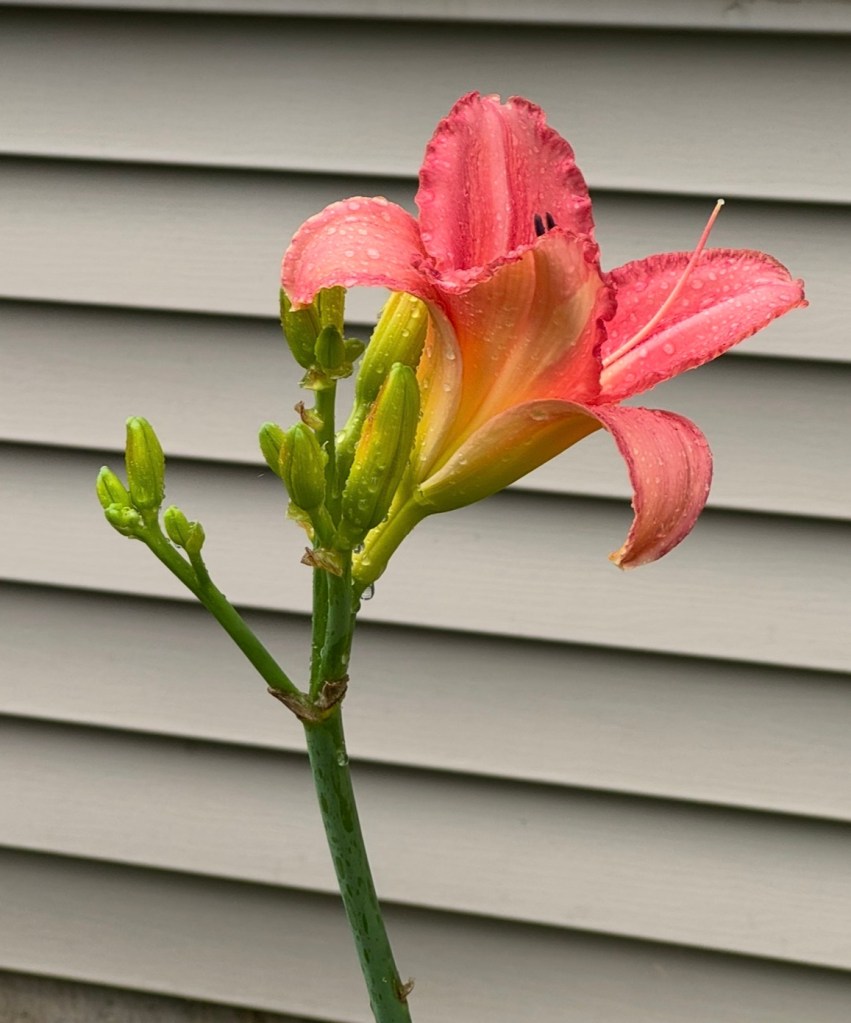
Pink Moon (one of my own seedlings) is showing some features I really like, especially the outline on the edges.
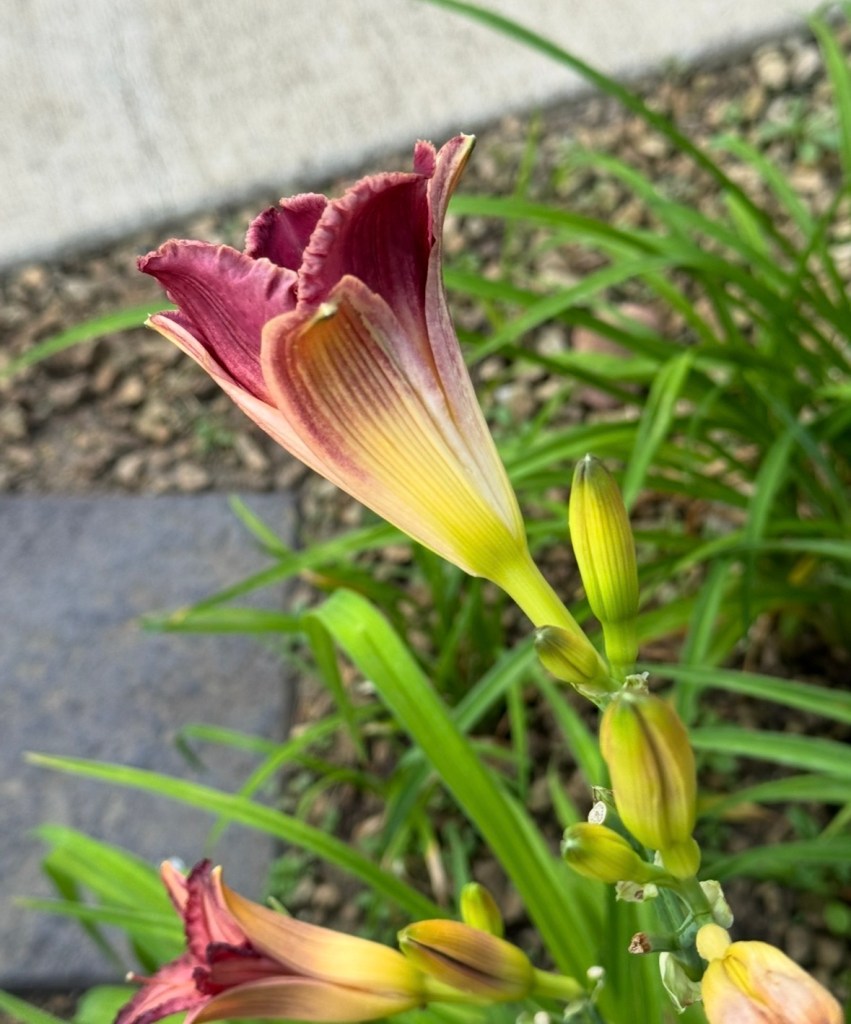
It also has an interesting look when it is opening up. A cool pattern.
I will be researching a bit more to see what the markings on the open blooms are. I’m guessing they are getting hit by the sprinklers. I may need to move Pink Moon to a better location this fall.
Hush Little Baby bloomed again today. What a welcome addition to the garden!
And what I think is Romantic Rose has an interesting feature around the eyezone today. I don’t remember seeing that in the past, but maybe I just haven’t noticed it. That is a daylily I bought many years ago and transplanted more into the sun just a few years back when we got a larger Traeger and it ended up in mostly shade and was failing. Look at it now! And it has seedlings, yes it does, with Naomi Ruth, both as a pod and pollen parent, so hopefully in 2027 we will see even more beauty!
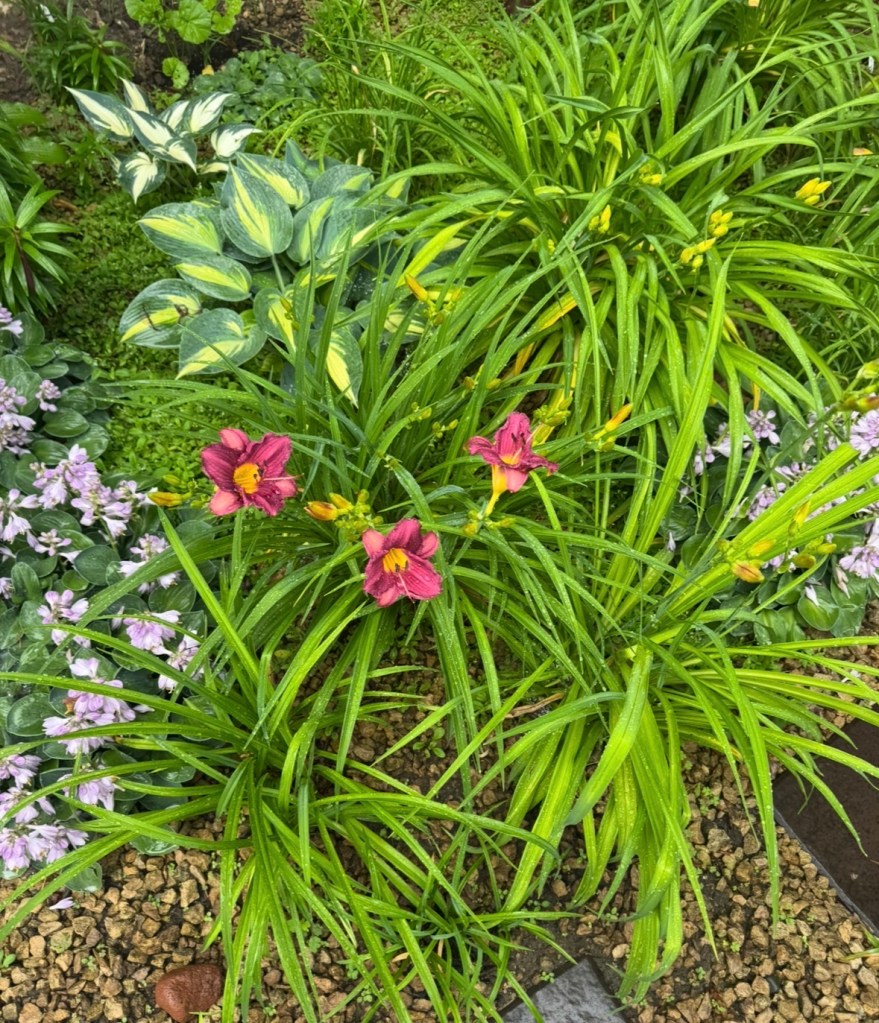
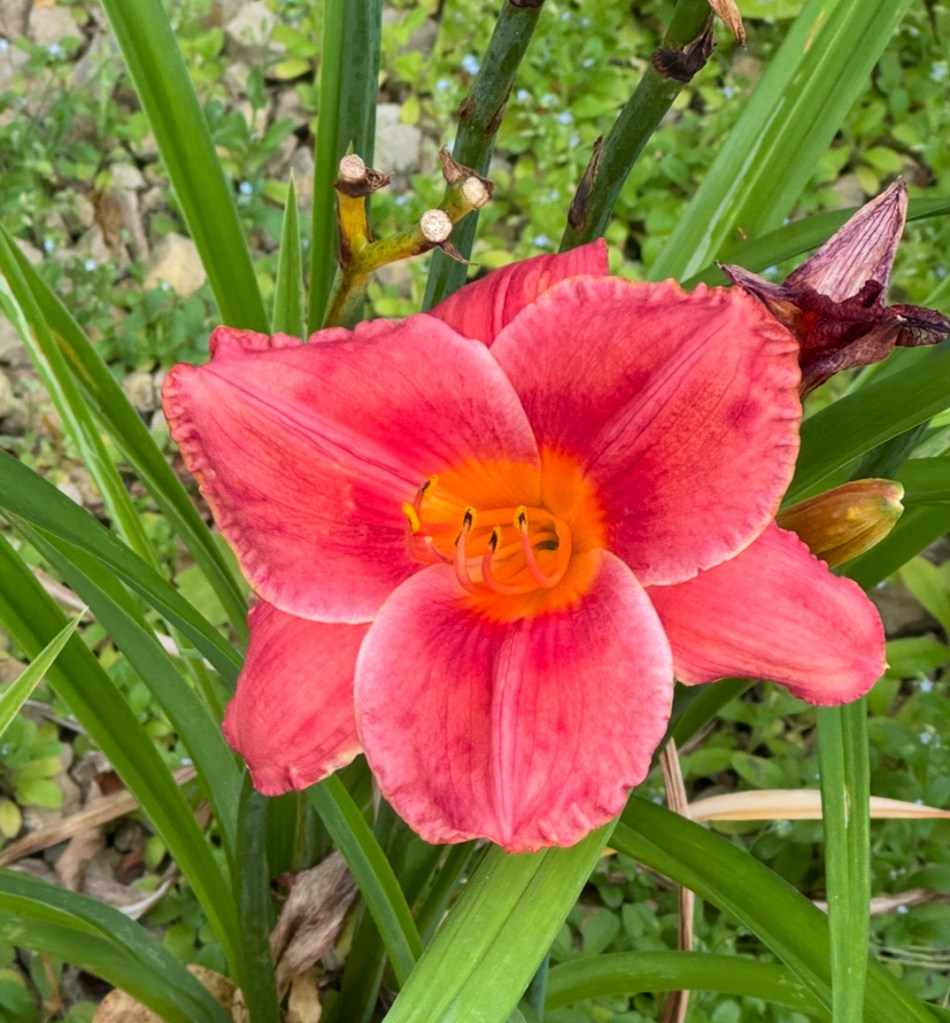
Just Plum Happy is coming into full bloom now.
And Pink China Doll had 7 blooms today! Very nice!
And as is normal for this time of the season, we are starting to see last blooms per variety. Yesterday Red Volunteer bloomed its last in our townhome garden for the year. I had high hopes for Red Volunteer, but I put it in a bit of a tuck-in spot when I planted it two years ago, and it seemed to get kind of lost as well as be a bit sparse this year – one scape, few buds. I did cross it last year so maybe it is recovering from that, but even so, as beautiful as it is, it is not doing well where I have it. I know Red Volunteer should be more vigorous because I also planted them at the historic cemetery and they look way better there. I am definitely going to move the one at the townhome to another location, but where, I am not yet sure. (Apologies for the not awesome pic – it was a bit awkward to get the front view, as it was obstructed.)
Beyond that, the pods from this year’s successful crosses are maturing. I am going to have such an easy harvest and planting this year. There are only 3 clear successes, and then the one pending from the Pink Tirzah x Hush Little Baby cross. It will be weird compared to other years, but I am looking forward to it. I have so many seedlings in the garden to watch over the next few years I think I will thank myself for putting on the breaks.
I hope you had a great weekend and wish you a great week ahead!
Just a super quick pic – Hush Little Baby bloomed its first ever in our garden today. I planted it in fall of 2024 and it got some greens last year but no scapes.
Besides being beautiful, Hush Little Baby’s bloom coincides with the end of Pink Tirzah’s season. In fact, our Pink Tirzah out back bloomed its last of the season today. I didn’t get to do my planned use of its pollen with Tender Love because Tender Love is very late this year.
Hush Little Baby is a diploid, with very good-looking pollen. Pink Tirzah is a diploid.
I broke my rule not only to be done with crosses for the year but also to not use Pink Tirzah as a pod parent this year.
Very bad me. We shall see what becomes of that decision.
The dog days of summer are upon us, and the wildfires up north are making being outside suboptimal. Our time outside has been minimized. But I am optimizing the time and paying attention to something that has been on my mind for a while – how the Autumn Red daylilies seem to be rising up as my historic focus next year.
I have tried to put my thoughts about this into words but it has been long. It is not about the features and crossing to try to keep the curls on the sepals while keeping the trumpet shape without going spidery, and it is not about getting to a different color. It’s that I have been on a path with those daylilies for a few years, and, as much as I have put them into the Steady Eddy category, there is continuously more to them.
It is time to address the plan for them out back. It is probably going to be a bit more than I thought.
The daylilies out back are heading into the second half of the season, and the look is changing. Although the look includes quite a variety of colors, heights, and interest, admittedly, it is also a bit of a mix mash. That is the annual norm. I enjoy every bloom.
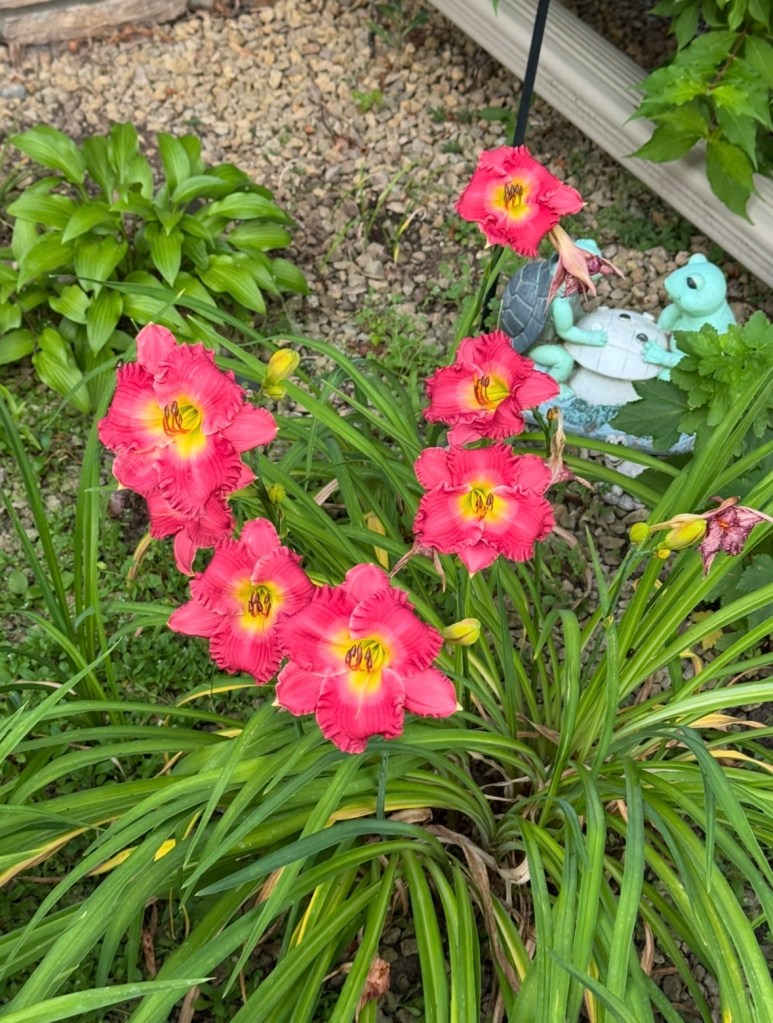
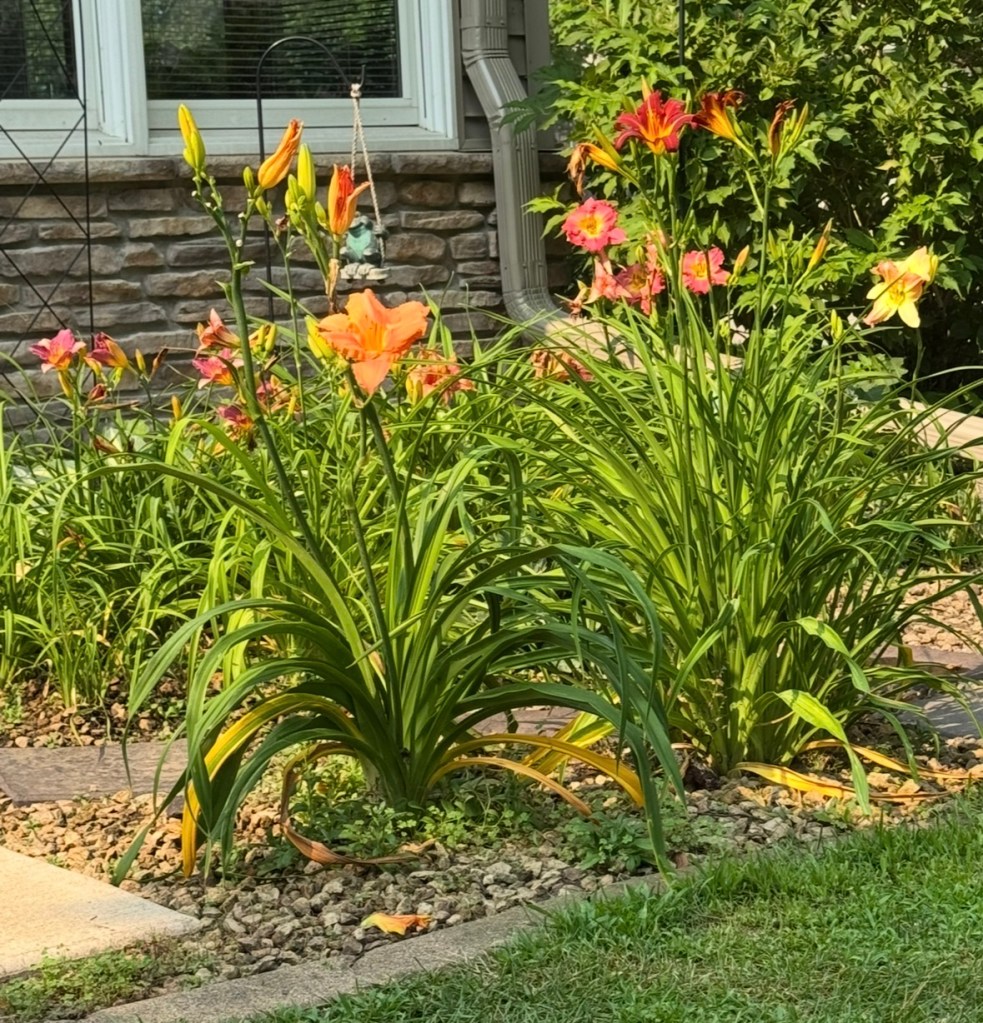
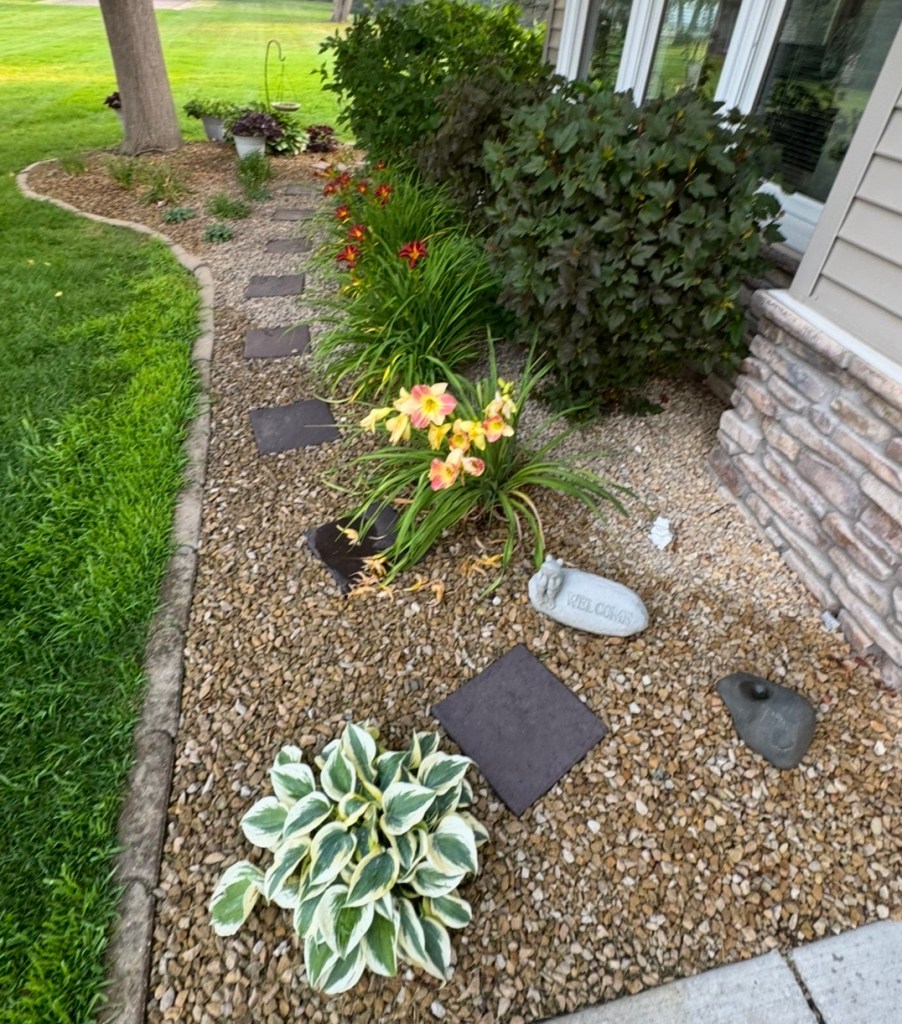
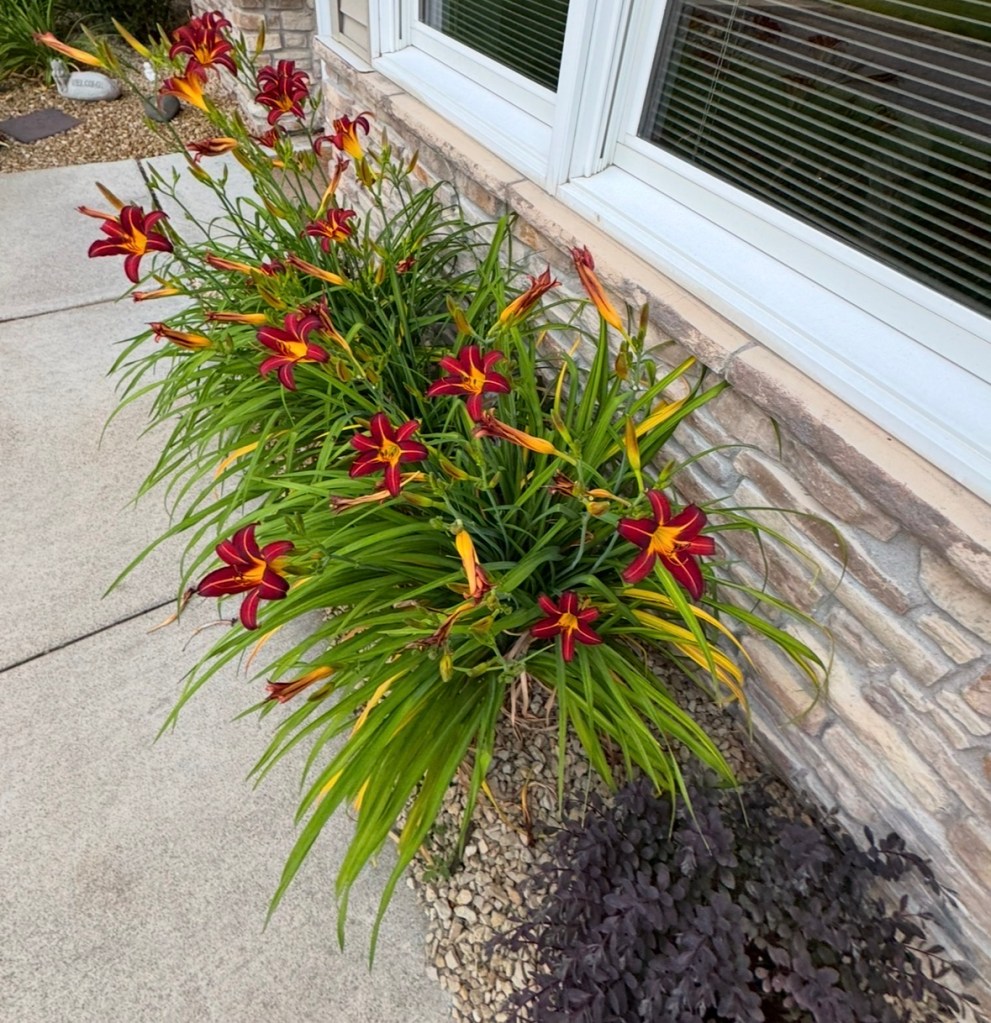
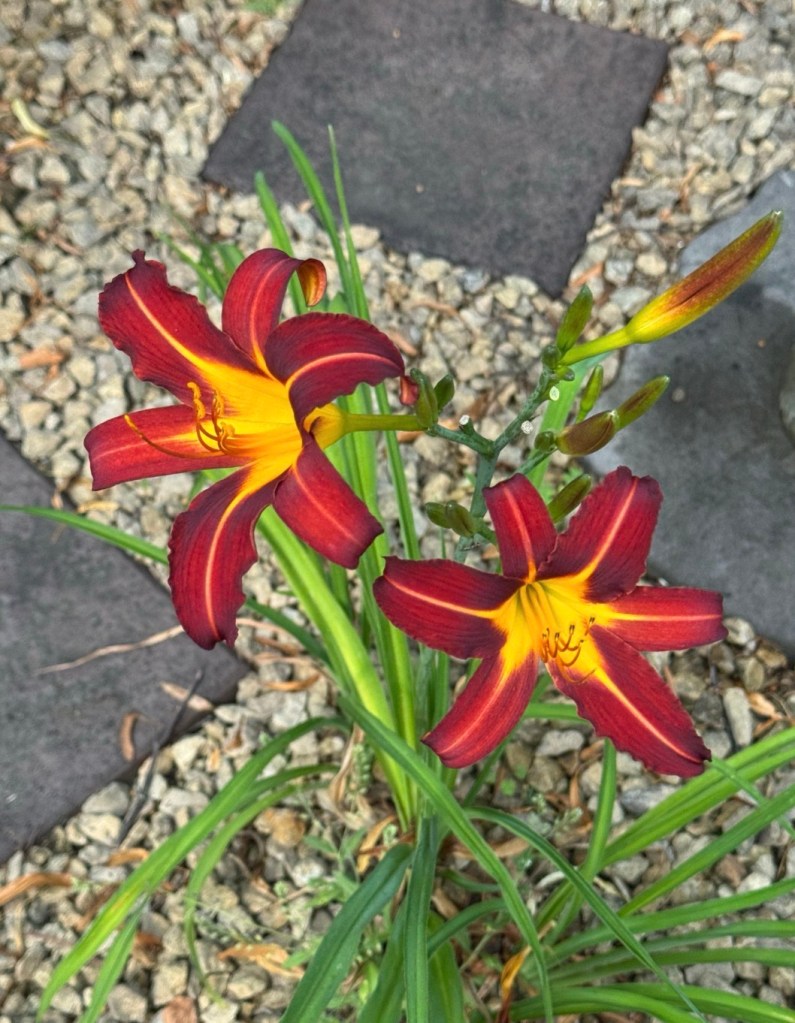
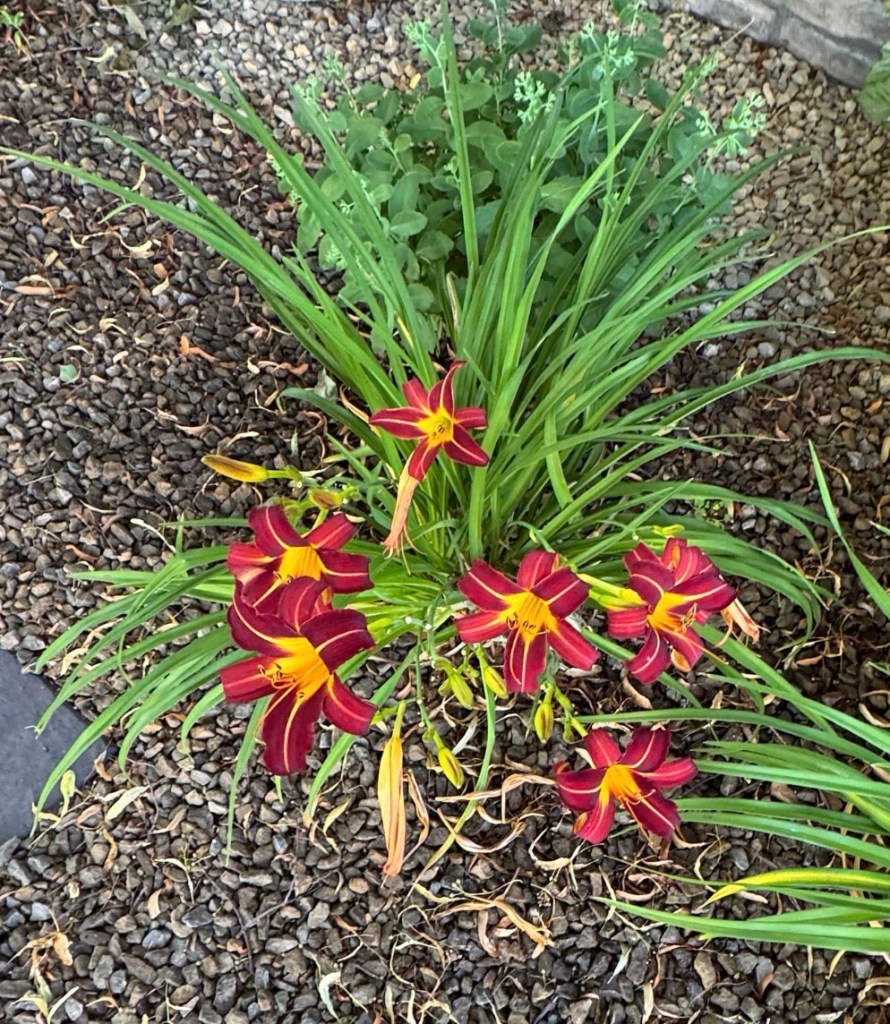
Out front where the Autumn Red daylilies have been blooming for over a week, things look nice and uniform. There is a long line of Autumn Red daylilies with occasional recessed Autumn Joy Sedum. And the Ninebarks. Soon the Autumn Red daylilies will swap focus from the one Pink Tirzah that is wrapping up at the front door. It has been in bloom for weeks, and is exceptionally prolific this year. Every year it keeps the entryway interesting after the Bluebells Clematis is done blooming. It is gorgeous and I will be sad when Pink Tirzah, once again, wraps up for the season.
And yet, as WOW as the Pink Tirzah is, the Autumn Red daylilies also look great out front. They are even more full this year than last. They are the perfect height, a great little pop of color, and they span a nice stretch to the front door and then following the path, they lead out to the back. They are wonderful. And I have crossed them, a lot. So far, they only like Pink Tirzah. They don’t care if they are pollen or pod parent. They just want to be paired up with Pink Tirzah. So far.
Autumn Red has been in my gardens for a long time – probably 15 years. I bought them in a bag at a big box store. I planted them at the back of one of my gardens, and they were there until 4-5 years ago when I saw they weren’t blooming very much anymore. That fall my husband helped me dig and divide them, and I planted them in a wave out front. 6 clumps, 2 areas. I was going for a red, white, and blue theme with the Bluebells Clematis and the Marque Moon daylilies. And of course, the Autumn Reds started thriving again. I have been delighted that they have done so well.
But that’s not the end of the Autumn Red history in our gardens.
I am fascinated with how daylilies naturalize and how they can be found at historic sites long after structures are gone. Last year I started digging deeper on the history of daylilies, specifically how long daylilies have been around the US, and in what form. I started to research more seriously on the daylilies I have and where I want to go with them at an intersection with history. I found that Autumn Red is a historic daylily. It was registered 85 years ago. It was my most senior historic daylily until I intentionally added Hyperion this year. But that is as far as I went on the topic for months. I let those efforts rest while I planted all my seedlings from all the daylily crosses I did last year, and while I intentionally spent time just enjoying the gardens.
Last week Autumn Red came up again in an unrelated conversation. Someone asked my opinion on a daylily, and how it might have gotten at a site. It was, it looked to me, a patch of naturalized Autumn Red daylilies.
Now, to be fully transparent, I had seen what looked like a large patch of naturalized daylily greens at that site before. I even briefly asked about it. It just wasn’t top of mind, though, so it slid way back in my “backlog”, and I didn’t pursue anything more about it.
Well, when things come back to the front like that, but are not a priority, sometimes I still let it sit in my mind until I can give it proper bandwidth. Sometimes it sits for a while. This time it was about a week. Until the Autumn Red in the front row of Sandy’s Corner started blooming. That clump also has a story.
There was a little daylily seedling I moved 3 years ago that I thought was one of the Purple D’Oro self-seed seedlings. Last year as it got the sun it needed it bloomed its first. Imagine my surprise when I realized it was an Autumn Red. (I am guessing it stayed in the ground when we dug and divided the Autumn Reds and put them out front.) This year, very happy in its new location, it is now much larger and starting to bloom. It has quite a lot of scapes and quite a lot of buds on each scape. It is right at the entrance to Sandy’s corner, at the start of the path. In fact, it is overarching the path. I planned to move it. Red is not even the right color for that front area lol. But the height, the size, the form, the little curls on the sepals. And, best of all, the sprinkler is not hitting it.
“Well”, I thought. “That Autumn Red might stay right there.” Might. For one year. As a worker. Crossing with Hyperion.
I bought three Hyperion daylilies this spring. They are historically even more senior to Autumn Red. I planned to cross them when Hyperion starts to bloom, hopefully next year. I would only use the Hyperion pollen next year, and only do a few crosses so I don’t overwork the Autumn Red. It would be great to have it so convenient, and out back.
And so, I guess that backlog idea of Autumn Red has now become front row.
I have done crosses with every one of my historic daylilies except Hush Little Baby, which will bloom its first in our garden soon. And I have done all the crosses I was interested in and even retried fails year over year. Maybe it really is time to start focusing on crosses with the seedlings of our historic daylilies, starting with the oldest ones.
I have yet to have self-seed germinate from Autumn Red. It has produced self-seed, but it did not germinate. Self-seed would be something I would like to try again.
There should also be a cross available next year. Hopefully.
Today is a rain day. It is also the first day of bloom for three much awaited daylilies at the townhome gardens: the Purple D’Oro (which was transplanted in fall of 2024 so was skimpy on blooms in 2025), the Cedar Waxwing (which I overtaxed in 2024 and did not send up scapes in 2025), and the Red Volunteer (which had success as both a pod and pollen parent in 2025 and will rest except self-seed this year). Hello Yellow, Equal Opportunity, and Pink Tirzah are also blooming, so there were a few planned crosses in the mix. But it is a very nice long rain, and I’m sure the pollen is ruined, so today the message is, “Just Enjoy”.
That I will.
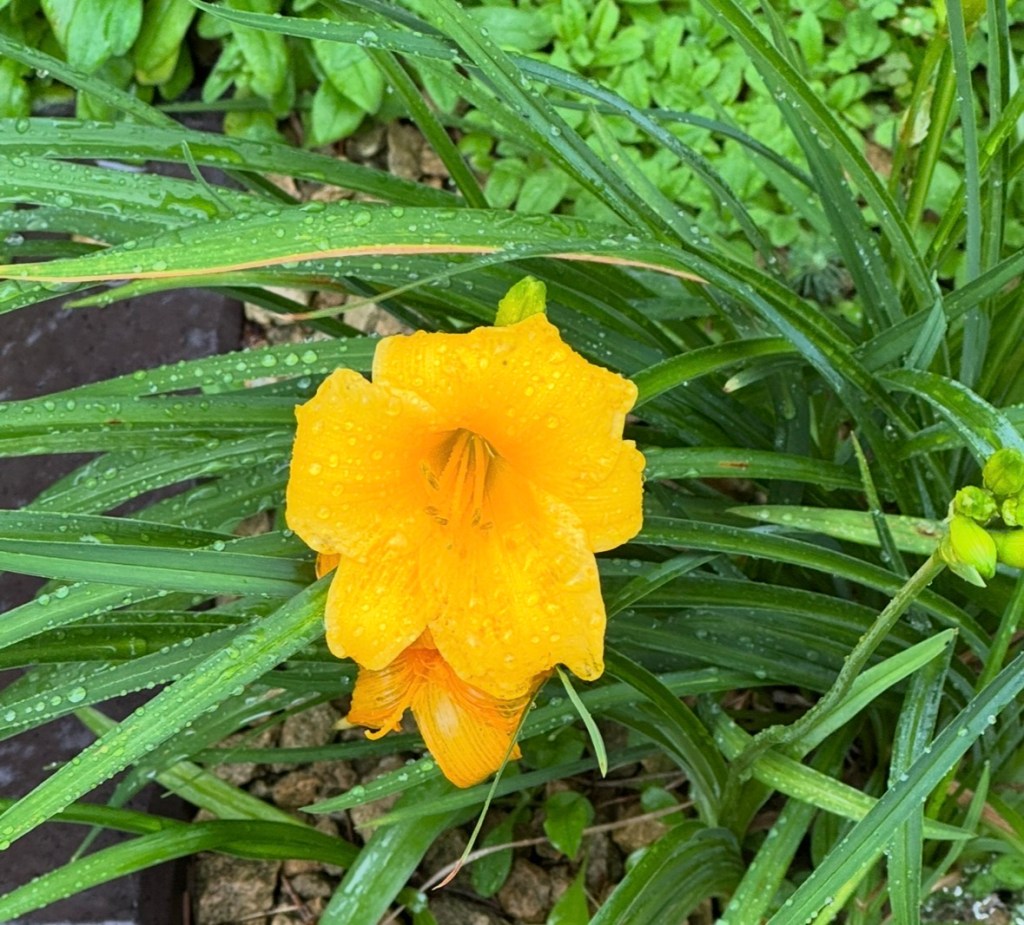
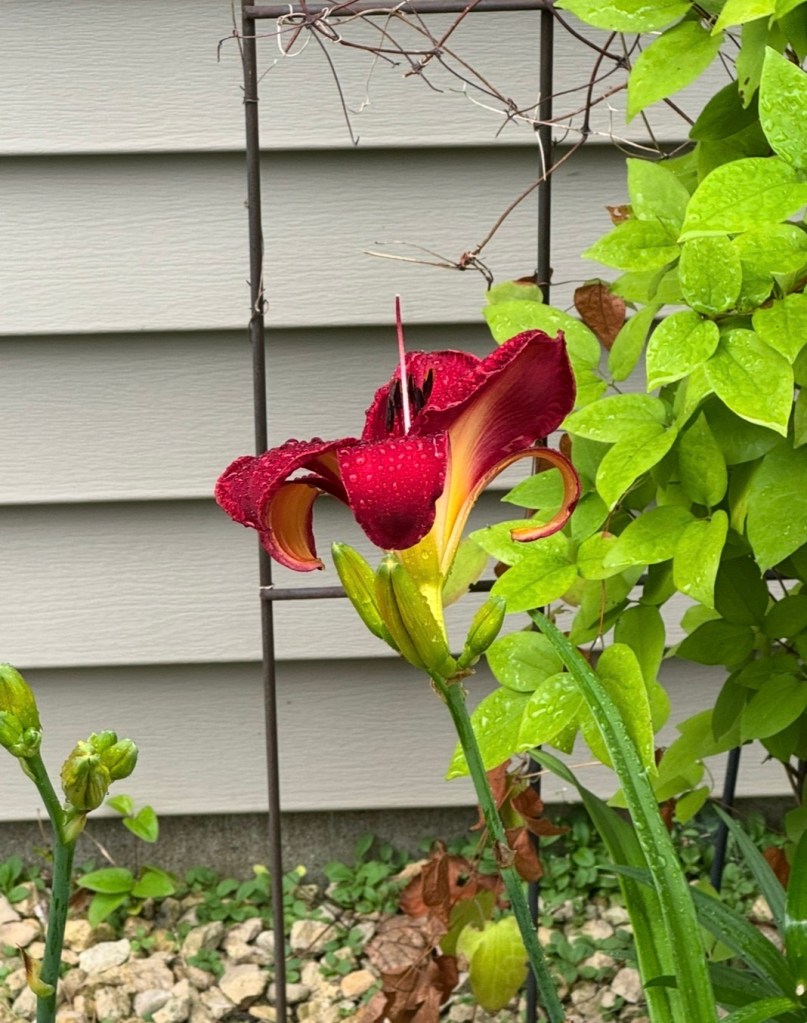
This poor bloom either had a malfunction, or it had a run-in with the sprinkler.Purple D’OroHello Yellow is an extended bloom so it also got the overnight rains.Red Volunteer is shy and facing the house today.Cedar Waxwing
Happy Tuesday! I hope you are having a good week so far!
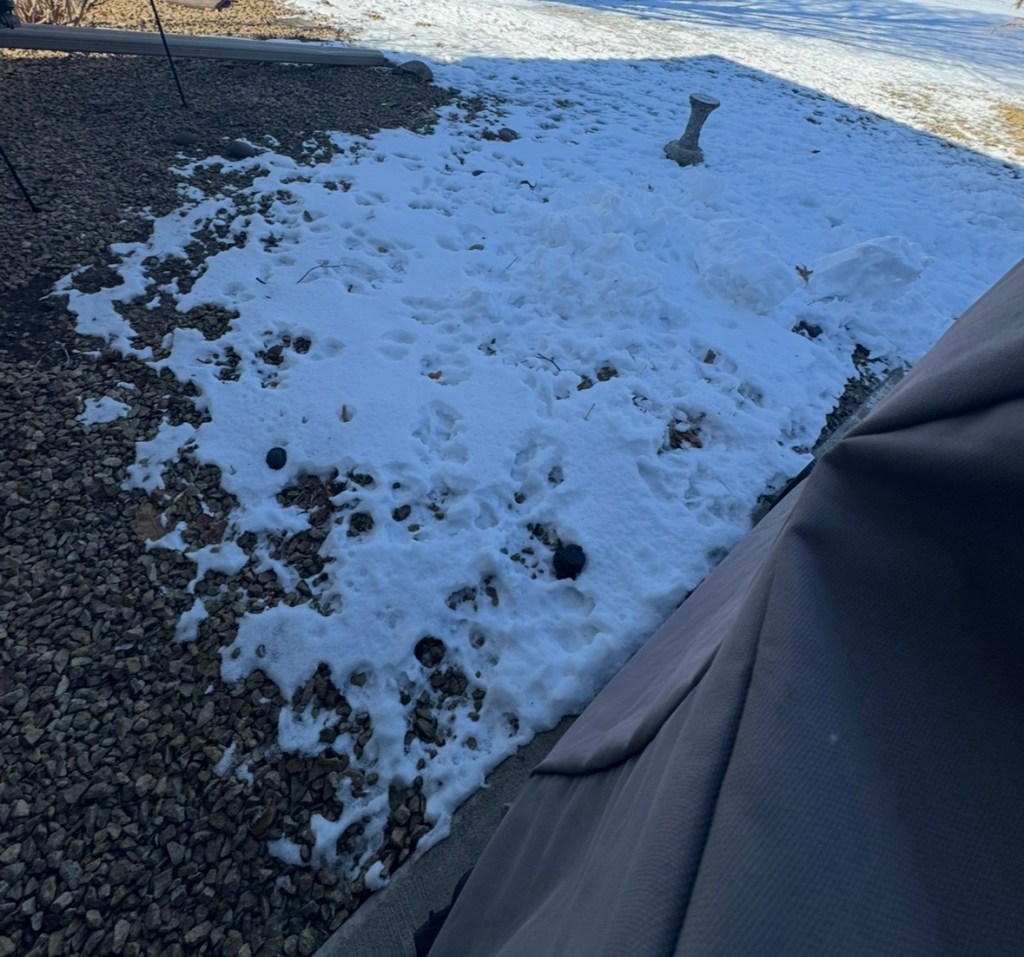
We are definitely in the march to Spring. Last Friday night we had a good ’ole thunderstorm. Early Saturday morning we had a snow globe snow fall. Saturday afternoon the snowfall was well on its way to melted, and by Sunday morning it was gone. The snowplow pile from the whole winter is just a shadow of what it was a few days ago. And although we will have cooler days mixed in, and even some snow, Winter 2025-2026’s time is coming to an end.
Saturday was the perfect time to knock out some remaining garden questions I was hoping to resolve.
Over the years I have saved a lot of info from older versions of the gardens, along with lots of daylily tags (dozens). Saturday as the snow swirled around, I pulled out those saved treasures and started to sort through them. By midafternoon, everything I no longer wanted to retain was in the trash, and I was researching my remaining daylily identification questions.
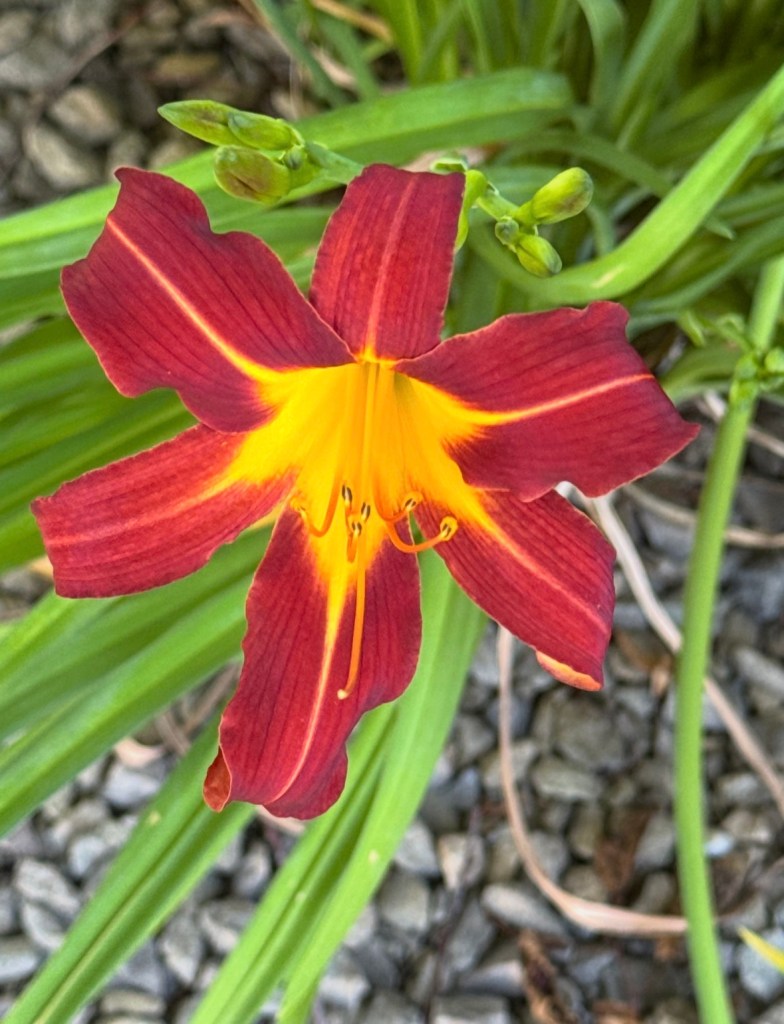
As I went along, I realized some pretty great patterns were already established in our gardens. Things I had been doing for years started coming forward as additional pieces of the future plan. First up, the daylily I have been calling “Red” is actually ‘Autumn Red’. I bought and planted them, oh, probably 20 years ago. The packaging is long gone, but at one time I did a search by pictures alone and pretty much figured that is what they are. Saturday afternoon, after I had excluded all other options from my saved tags and data, I went on a deep dive of online sources and finally made the call. Going forward “Red” shall be referred to as ‘Autumn Red’. The curled petal tips, the yellow mid-ribs, confirmed a diploid, confirmed pod and pollen fertile, bloom size and scape height match, along with mid-season, diurnal, and rebloom. And it looks exactly like the pictures. Exactly.
What caught me off guard, and was kind of a delightful find, is that ‘Autumn Red’ is quite old. It was registered in 1941. It is 85 years old this year. Not hundreds of years back, but ‘Autumn Red’ is definitely not a modern hybrid. And, I am already a few years into hybridizing with ‘Autumn Red’, with 5 successful crosses to seed, as both pod and pollen parent in 2025, and a set of seedlings from a 2024 cross with ‘Autumn Red’ that I planted in our gardens last year. Now we wait to see those blooms.
I did those crosses on a whim a few years ago, proving out ploidy. That work turned into a pattern, and now it looks like hybridization with ‘Autumn Red’ is going to be the only path. Self-seed is most likely not a go. It is stingy on producing self-seed and I do not have any “Autumn Red’ self-seed that has gone to seedling. It does reestablish well from division, and I even have a note that I re-planted a single fan. I forgot about that, but it kept on doing its daylily stuff, and it bloomed last year. It seems “Autumn Red’ is great at making seed from intentional crosses and great at going to seedling from that seed if I stratify, bring the germinated seeds to seedling, and plant those seedlings into the ground in late summer. And so, that will be the ‘Autumn Red’ daylily scope.
Unfortunately, with that. I am now back to working to bring all of the ‘Autumn Red’ seeds to seedling before they go up north. Maybe I should dedicate the little 6-cell greenhouse trays I just bought to the “Autumn Red’ seeds. More likely, though, I will plant 20 same cross seeds per medium pot and whatever goes to seedling will go up north – minus a small sample for here.
As for additional results of culling through all that old daylily data, I realized “Unidentified Yellow Freebie” is most likely the ‘Schnickel Fritz’ I bought in 2020, and quickly planted, amidst a lot of other activity in our life at that time. Unfortunately, it is not at all what I was looking for, and also unfortunately, it did poorly last year. I think it is failing in its current location. Poor ‘Schnickel Fritz’ may say goodbye. I wish I had that money back lol.
As for “Peach”, I saved packaging from ‘Romantic Rose’, and that may be a match, but although ‘Romantic Rose’ meets a lot of the criteria of “Peach”, “Peach” is quite a bit lighter in color. That can happen, but I am not quite ready to make that call. We’ll see what the color looks like this year.
And, also unfortunately, Hello Yellow’s parentage will continue to remain a mystery. I definitely planted those seeds. I just have not been able to replicate it from my less than stellar retained data. But Hello Yellow stays. For sure. If need be, it can just be its pretty self.
20,000 foot view – We learn as we go. I have shipping lists and a plethora of tags that reflect my exuberant anticipation of a delightful daylily garden. And I got it. I just didn’t initially realize the documentation needs for the scope of the auxiliary hobby that evolved. Hybridizing daylilies definitely crept up on me. And daylilies plopped into the ground are great for enjoying. Not so great when life was super busy when you planted them, and your notes were hasty and sketchy.
I hope these shares are helpful, or at least fun to read 🙂
In the meantime, I am now only allowing myself 4 (not 5-7) new crosses in 2026 – until I get the scope of this daylily hybridizing thing stabilized. You guessed it – all of the new crosses this year will be with South Seas self-seed blooms. So, no new ‘Autumn Red’ crosses. And, in fact, no new diploid crosses at all.
I have a lot of harvested daylily seeds from 2025. If even half of them germinate and go to seedling I will be in trouble in a few years when they start to mature. I have run out of room.
But I knew that last fall. I knew I had harvested 521 daylily seeds and did not have room for them. I knew I didn’t even have enough seedling boxes to germinate and bring them to seedling properly. I have been slowly, steadily, chipping away at a plan.
99 of the 521 seeds were self-seed from the historic cemetery, to be added back this summer. 78 of those seeds were from the existing Stella De Oros there. The Stella De Oro seeds will be direct sown in groups in that garden. I just don’t have capacity in the squirrel protected seedling boxes to germinate those. The other seeds I will attempt to bring to seedling in the seedling boxes, and then transplant them in late summer, as is my cadence. There are already other daylily seedlings I have added at the historic cemetery in past years, and they did pretty well with that method, considering that garden survives on just rainfall for watering. I have hope for another successful set of additions.
In a perennial garden a plan is needed to keep the plants healthy, not overgrown, and also always have a variety of interesting blooms throughout spring-fall each year. We are going into year 4 with the historic cemetery garden and year 23 at the townhome. As always, some dividing will be needed this year. The seedlings from years past should help to keep things interesting while the divisions reestablish. And the rotation will continue each year.
Just as I love working on the townhome gardens, I love working on the historic cemetery garden. It is a great pleasure to have made a beautiful garden to honor those who are interred at the cemetery, as well as delight the neighbors and passersby. But the historic cemetery is not either of our family’s history. We are invested in this community, but we are the first generation in our family with history here. We don’t own that land. We are not even community property owners there as we are at the townhome. Those gardens could be, or may need to be, moved at any time. They are part of my hobby for this snippet of time. A lovely hobby and a lovely snippet of time. AND, at the same time … it is time to plant our own garden. On our own land. Even separate from the townhome gardens.
It will not be smooth sailing. I failed before at a garden up north. It was a colossal weed patch ending fail from an over $300 investment. Back in the day. But quite a few years have passed. I have been studying the topography. I know the area that has decent groundwater. I know the deer have far more nummies elsewhere. A fence will be needed, for sure, and I already have some heavy-duty landscape fabric from my DIL to keep the weeds at bay. I am telling myself, “These are daylilies. They are hardy. This is the year.” Hopefully they survive. The other option is to feed the seeds to the birds lol.
Up north I will start with 80 seeds from the 116 that I have of the cross between the red daylilies and Pink Tirzah. It is the opposite cross of what worked to make seed for the seedlings I named Molly Cowles in 2025. I have a name in mind for the new cross already but first they have to succeed up north. It will not be easy. I am going to do direct sow just like with the Stella De Oro seeds at the historic garden. But I will grow the other 36 seeds (of that same cross) here at the townhouse, just in case. (Seedlings can be grouped until they crowd.)
And we will see. It just takes one to get a field full in the years ahead.
And with that, the rest of the 2025 harvested seeds will have room in our seedling boxes at the townhouse. We are a go. I have the pots, I have the soil, I have some chicken wire to cover the open seedling boxes and can easily get more. We’re set.
Time for spring!!! Yah, I know. Not quite yet.
Screenshot
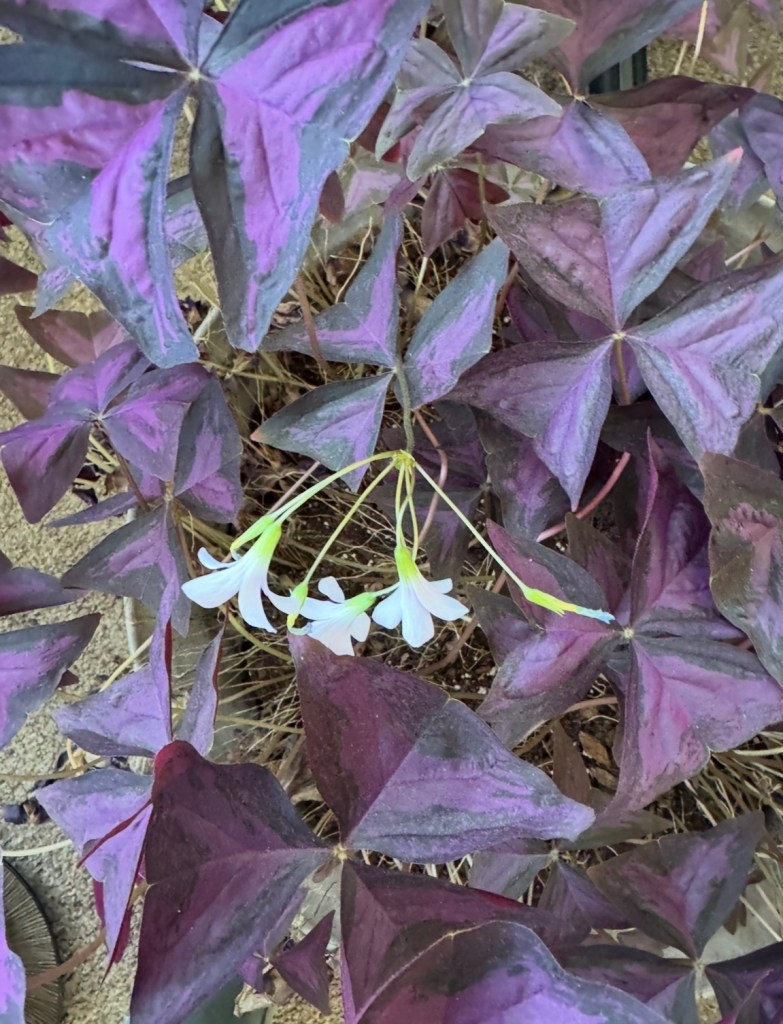
For now it is the shamrocks.
Screenshot
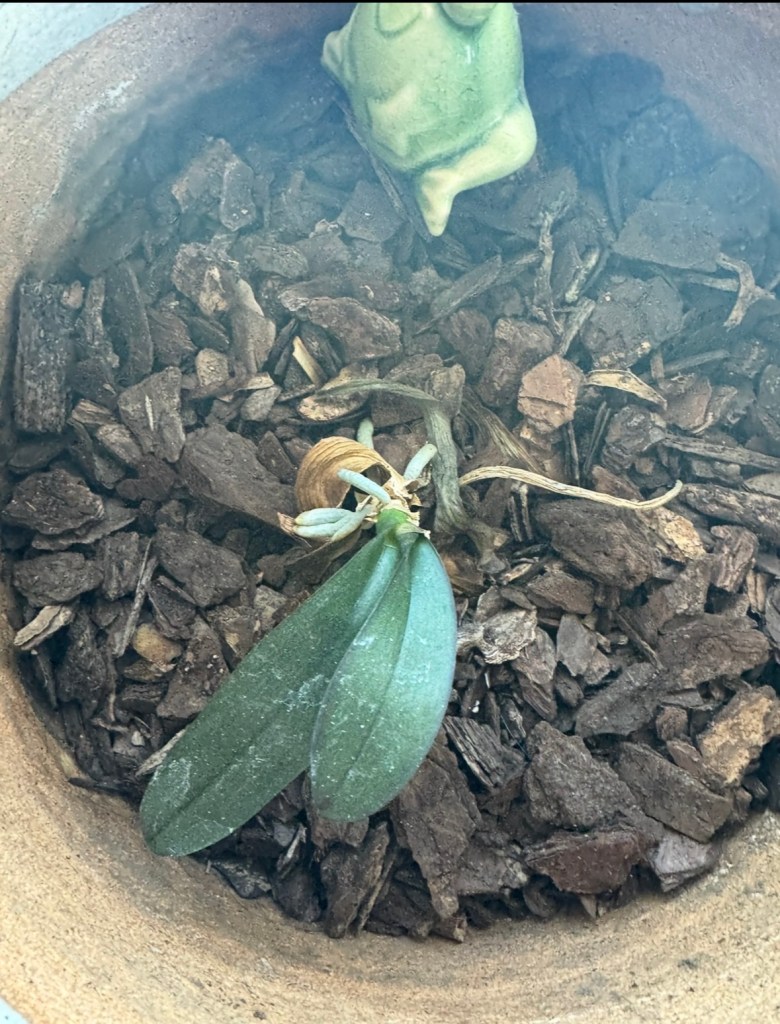
And maybe I can bring this poor orchid back to life.
Last year I had a bit of an issue with daylily scapes being pulled down and eaten by something. Probably something with four paws, but you never know, right? I used quite a few deterrents, all safe, and it was minimally effective. Minimally.
When I put all my 2024 notes and daylily crosses info onto my 2025 daylily tracking spreadsheet, I was reminded again about how much of an issue it was in 2024 – and how much it wasn’t in 2025. At least at the townhome. The historic cemetery, well, I have shared what happened with the Mahala Felton daylily seedlings that I planted by the gate. But that is a bit different, I think. And for this post we are focusing on daylily scapes.
As the 2025 daylily season was starting to produce spent scapes, I began to have the urge to tidy up. I did not, however, do that. This year it occurred to me to me that perhaps my habit of trimming spent scapes was actually attracting playful snackers. Against my preference to clean as the garden matures, I left all scapes on all daylilies until the pod harvest season was complete for that full area.
I also introduced another deterrent this year, and that is lemongrass essential oil (diluted and sprayed on the pavers). And, of course, there are the forget-me-nots, which are also a deterrent.
We are to the end of the daylily seed harvesting season, and I can report – no daylily scapes were pulled down and eaten by critters this year, even the shorter daylilies. All pods made it maturity and were harvested by … me 🙂
I also discovered something new. Spent daylily scapes, when completely dried in place, are very easy to pull. I have a few things in the garden that share that feature, and it is very welcome. Not all of the scapes had dried when the pod harvest wrapped up, so some were cut back when I started the daylily cutback out front, but in the true garden, out back, almost all the scapes were able to just be pulled. There remains just a few from the very last pod harvests.
And with that, the greens are getting another week or so of photosynthesis before I come through and cut everything back. And trim the shrubs. And say sweet dreams. And call it a wrap.
For now, cheers to not trimming spent daylily scapes, to lemongrass essential oil, and to forget-me-nots. I am thankful for no critter interference in the seed maturing process this year.
I have now had time to sit with the data on the 2025 daylily crosses. I am a bit shocked, but not totally. I harvested 422 seeds from our gardens here. 277 seeds are from diploids. That is not surprising, as I know what Pink Tirza does. There is a reason Pink Tirza is my diploid line. This year Pink Tirza was an incredible pod parent. Last year it was the opposite – Pink Tirzah was our top pollen producer in 2024. Naomi Ruth and Pink Tirzah don’t do fantastically well together, but Naomi Ruth was a top pollen producer this year, as well. Peach also typed out as a diploid (which did surprise me – a lot), and we have seeds from Peach. And with the Red daylilies in the mix and at an overwhelming quantity of 8 clumps, red boosted the diploid numbers.
Then there are 111 tetraploid seeds. Not surprisingly, South Seas took the prize for tetraploids. South Seas is my tetraploid line for a reason. South Seas is a powerhouse. And Coral Majority, one of her children (which I did not know when I purchased Coral Majority, but bonus!) continues to amaze. In fact, South Seas may have daylily grandbabies in the next few years in our garden due to Coral Majority. Fingers crossed. We have seed. It would be kind of cool. We shall see.
And then we have 34 self-seed from our gardens. Mostly – South Seas and Coral Majority, but a few Red and Just Plum Happy.
Not in the above numbers are 99 seeds harvested from Oakwood – 78 of which are Stella De Oro and look kind of iffy, but maybe they will do something for those gardens. I will try. There are 2 Red Volunteer seeds I harvested from a Red Volunteer I planted there last fall, and then 17 seeds from some new daylilies I don’t remember from last year, but they did very well this year.
So – 521 seeds. Oof! Yah. But I have my thinking cap on. I will figure it out. Lots of other people do this, at a much bigger scale. We shall be creative. There are 4 large success crosses. The rest can go in little seedling pots. Maybe direct sow the self-seed.
My 2025 daylily crossing (hybridizing) work is done, and pods are formed and maturing. I have had a week to relax and just enjoy the bloom finale, and some lessons learned are coming to mind. I thought I’d share. Here goes:
1) The journey is exponential. I have gone from harvesting self-seed from one South Seas daylily 7 years ago to now well over 100 intentional and self-seed seedlings. I have seedlings at the townhouse and at the historic cemetery, and have planted seedlings in other gardens as well, including our little house up north that we sold. In addition, this year I have dozens of successful intentional crosses that have gone to pod. Pods often have multiple seeds, so hundreds more seedlings are potentially on the way next year. To move to the next step, some of the 2025 seedlings are moving up north this fall. Those are the 2024 seeds that went to seedling this season.
2) Crosses that worked one year may not work the next. Crosses to the red daylilies were crazy successful last year. This year? Very skimpy. And believe me, I tried. But new ideas abound, and even just flipping the cross, pollen to pod parent, works.
3) Daylilies I want to use a lot for crosses need to be very accessible. I love paths, but I do not love stepping through daylilies on a forget-me-not path. a) Forget-me-Nots stick to fabric, and b) it just feels wrong to step on flowers. As an example, this is Coral Majority. Although she is not a good pod parent for intentional crosses, her pollen is awesome. But she is not in a good accessibility spot right now. Eventually I need to move her to a more accessible spot. Probably next fall.
I have done crosses with her pollen this year, and she also has some self-seed pods again this year. I am, however, more often than not, just enjoying her blooms. She has had quite a few more tame (not so wild tie-died looking) blooms in the past few weeks. Isn’t she looking exceptionally lovely? I will miss her blooms.
4) Only cross one daylily type’s pollen to one clump of daylilies. This year I took that even farther for some crosses and only did one pollen type cross to all of the Marque Moon blooms, all on the same day, and I got 4 pods. Semi-Simplistic. Who wants to make a fun hobby stressful? Not me!
5) Take time to smell the daylilies – literally and figuratively. Some daylilies, like Tender Love (below), are very nicely fragrant, so don’t ignore that treat.
And figuratively, when doing crosses starts to feel like burn-out, stop. The pods will require work yet this season – harvesting, labeling, storing – and then the seeds all need to be stratified, and planted and cared for to germination and growth next year. No shame in setting a date to stop. Name a date and then stick to it.
6) Remember this is a very long game. Years. Maybe more than half a decade. Unless you are willing to pitch greens after just a few years, be patient. I had a six-year-old seedling finally go to bloom this year and it was well worth the wait.
7) There is landscaping, and there is gardening. For “landscaping” be willing to stick to a mass quantity palate. I have a red, white, and blue theme for the landscaping out front with masses of red daylilies – very simple.
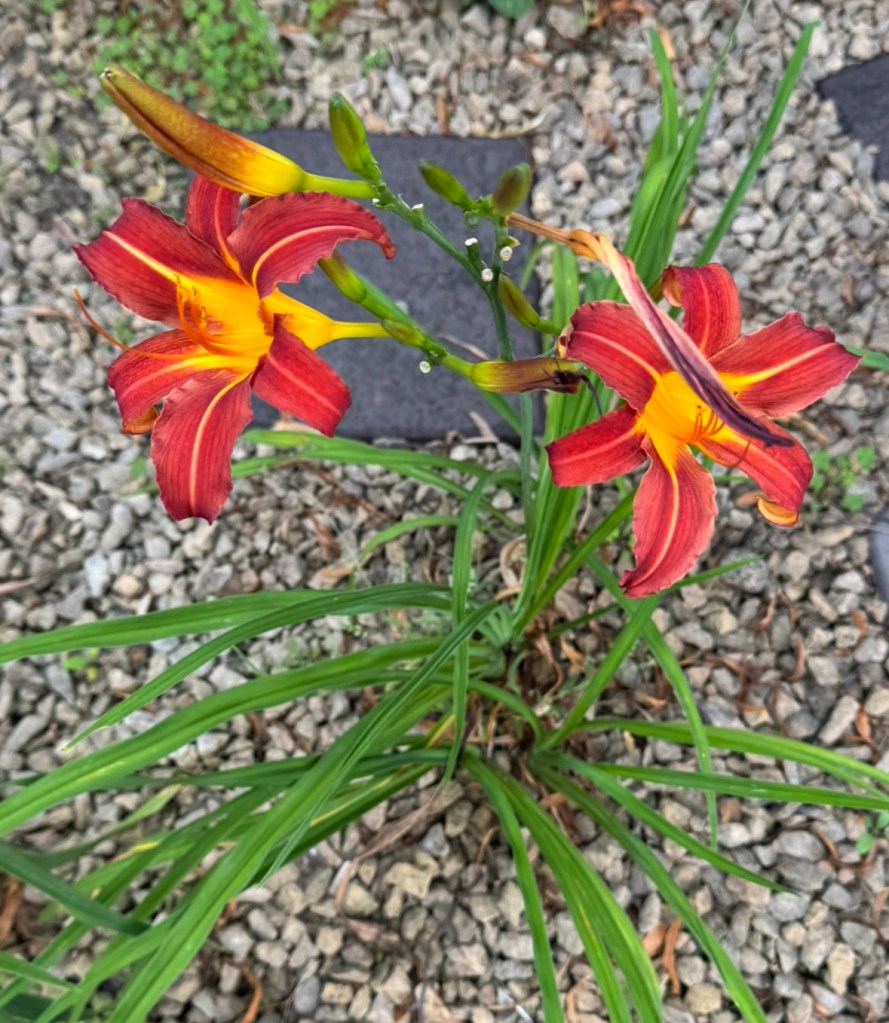
8) Gardens are not landscaping. I have gardens out back. In gardens, especially daylily crossing gardens, color surprises happen. Wonderful surprises. And ”not for here” surprises. This year one of the surprises was a red daylily volunteer from the red daylilies out front.
They used to be out back, and I think a seed got in with the Purple D’Oro seedlings I moved, right into my line of view where I sit on the patio. Right next to Equal Opportunity, which turned out to be a peachy, frilly bloom I wish I had 10 of. But Equal Opportunity is done blooming now, and you know what? The red volunteer just keeps blooming away. I love the masses of red out front AND I love the calm of pastels out back. I came to the conclusion that the red daylily seedling will be moving, but probably not until next fall. I am still hoping there are Purple D’Oro seedlings to come in that bunch.
9). Focus, Focus, Focus. Pick one or two lines for crosses (parentage), and work with that. South Seas is already, for sure, my primary. Pink Tirzah will probably be a secondary. Even though I can’t find Pink Tirzah’s parentage, I already have seedlings and pods from Pink Tirzah, so I know that line will also work.
10) Document, Document, Document. And document some more. My sad, sad story on that is that I am beginning to think I have a cross I mis-labeled in the early years. It went to bloom a couple years ago. I had it labeled as a cross between a diploid and a tetraploid, which I might actually have done back then. Or it could be a self-seed. Or it could have been a tetraploid cross where I wrote Pink Tirzah instead of Pink China Doll. It has fairly driven me bonkers! Especially since it has typed out two years in a row as a tetraploid and Pink Tirzah is supposed to be a diploid – but, then again, I found reports of it crossing with a tetraploid. Since this is such a long game, testing out for replication will take years. In the meantime, Hello Yellow is a nocturnal tetraploid that took a cross with two different tetraploids this year and made pods. And in the end, I am doing this for fun. Hello Yellow may forever remain a beautiful mystery.
11) Enjoy self-seeds. I have fallen in love with the self-seeds that went to bloom in our garden this year. They all will stay. I may even do an “only self-seed” year in the future. You never know.
So there you have it. 10 Lessons Learned from the 2025 intentional daylily crossing work I did, plus an extra option for “no intentional cross required” (the self-seeds).
I hope you have a wonderful weekend, and Happy Gardening!