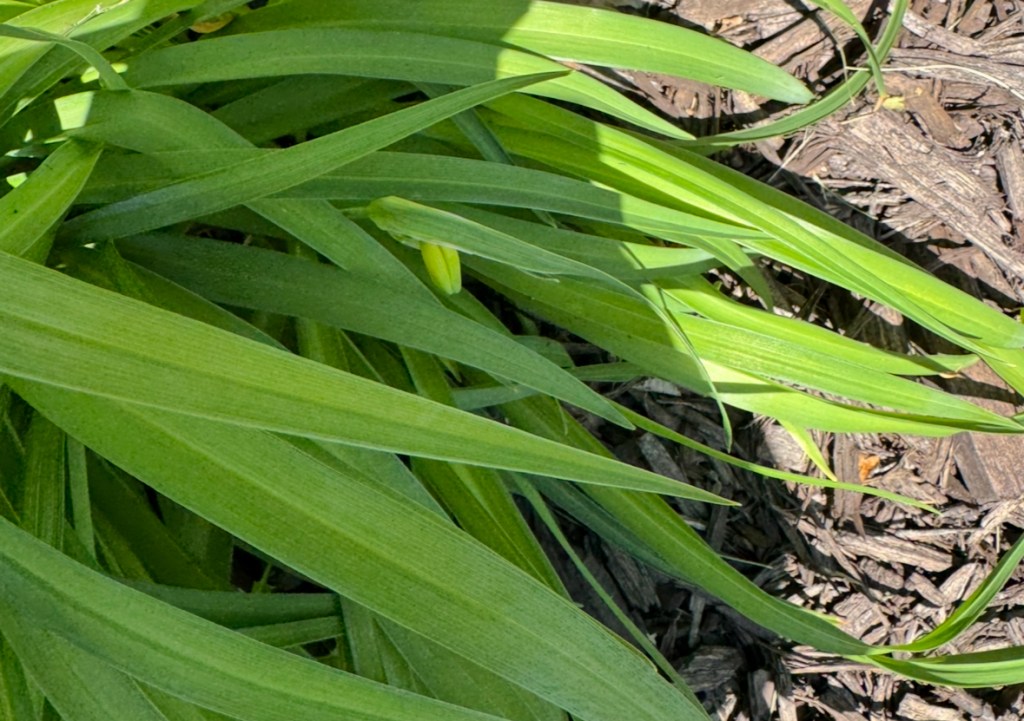
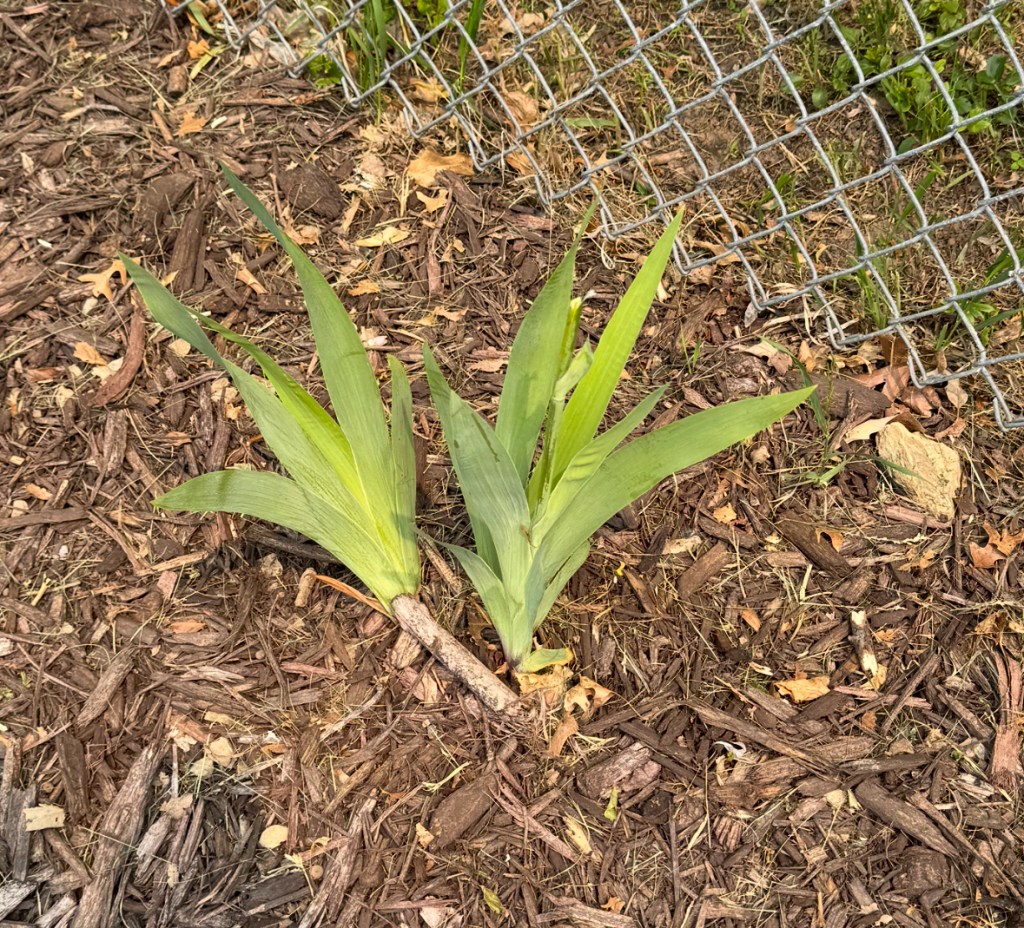
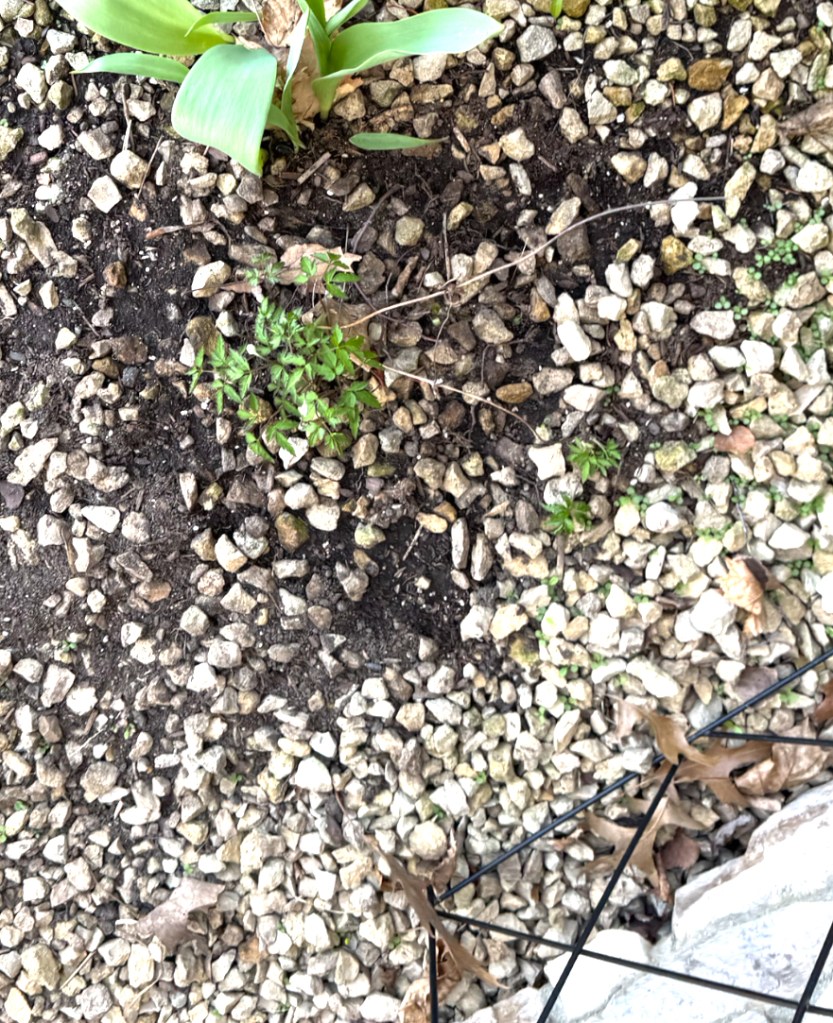
Today is the last day for 2025 daylily blooms in our townhome gardens. Hello Yellow opened the 2025 daylily bloom season, and she is closing it out as well. She is AMAZING! And she is a mystery. I would be tempted to say a bird brought in a Stella De Oro seed, but a) she has repeatedly now typed out as a tetraploid, and today I harvested seed from one of those crosses, b) I planted her as a seedling from seed I harvested (I don’t own any Stella De Oros) and c) I haven’t been able to replicate her. So, she remains “Hello Yellow” with parentage as “sdlg” Her seedlings, if we are so blessed, will be fun – partially because she is not at all scientifically supportable. She is a gift. A reminder that I cannot support everything beautiful with data 🥰
And as the daylily bloom season at the townhome comes to a close, of course I have interwoven that eventuality with something new. Why wouldn’t I? And not something small like weeding or tossing worn out garden gloves or taking cloches off seedlings or moving rock that keeps overflowing into the grass or onto the sidewalk when it rains. No, no, nope. I need something much bigger. Multi-year, very challenging, requiring no money investment, but rather just repurposing and harvesting for new – exclusively, you guessed it – from and to the historic cemetery garden. How did I arrive at this set of requirements? Well funny you should ask. It has to do with 3 years of work there, studying, observing, seeing weird stuff (like things disappearing – ahem – Mahala Felton seedlings and purchased and planted daylilies), and a love for solving reasonable needs. Enter the Fischer project.
The Fischer project was born out of me not being able to keep my joy to myself and sharing that it only now takes one hour per week to weed the entire historic cemetery garden. And, by the way, since we are adding another garden, we need some refining nomenclature. Going forward, for my blogging purposes only, the left side of the wall garden at the historic cemetery will be referred to as the Mahala Felton garden. The right side of the historic cemetery garden will be referred to as the Shirley D garden. And the new garden will be the Fischer garden. So, I was sharing that I felt a bit guilty, not too bad, but a bit, that the historic cemetery garden in year 3 now only takes one hour per week to weed. Or one hour per side every two weeks, or, well you get the gist. And Shirley’s husband, who is an absolute rock star, who helps Shirley keep up the cemetery, said something to the effect of “Do you know the Fischer site?” Yep, kind of, I said. And off the project started. The Fischer site is definitely a long-term project. It will for sure take a couple years to turn into a garden that replaces grass with plants, that does not require mowing. And that is the need.
So, the challenge is a garden at the site that is deer, squirrel, bunny, and other critter – two and four legged – resistant, drought tolerant, very low maintenance (like cut it down at year end), no mulch, does not obscure markers (so ground cover in some areas), and (my requirement) feels healing, and peaceful, and, well, quiet. The Fischer site is the site of early settlers to this area, but their story was very different from the Feltons story.
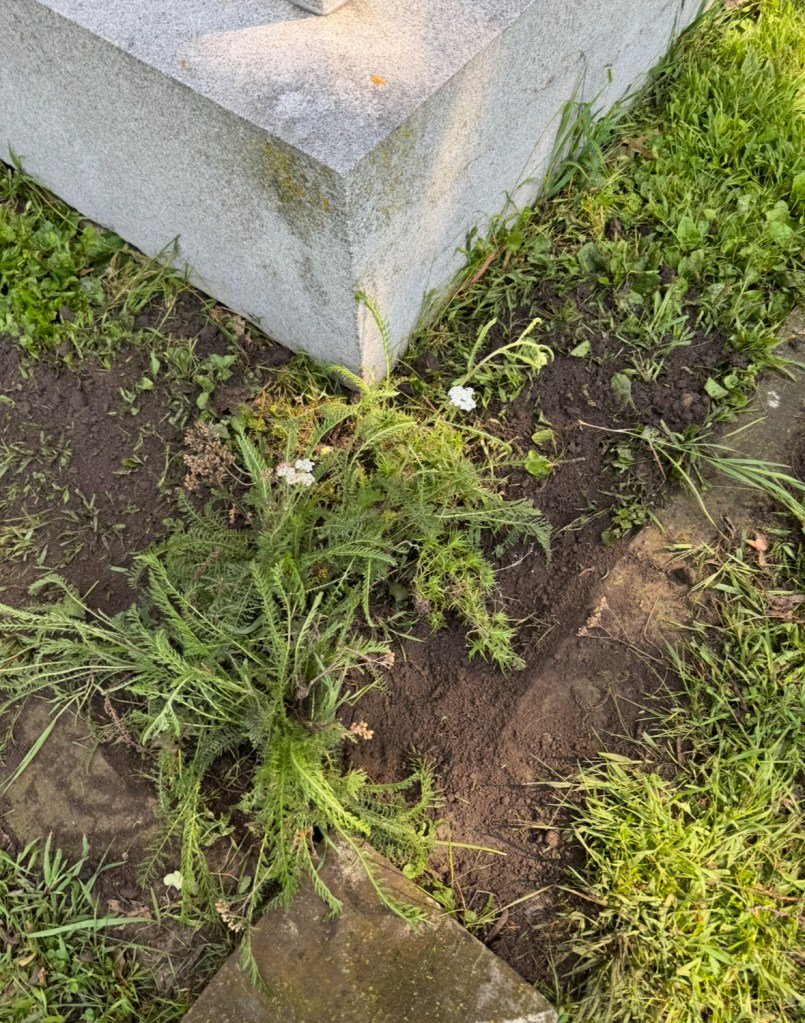
And that is where this blog ends. But I (with the help of Shirley’s historical research) will share more as time goes on. About the Fischer story (history), about the new garden plant choices, about the new garden successes, and I’m sure failures, and about how things look as we go. Shirley just texted to say they are at Oakwood, and she will water the new plantings. They don’t look like much – a few bunches of transplanted yarrow from the Mahala Felton garden – but it’s our new work in progress. Now that the Mahala Felton garden and the Shirley Dalaska garden take so little effort, their gardens are going to fill the new Fischer garden. That I LOVE 🙂
We are deep into daylily season now, and I am seeing patterns regarding daylily crosses that will work this year. For instance, the cross that made the Mahala Felton dedication daylily will not have a repeat seed creation season this particular year. One of the parent daylilies is not sending up scapes right now. That happens. It is a healthy daylily, not crowded. It could be that I just overworked it last year. For this year, the Mahala Felton daylily seedlings are doing well and will start to be be planted this fall in various locations in the Oakwood Cemetery garden where Mahala Felton is interred.
I am also having challenges this year with getting the Molly Cowles dedication daylily cross to replicate. 60 seeds last year, and not a single success with that same cross this year. But that, too, is OK. I have so many Molly Cowles seedlings that some will probably even go up north. I will continue to try to replicate those crosses this year. There is still lots of runway ahead. And some things happen for a reason.
Those daylily seedlings are wonderful, and I hope they will bloom absolutely beautifully, but I knew there was more to come. It was forming in my mind. Something a bit different.
We were “getting there” when one of the daylilies I purchased and planted at Oakwood last fall began to bloom a few weeks ago. That daylily’s name is Red Volunteer.
“Volunteer” has layers of meaning. What a cool daylily to be at Oakwood. And it is stunning. I am hoping for way more blooms next year. I only caught two this year.
But something was still in my mind. It just was still in a “waiting” state. Something with ties to meaning. It finally arrived.
Dedication daylily “Shirley D” is a dedication to my good friend, long time historian and author, and fellow volunteer at Oakwood Cemetery. Shirley puts up with my relentless garden talk, endlessly long texts, and ridiculously ambitious ideas. And Shirley and her husband Mike dedicate uncounted hours of personal labor as well as their substantial leadership to Oakwood Cemetery. They are, in my humble opinion, the primary reason Oakwood Cemetery is in the renovated state it is in today.
Dedication daylily “Shirley D” is from 2022 harvested seed. 2022 was a tough year for me. It was the year my husband and I decided that the little home up in the mining town in northern Minnesota (that we had renovated and planned as our retirement home) was not truly a match. Our plans were upended. We were back to the townhome plan, and I was gutted. I wanted a yard to renovate into a garden. I wanted to be in that area. But it was just too small. My friend Shirley was a dear sweet comfort as I greatly grieved selling that house.
The following year, as I was looking for something I could pour myself into through gardening, Shirley, once again, reminded me of opportunities at our local historical society. While dedication daylily “Shirley Dalaska” was slowly putting roots down where I had planted her the previous fall, I joined the historical society, intending to mainly garden. I took a meandering route, but eventually I found my way (back) over to Oakwood, where I, once again, saw the old, abandoned garden I had seen before. Volunteers are not in plentiful supply, and no one had felt both a calling and the time to address it. And honestly, I too had no interest in that garden. The goats that had been at Oakwood to eat the buckthorn a few years before might have enjoyed it had they had access to it, but it did not really speak to me at all. I was looking at the huge expanse of a raised bed fence garden that so needed love. The old, abandoned garden had stuff that would look great in the fence garden, but the fence garden needed way more than weeding and transplants. What happened next is a testament to Shirley’s absolute genious. While I was working through what I was feeling called to do, Shirley didn’t give me her plan. She let me come up with a “Susan plan”. An impossibly ambitious plan to move the heaving rock and exposed plastic out and go to a mulched garden. I went to the store, bought three bags of mulch, put some in, took a picture and asked what she thought, and pretty soon Shirley and Mike were there doing garden days, sometimes even when I wasn’t there – moving rock, pouring out bags of mulch, putting up with my insistence that hostas would never survive there and that people who were increasingly plopping hosta donations in the newly renovated garden were going to be sorely disappointed when their hostas died. It was, after all, I said, a full sun garden, for goodness sakes 🙂 (Those hostas are thriving – lol) Shirley has stood beside me, even talked me out of really bad ideas, and still encouraged me in my efforts. She soooo gets me. She gets my intensity. She gets that I primarily want to make gardens. She gets that I am so pleased seeing the community appreciate the completed renovation. (Is a garden ever truly completed though? I don’t think so.) Shirley gets that I was pretty driven about getting the garden renovated but now am thrilled that I only need 1 hour per week to weed it because neighbors are weeding as they walk by. So cool!!! And she puts up with me saying, for the 900th time, that I am not going there every day to water plopped plants, which still happens lol. It’s OK, she says. Shirley really is a saint. I think she may be watering plops. I’m pretty sure she is 😉
This year, as the daylilies in my townhouse gardens started to come up and then show scapes and buds, dedication daylily “Shirley D” took her sweet time. Other South Seas self-seed creations were coming up, making it onto my blogs. Still created by our mutual neighborhood pollinators but looking “not Shirley”. And then the first bloom. Does “Shirley D” not have the “it” factor? Understated, yet undeniable presence. Like Shirley D the person, my dear friend.
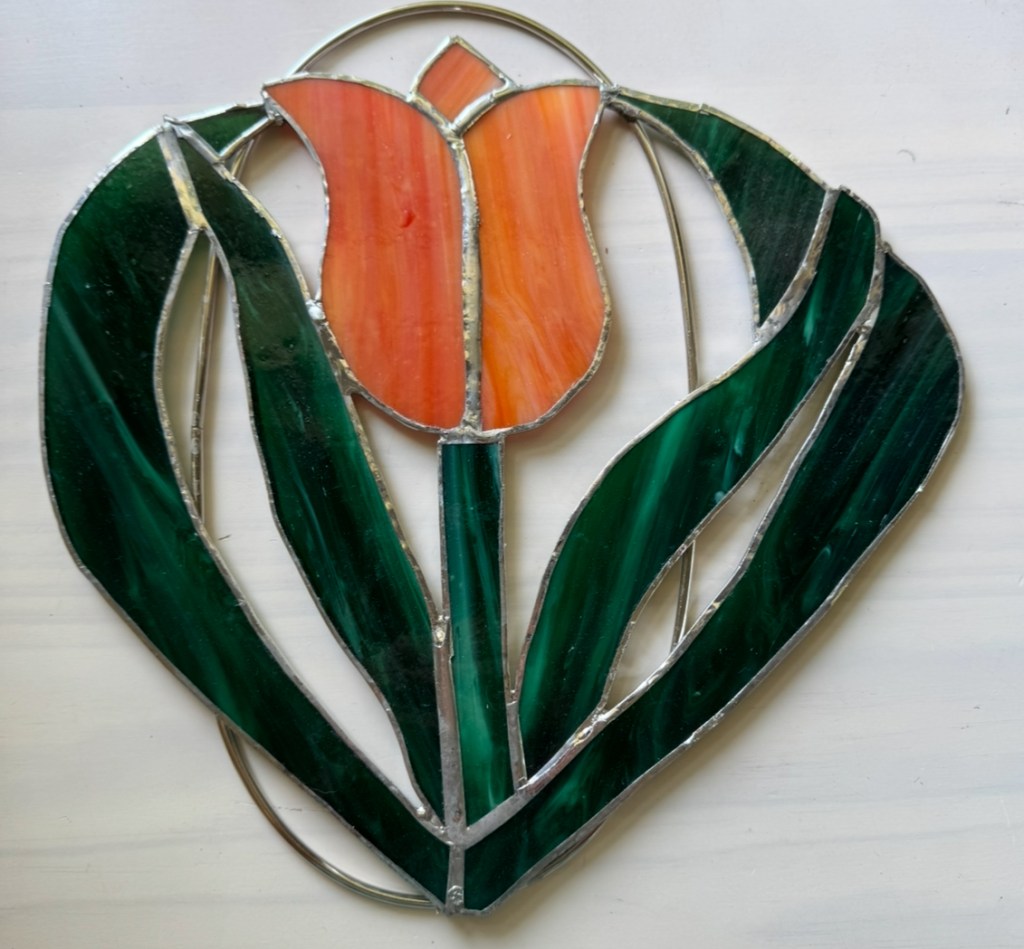
Among Shirley’s many contributions, Shirley does stained glass work.
Back at you, my friend, with another floral beauty.
About this time of year I start to make my fall list of garden changes/updates/refreshes. It can get to be quite ambitious in my mind, so getting it in black and white is important. To set healthy limits, I have a moratorium on in-ground to in-ground transplanting from late June to the beginning of September. That timeline gives me time to focus on the daylilies during bloom, and it helps give me a chance to fully assess the gardens’ future needs. It also keeps me remembering that the September heat adds to the transplanting effort and curbs my “enthusiasm”, which in turn keeps the list manageable. So the list has begun. #1 at the townhouse is dividing and transplanting more of the Blue Mouse Ears hostas. This one is already part of a long-term change for the gardens. Those Blue Mouse Ears started fairy ringing a few years ago. I divided and transplanted a few clumps last year and they are doing well, even scaping out and blooming.
The divisions this year will follow last year’s pattern, moving them more into the shade. I want to reestablish a path to the back of the garden again, so the hostas I divide will move into that area, giving more layering, which also keeps weeds down, and then the space where the Blue Mouse Ears hostas will come out of will become a footpath again.
The forget-me-nots are winding down their bloom and getting pulled out. They are biennials so as I pull more and more, only leaving them for a bunny deterrent, they will stay – but in significant moderation. I do miss them a bit, but you can imagine what I don’t miss. I don’t miss how the tall stems cling to anything fabric. So the decision is – they are awesome bunny repellent but they are not going to be taller parts of “bouquets” going forward. They can stay low. A sweet sentimental part of our garden.
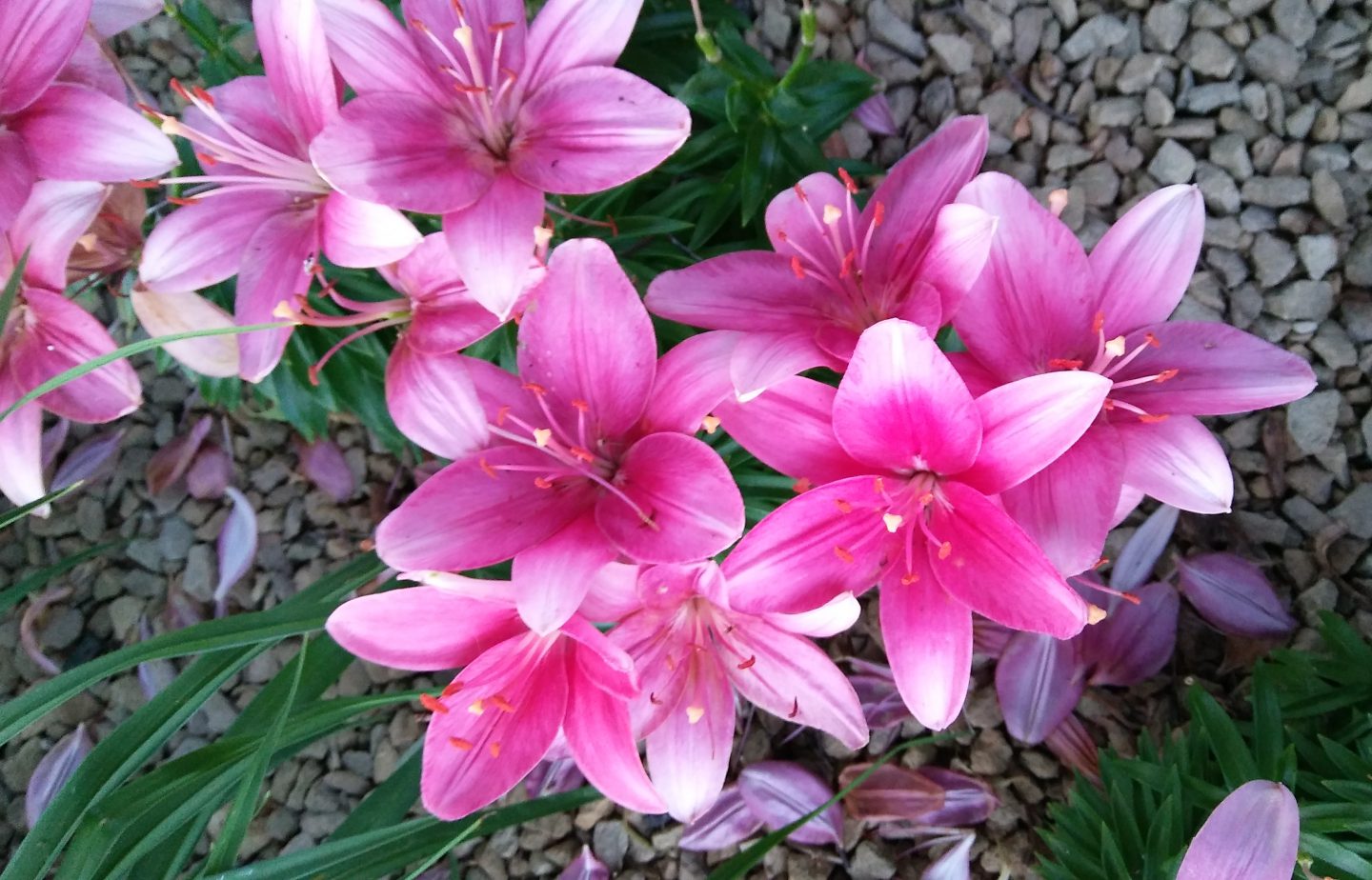
The peach asian lilies are done blooming, and they have now been cut back to half height. All except one I missed. I do like that they not only look tidier but that cutting them back preserves their energy from going to seed. Oh, believe me, I am tempted to let the one I missed go to seed, but I researched to remind myself on why I don’t grow Asian lilies from seed, and to get success with bringing harvested Asian lily seed to bloom it takes a series of stratification steps, followed by 3-7 years as a seedling, before bloom. I think I may say no to that wonderful opportunity this year at least. Probably longer.
Speaking of years, 7 years in to my daylily propagation journey, I am now growing enough daylily seedlings, to bloom, to keep me (and the historic cemetery) more than good. This year we have three new daylily seedlings with scapes, and the 2024 seeds are popping up more for the future. The cloches are on the seedlings, and the Mahala Felton seeds that don’t germinate this week are going into the shamrocks with their dirt. They still will have a chance, just not a dedicated space.
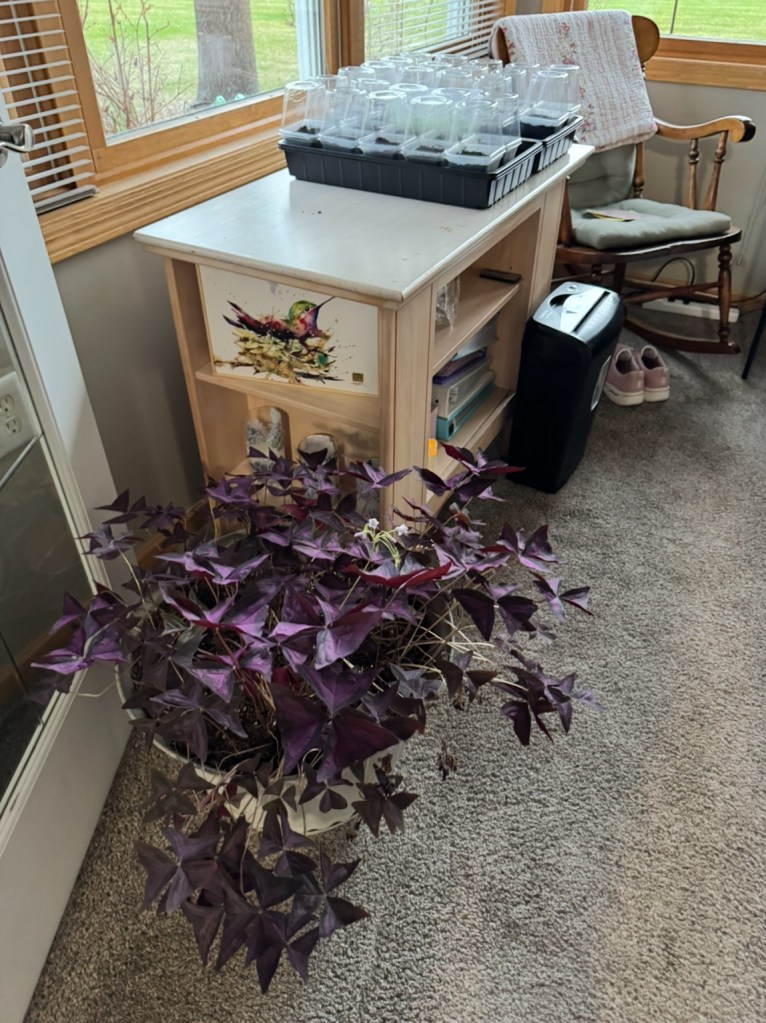
And the shamrocks? I don’t know what is going on there. Birds or bunnies or squirrels or something are starting to dig at those pots again, so I am going to do an experiment. I am going to put them in the ground in a spot where we lost a hosta. That spot is already growing some shamrocks from bird, bunny, or squirrel damage I missed collecting earlier this spring. We had a friend who somehow managed to grow them perennially, outdoors, in the ground, here in Minnesota, even though they are not supposed to be winter hardy. At this point they are getting distroyed anyway, and I have plenty saved in the house, so no big. It will be an adventure. Could be I grow them as annuals in our garden forward. Or we could have a new perennial. We shall see.
Finally, I have a seedling from the early years when I was doing uneducated crosses that is baffling me. I have looked and looked at pics and notes, and it sure looks like I successfully crossed Pink Tirza with a tetraploid. That’s what the envelope said (my handwriting) when I planted it. That should not have worked, as Pink Tirza is supposed to be a diploid. Very odd. Maybe something got crossed before I did the cross. We shall see how that matures.
Other than that, Red Volunteer bloomed its first bloom since I planted it last year at the historic cemetery, and I missed it. Hey, that’s how it goes. It has another bud that looks like it might bloom soon – maybe the 4th of July 😊
And finally, July 2nd was the 162nd anniversary of Gettysburg where one of the historic cemetery’s residents, James Akers, was killed in action.
This year I finished up adding purple irises to both sides of the fence garden. I am hoping they bloom for Memorial Day next year.
Wishing you a wonderful 4th of July if you are in the United States, and a beautiful week ahead.
Molly Cowles was the wife of SGT Asa Cowles, an American Revolutionary War patriot. SGT Asa Cowles and his brothers served in the Revolutionary War. One of his brothers did not return. His brother was taken as a prisoner of war and was assumed to have died in an English POW camp. The Cowles were patriots. How do I know this, and why? Well, it is a long story. I could give a short answer, but it really didn’t happen that way. In fact, I never would have researched anything about the Cowles had I not gone on the path I will share. The long answer to why I have this information really started many years ago with a grade school field trip I chaperoned for one of our sons’ classes. That is when history actually came alive for me. Before then I just could not get excited about paper maps being rolled down from the ceiling and wooden pointers showing us war locations and routes. I really tried. I did! But for some reason while math and English kept me wide awake, I kept dozing off in history class. Literally – dozing off. Arrggghhhh. But … I married a historian. Yah, absolutely true story. And one of our sons had that school field trip to a historic site and I agreed to be a chaperone. Well … I loved that site. Way more than our son did hahaha! It made history come alive for me. Next thing you know we were reenacting and doing historic rendezvous, in a tipi and then a wall tent. I know, crazy. So, you see, I was more interested in the everyday lives of the historic people at that point in my life, much more than the war maps in classrooms of my teen years. But everyday life history is harder to find. It is the bigger things that stand out, get documented – discoveries, settlements, births, wars. Sometimes occupation. Fast forward, many years later we moved to our current town, and my friend who is a long time historian got me hooked into local history. But wow, she is good! She got me back in through gardening. Yah, gardening. Probably because she knew this girl was not reenacting anymore. I was pretty clear about that 😉 And there you have it. Regarding history, I volunteer garden at a historic site cemetery and do garden stuff in honor of some pretty cool historic people. One of those people is Mahala Felton, the first white woman settler to our area. As that research project unfolded for me, I realized Mahala Felton’s incredible contribution to local history. I decided to name a daylily for her. And I shared the incredible history I had learned in a four part blog. I was thinking at that point that I would take a break from researching, but it was not meant to be. The answer to how I know about SGT Asa Cowles falls in the timeline at the end of my research on Mahala Felton. About that time my sister shared our ancestry chart. I was intrigued by a very unique name (Sempronia) in our family genealogy. I might have stopped there, and missed SGT Asa Cowles, but somehow the name Tirza popped up. A very unusual, yet very familiar name to me – Tirzah. As in Pink Tirzah, the daylily. Pink Tirzah has a very storied history in my garden that I shall not recount. But suffice to say, Pink Tirzah overcame many obstacles and today she is thriving. She is now knocking it out of the park. Pink Tirzah was my most successful pollen source last year. Go Pink Tirzah! But I digress, slightly. I found Tirzah Cowles but she was not in our lineage. Her brother was. And their father was SGT Asa Cowles. Now stick with me here, because I suspect, as we used to say while sitting around evening campfires at rendevous, telling stories, it will seem like this is a “smoke goes up, heads north, and makes a hard turn right” but it is not. This all ties together, I promise.
My husband and I agree on names for my daylilies. Some of my intentional crosses get female names. That’s just how it rolls. We chatted one morning about all this and agreed. The Pink Tirzah cross will be named Molly Cowles.
There may be more female names from our genealogy. I thought I saw a Civil War reference somewhere along the way but didn’t pull that url. It looks right now like our lineage goes back to Jamestown, but we shall see. We are still researching. I will write more as we go.
Let’s see … where did I leave off last week? I think it was with the discovery of the first daylily scapes of the season.
Last Friday I was weeding at the historic cemetery. I was down to the end where there are some mature Stella de Oros. Full disclosure, Stella de Oros are not daylilies I would buy. I do like the color. The size is not the issue. It is just that they are everywhere – in residential gardens, commercial landscaping, everywhere. But … they are daylilies, they are improving in health since the rock was switched out to mulch, and they were gifted to the historic cemetery garden before I started in earnest, so they stay. Stella de Oros also bloom fairly early, so they are a harbinger of the start of the daylily blooms on the way. So, last Friday, as I was wrapping up weeding, I looked over and there it was – a scape, on a Stella de Oro.
Which means the scapes will soon start showing up on other daylilies. And that is my start of the daylily season. Scapes hold buds that bloom and blooms can be not only enjoyed, but crossed, by birds, bees, butterflies … and humans. It’s almost here!!! Hurray!
While daylily gardeners everywhere await daylily season, irises are in full bloom. The iris bed I made two years ago at the historic cemetery is starting to really shine! Almost all the irises in the lower part of the bed came from a smaller overgrown old garden. They were not blooming there, so I took my chance on color. I lucked out. Last year all those that bloomed were yellow, and this year as the iris bed began to really shine, the color yellow was predominant, save for one purple iris in a line of five that I had added last year from the big old garden. That purple bud showed up late. We shall see what comes next year.
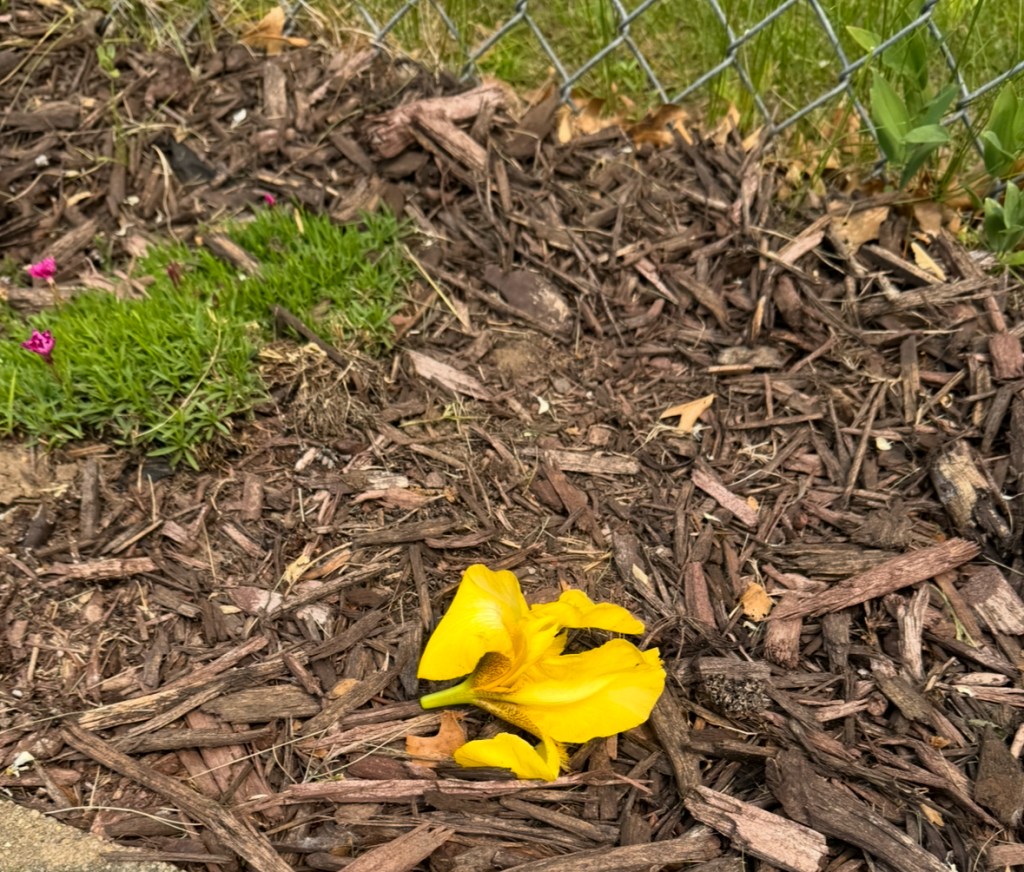
Now here is where I get to share the joys of a community, public garden. 99.5% of the experience is AWESOME. People are so kind and thankful, and it is so fun to meet them and see them over and over. But there are, shall we say, occasional shenanigans. And herein is this week’s shenanigans story. I shall say it did not make me smile and say “silly turkeys”. So here’s the story. I was all excited about the yellow irises because we have 14 veterans buried at the cemetery who came home safely from war. Think yellow ribbon for safe return. We also have a Civil War soldier, James Akers, buried at the cemetery, and he was killed at Gettysburg. I wanted at least one purple iris in remembrance of him, amidst the yellow irises. Think Purple Heart. And one came up! But it was not meant to bloom there. You see, within the past day and a half someone/something came by and snapped off a bunch of yellow irises and the one purple iris. The yellow ones – in various stages from bud to bloom – they threw around in the mulch and even on the ground,
but the purple one was totally missing. Now what possesses an action like that, I cannot imagine. Irises don’t even smell good, and animals usually leave them alone, so … my guess is shenanigans. Now, I have been putting the best construction on missing plant markers and missing plants, thinking maybe it was squirrels or turkeys, but now I am thinking along other lines. And what is my logic? The turkeys that live inside the fence have a big old garden of irises, even one that made it to bloom. And … they aren’t touching them. Soooo …. probably shenanigans. Decision? The Mahala daylily seedlings definitely aren’t going to the historic cemetery quite yet, and I will not be purchasing any additional plants for the historic cemetery. Just out of wisdom. We shall watch and assess. No big. Just prudence.
For now, we enjoy pics, and see the one purple bud in front.
In the townhome gardens the clematis out back are blooming beautifully,
following the Bluebells clematis out front that just wrapped up.
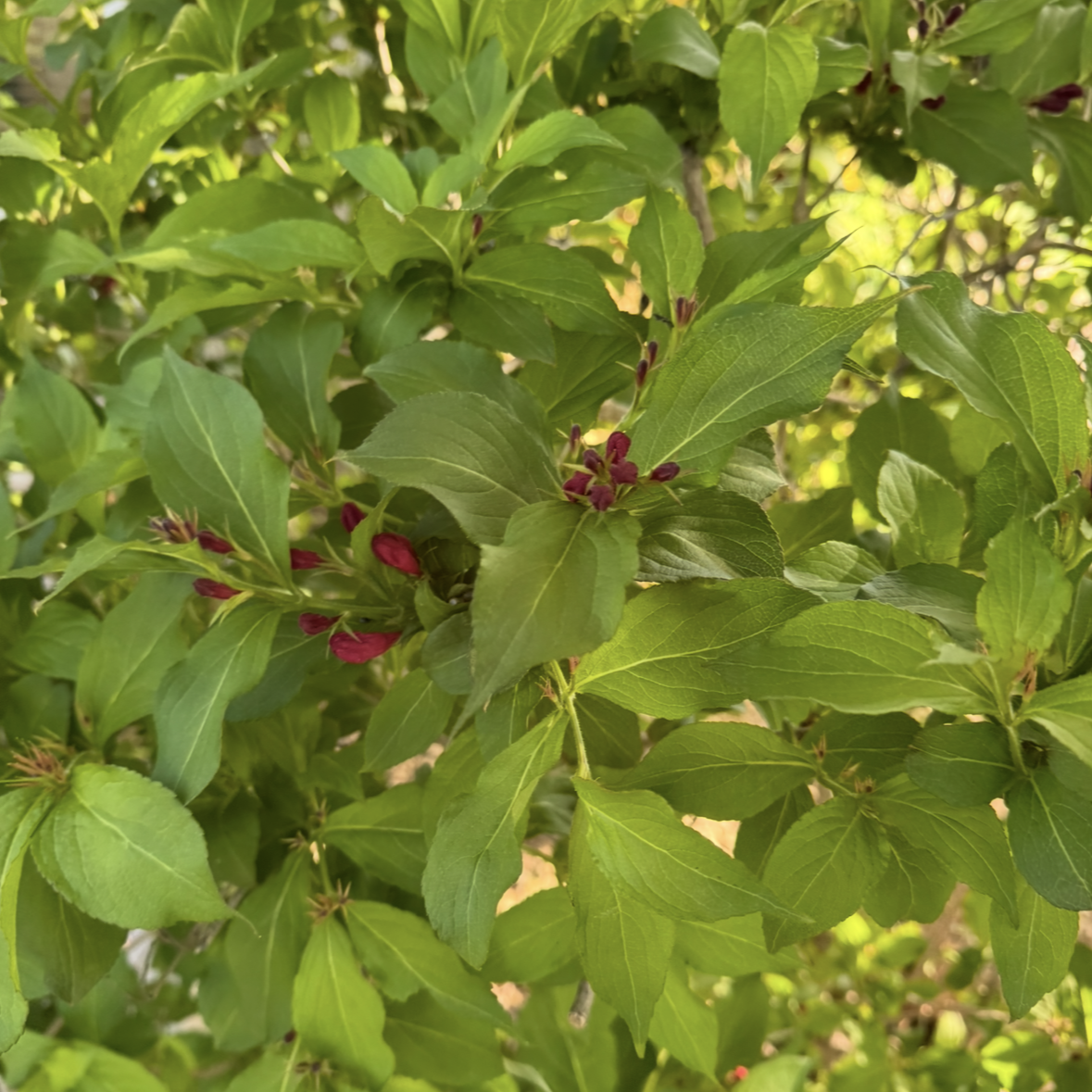
The Weigelia has also started blooming, and, soon, like the clematis, the hummingbirds will be found enjoying those blooms.
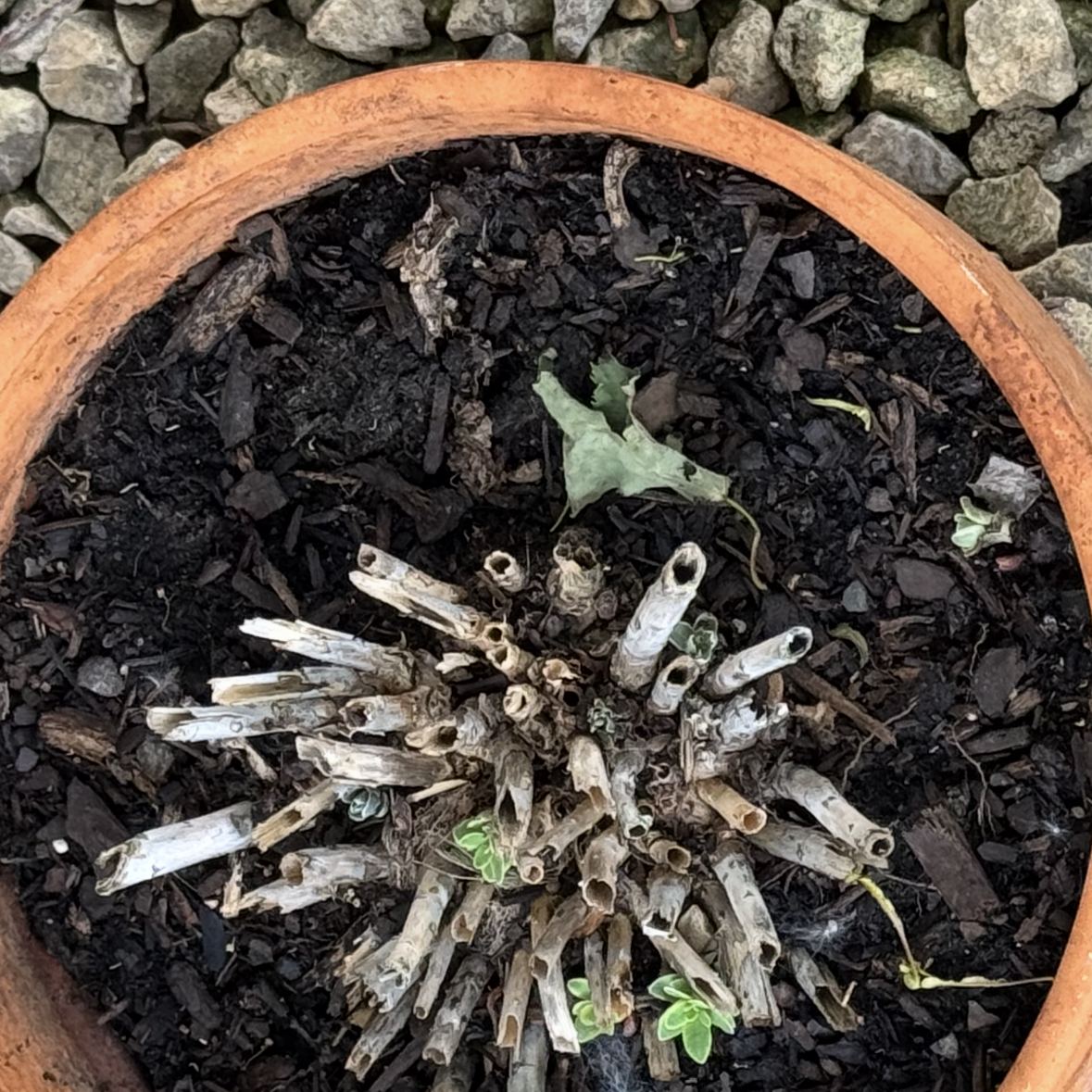
Do you remember the variegated sedum I pulled out and then saw it had a few tiny green buds? I potted it in an old terracotta pot, and it is growing new buds. Yeay! Sedums rock!
The Ninebarks are also doing wonderfully, and, along with the Weigelia, they remind me every year why bushes do have their place.
But, there is a shenanigans story in the townhome gardens too. I suspect they are of the bird variety. After over fifteen years of birds being helpers in cleaning up the shamrocks, we might have a crop of mess makers this year. They have decided to make quite the mess of all the purple shamrocks. No worries. There are so many shamrock rhizomes. I brought them in and will restart them in the house. Sorry birds. No more purple shamrocks fun for you this year.
And that was our week. I hope yours was fun! Catch you next week!
Two weeks ago it seemed like the gardens were on hold. This week things were full speed ahead. But today with a rain and cooler weather, I am once again spending my time indoors. No worries. It is a good time to finish this blog post. It is a longer one. I need to cut it off, wrap it up, insert the pics, add the tags and categories, and get it out there. Here goes.
Top of mind is still the prospective “Mahala” daylily seeds – With the seed planting underway, I am trying to figure out what I will do to protect the seedlings when they need to go into the ground. The seedling box is not a season-long option with the small seed starter cups I used for those seeds. I used special seedling cups for them, with little greenhouse style covers. I am hoping that will be very successful for germination, but if so, they will need to get into the ground within a month. The little cups will be too restrictive for their roots.
If they are successful and germinate and go to seedling, where I think I am heading is something called a “cloche”. It is a wire mesh cage topper that is placed over the seedlings to protect them. In our case that protection time would be the 2025 gardening season. The cloche solution would allow any seedlings a full season to grow and mature in the ground. Then in the fall the cloche would be removed and in year 2 forward the “Mahala” seedlings would be just like any other daylily in the gardens.
I like the cloche idea as a next step. It keeps with “simple”, and it looks nice. It is also a sustainable one-time purchase if I want to continue the early seedling process in future years, for future dedicated seeds. And it doesn’t add another seedling box to be stored over the winter, a definite bonus.
For right now I am still watching to see if we get seedlings. If we don’t get seedlings, we don’t need cloches. But, fingers crossed, we will need them.
In the meantime, the established gardens are popping, so there has been plenty to do.
In the townhome gardens, everything except two late daylilies, a few missing hostas, and two sedum, have popped, including the bushes. One day the ninebark bushes didn’t even look like they had buds. Two days later they were leafing out. And yesterday I noticed the weigelia bush is taking off too.
For daylilies, all the longtime daylilies, including those I divided and transplanted, are back. There are two daylilies from last fall’s order that I am still watching for. In a funny twist, they are supposed to be part of my “control” daylilies to compare against what works at the historic cemetery, and also, an easier way to do and monitor crosses. It is much easier to step out the door at the townhouse and do a cross than get in the car and drive to the historic cemetery. Not that I don’t intend to do crosses there. I do. But it will just be a little more time consuming. Full transparency, though? The historic cemetery garden is easily two weeks ahead of the townhouse gardens. It is an all-day sun, retaining wall, mulched garden. The two control daylilies that are missing from the townhome gardens are already up at the historic cemetery garden. I am kind of bumming, kind of thinking, “can you say extended crossing season?” We shall see what actually blooms. Hopefully both of the missing control daylilies will still show at the townhome gardens as well. One is a tetraploid, and one is a diploid. The tetraploid is one of my faves. It is one of the “parents” that are waning in the townhome gardens and also one of the “parents” of a cross I am watching to bloom this year. I was hoping to use the newly planted one this year, but eras change, and the torch may be passing to a new “rock steady”. Long story short, it will be a bit before I can fully say what we have to work with at each location for 2025.
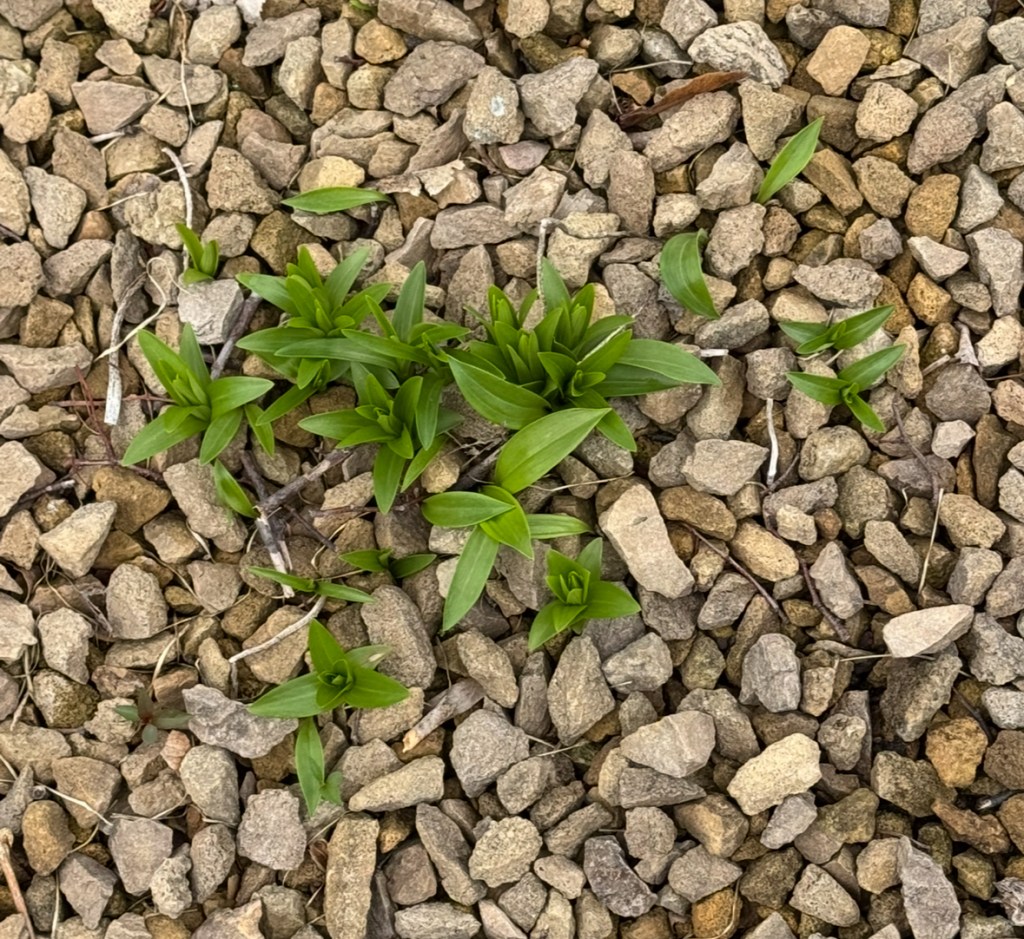
Regarding daylily seedlings, awesome news … at all of the gardens the seedlings are back. I am especially excited to see one particular set of 2024 seedlings (an intentional cross), and am hoping it blooms this year. As I had also hoped, all of the 2023 seedlings are quite a bit larger. Hello Yello is three times larger! She will be a focus again this year. I think she is a tetraploid, as a tetraploid cross went to pod last year whereas a diploid cross didn’t. But that tetraploid cross pod started to fail, and then Bunimous Rex (our beloved neighborhood resident very large bunny) or a naughty squirrel got it. I know for sure it was not one of the white squirrels. Na-ah. They are very well behaved. Maybe this year some of the shorter crosses also need cloches lol. We shall see.
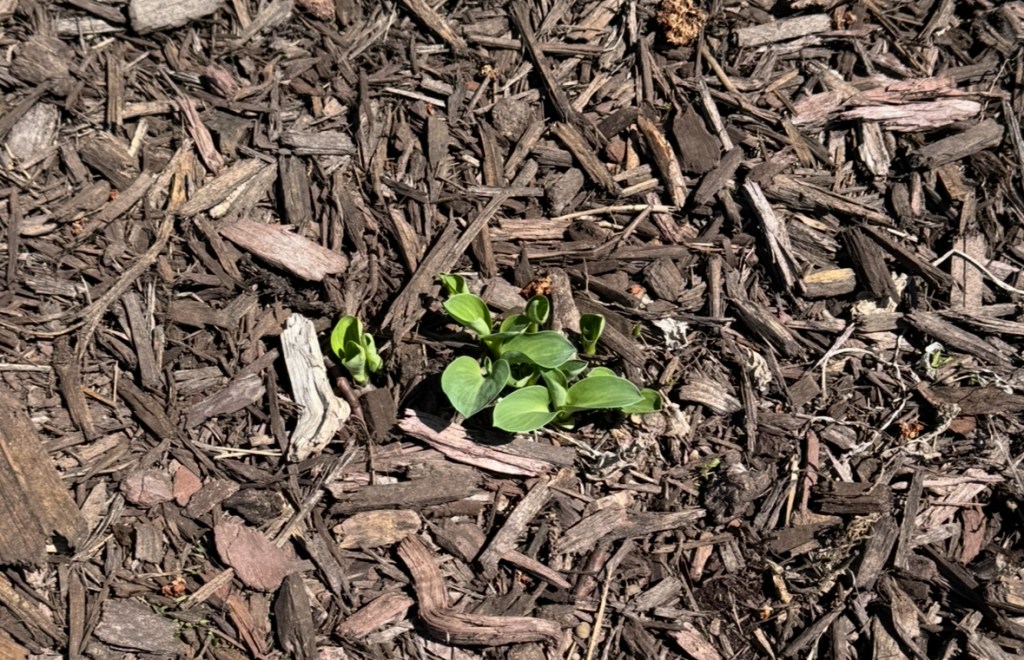
On the hosta scene, Blue Mouse Ears continue to amaze me. Last year’s divisions are popping up.
I think if I could only have one type of hosta, it would be Blue Mouse Ears. Yes, Rainforest Sunrise and Guacamole and Elegans and Praying Hands and Touch of Class. But goodness! Blue Mouse Ears year after year after year checks all the boxes – sun tolerant, disease free, drought hardy, and they reproduce very well. So well that they got divided and placed all over last fall. They are now coming up where we transplanted divisions – both here at the townhome, and at the historic cemetery.
The Asian lilies are also coming back.
Not terribly strong. They are quite old. But they are returning. And … the clematis the lawn maintenance guy tried to pull last year? Back! Hahaha! I thought it was a goner, but nope. It’s back.
The daffodils I planted last fall are largely a no show. There are a few coming up at the historic cemetery, but most of the daffodils coming up there are the ones I planted in fall of 2023. And yes, I planted them correctly lol. It seems they did deter moles, as was my primary reason for planting them. They just didn’t bloom well. And that’s OK. The bags of 50 are coming to the end of an era. This fall I want to change things up a little and force grape hyacinth this coming winter. They also deter moles. And I can do smaller pots for forcing. If I want to.
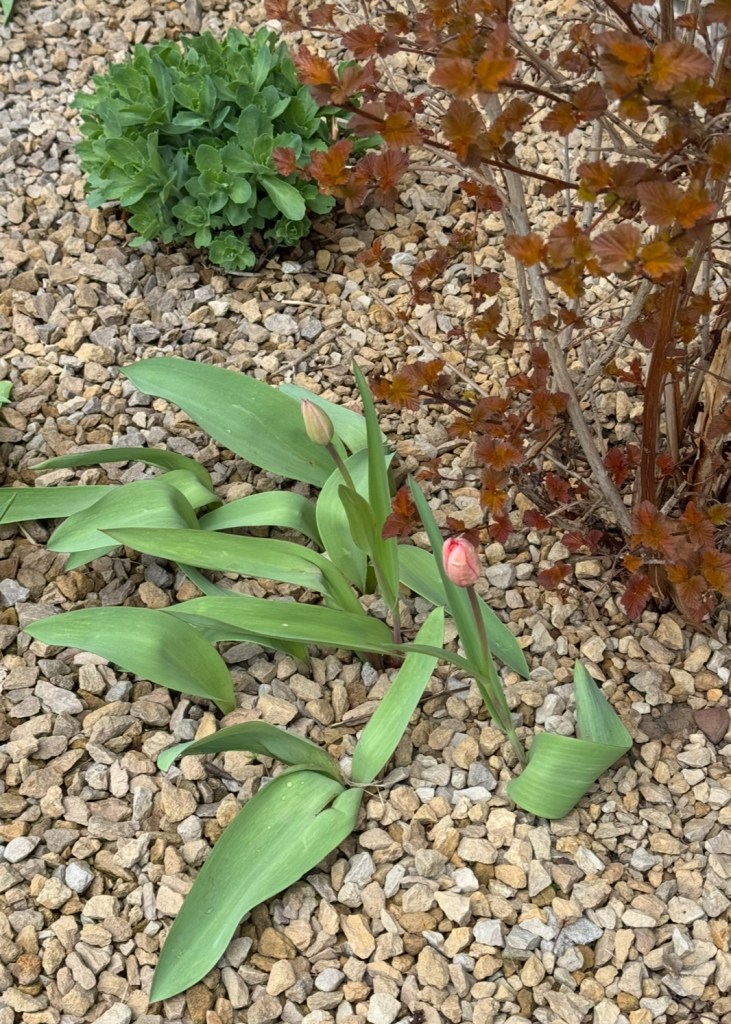
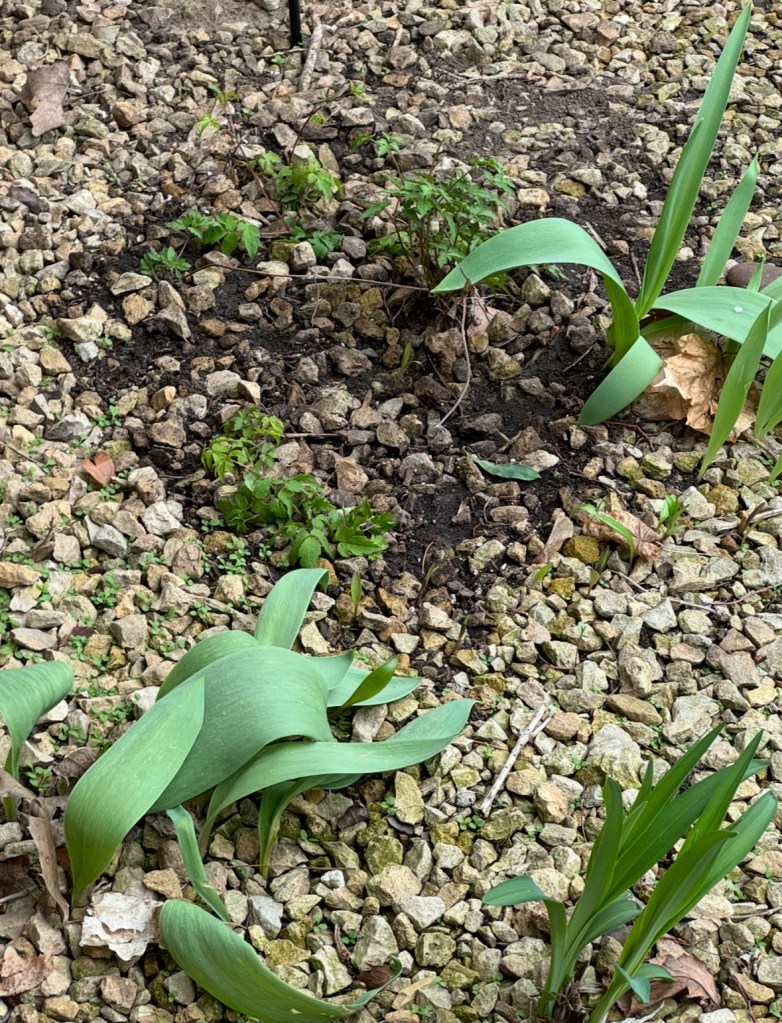
And then there are the tulips. Of all the multiple (lots of) tulip bulbs in the townhome gardens that produce greens, only two have buds.
Yesterday after the greens of a few got stepped on while we cleaned the windows, I tested digging one out. I had kept my hand shovel out after digging and transplanting Blue Bells clematis volunteers.
I thought I might be able to dig the non-blooming tulips and consolidate them to one area (or bring them up north to naturalize or be deer food). Well, I probably should have gotten out the full-sized shovel. Instead of the bulb coming up, the stems broke off first. At which point I thought, “Why are you doing this? Pull the other stems and be done with it for another year.” I would like to say I did that immediately. I did for one more bulb. And then I remembered the next one I went to pull actually bloomed last year. They can fade back. Maybe next year I will feel differently.
To wrap up the afternoon yesterday, while I was in a cleanup mood, I tested to see if the variegated sedum (that it looked like we lost) was really a goner. It pulled out super easy, but wouldn’t you know it, there were little green sprouts. Dang! So, I searched around for a place where I could put it to give it one last chance. Aha! A swaparoo! A two-for. I moved the small Pink Tirza I want to use for crosses again this year to a more accessible spot,
and the variegated sedum went to a more secluded spot to R&R and hopefully come back stronger next year.
With that done, I called it quits. I was kind of still working off a crummy mood from something else. (What is it that makes normally sane drivers turn road risky on rummage sale days? Yikes!) I got myself a sweet tea and sat and looked at how nice the newly relocated Pink Tirza fit into its new home. That was a very good choice 🙂
And then, this morning on my walkabout I noticed … we did not lose the Guacamole hosta, as I feared. It is slowly coming up. The two Elegans, not looking good. Oh well. The circle of life.
Have a great weekend. I may take some time off early next week to put the finishing touches on something I will be kicking off next weekend – the Mahala Felton historical blog series. One post per week will be devoted to getting all the Mahala Felton research I have done out into the public domain. It has been a worthy endeavor, and I really want to share. The tie in is to the historic cemetery. More to come on that.
It is about this time of year that I start to see the daylily seedlings visibly emerge from the soil. The well-established “parent” plants emerge first. But then, inevitably, I will see something that really jazzes me. A couple weeks ago it was the re-emergence of last year’s Hello Yellow. Hello Yellow was our first seedling that progressed from harvested seed to seedling to bloom, and in record time (year 2). Coincidentally, I find it quite fun that our oldest grandson, who knows nothing of my daylily work, has made it quite clear that his favorite color is yellow. Grandmas notice these things.
In the past couple weeks, my most promising seedlings from 2024 (2023 harvested seed from crosses) emerged. They are what I hope will be “Pink Moon”, an intentional cross that yielded 11 seedlings, and it looks like 7 winter survivors. Potential “Pink Moon” is on watch for bloom this year, but daylily propagation from seed is a long game. It may be a few years yet until bloom. I hope we see “Pink Moon” bloom this year, but it may be longer, or never. For reference, I have a South Seas self-seed that is on year 6 with no bloom. I keep saying if it doesn’t bloom “this year”, it’s going up north to feed the deer, but … I just can’t seem to do it. Maybe this fall, but doubtful. I have my 2, 3, and 4 year seedling beds established, and it is nowhere near where the 6-year-old non-blooming South Seas self-seed plant is located. Maybe it will surprise me. Please surprise me 6 year old South Seas self seed daylily.
Now to 2025. This year’s seedling project is what I hope will be “Mahala”. The Mahala Project is named for a history making pioneer woman for this area. Mahala Felton was the first white woman settler in our area. She and her husband William and one of their sons came to our area when there was no hotel, no railroad, not really any way of getting anything substantial across the Mississippi in our area. She was well respected by native and settler alike as she and her husband ran the first “hotel” (which was a converted, multiple purpose trading post). I began my research as what I thought would be a 15–20 hour endeavor to write a facebook post for our local historical society. But there was so much history that kept unfolding. So much that I went on a discovery that kept me happily busy for a great portion of the deep of winter. The more I discovered, the more questions I had. Eventually though, my project management skills turbo-charged and I realized I was having scope creep. I was amazed and impressed with all I had discovered about Mahala Felton, but it was time to stop the research. I had dozens of resource citations, and what will probably be at least a dozen pages of excerpts when I finally write it all up. We shall see. But along the way, I decided to name a daylily seedling “Mahala Felton” and plant it in the historic cemetery garden. Full transparency, I had entertained the daylily dedication idea previously, but now I had more pieces to the puzzle. Funny how things unfold, all in good timing, if you listen to your gut, and your heart.
This past week I took 25 of the 28 harvested (and now proposed as “Mahala”) daylily seeds and planted them to seedling pots. This is a huge (and probably not to be oft repeated) departure from my normal process of putting all of a type of cross’s seeds in one pot and seeing what comes up. I try to keep things simple, but for this one I decided to give conventional practices one more try before I abandon it all together. I have my doubts as to its efficacy, so, just in case, I kept three of the seeds aside and will plant them with my normal process when it is warm enough to do that. With that process I have a seedling box that protects them from bunnies and squirrels and all those types of dangers, a necessity around here, and I will need to employ that with whatever comes up from the 25 as well. I hope at least a few seeds are successful, as I would like to plant one on each side of the gates, as a nod to the hospitality Mahala shared with all. A “welcome” of sorts. And I would like to plant one in the garden down by their marker.
We shall see how it goes. All 28 seeds could decide not to go to seedling. In that case, I have another cross from last year that produced 60 seeds (yes, 60) and maybe that is destined to be named “Mahala”. You never know. You do the crosses and you see what happens. It’s an adventure.
The long wait is now over. Things are popping all over the gardens, and I am starting to see what made it, what didn’t, and what work there is to do.
At the townhome gardens, sadly, it looks like we lost two sedum. How that happened for one of them is a mystery to me. That one was our only variegated sedum, and I will miss it. It had been there for a long time, maybe over 10 years, so I am a bit surprised. I won’t replace it with another sedum, but I may put a daylily there this fall. Potentially a seedling. But first I want to refresh my memory on how strongly the sprinklers hit that area. I don’t think the variegated sedum died from sprinkler damage, but I want to make sure it is a safe place. The other sedum that didn’t come back was under the linden. That one never did well. It just never took off. I won’t put anything in that spot to replace it because the daylilies are also starting to underperform there. There are a lot of linden roots. It is a spot I will leave as “rock only” as things fail.
On the flip side, we have a bumper crop of Bluebells clematis volunteers, and those are in the “work” category. I need to transplant them to another area. This area is not optimal 😂
The volunteers are from our large Bluebells clematis that always performs very well, and I suspect I will continue to have volunteers over the years now that it is well established. Last year I allowed one to grow around the red daylilies, and this past weekend I dug that out and transplanted it into the spot where another clematis volunteer (different type) was way underperforming. Hopefully this volunteer does well. So far so good.
And then there are the missing hostas. There are three in particular that have no sign of anything, and that is a bit concerning. Two I was going to give to my Dad, but the third was one of my long-time faves, and if it doesn’t come back, I will miss it. BUT I have made a decision. If it doesn’t come back, I will convert that real estate to daylily space. That hosta really always amazed me because it should never have done so well there for so many years. That spot really is more of a … daylily sunny spot. But I put it there in my early years of creating our gardens, and it went to town for well over a decade. Probably 15 years. So if that hosta is gone, I will greatly miss it, but it will be replaced by a purchased daylily this fall. (Yes, I have my sites on a few candidates.) Then that entire area will be daylilies, with a few remaining Asian lilies, a few remaining tulips, and a legacy Autumn Joy Sedum. For the other two “missing” hostas, if they do not come back, I will not replace them. The area where they were was getting way overcrowded, hence why they were going to find a new home with my Dad. And, my Dad just had a bunch of trees removed so they may have not done well there anyway.
Which leads me to story time. When I started our gardens at the townhouse many many years ago, I was head over heels in love with hostas. I planted boatloads of different hostas. I visited hosta gardens. I bought “hosta of the year” varieties I liked. I was gifted hostas. My Dad even bought me hostas from a neighborhood gardener he called the “hosta masta” (master, that is 😊). I have grown and divided all kinds of hostas for over two decades. I even tried my hand at harvesting hosta seeds and seeing if I could grow hostas from seed. (Not for me.) I love hostas. And I will keep the hostas I have that are still doing well. But that era was that era, and the garden “container” is the garden “container” (not getting any larger), and I am not getting any younger. So … in a finite space garden … hosta attrition makes way for daylilies, if the space is sunny. (Amazingly, I did have some huge hostas that did very well in relatively sunny spots. Go figure). In this new era, I have my daylily seedling beds, and they are doing well. Those were solidified as the plan last fall. I also have one 6th year non-blooming daylily seedling in a different area, and I just can’t seem to move that one out, but we shan’t dwell on that. I figure at some point when the garden “container” is full, I will know it is time to stop doing daylily crosses, and then I will sit in my patio rocker, with a beverage of choice, and just enjoy. Haha, I can hear family and friends alike laughing uproariously. But that will be a few years yet. Hopefully quite a few. Because goodness! I have 60 “same cross”seeds I still need to get into pots in the seedling planter, and if even half of those go to seedling, oof! Realistically, experience tells me “probably not” and I will most likely end up with optimistically, 10 seedlings from that 60, to be planted in the 2025 seedling bed this fall, and watched for bloom starting next year.
At the historic cemetery, I am gonzo in love with what I see so far – legacy plants are doing so much better in year 3 of the mulch bed. The iris bed is in year 3 now, year 2 for watch to bloom, and I already see multiplication. Daylily seedlings I planted last year from here look great. Daylily purchases I planted last fall are coming up. Even the Blue Mouse Ears hostas made it.
Overall, so far, so very good.
Weeding time at the historic cemetery is down to an hour per week – amazing what the mulch bed tamps down. The only thing I want to work on is the aging creeping thyme. It needs some cleanup, and I may grab some irises from the old garden bed and do some fill in there. Otherwise, one hour per week weeding, watch for the garden to do its thing, and maybe, optimistically, try a few crosses.
Any perennial gardener will tell you that we are an interesting bunch this time of year. We are raring to go, but the weather teaches us patience. I am soooo there these past few months. And compounding that is a not so little journey I have been on to get ready to retire.
So this story goes back a few years. I have known I needed a plan to successfully retire for quite a few years. I have watched various female family members “fail” at retirement, and return to work. I didn’t want to have that scenario, so I started to consider options. I started to look at my bucket list. We had done the camper on land up north. But to do a garden up north we needed a well. That was tbd. Our getaway, but potentially a retirement location to build out. If I could handle not being in a neighborhood. We had also renovated a little house in a mining town off Lake Superior. I could have turned the whole back yard into a garden and spent winters on lots of seed projects. It also had a neighborhood. All of that would have been a success from my viewpoint but my husband was very unhappy. Not with the location, but with the house. After we sold that house, I needed to do more definition of the items on my bucket list. I kind of stalled out there. More like gave up for a while. But eventually I got back into gear and came up with next steps.
I had started to volunteer garden for a local historic cemetery. I knew I could stay very content from the beginning of May to the end of October, gardening between the townhouse and the historic cemetery. I had bumped up against my energy limit last fall while planting all those new daylilies and divisions, but I knew that was a big season finale. With everything planted and the historic cemetery garden switched over from rock to mulch, I knew 2025 and forward were right-sized – enough challenge but not too much either. Where the problem came in was November through April. I simply didn’t have room for big seed projects, and I needed something to do in our long cold winters, preferably with a neighborhood or some type of consistent socialization.
Now admittedly, I am not a spring chicken with unlimited energy, and I also have some health stuff. But our house is pretty clutter free, so it stays pretty easy to clean, and the garage only takes a day in spring and a day in fall to get into maintenance shape. There is just not enough to keep me busy November – April in retirement. But I came up with a plan for that too. I would work toward going back to contracting, and look for 6 month contracts November through April, when I was ready, and see how that went.
Simultaneously, as part of my volunteering, I had a plan to do posts for our local historical society to keep me busy this past winter and to bring more proactive attention to the historic cemetery. Between contracting and writing, I knew I could keep a good level of challenge. And, of course, normal life has normal family and friend activities. All was in hand.
What I did not expect was the level of historical research I got interested in. I wrote a few high level, season appropriate posts and then I started on a deep dive. And that, my friends, was how the Mahala project was born. That project has kept me very busy, through the deep of winter, past a layoff I suspected was coming but may have shortened my runway to retirement, and now almost a month into spring. The research is now done, and I need to start writing. And I need to get what I hope are the “Mahala” seeds to go to seedling and, hopefully bloom. But before I plant those 28 seeds there is a second baby shower to attend for our third grandson, and then Easter. And it would help if I could get the shamrocks outside so I can have that indoor space for seed planting, but it needs to be consistently 40 degrees Fahrenheit at night before that can happen. Oh, bother 😘
I am applying for jobs that really look super interesting, as they come up, but my guess is this is either retirement time, or a winter contract will pop up in due time. We shall see. There is a lot that is out of my hands.
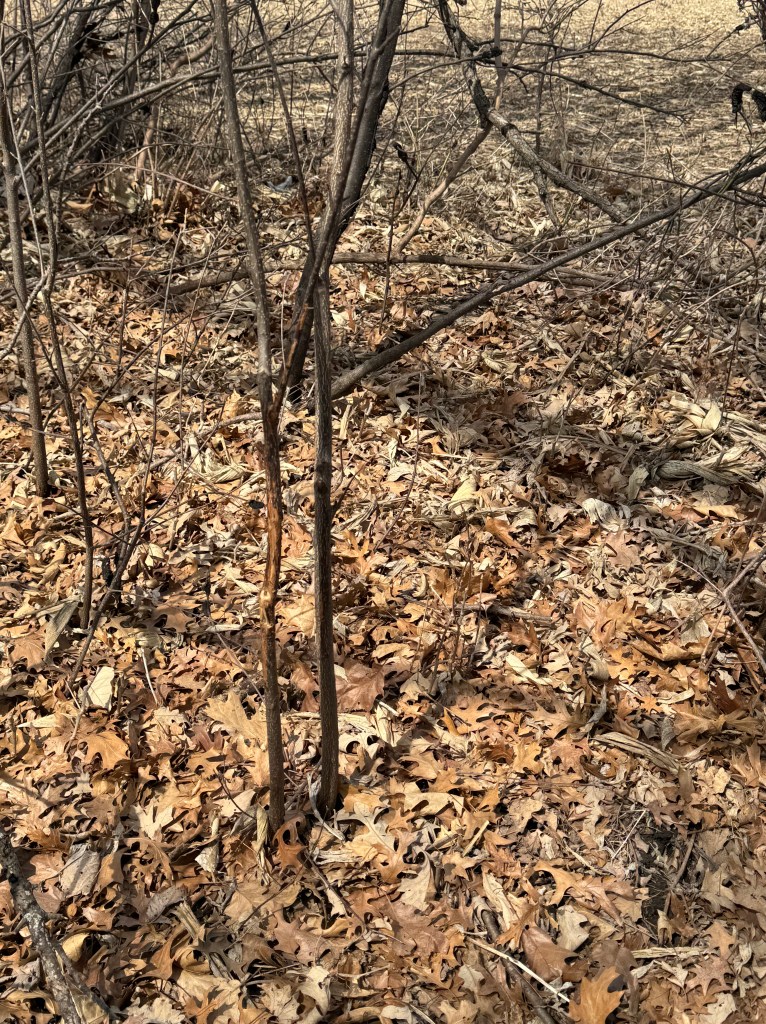
Yesterday was cool. All that got done, garden-wise, was a walk over at the historic cemetery. My husband showed me some new things in the woods – a buck rub,
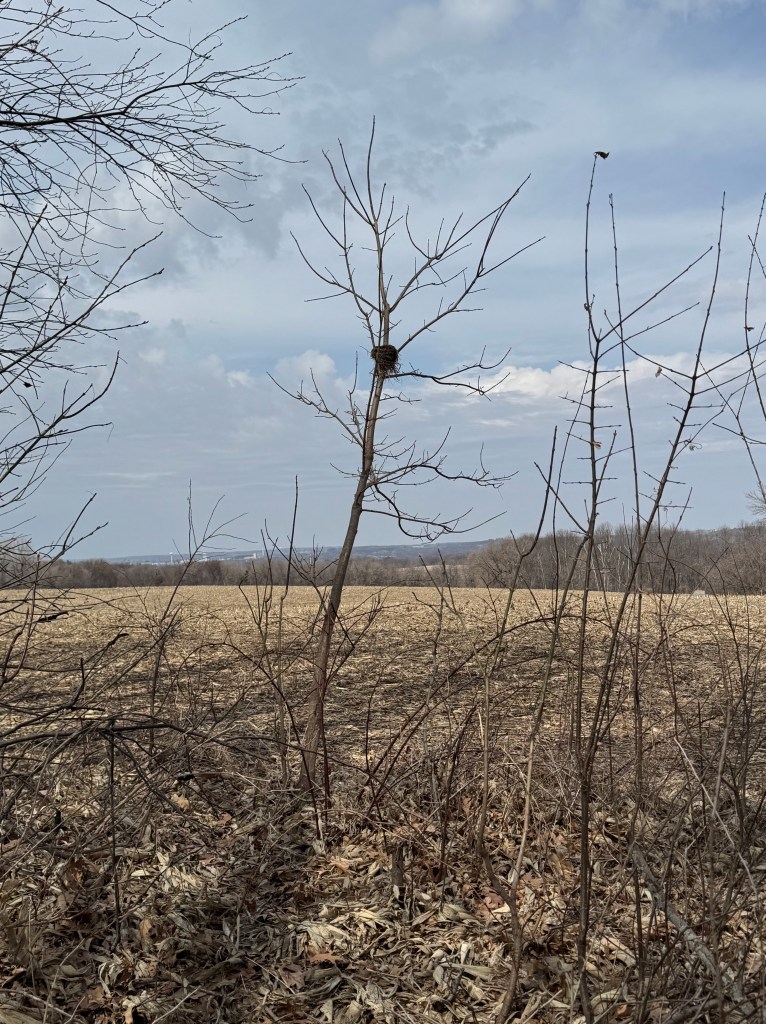
and I noticed a bird has a very nice nest in a tree along the edge of the adjacent corn field.
I also noticed the old garden has turned into a food plot for the deer lol
More to come.
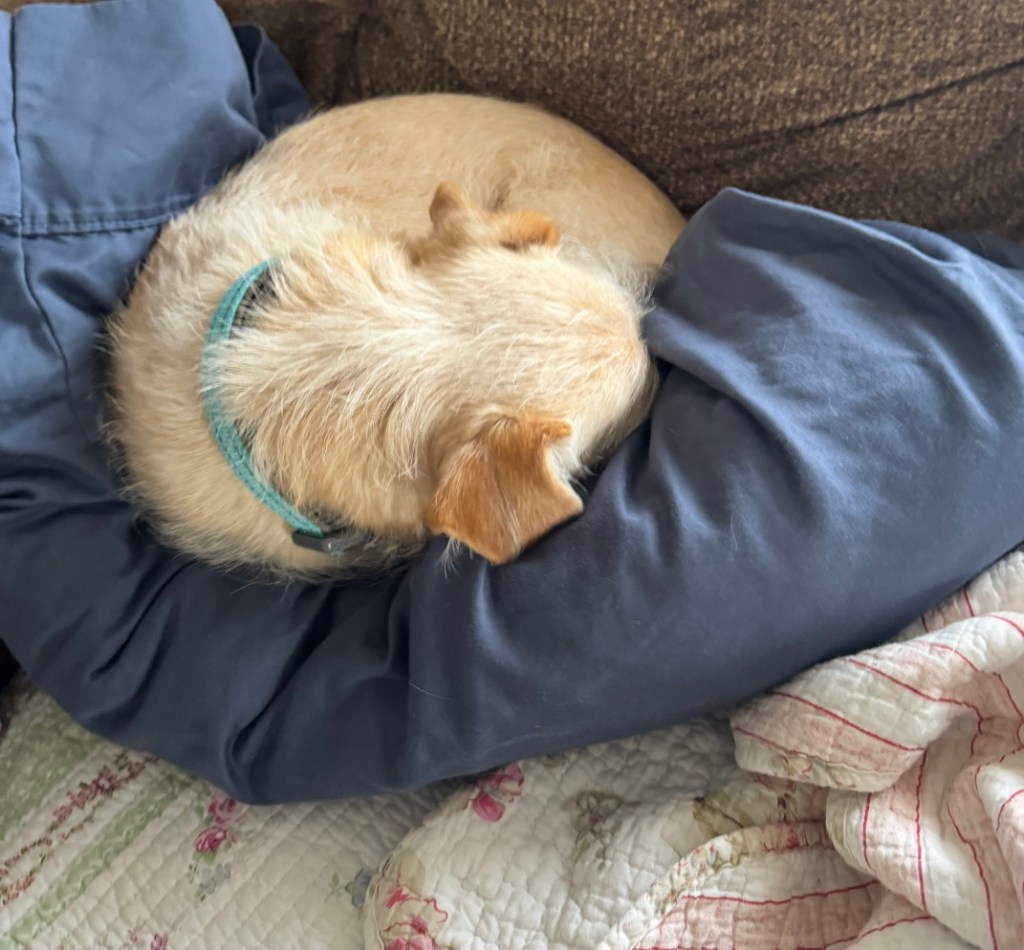
My trusty side kick is here to spur me on. I guess when you are a centenarian in dog years you can nap on a pillow, on blankets, on a recliner 😂
At the historic cemetery, there is a spot where an old shed used to sit. We use that area as our “compost” pile. But truth be told that compost never really does get to be substantially usable compost. The resident deer and turkeys come and poke through it and take what they want. After they are done, there is usually very little left. We have actually been amazed. Within days, it looks like someone came in and scooped that all out. And we definitely know they are still there because not only do we see them from time to time but we also see little clues lol. Turkey scratches, deer hoof prints, and droppings.