
It is about this time of year that I start to see the daylily seedlings visibly emerge from the soil. The well-established “parent” plants emerge first. But then, inevitably, I will see something that really jazzes me. A couple weeks ago it was the re-emergence of last year’s Hello Yellow. Hello Yellow was our first seedling that progressed from harvested seed to seedling to bloom, and in record time (year 2). Coincidentally, I find it quite fun that our oldest grandson, who knows nothing of my daylily work, has made it quite clear that his favorite color is yellow. Grandmas notice these things.
In the past couple weeks, my most promising seedlings from 2024 (2023 harvested seed from crosses) emerged. They are what I hope will be “Pink Moon”, an intentional cross that yielded 11 seedlings, and it looks like 7 winter survivors. Potential “Pink Moon” is on watch for bloom this year, but daylily propagation from seed is a long game. It may be a few years yet until bloom. I hope we see “Pink Moon” bloom this year, but it may be longer, or never. For reference, I have a South Seas self-seed that is on year 6 with no bloom. I keep saying if it doesn’t bloom “this year”, it’s going up north to feed the deer, but … I just can’t seem to do it. Maybe this fall, but doubtful. I have my 2, 3, and 4 year seedling beds established, and it is nowhere near where the 6-year-old non-blooming South Seas self-seed plant is located. Maybe it will surprise me. Please surprise me 6 year old South Seas self seed daylily.
Now to 2025. This year’s seedling project is what I hope will be “Mahala”. The Mahala Project is named for a history making pioneer woman for this area. Mahala Felton was the first white woman settler in our area. She and her husband William and one of their sons came to our area when there was no hotel, no railroad, not really any way of getting anything substantial across the Mississippi in our area. She was well respected by native and settler alike as she and her husband ran the first “hotel” (which was a converted, multiple purpose trading post). I began my research as what I thought would be a 15–20 hour endeavor to write a facebook post for our local historical society. But there was so much history that kept unfolding. So much that I went on a discovery that kept me happily busy for a great portion of the deep of winter. The more I discovered, the more questions I had. Eventually though, my project management skills turbo-charged and I realized I was having scope creep. I was amazed and impressed with all I had discovered about Mahala Felton, but it was time to stop the research. I had dozens of resource citations, and what will probably be at least a dozen pages of excerpts when I finally write it all up. We shall see. But along the way, I decided to name a daylily seedling “Mahala Felton” and plant it in the historic cemetery garden. Full transparency, I had entertained the daylily dedication idea previously, but now I had more pieces to the puzzle. Funny how things unfold, all in good timing, if you listen to your gut, and your heart.
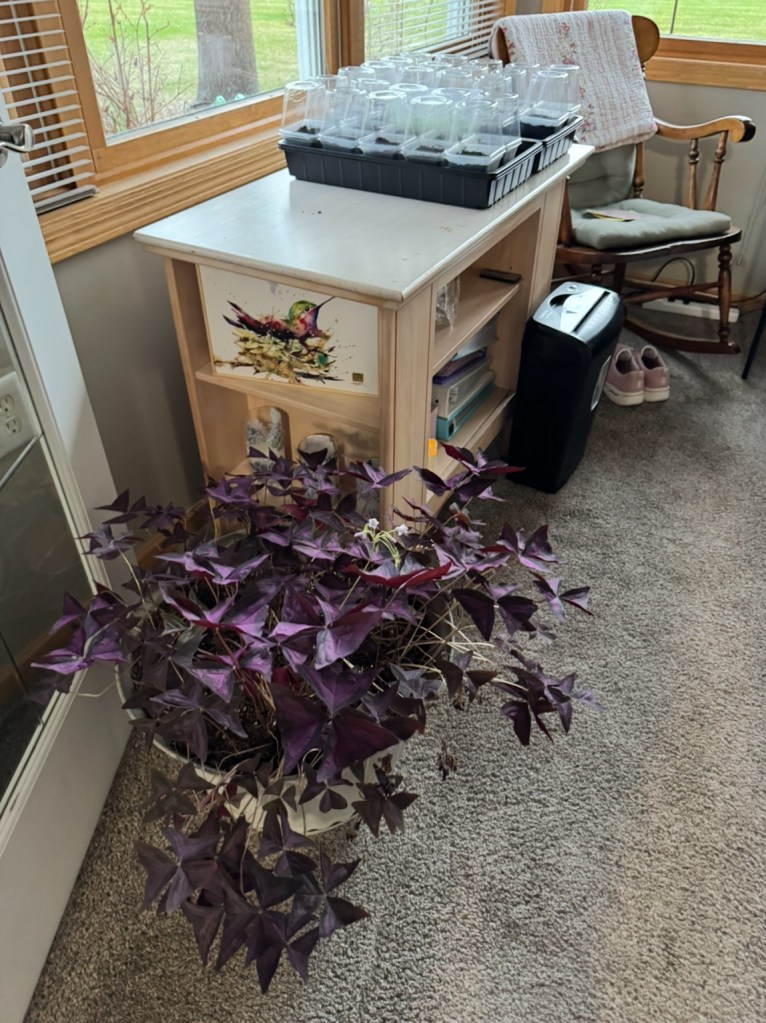
This past week I took 25 of the 28 harvested (and now proposed as “Mahala”) daylily seeds and planted them to seedling pots. This is a huge (and probably not to be oft repeated) departure from my normal process of putting all of a type of cross’s seeds in one pot and seeing what comes up. I try to keep things simple, but for this one I decided to give conventional practices one more try before I abandon it all together. I have my doubts as to its efficacy, so, just in case, I kept three of the seeds aside and will plant them with my normal process when it is warm enough to do that. With that process I have a seedling box that protects them from bunnies and squirrels and all those types of dangers, a necessity around here, and I will need to employ that with whatever comes up from the 25 as well. I hope at least a few seeds are successful, as I would like to plant one on each side of the gates, as a nod to the hospitality Mahala shared with all. A “welcome” of sorts. And I would like to plant one in the garden down by their marker.
We shall see how it goes. All 28 seeds could decide not to go to seedling. In that case, I have another cross from last year that produced 60 seeds (yes, 60) and maybe that is destined to be named “Mahala”. You never know. You do the crosses and you see what happens. It’s an adventure.
 Susan's Daily Garden