All the 2025 crosses are now recorded in the excel spreadsheet, and I am starting to wrap that up for the record. I thought about doing a cool graphic, but that will need to wait until much later. There are garden areas to plant with seedlings.
Yesterday morning I took a fair amount of time to enjoy the day’s blooms. I was tempted to do just a few more crosses, but I stuck with the plan. Eventually I started to make decisions on locations for the remaining 2025 seedlings, and then began day 1 of the tucking in. They will not bloom for at least 2 more years while they establish, and by then I will be dividing their neighbors. The first decision was easy – the second (and final) set of 3 Mahala seedlings that will live in our garden went in today. The rest of the Mahala seedlings will go to the historic cemetery in September. Next week half of the Molly Cowles seedlings will go into their 3 year space. And then the Coral Majority self-seed seedlings, and on it will go. Some seedlings will go up north. Definitely half of the Molly Cowles seedlings. My DIL is giving me landscaping fabric, we have boatloads of boulders to secure it, and we are a go. More on that this fall.
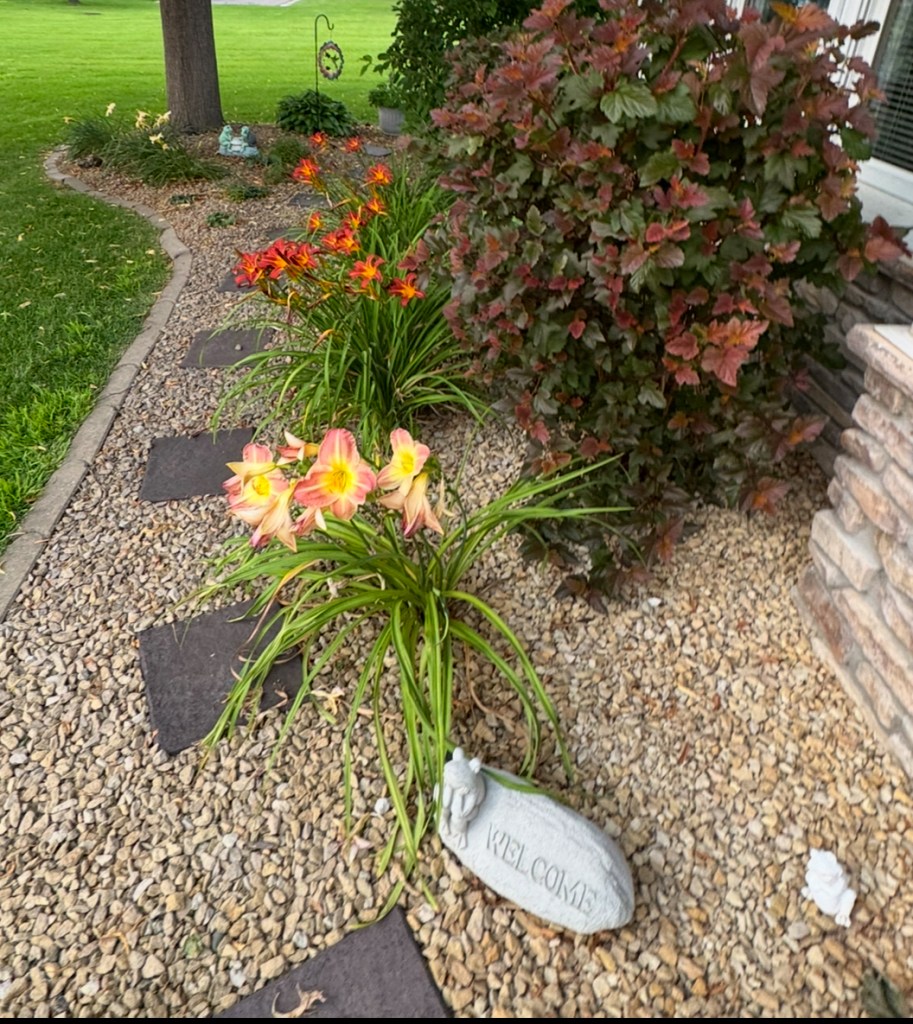
The past six weeks have been so full of daylily color that I got kind of spoiled. Daylily season is like having fresh flowers delivered every single day, and not having to deal with changing the water in vases lol Up front the ninebarks are putting on quite the show, but out back there is increasingly a sea of green staring back at me. I want to solve for that. Short term I think I will bring more purple shamrocks out, but as I am tucking seedlings in, I am planning (hopefully) for more late season soothing color from the crosses in the next few years. I could also propagate more Autumn Joy sedum and plant them around the bend in the path (the bees love them). We shall see.
It is the time of year where I get to start relaxing my mind and start just following the palette of daylily crosses I have put together for the year, crosses put together depending on how and when each daylily bloomed. Yes, it is still a lot of work, but the template has been made, and now I get to spend more time really, deeply enjoying the second half of our daylily season.
Last Friday was our apex. The daylilies were blooming like crazy for days, and there were also spent blooms in various stages, still on the scapes, making pods. It is not my favorite “look”, but it is my craft. I let them do their best work, even if it means blooms that follow get a little compromised. It is actually my cue that the garden is about ready to move into the second half of the season. It is also a very good reminder to me that I am not the only one working on the garden. And nowhere is that more evident than in the self-seed blooms. They are all over the garden, too.
Side note – I need a spreadsheet to keep track of which daylilies are pollen producers only, pods only, and especially when I do a “one up” cross, either as a test or because I could not resist. And remember, not everything that worked last year is working this year, for both pollen and pod, and then there is rain and sprinkler patterns and location and age. It is … a lot. A lot that my very busy mind really enjoys. But there is even a point at which I say enough. This year it was the apex.
So back to self-seed. I cannot resist harvesting self-seed. This year we had quite a few South Seas self-seed seedlings go to bloom for the first time. I started this daylily propagation journey by harvesting self-seed, and South Seas is really good at self-seeding. (It could also be because I use South Seas pollen a lot, and that may cause self-seeding.)
All of the South Seas seedlings for all of the years up to 2023 seed harvest/2024 seedling, bloomed this year. And although I separated the years into separate plantings, I stored all of the South Seas self-seed harvest together, and the next year when they went to seedling, I planted them together, as a group, by year.
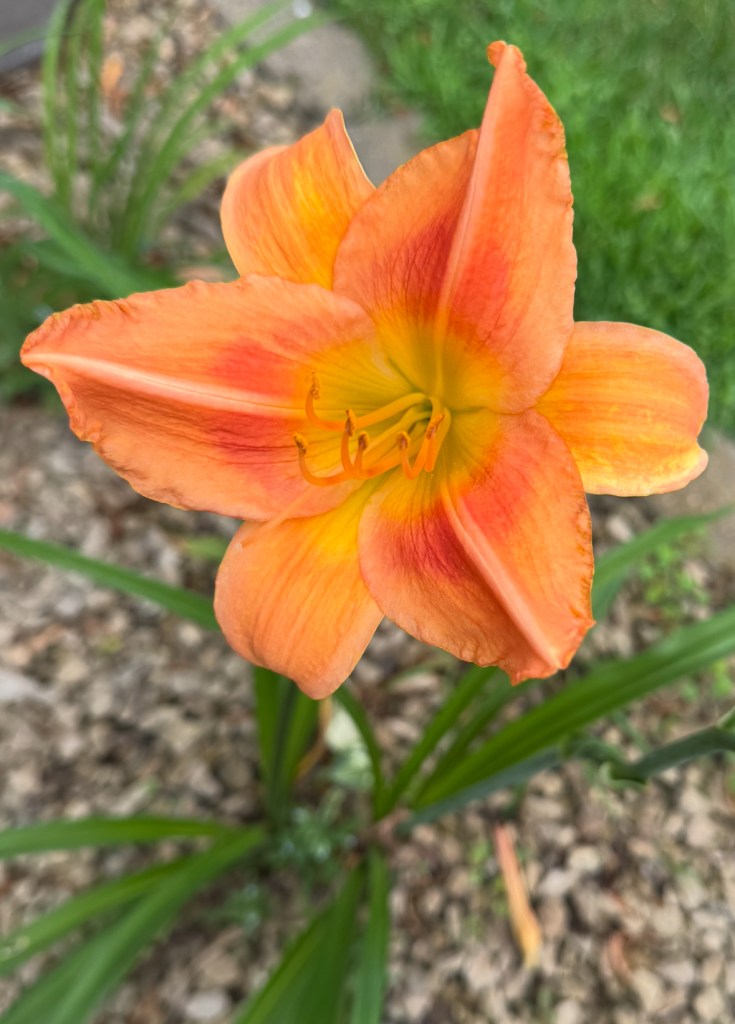
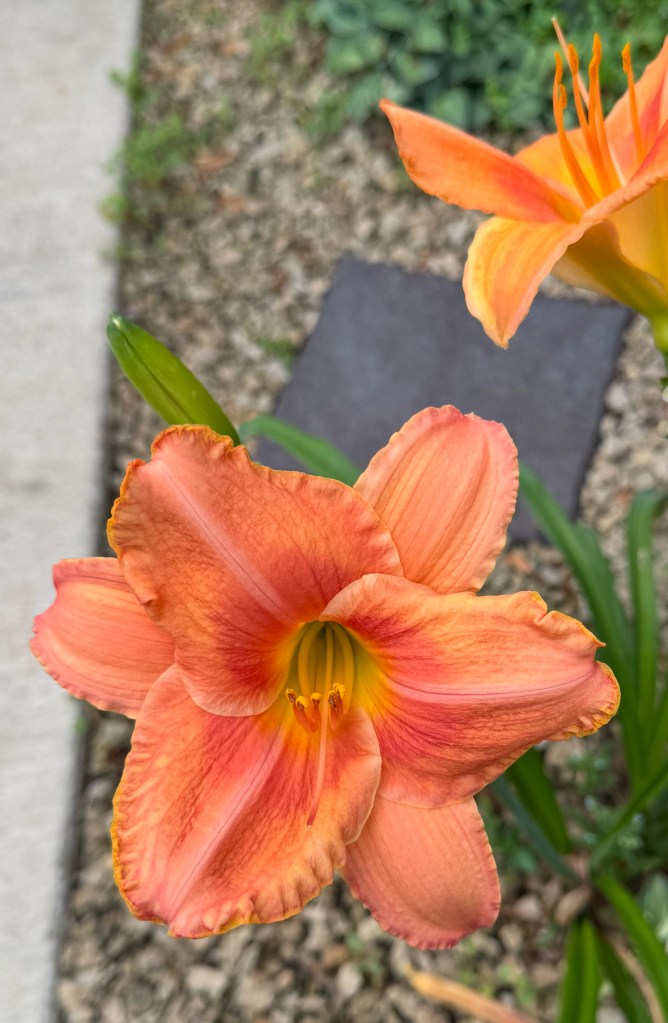
I am starting to see very different “looks” in the different yearly planting groups. The most dramatic has come through Equal Opportunity. Below are two scapes, and two different looks.
I love them both.
After seeing this year’s blooms, I get the feeling there is definitely a message go-forward. First, “Please don’t stop harvesting self seed!” (I won’t) and maybe even, “When harvesting self-seed – save, store, and plant each self-seed pod separately” (yet to be determined).
The other morning as our dog woke me to go outside at 4 am, and I realized the birds were not starting to sing yet, I was reminded we are into mid July. We are on the waning side of the summer solstice. Even though the days are hotter, the amount of sunshine each day is decreasing now. Kind of bummer-ish. And truth be told, were it not for daylily time, I would be tempted to be indoors way more in July. I do not naturally love the heat and humidity we get in July. But I love the gardens, and the daylilies make July sing, so outside I am.
There is so much “garden” going on that I didn’t get my blog from Friday finished, and didn’t do anything blog related on Saturday. Here is a download:
A few of the Molly Cowles crosses that were so easy and successful last year have failed so far this year. I decided to flip the cross, and see what happens. So far so good. But honestly, if that cross isn’t a go this year, I’m good. I have 38 seedlings going from that cross. I can rest on that one.
Hello Yellow is done blooming for a while. And she has two self seed pods going. I am so excited about that! I am still working on figuring out her parentage. I so regret my sloppy note taking early on. I still think my note that she is a cross with Pink Tirzah as one parent could be accurate, but I need to prove that out. Pink Tirzah is still a puzzle to me. Last year she behaved like a diploid, but this year her diploid crosses are failing, so far.
We have another puzzle, too, but this one is easy, I think. To set the stage, I have been reading up on daylily propagation, and one consistent recommendation is “FOCUS, FOCUS, FOCUS”, meaning choose a couple daylilies to cross, and then focus within that parentage to work on the desired characteristics. Sage advice. The reason I needed a third seedling box this year is because of all the “one ups” I did last year. A lot of them produced questionable seed and are not going to seedling yet. Arrggghhhh. So for me, I definitely think South Seas is one of my focus lines. The Mahala Felton daylily seedling cross is in the South Seas line. A lot of my self seed seedlings, and now blooming daylilies, are from South Seas. I even have Coral Majority self seed seedlings cominh up. South Seas is one of Coral Majority’s parents. (Not my cross, I bought Coral Majority.) But with 5 new South Seas self seed seedlings blooming for the first time this year, and successful crosses in that line, am hearing the message that South Seas is my “FOCUS, FOCUS, FOCUS”. I even have a Lullaby Baby I bought last year, a diploid, that is budding out this year, that is, guess what? In South Seas parentage. A diploid, in a tetraploid’s parentage. Apparently, it can happen.
On to the puzzle – I have had 5 South Seas self seed seedlings go to flower in the past couple weeks, and they all look different. They are from different years. But what I thought was solely the 6 year South Seas seedling has 3 very distinctly different blooms, a different look and even height per scape, and I know that the 6 year seedling was one seed. It should be the same genetics. So …. I am guessing the other two, different fans, are from bunny and squirrel assists. Direct sow, so to speak. Different genetics. South Seas almost always has some seed spillage each year where I find there has been critter activity. I think the seed spilled around the 6 year seedling and made the different versions. Something to be aware of, as I had a similar scenario with Just Plum happy last year, but OK with me. I absolutely love all the self seeds that have bloomed from South Seas. So much that I have decided not to cross any pollen TO South Seas, at least this year, to make any seed that comes from South Seas be noted as self seed. Keep my like easy. But I will use South Seas pollen. I already have a successful cross this season to peach daylily with South Seas pollen (one pod, and it looks like others on the way). That will be fun if the seed is viable. And hopefully others like Lullaby Baby will work as well.
I am thinking Pink Tirza is going to be my other focus line, but first I have to figure out how she is going to behave in the garden. ie. Did she really cross with a tetraploid in my garden, and if so, are there others that would work? Hint: I already tried South Seas. No dice. But she did make the start of a pod from Hello Yellow pollen (until I accidentally pulled it), and I typed Hello Yellow out last year as a tetraploid. Yah. It’s a puzzle.
Looking the past few days at the space I have at the townhouse, what we can reasonably use at the historic cemetery, and all the seedlings, I decided I would buy a 3rd seedling box. It is on its way.
And my husband and I agreed – this is the critical mass year. This is the year daylilies need to start going up north.
Now, for newcomers, we have land up in far northern Minnesota USA. Along with black bears, bobcats, coyotes, wolves, foxes, of course deer, and a veritable plethora of small game – rabbits, grouse, some squirrels … oh, and a porcupine who seems to have moved on, thank goodness, and a woodchuck who was moved on. Plus a variety of very cool birds including owls. This earth mama, with all the tenderhearted earth and creature loving kindness just oozing out of me in our first year up there, tried a raised bed hugelculture set of gardens (money I sincerely regret spending). They were a wreck within months and such a loss by year two that we pulled them in year three and set the camper over the top of the beds when we built out our shed to cabin. And that was that. Except that I kept propagating daylilies here.
I am now solidly in year seven of this daylily propagation journey, and things are maturing to bloom all over the place. There is no more room after this year, and, truth be told, I now have 38 Molly Cowles seedlings in one seedling box, 14 Mahala Felton seedlings between two seedling boxes, and more coming up every day. We have reached our limit here, and we have perfectly good land for daylilies up north. So … I have picked out a spot on our land where we have good groundwater. I have been bringing my forced bulbs up north and planting them there for a few years. It’s just that when June comes and we are literally awash in in a sea of 4 foot tall ferns, my husband gets out the brush cutter and mows it all down there. Or we get awash in a sea of wood ticks as we walk around camp and to the outhouse. We have both gotten tick born illnesses. Not cool. So the brush cutter rules. Kind of like mouse poison rules after you spend a few sleepless nights listening to the mice skitch in the camper walls and run across your camper counter. Ugghhh.
What I need to do is get on my real world panties and get over my objection to landscape fabric, and lay a swath of it down up north and tack it to the ground and make holes for each daylily, and put a cloche over the top of each planting until we get it deer fenced, and let the leaves and pine straw and whatever wood chips and mulch I can harvest from sawing and splitting days cover the landscape fabric … and see what happens. Yep. Right here.
That’s it. Hard stop. Or I can stop propagating daylilies – and “that ain’t happenin’”. 😂



 Susan's Daily Garden