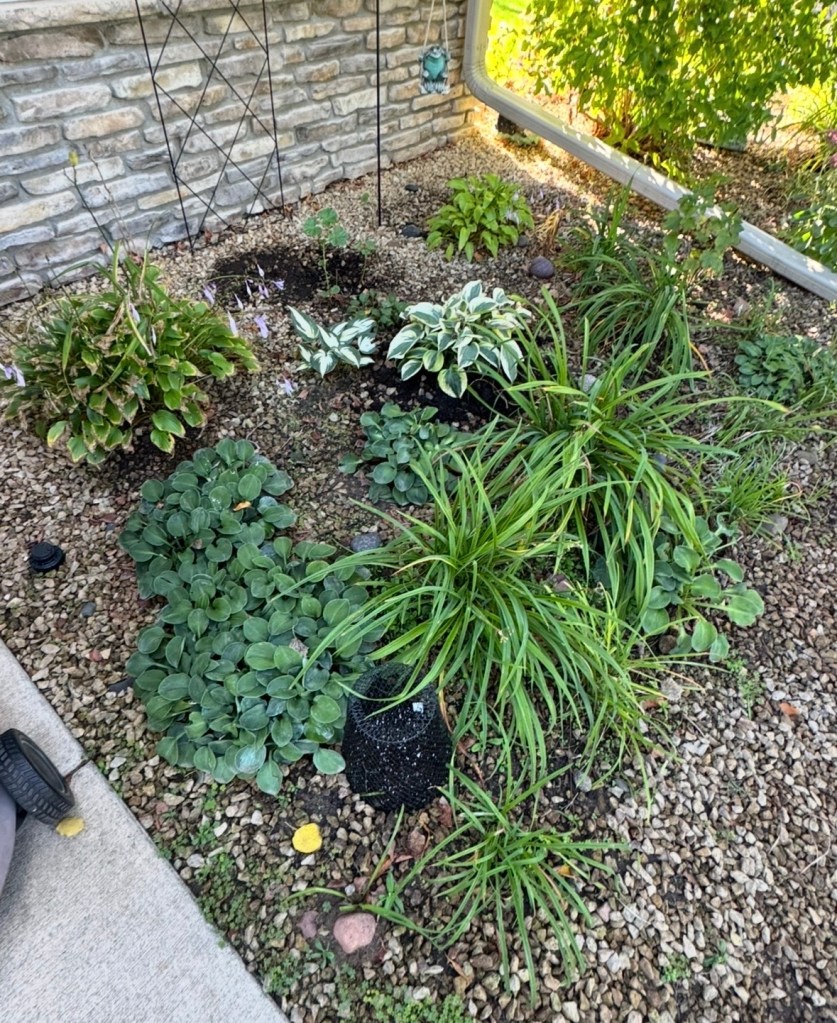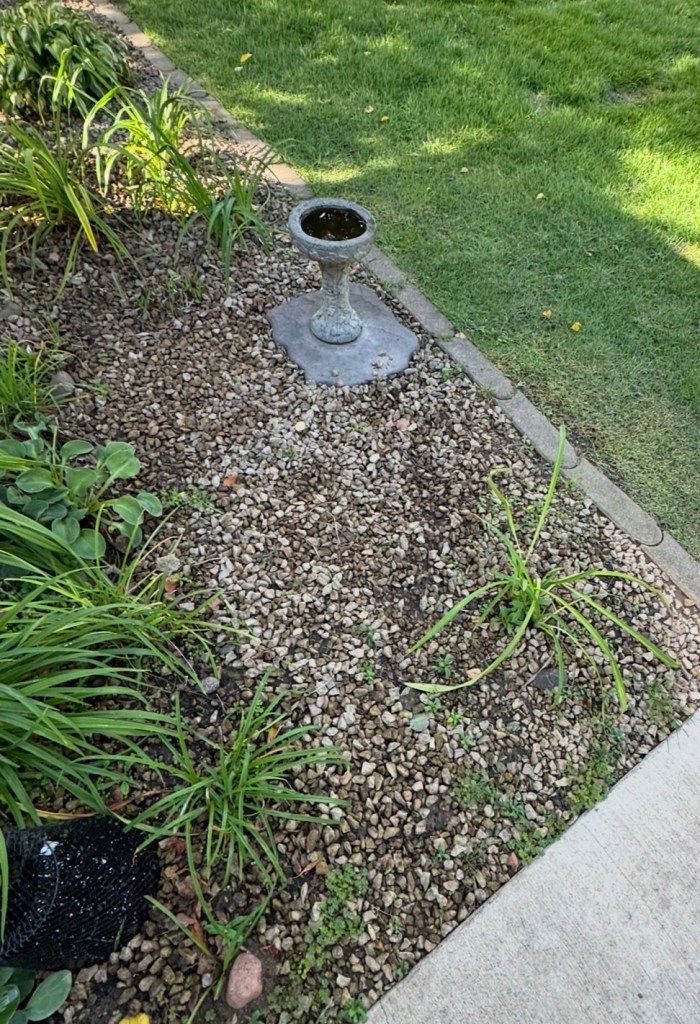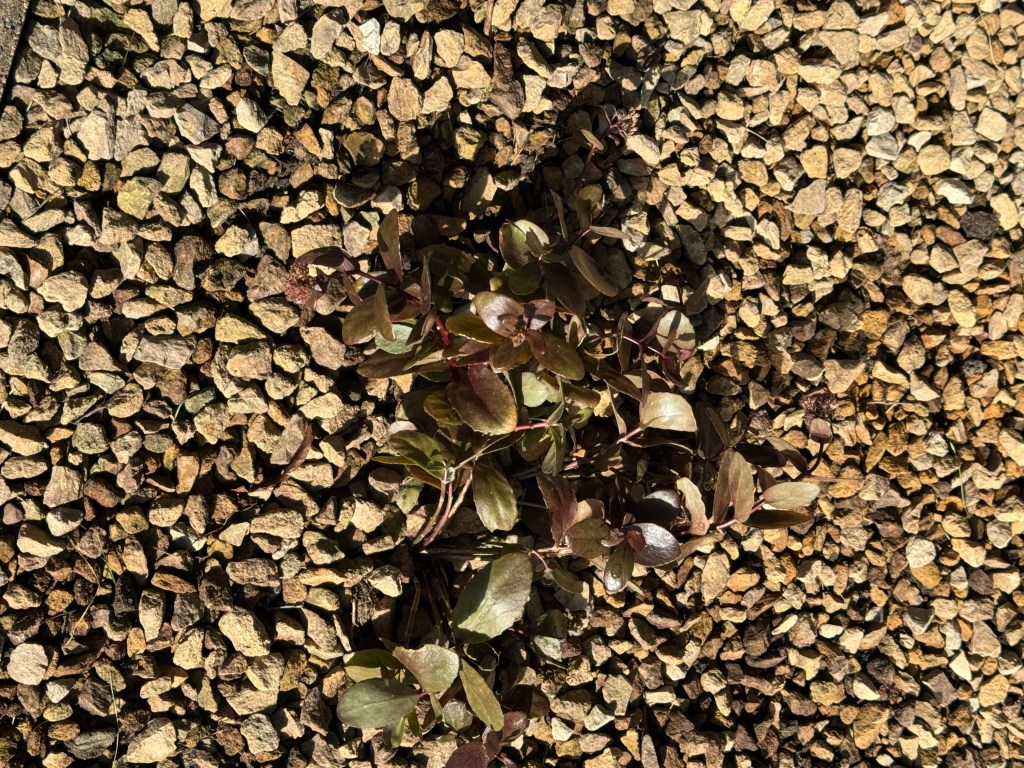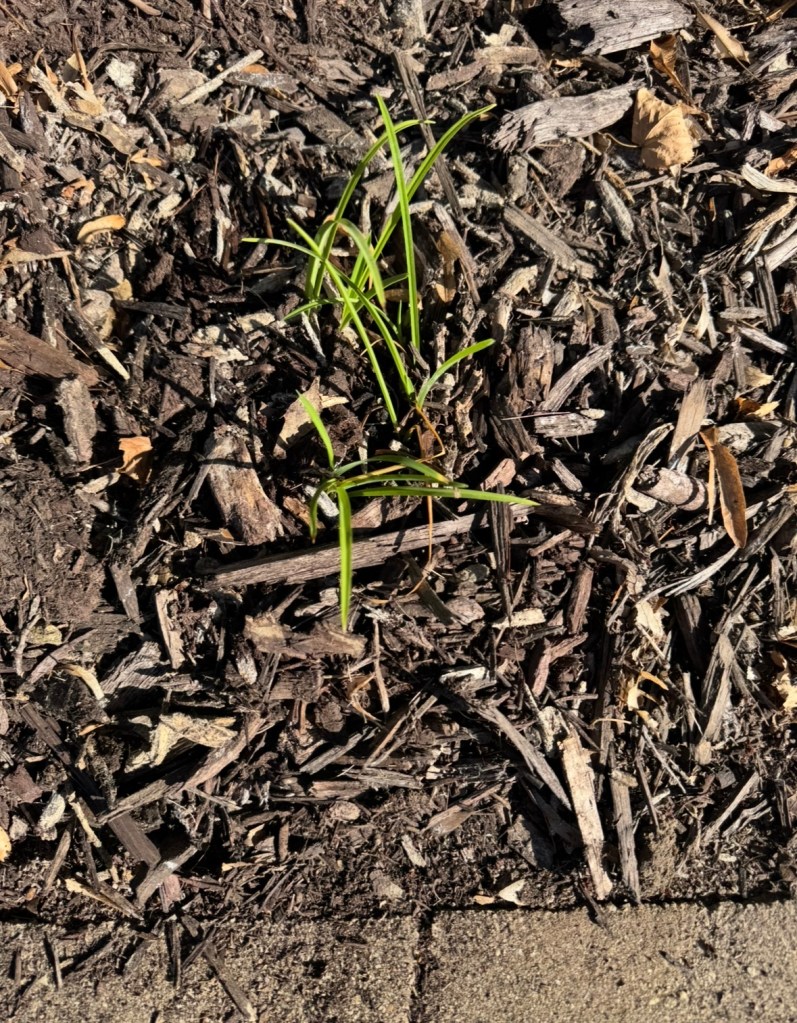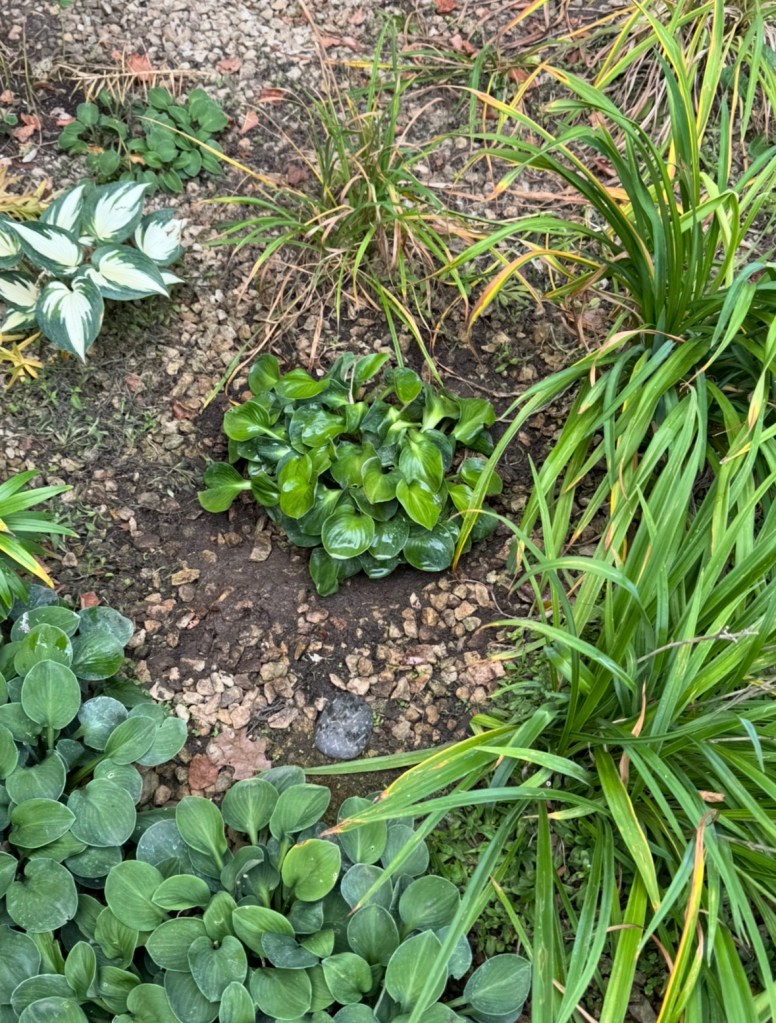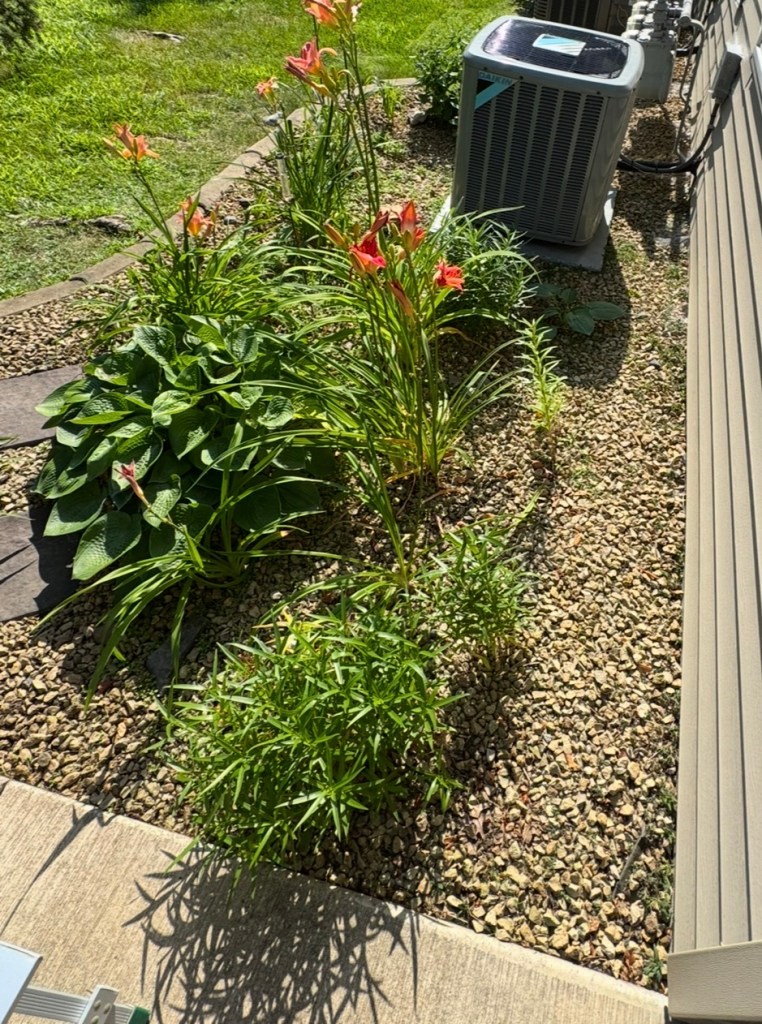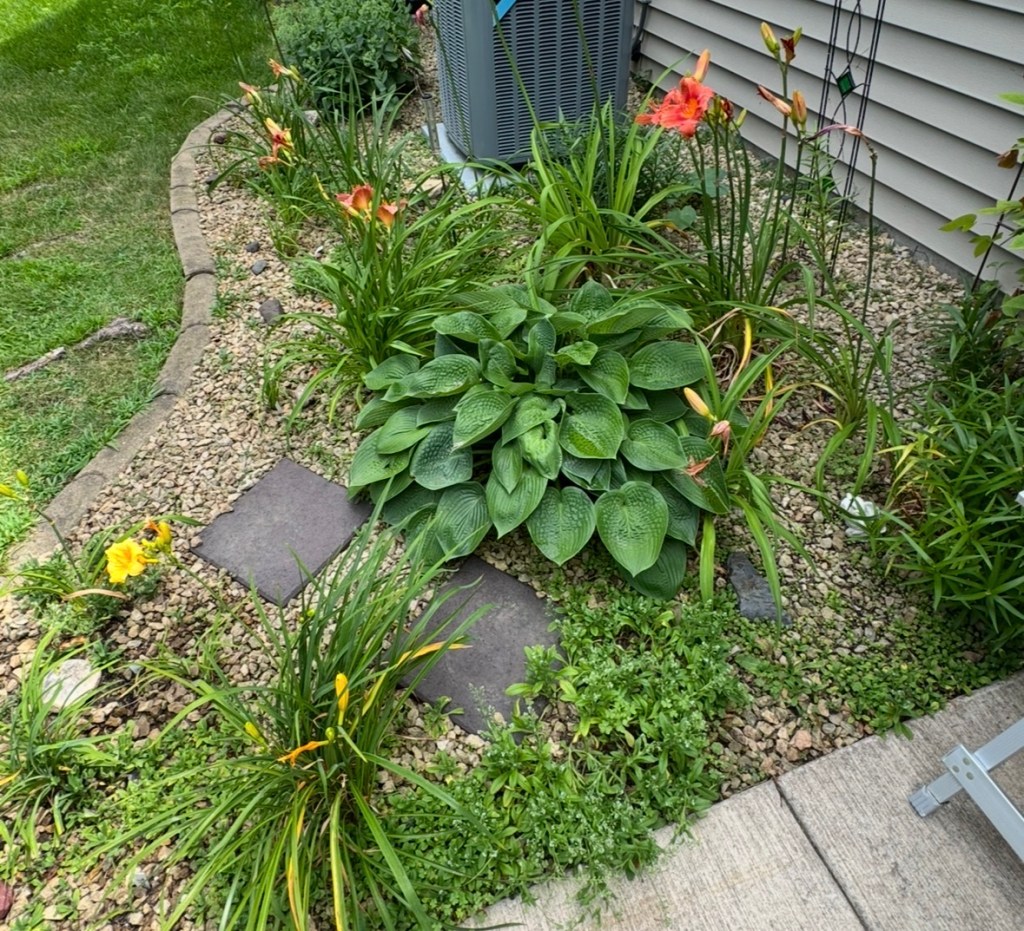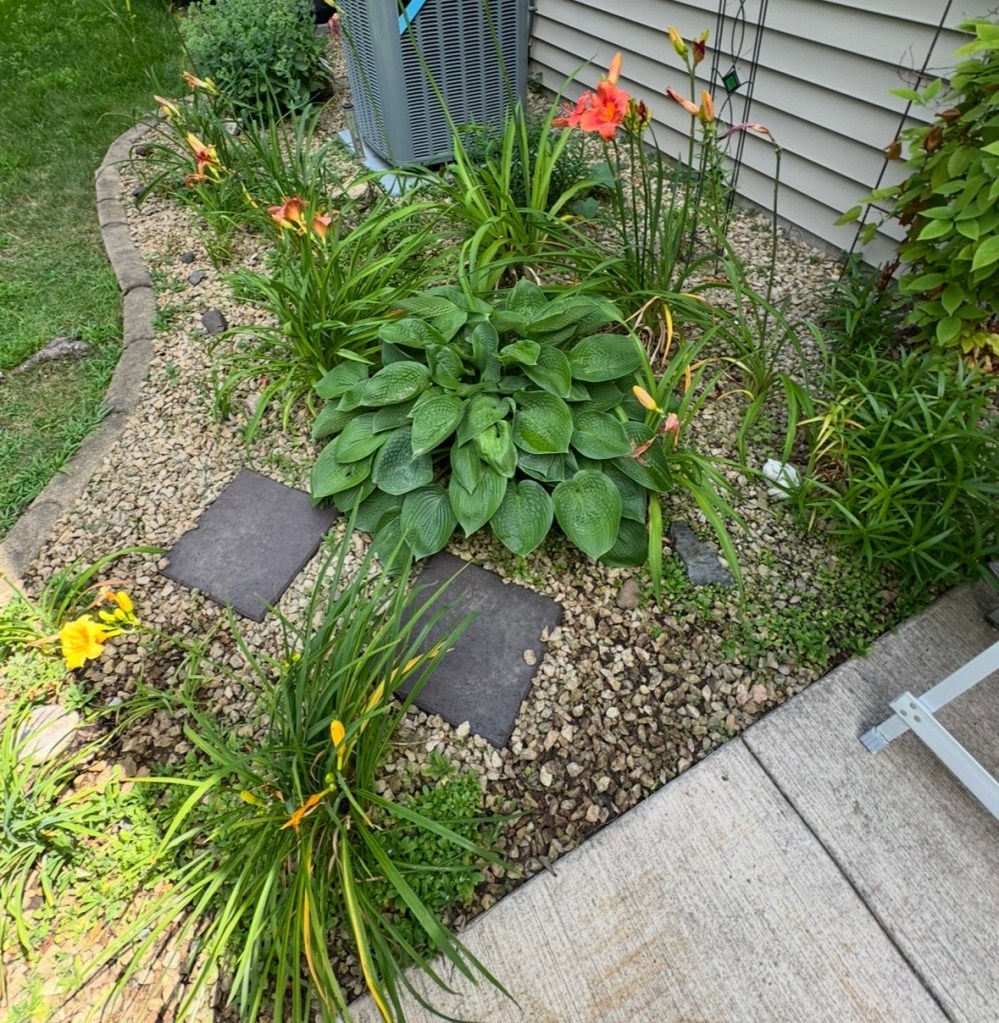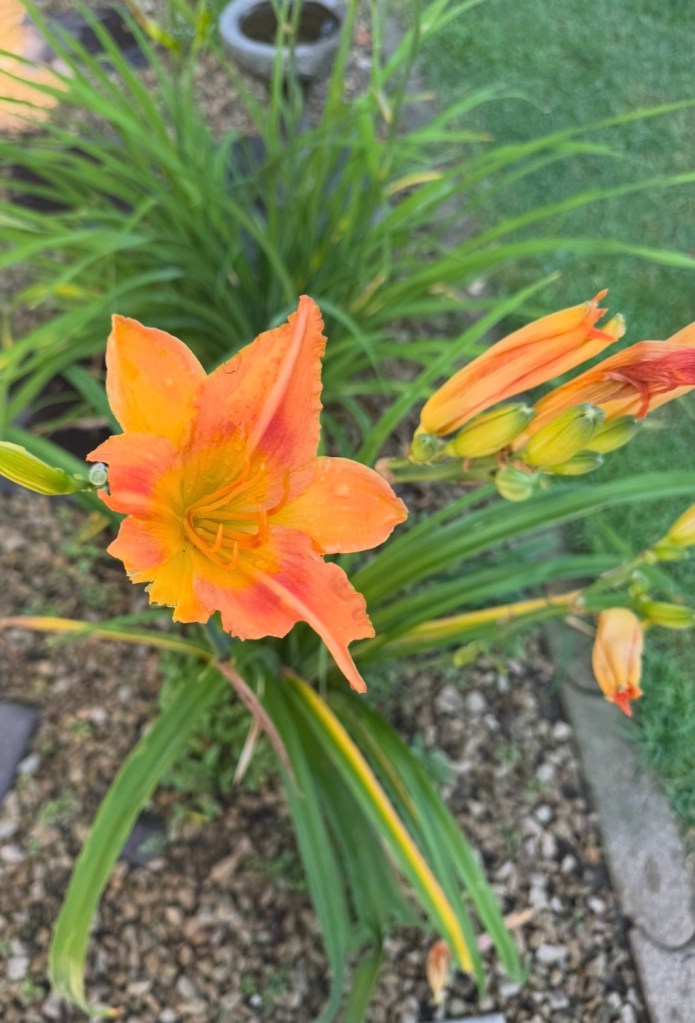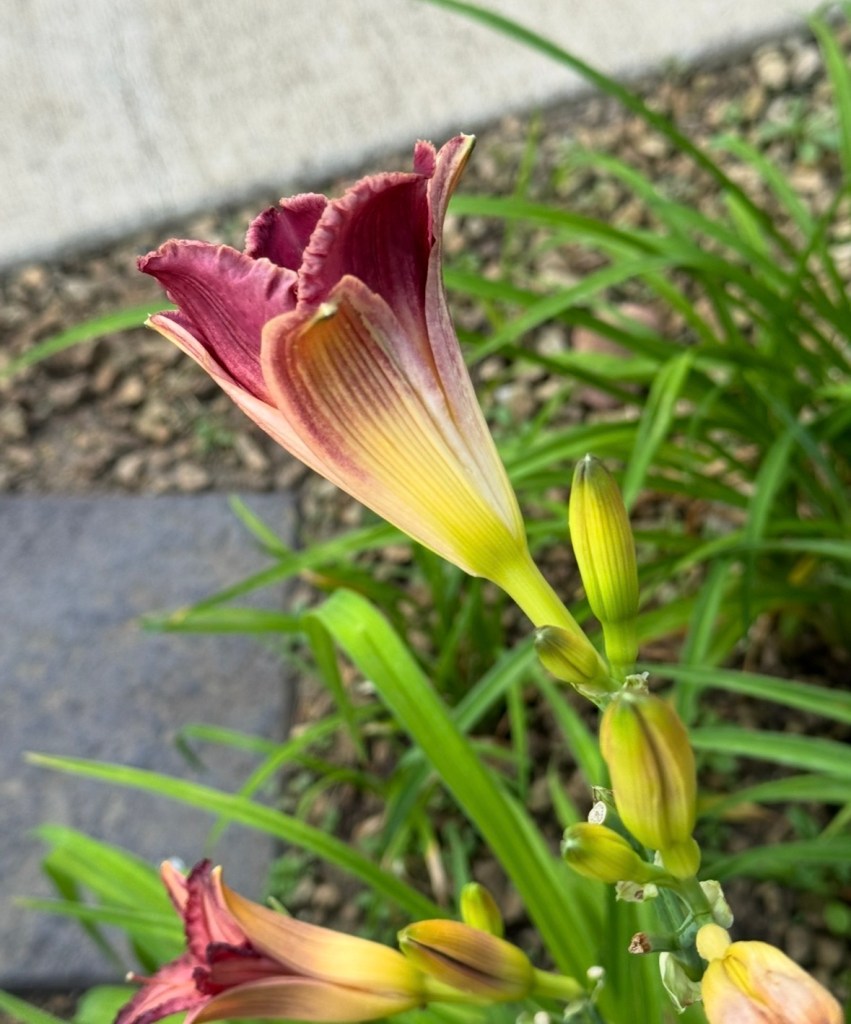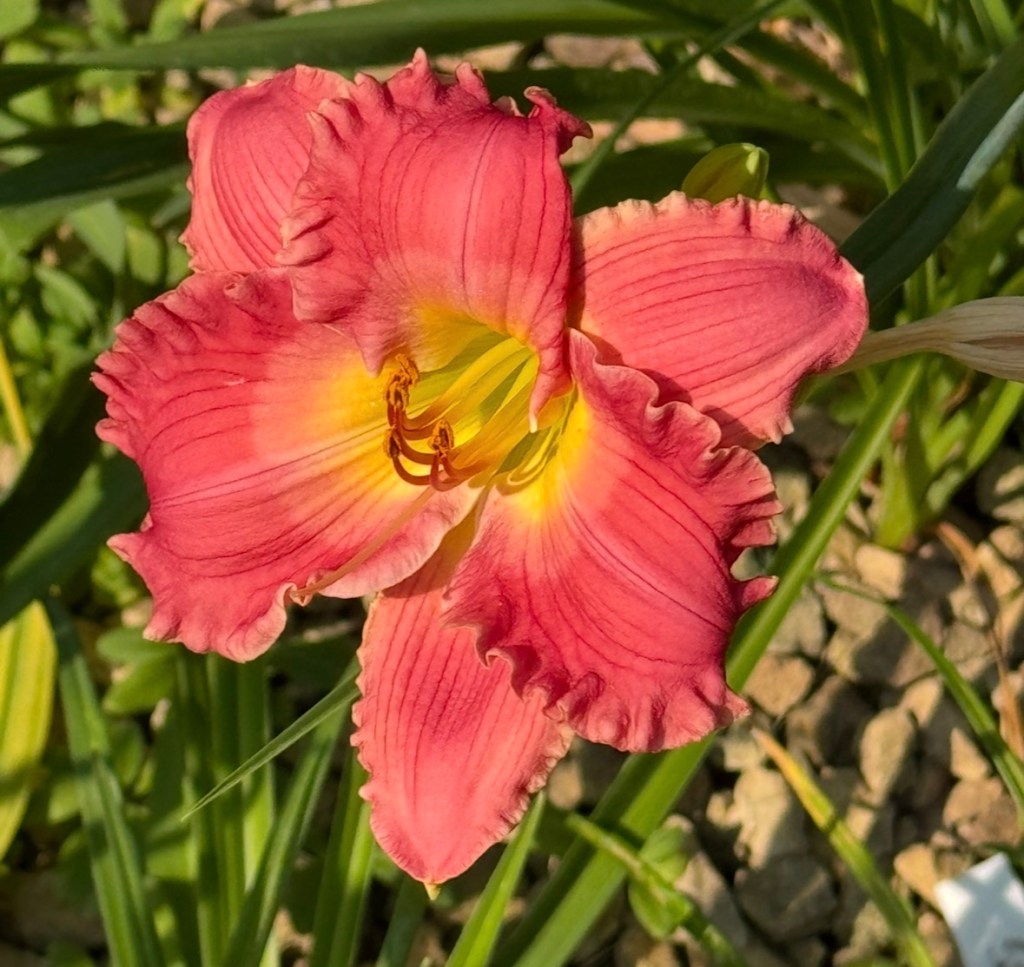
Direct sow daylily seedlings like this are popping up when they refused to germinate in pots – Go figure
Well … I now have all of the daylily seedlings out of the seedling boxes, and most of the daylily seedlings planted. There are some seedlings that are still kind of small, so they are still in pots, under cloches, and awaiting a future planting day. But most of the seedlings are in the ground now. I cannot tell you how glad I am. And how much I got really tired of planting. I learned my threshold. One or two seedling boxes full were fun, even cute. 4 boxes taking up a corner of my relaxation place – reminding me of all the work I still needed to do – no. Just no. Too much.
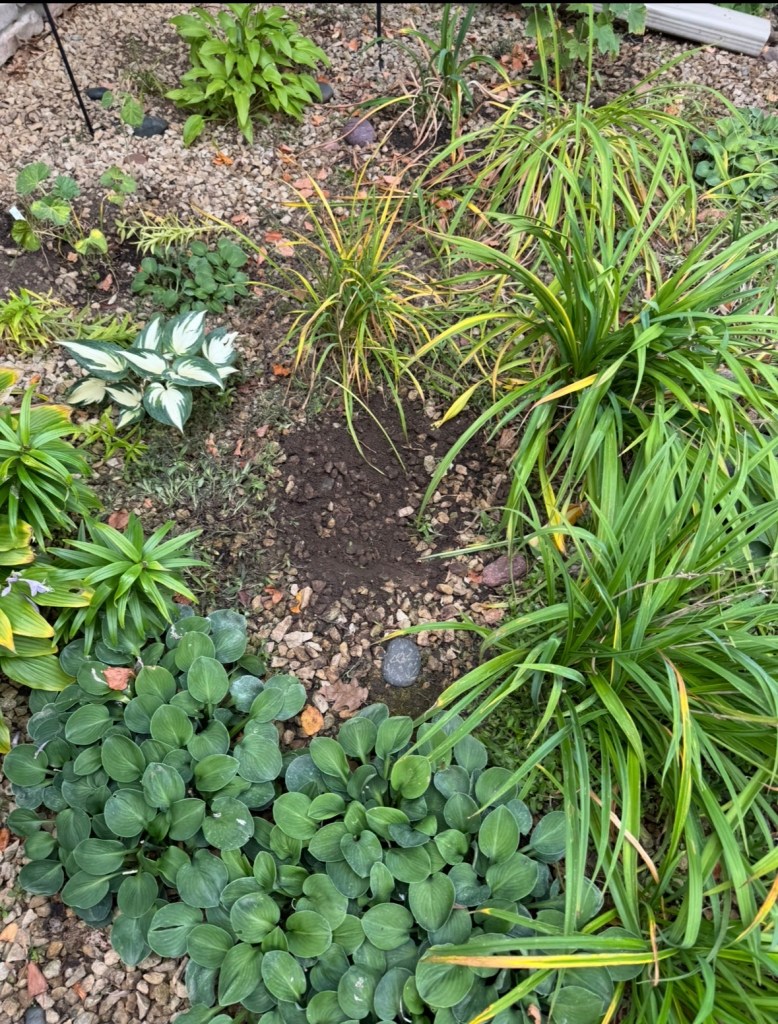
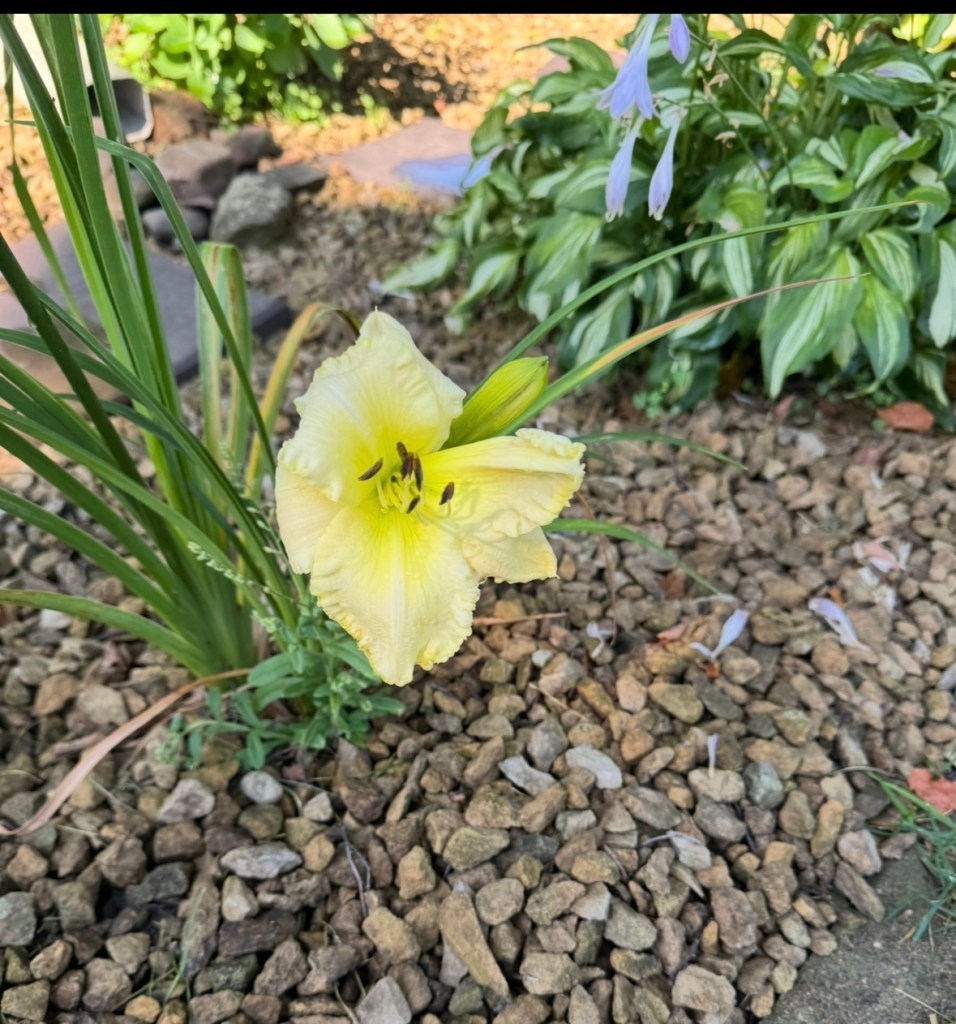
And simultaneously, my most stubborn seeds this year, the ones that didn’t germinate in pots, the ones I tossed into open spots in the garden – seeds and soil and loosely put rocks over the top, not even covering them with cloches – are germinating. Even, it seems, one I would have given very minor odds – a cross with Hello Yellow. That got my attention big time, because Hello Yellow seed has been hard to make, and has never germinated.
So, everything smooshed all together. I started seeing direct sow seedlings popping up, I saw my Hello Yellow seed germinate, I was wrist deep in mucky mud, seedlings flopping over in holes, and I was running out of my 20 cloches to cover up my newly planted batches of new varieties of seedlings.
I seriously, seriously love to garden. I seriously, seriously love daylilies. I seriously, seriously love propagating dayliles, And I am seriously, seriously, seriously thinking about downsizing the whole practice of germinating daylily seedlings in pots. It might be time. 2027 might be the perfect time.
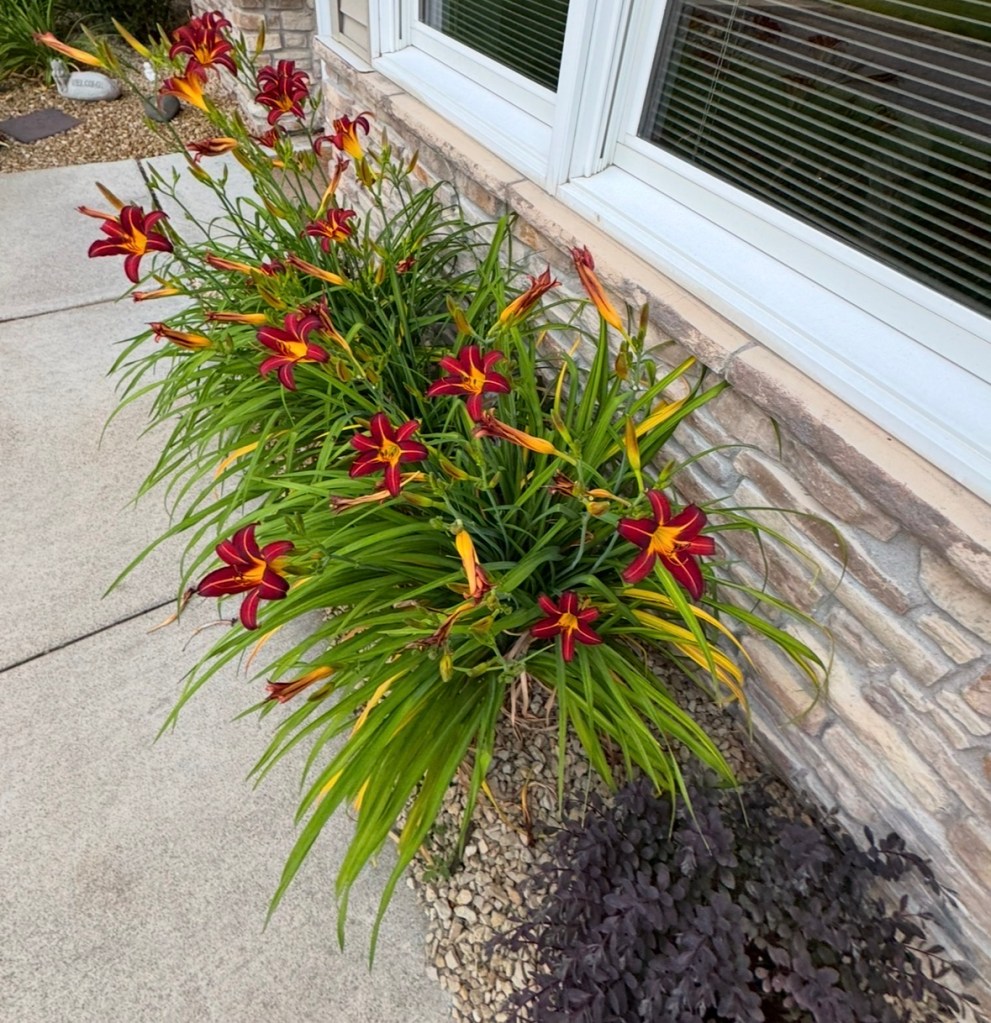
The townhome gardens are full, full, full now. Like really, really full. So full that I am removing the Autumn Reds in back this fall to make room for new crosses that succeed next spring.
I am doing very few new crosses this year – only four new ones, and two of those are a reverse of a success, just for giggles.
I am doing one replication, in case I ever want to register it, and
I am retrying four failures, just in case they would finally work.
Any other daylily seed harvest will be self-seed.
My previous fails at direct sow germination of daylily seeds did not include stratification or planting them with good soil. This year’s successes included those practices. By accident, admittedly, but worth considering. And the new and replication crosses would hit my enjoyment threshold for germinating in pots (5). Anything after that could be direct sow.
So, I am thinking, seriously thinking. Life in daylily planting-ville was a lot this year. My threshold is now very known. Using wisdom π
And what of the extra planters? Well, someone I know and love is trying his hand at growing hot peppers again, and enjoying it, so far. He really likes to cook, and he likes hot sauces. We have some canning jars from when I thought they were adorable and could be made into little candle holders lol (never did). Homemade hot sauce? It could be a project. For him. I don’t eat that stuff. No siree. And maybe just one planter full of peppers to start π
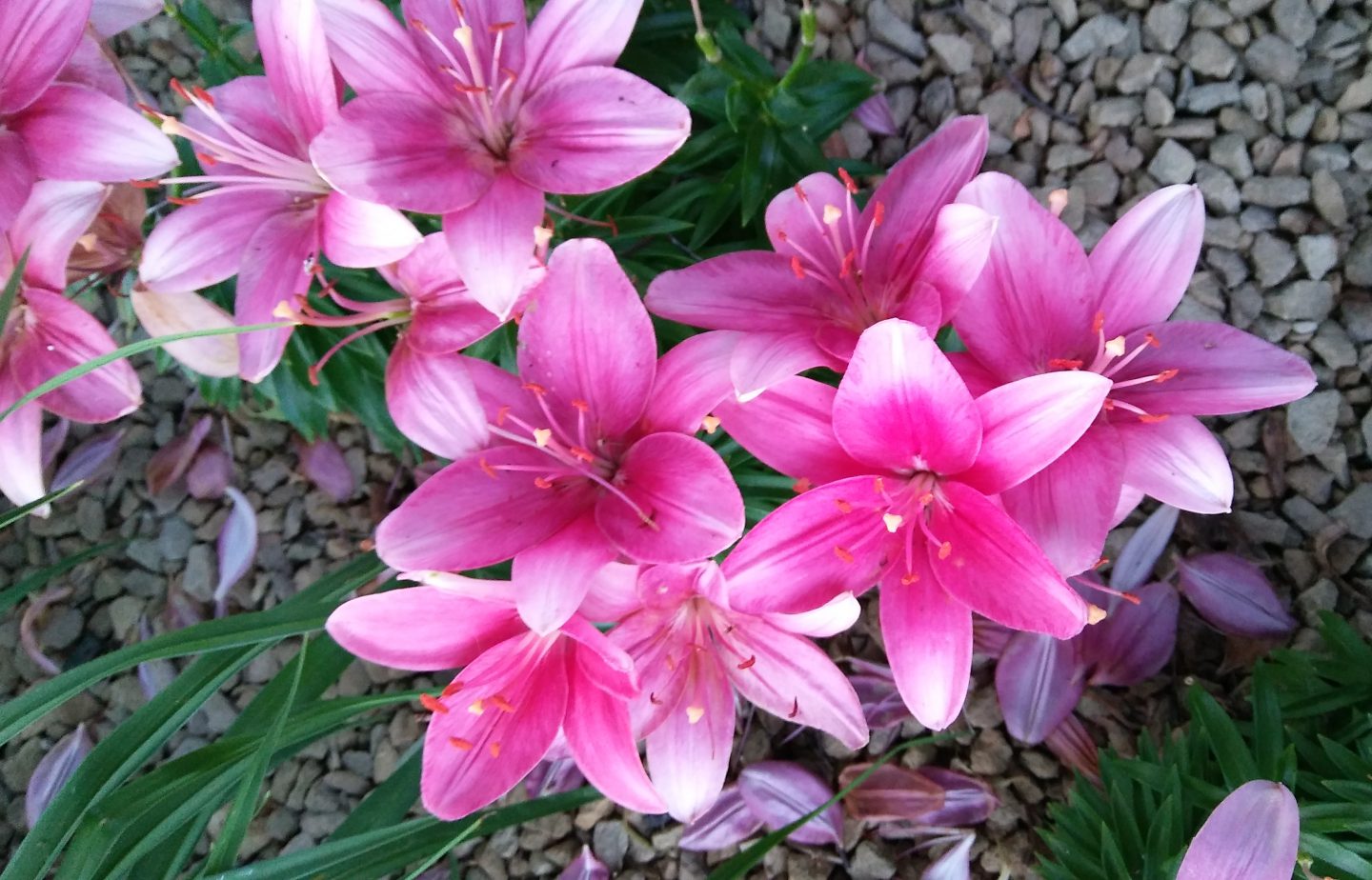
As we move into official summer, the look of the gardens is starting to change. The Weigelia has shed its blooms, save a bit of remaining color, and the Asian lilies are now in full swing.
We will have a couple more weeks of Asian lily bloom and then daylily season will be upon us.
But before we get there, last year’s daylily blooms that made seed and went to seedling are starting to join our gardens. A lot of seedlings. They are getting tucked in between existing daylilies until they reach the bloom (daylily) status.
For a while I was wondering how much we would really end up with for seedlings. This year’s seedlings took longer to germinate than I am used to here. But in the end, the germination ratios proved to be consistent with previous years. This year’s success ratio by new cross/variety is now at 82%. The success ratio for self-seed germination by variety (which I track separately) is at 71%. And then both replications of previous year’s crosses were successful, so 100%. All that work over the past year has come to a blessing. Of course, bloom is years out, but they are on the way.
Now on to the 2026 daylily season. Most of the established daylilies are starting to get scapes. It looks like we will have a colorful July and August. And it looks like I will have pod and pollen parents for the few crosses I plan to do this year. Much less than last year. As always, I will also allow self-seed. But mostly I will enjoy the blooms. Maybe even a few new varieties of blooms from 3+ year seedlings.
Speaking of self-seed, I had a Just Plum Happy self-seed germinate yesterday morning, the first time ever for that long time daylily in our gardens. That was such a pleasant surprise. Hopefully it will survive and eventually go to bloom.
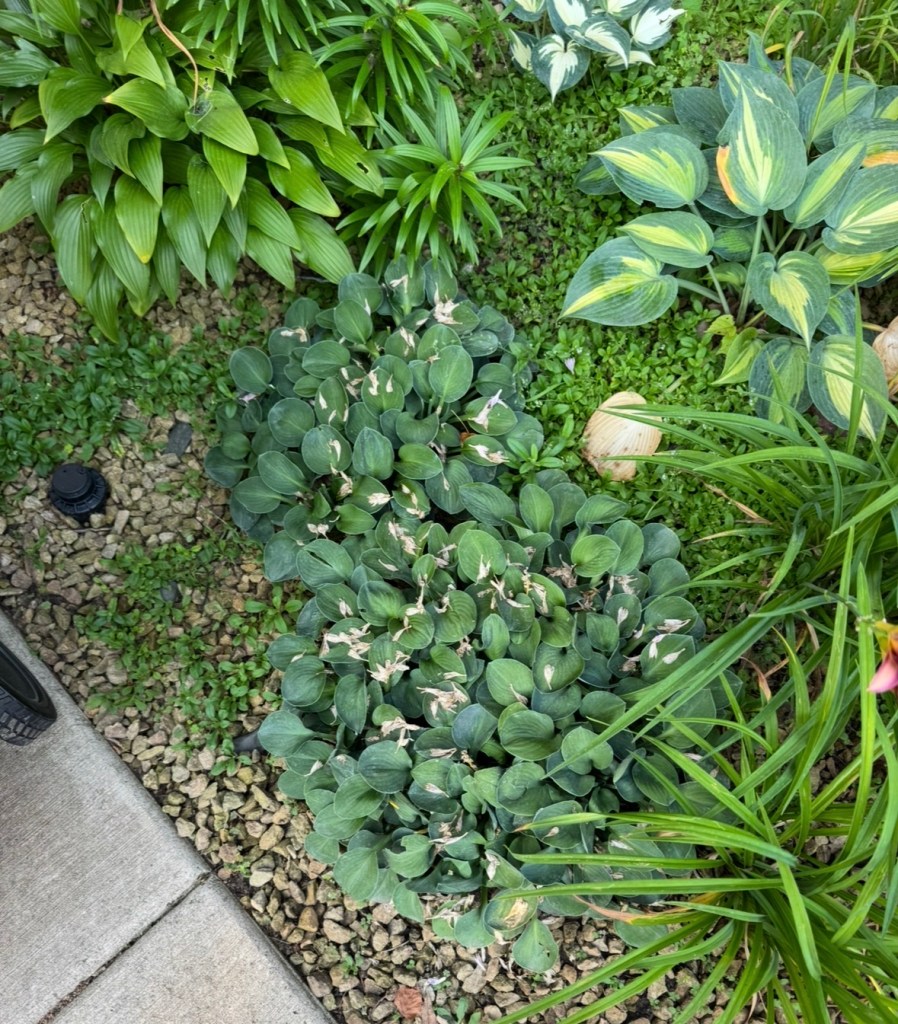
As for the hostas, they are also scaping out now, both here in the townhome gardens and at the historic cemetery. The hosta below and the Blue Mouse Ears are already starting to show the start of color.
While I do not propagate hostas, I do divide and transplant them when needed. And here comes story time π
A few years ago I began to move some of the Blue Mouse Ears hostas out of the sun (in what is now “Sandy’s Corner”) and into the shade along the path by the Linden. I also planted some Blue Mouse Ears divisions at the historic cemetery. The divisions did very well in both locations.
This year I need to do more division of the Blue Mouse Ears hostas. I am considering planting those divisions under the Linden where we lost so many hostas last spring. The look will be much different than the large hostas we lost last spring, but I actually think they will be an improvement. Regarding aesthetics, they are very compact, and bloom beautifully for weeks. Regarding maintenance they are a dream. In the fall if I wait until the leaves turn deep yellow, the leaves pull right off.
On to more story time.
At the historic cemetery:
The Asclepias (milkweed) are blooming. Full disclosure, they are not my favorite. I know, gasp, even blasphemous! What kind human, much less a pollinator loving gardener would not want to help out the Monarchs. Well … They get very tall and then start to fall over in a not so wonderful way, and, even though the main reason to have Asclepias is to provide a home for Monarchs to propagate, I have never seen eggs, let alone chrysalis on the Asclepias there. But they are a popular plant amongst the walkers and visitors, and they garner a fair amount of support, so they stay – in moderation. (They are invasive, so I do pull judiciously.)
The Stella De Oros are looking very healthy again this year, and their 2025 self-seed has germinated 20 seedlings so far this spring. Those will eventually get planted right back at the historic cemetery gardens. I was doubtful the seeds would do anything, but now that I see those beautiful seedlings popping up, I am hopeful to see those blooms in the years to come.
The Yarrow is hitting full bloom, and that brings me to the topic of the uniqueness of public gardens, and how the historic cemetery gardens continue to surprise me.
For the Yarrow in the historic cemetery gardens, I am seeing some fairly decent stands of a new color (pink) this year. Wild, white yarrow, which we have at the historic cemetery, blooms true from seed, which I have direct-sown, and it readily spreads as well. Meaning, the Yarrow we have had would not produce pastel pink blooms. I am wondering if we had some pink Yarrow plops (anonymous gifts that got planted).
I used to be a bit thrown by plops, but now they bring a smile. You see, the historic cemetery is a public place, and the fence garden is a public garden. And it is becoming quite loved π Yes, there are some things like wrapper and beverage tops that show up, but, at the same time, it is my absolute pleasure every time I am there to hear thanks over and over again for the transformation from 4 years ago.
I also know the community contributes as they walk by. We definitely have some consistent phantom weeders π I have witnessed their work as I arrived, talked with them, and in turn thanked them for all they are doing.
All of that makes my heart incredibly happy.
That being said, back to plops, if a plop fails, I have no problem pulling it and putting it in compost, and if a plop gets invasive it also goes out.
But the vast majority of plops become a loved part of that very public garden, for all to enjoy. In fact, we have a couple daylily plops that went to self-seed last year, which I harvested, and planted to germinate this spring. The seed did germinate, and when those seedlings get big enough to be easily recognizable as daylilies, so they do not get accidentally weeded, they will go right back into the historic cemetery gardens. In addition, one of those daylily plops already has a plethora of scapes again this year, so we all will be treated to its beautiful blooms again soon.
And finally, the plant below (tall stems coming from very green leaves) at the historic cemetery was either a plop or a bird drop. I think it is a Figwort.
Full disclosure, I do not love it. But a few other people do. One sweet walker even carried a bottle of water every afternoon to sustain it when it looked droopy a couple years ago after I moved it.
What do you all think of it?
For now, it stays, but it may go into a new area this fall where the look will be more toward wildflower. Probably right along with the Stella De Oro it is overtaking π
I believe that is it for this What’s Up Wednesday.
We are now coming into the latter part of the daylily seed germination watch and moving into the bloom season for the Asian lilies.
Two seedling planters remain.
As I sat on the patio this weekend, relaxing in my rocker after reducing seed plantings, I looked over at the two seedling planters and realized that is what I want next year. Enough capacity to be creative, but also a nice limit. 32 of the silicone base medium seedling pots I love to work with fit perfectly in the grey box, and 4-5 medium plant pots fit in the cedar box.
I am thankful for the expanded daylily propagation experience last year. Doing all the crosses in 2025 was a boatload of fun, something I had to try. And I am grateful for the result of that harvest as well. I still have a few stragglers so there may be additions, but I currently have 15 new daylily seedling varieties from last year’s work. Lots of potential to work with in my future daylily crosses – when/if they bloom in the years ahead. That’s good.
My garden thoughts and my garden words and my garden pictures are now shifting into well-worn territory – with a few surprises, but nothing too crazy.
This week the Asian lily bloom season started. The peach ones are consistently first, but this year, the pink ones under the Linden have returned right along with the peach ones. I thought they were in decline in our gardens, but I got a happy surprise this year. They were just rebuilding.
A couple years back, on a very hot September day, I sat with a plethora of Blue Mouse Ears hostas I had divided and needed to transplant. I had an idea. The pink Asian lilies under the Linden had been fading to almost nothing over the previous years. The Linden provided some nice afternoon shade. The Blue Mouse Ears hostas might look nice along the path at that corner! But I was whooped. Like getting dizzy whooped. My husband agreed to help. As we dug the holes for the Blue Mouse Ears divisions, we removed the few pink Asian lily bulbs we found and that was that. It was time to stop. I later transplanted the pink Asian lily bulbs to the historic cemetery, along with some fans from Purple D’Oro daylilies I had also divided at the townhouse. I made a quick little note, went to water them every other day or so, and then pretty much stopped thinking about those plantings.
Last year, 2025, I did notice some Asian lily greens were returning at the historic cemetery and at the townhome some pink Asian lilies did bloom. That was nice. But when I saw the pink Asian lilies at the historic cemetery this week, I was delighted. Even more, I was surprised to see greens from daylily “seedlings” planted with the Asian lilies. Maybe there was hope for seedlings, I thought. But today as I was planting some donated hostas, I found the marker for the Purple D’Oro self-seed seedlings. Those seedlings did not make it. The Purple D’Oro divisions did. It’s all good. I am hoping to see Purple D’Oro daylily blooms at the historic cemetery this summer. Or next π
Additional fun in the townhome gardens:
The Malva Zebrina Hollyhocks are growing very nicely, as is the sole seedling of my experiment planting one daylily seed at a time in tiny little pots in 6 pk trays. I am equally happy to report that the wave 2 plantings of seeds from that same cross yielded much better results – see pot next to the cloche on the ground. I am not a professional propagator by any means, but, for me, multiple, same cross seeds, planted in one pot – Golden.
And we continue to get Currant seedlings. This one may not stay. I think I need that space for daylily seedlings.
But this one probably has found a home.
And at the historic cemetery:
The historic cemetery has quite a few Stella De Oros. Last year they hit their stride and then had a lot of self-seed pods. I harvested the seeds on a whim but doubted those seeds would do anything. This spring I dumped those 80 seeds in soil in one big pot, put dirt over them, put a cloche over the top, and made sure they got water. Well … they must be meant to be! They are coming up! More every day! We’ll see what the count looks like in a few weeks. Where I will put them is very much TBD. The fence garden, both sides, are getting nice and full.
And that brings me to another fun thing – we had a nice donation of a variety of hostas for the historic cemetery. Some are already allocated for a new project, but there were a few spaces on the left side of the fence garden where I have repeatedly tried to plant seeds and seedlings, and for whatever reason, they just don’t make it. So today I officially threw in the towel on that idea and used those spaces for some of the donated hostas. Amazingly, even though that garden is in full sun for almost the full day, hostas do well there. I hope the new ones follow that pattern. They look very nice in their new location!
It was a relaxing morning in the garden. Time to sit in the sun a bit, and then the shade when it started to get warmer. Just taking it all in and then doing a little putzing.
The shamrocks needed to get out to their summer spot under the Linden. Then they got a good watering and some pruning. The sprinklers will water them now until they come back inside in October.
And although we are still in a sea of green for the daylilies, we have our first daylily scape of the year.
First scape of the year – Hello Yellow claims the honor
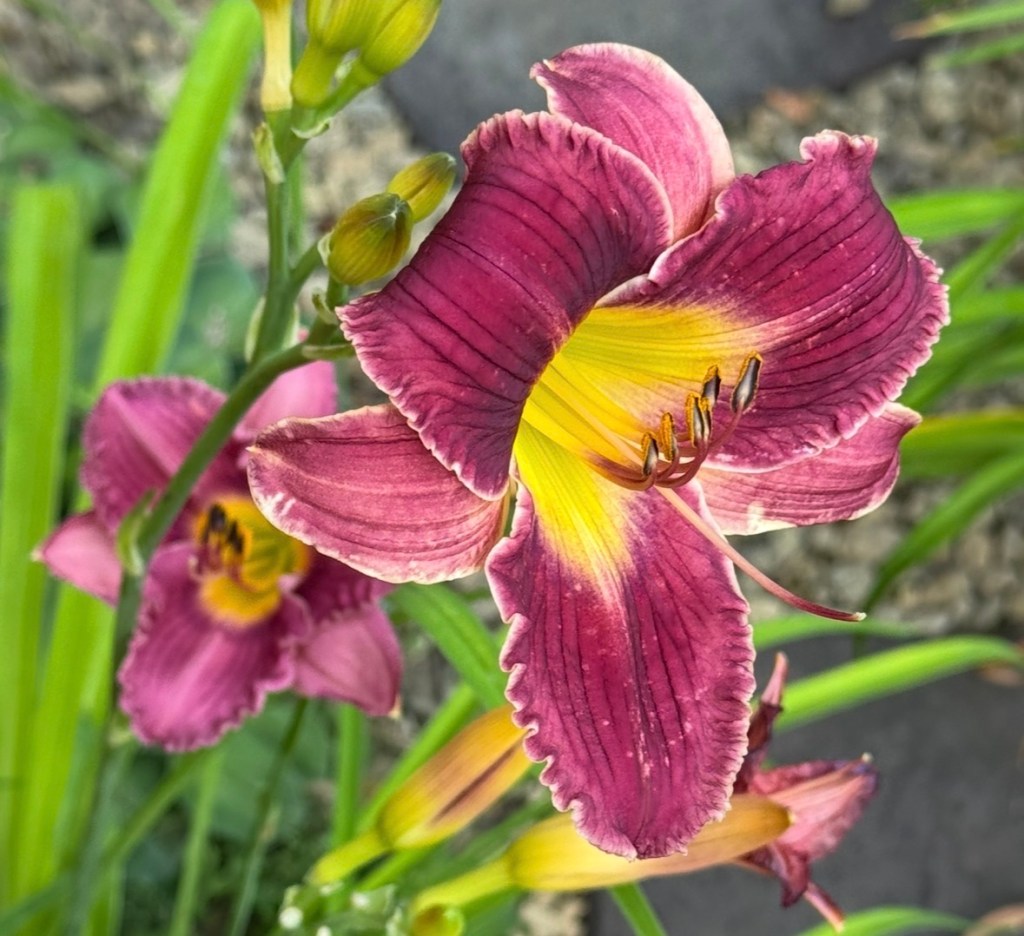
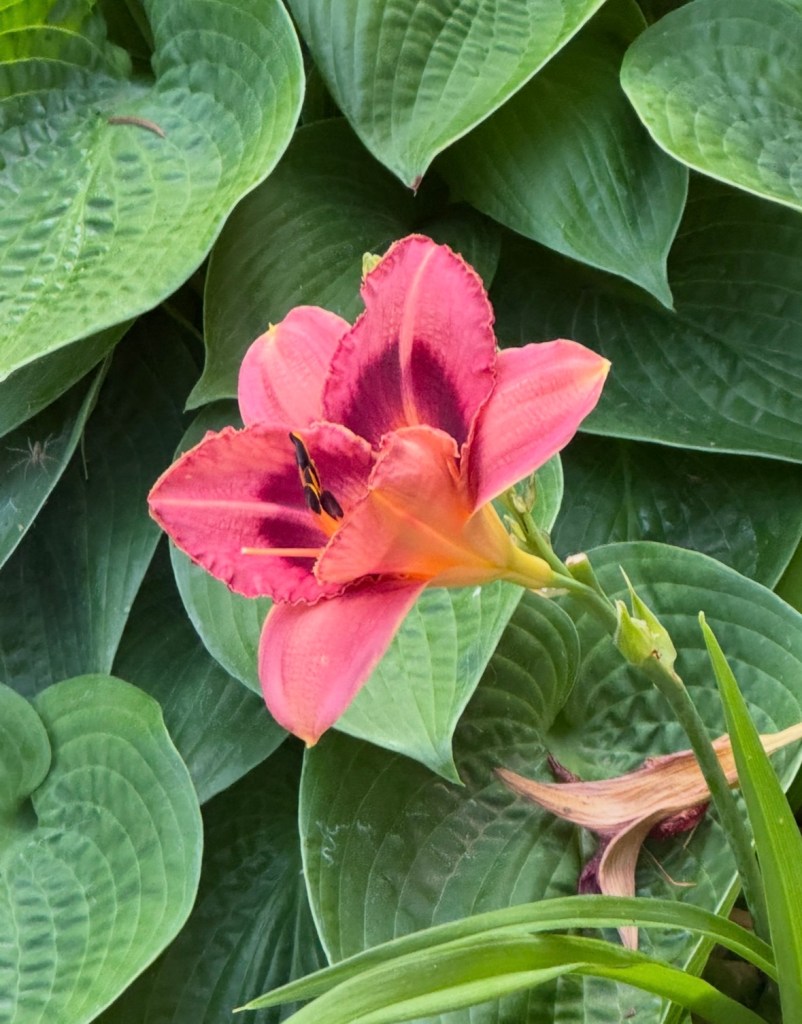
True to schedule, it is on Hello Yellow. Hello Yellow is one of my seedlings, so that is always extra special. This will be the third year of bloom, but we still have a few weeks to go for that. Here’s a pic from last year.
Unfortunately Hello Yellow does not seem to want to produce viable seed. (Last year’s seed looked ok, but it did not go to seedling this spring.) It is however, very pretty, and a keeper. I will post pictures again this year when it blooms.
And the list for fall moves has begun. This Asian lily (in the middle left) blooms peach. It should begin to bloom in a couple weeks. I noticed, however, that it is tall enough this year to be directly in the sprinkler line. Time to find it a new home, this fall. I think I know the place. It would probably look nice filling out the corner, right by a certain frog on a swing.
And I noticed this morning that we have another new daylily cross that went to seedling. That makes 13 new varieties this year. I’m guessing that is small potatoes for many propagators, but that is the most I have ever had in a spring. It was a lot of work, and I am still in the middle, but I am definitely thankful and very happy.
Rain is coming, starting tomorrow. Between the rain and the June heat things will start to pop color very soon.
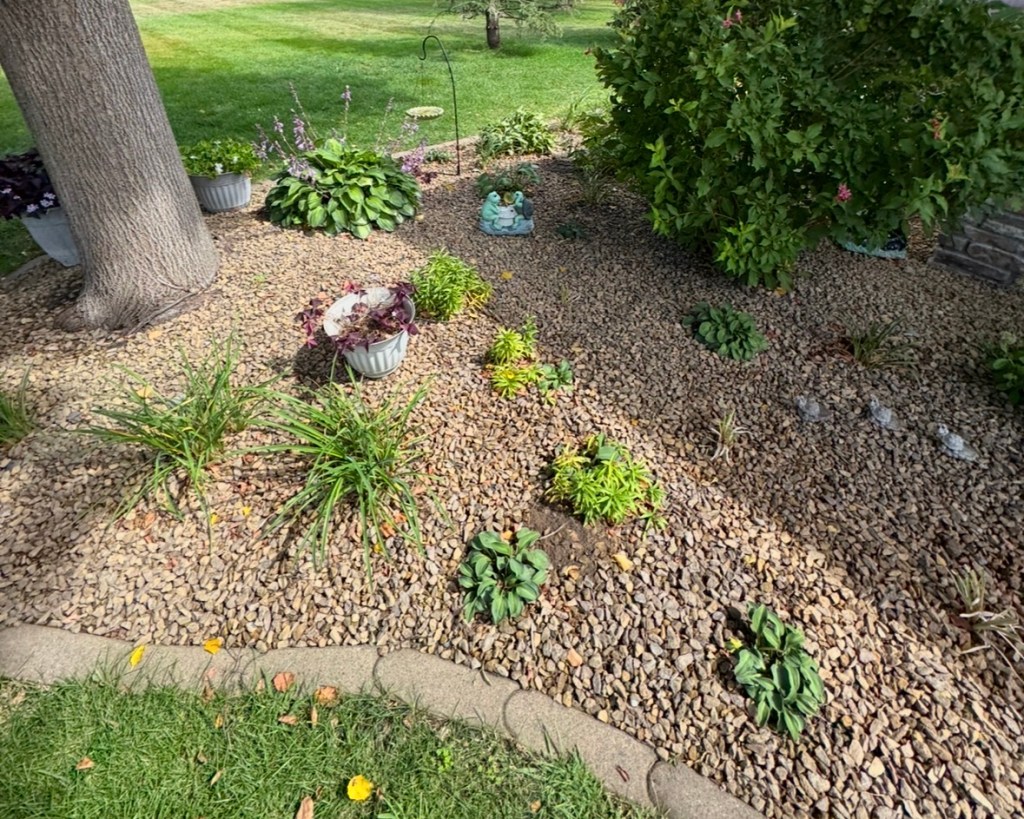
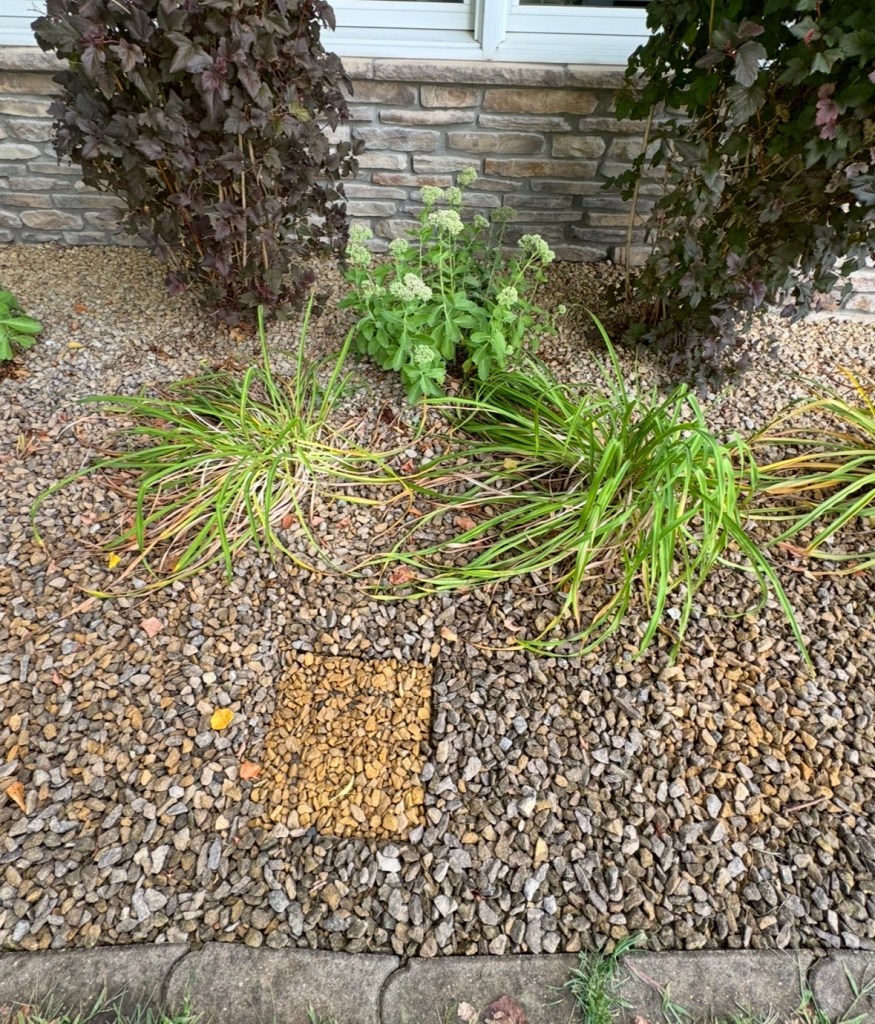
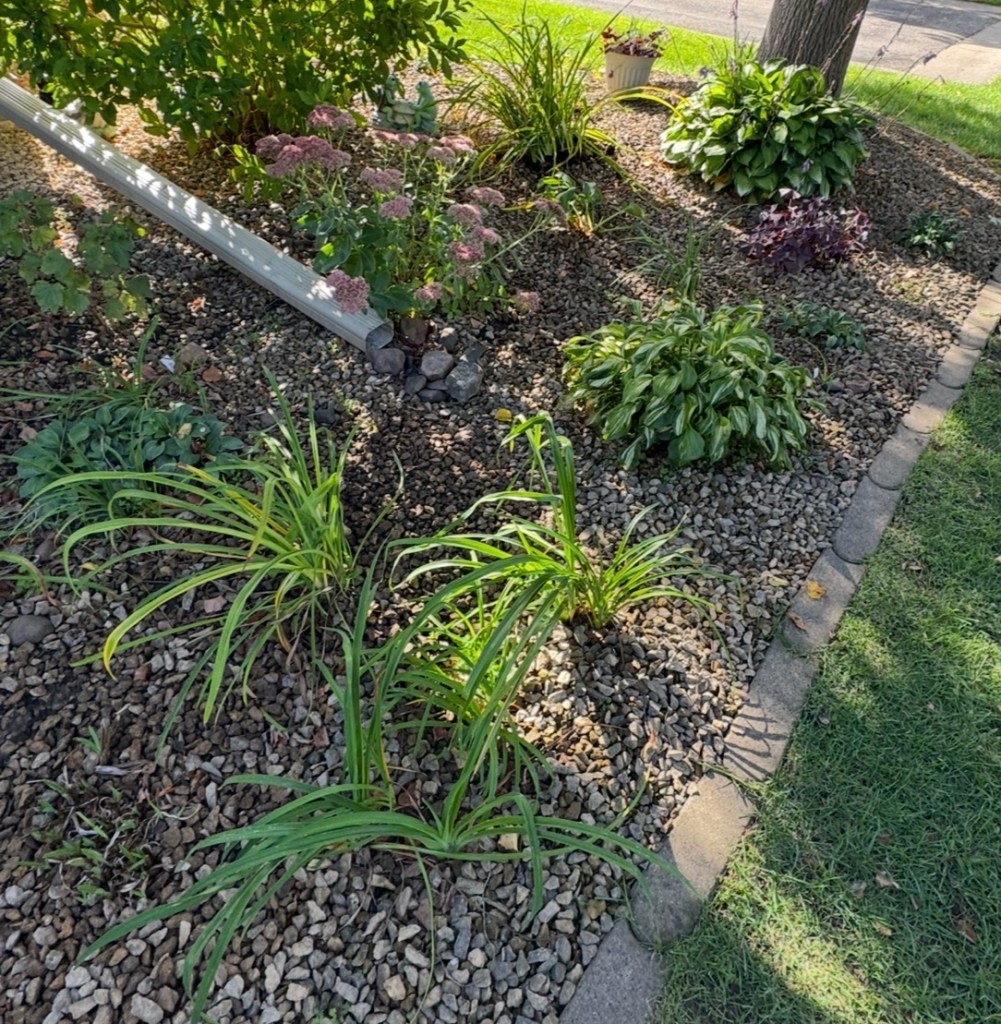
This year I have posted mostly about Sandy’s Corner, but there is an entirely separate garden I show blooms from, yet hardly ever post the full garden. I like that garden just as much, and it has a history just like Sandy’s Corner, but nowadays it is as much of a working garden as something with pretties in it. That garden has a lot our tried and true, purchased daylilies, a very nice sedum, a very nice hosta, some clematis, some asian lilies, some forget-me-nots, and a corner of daylilies I grew from harvested seed. There is a boatload of history in that garden, tons of fun and funny stories, and, when I look at in real life, I, as a gardener, zoom in on the individual beauty, plant by plant.
But in pictures … yah. Time for a little optimization.
That garden is exactly perfect for daylilies. It gets sun for a long portion of the day. But that area is also a bit … rough. I actually have thought about requesting to put mulch outside the border, between the pine and the pavers, because it has pine tree roots. But meh, I don’t want to replace that mulch each year.
Like Sandy’s Corner, that area has gone through multiple iterations. At one time it was half sedum. One of our previous dogs, a very precocious Irish Terrier mix, REALLY did not like bees, and would lunge at the sedum out front in the fall, breaking off pieces. Well, of course I rooted those pieces, and when they were ready to be planted, I went about it. In those days I was lining and swooping lots of multiples in the landscape, and that’s what I did with all those sedum rootings. They started out itty bitty, grew to just right, and then all of a sudden, they were huge. I kept one in place, donated a few, and relocated the rest into our other garden areas.
That area also had a trial period as a berry bush spot (failed), and for over a decade it had quite a number of tulips followed by hostas. That was in the Hostaville days. Those poor hostas. Way too much sun. And the tulips are just memories.
Eventually that garden rounded the corner to be primarily a daylily garden. As I got more and more into daylilies, and started ordering from the source I currently use, I plopped them in in the fall and waited to see what did well over successive years. I did take some care to place them for size (tall to the back) and bloom time (for appeal), and they were very definitely pretty. So pretty I ended up wanting to use some of those daylilies for crosses. Including some of the ones to the back haha! Playing hopscotch was kind of humorous in those days, but now that I know which ones I use, I want to make those more convenient.
So here we go. Seedling planting first.
The 2025 crosses that went to seed and then went to seedling this spring are doing way better than I remember in previous years, as far as growth, and they are starting to get ready to be planted. This has kind of caught me off guard, as I usually plant seedlings in the late summer/early fall when I do divisions, transplants, and additions. But I have space for seedlings in that garden, and I can start what I have been meaning to do – make “family” plantings. Planting seedlings close to their parents – or at least their pod parent.
The backdrop is already there
Unlike Sandy’s corner, I already have a long-time established backdrop to that garden. Way back when I first started the gardens I put in clematis on trellises. It was a bit of a learning curve there, too, as I put a huge trellis by the AC and learned what AC venting up high does to clematises. (It blows them apart π₯) I donated that huge trellis to a friend, along with blooming cactuses he also thought were cool (and I wanted out), and I went much smaller. Then came the day when we had two things happen at once – we replaced the AC and furnace, and we bought a very small house way up in a little mining town on the north shore (Lake Superior). We thought we would retire up there, and I was building out my gardens. Well, I dug out that beautiful deep pink clematis and pulled out those shorter trellises and brought them up to that little house and planted them there. (They took π) But I didn’t get it all, and a little bit remains and blooms each year, even despite a previous lawn maintenance service thinking it was a weed and yanking out what was above ground. Oh yah. The stories! Anyway – that remnant of a clematis comes back each year. Sometimes more than others. This year we only have one bloom on that clematis. It is pictured above. I am hoping that clematis remains, but we shall see.
The other clematises also have a story. When they bloom, I will share those.
And those pots on the path? They are planted daylily seeds harvested from the historic cemetery. The small pot has seedlings harvested from what I call a “plop”. As in donation including planting, with no further information. I don’t know what they are, but they are very pretty in bloom, and they had self-seed, so I harvested it. It worked, but now I have a dilemna – seedlings do very poorly in the historic cemetery gardens so … they are living here for now, until they get big enough to be obviously a daylily. The larger pot is full of Stella De Oro self-seed and … they are not going to seedling. The dirt will eventually be spread out under the pine tree.
Then in the front open space is the failed Schnickel Fritz daylily. Long live Schnickel Fritz. And the small grey planter is my seedling planter with some townhome cross seeds that aren’t germinating yet. Soon they will go up north to give those seeds one final chance to germinate in the wild. Probably not, but you never know.
The wooden seedling box stays. Another story for another day, but the kids made it for me for a milestone birthday, and my husband lovingly made repairs to it this spring.
And that is the garden I hardly ever show as a full garden. Soon to be optimized and then be named. I’m mulling that over. I’m thinking something like Worker Bee – tongue in cheek to honor our Irish Terrier, who did not love bees, took many bites to the mouth to try and remove them, and who could not understand why I would entice more lol.
It is Memorial Day in the United States. It is a dedicated time to remember all the people who have made incredible sacrifices to form and establish and maintain this wonderful republic we call the United States of America. I am so very grateful.
This past week we remembered the anniversary of my Father-in-Law’s passing. A loving husband, father, family member, friend, community member, and World War II veteran. We are so thankful to have had him in our lives. We were truly blessed and our memories with him are a treasure.
Memorial Day weekend also kicks off the “unofficial start of summer”, and we take time to enjoy gatherings and relationships. We can accomplish all the things in the world, but there also needs to be rest and fellowship. Those times form sweet, sweet memories.
And, as it falls, a couple days ago it was also time to renew my blog domain for another year. I am officially in year 9 of this blog. But full transparency, I almost let the blog go. It isn’t that there is nothing to write about. The garden is absolutely beautiful. It is living its best life and doing a wonderful job of providing all sorts of beautiful moments and opportunities. And it is a place for many types of moments – moments to rest and moments to challenge myself and moments to contribute. It’s just that I have been in the rest and enjoyment moments so much that I haven’t gotten back into a good (contributing) pattern of posting again. I take the pics, I consider what would be fun to share, and then I relax and think “I’ll post tomorrow” π
For historical reflection, I am recognizing I truly am at what could be called “Someday When”. So much of where I wanted to go with the gardens is now here. I am enjoying it more and more and adjusting it less and less. And yet, there is always room for “one more” when circumstances provide. As some 20-year-old seeds recently taught me.
This winter I decided it was time to see if the 20+ year old Malva Zebrina Hollyhock seeds I had harvested from my gardens at our first house would grow. I planted those seeds indoors in a pot and watered them, and they did nothing. I thought I had my answer. But, as I often interject into posts that daylily propagation from seed is a long game, so appears to be the journey of at least a few of those Malva Zebrina Hollyhock seeds. It appears they were still viable. They were just needing more time to show up for the 2026 garden. But, thinking the seeds were not viable after all those years, when I began to plant my 2025 harvested daylily seeds, I took the dirt from the pot I planted the Malva Zebrina Hollyhock seeds in and used it in planting the daylily seeds. Fast forward two months, the daylily seeds are emerging, albeit slowly. And along with them, some “familiar looking” seedlings have also been showing up in those trays and pots. They are definitely not daylily seedlings, but since they were so familiar looking, I decided to leave them in place and see what happened. I may be mistaken, but I am thinking they are Malva Zebrina Hollyhock seedlings. Time will certainly tell, but I am thinking they are from that 20+-year-old seed!
Screenshot
And I realize those seedlings are a garden bridge from the house where I started my own gardens, to today. If they survive, they will have a chance to grow at the back of Sandy’s corner, a backdrop to the 35+ year story of my gardening experience. All these years later, a story of different eras, still thriving. I hope the hollyhocks do well. That would be super fun!
And it brings back so many memories! A few days after we closed on our first house, my Mother-in-Law and Father-in-Law came with buckets of irises, dug from their garden. They knew how much I loved their gardens. They were sharing. We kneeled down in the dirt on the west side of the house and planted 40 irises together. Three years later when it was time to divide them there were hundreds! Those irises were gorgeous!
And I remember the first seed catalogues that arrived after we bought our first house. My husband teased me as I spouted off scientific names I was learning from poring over gardening catalogues so much. But it wasn’t just that. Those catalogues that came in the mail were so enticing. I imagined beautifully lush gardens coming out of tiny seed packets. It all looked so wonderful. And so, I bought seeds and started growing them. And I began to dig out grass and lay down mulch all around the periphery of our back yard, much to the chagrin of my husband who thought the sod we had laid was the final frontier. Oh, I sooo remember the aching muscles from laying that sod! And I sooo remember the aching muscles from tearing out that sod, too π Anyway, I planted layers with shrubs at the back of the beautiful gardens I was imagining, and I planted tiers coming forward from that. Seeds, bulbs, tubers, wild roses. And some food. But mostly perennials. And every morning, sometimes at 5 am, I walked our black lab around the gardens, discovering what the new day had brought. Wonderful!
Then one year I stumbled on hostas. My love of hostas started very innocently, from bringing home (“saving”) a few discarded corms my Dad was sweeping up off the driveway after we did some dividing and transplanting. My husband doubted they would grow. They were teeny, tiny. But oh! did they ever take off! And thus started a long journey in “Hostaville”. Lots of years. Hosta of the year, buying backwards into that collection, in multiples of 3-6, yah. That was fabulous. Many of those hostas are still in my current gardens.
Then I got some daylilies. That, like seeds, was me succumbing to successful garden catalogue marketing. The same company that was successful at getting my seed business from catalogues also featured 1-year daylily seedlings. The pictures got me. I imagined a lush garden full of beautiful blooms. That came, eventually, but it took a while. Quite a while. Nevertheless, over the years, as the daylilies began to fill out, I fell in love with those ‘Purple D’Oro’ daylilies, and then ‘Marque Moon’. I also bought some more bare root varieties, sometimes in big box stores – ‘Autumn Red’ for instance. And I bought some stock from a couple large local garden centers. I was chugging along, adding and removing things as they worked or didn’t work in the gardens, and then it happened.
In retrospect, it was a wisp, a vaper. A wisp, a vapor that became another wonderful memory. Here’s what happened. Our son brought his new girlfriend over to meet us for the first time. Kindred garden spirits, it took us just a few minutes to start chatting everything gardens. I do remember the smiles on my husband and our son’s faces. Yah π Some minutes in, I was saying I needed to deadhead the drying daylily pods. Our son’s girlfriend’s response was, “Don’t throw those seeds out. You know you can make new daylilies from those.” And those few words started the daylily propagation journey I am on today. That very year I harvested my first daylily self-seed and began to try to bring them to seedling. Direct sow led to harvesting and storing and stratifying and various iterations of crosses and planting to eventually get to seedlings and then, very eventually, daylilies. And yes, our son’s then girlfriend is now my daughter-in-law π We still chat gardens, all the time. Most recently as she realized one of our grandsons was pouring grass seed into the dirt for her flower planter lol. Oh yah π It’s all good π
And 9 years ago, in a bit of a “state”, I started this blog. Our younger son was hiking the entire Pacific Crest Trail (from Mexico to Canada) and blogging on that. I was a bit concerned about that adventure, and in an effort to focus my energy positively, I created my own blog, about gardening. And so this blog began, 9 years ago.
So, my craft room is the garden, my plant storage is in the ground or in little envelopes of seed, and my contributing springs from that. Last year I harvested hundreds of daylily seeds, and they are now planted in pots and in various stages of seedling and pending germination. What I hope will be daylily “Hannah Cowles’ needs to be planted soon. There is just one seedling from that cross. Among hundreds of seeds from that cross. VERY unusual for me. But fitting, as Hannah Cowles was the first woman American settler in our lineage, going all the way back to the 1600s. And potential daylily ‘Hannah Cowles’ will be planted right next to two large bunches of what I hope will be daylily ‘Molly Cowles’. Those seedling bunches were new seedlings last year. Molly Cowles was wife to Sgt Asa Cowles, a Patriot in the American Revolutionary War. Asa’s brother Jabez died in a British prison as a Prisoner of War.
And so, the history melds with memories with the gardens through the years now down to our grandchildren.
This year does, however, feel different. Last year was a pivotal year for me. I was setting some new groundwork, and as so often happens, the gardens were a big part of that. I was marching happily, even exuberantly down the daylily crosses path and feeling very creative. An analogy would be going to the crafts store and buying a bunch of very cute embroidery or knitting or crocheting or finger weaving or scrapbooking supplies. Soon it is time to properly store those supplies and organize them so they are ready for use and then it is time to actually get about using them. Actually work about getting the imagined thing to be real. Uh-huh. And that part, realizing I was definitely over my threshold, led to me saying I will only do four planned daylily crosses in 2026. It turned out that 19 varieties of crosses produced so many hundreds of seeds I was just counting the days until it was all done. And truly it is not done even now. I watch every day to see what new seedlings emerge, I document information on my voluminous excel spreadsheet, and soon I will start planting in the ground. But what I truly enjoy is exactly where the gardens are at right now. And though I know that learning and experimenting will always be there, I am enjoying having the “Someday When”. I like the slower pace, the early morning tour around the garden areas. I like relaxing on the patio, watching the veritable plethora of birds and bees and butterflies and dragonflies, and just enjoying the Now.
So right now:
The Weigelia is starting to bloom. That Weigelia looked pretty bad a few years ago. I have been working with it and this year it is looking great.
The pines are budding out.
The Ninebarks are going through their beautiful color morph sequence.
The stonecrop out front looks awesome right now but will soon “donut”. I am sure I will talk myself out of pulling them out again this year lol.
The Elegans hosta that was a tiny rooting from before we lost the 18 hostas last Spring is doing very well.
The Blue Mouse Ears are loving their new locations.
And the Pink Asian lilies are making an unexpected comeback. (Still forming bloom buds. More to come.)
And not just the townhome gardens are doing well.
At the historic cemetery the irises are mid-bloom. The yellow blooms first and then the purple starts. In 2023 they were in an old garden inside the fence and were just begging for a fresh start. I dug some, divided them, and planted them in an area that was grass but had “iris bed” written all over it. They are so fun now! Yes, we definitely did not add any mulch to that section this year. It is plenty full π
Screenshot
Not everything is roses, though.
In the townhome gardens:
The 7-year-old South Seas self-seed daylily that only bloomed one year (last year) does not seem to want to come up this year. And I had 3 of the total 4 daylily crosses planned with it. Ouch. Only one cross this year? Really? We shall see about that.
The original South Seas daylily clump will need dividing and transplanting this year. It is starting to fail.
The Carpenter’s Choice daylily doesn’t look good to me, and although I had hoped to get self-seed and experiment with ploidy (a parent is a diploid), it may move out. If I am going to work with it, I don’t want fussy.
And, sadly, the stonecrop under the Linden by the pavers have gone the way of the disappearing hostas. They will not be replaced.
And working at the historic cemetery gardens is no different:
Daylily seedlings don’t do well there, and that was a loss of quite a few good seedlings.
Additionally, fall is not a great time to plant bare root purchased daylilies there. Most of them disappeared and it looks like they are not coming back – probably moles.
Today I will go over to the historic cemetery and see if the purple irises are starting to bloom en masse like the yellow irises have been over the past couple weeks. I’ll share next week.
For now, I’ll wrap up.
I hope you have a wonderful weekend, and if you are in the United States of America, I hope you have time to observe Memorial Day.
I am trying to decide if these are Malva Zebrina Hollyhock seedlings.
That would be an absolute hoot. They would be 20-year-old seeds I had tried to start this winter. Thinking it didn’t work, I reused the soil for starting daylily seeds. The daylilies are starting to very slowly pop up, and along with them, these seedlings.
These trays were planted indoors on March 23rd and went outdoors on April 12th. On April 24 I saw the one seedling (in the shadow of the cross bar) and since then nothing else has come up.
Here’s reasons I can think of for the failure:
The seeds need more time out in warmer weather. (Maybe. I will give them a couple more weeks.)
The trays are horrible (I’m going with this one. These trays are not staying. Way too putzy for me, and so far, the results stink.)
The one seed that did germinate was the only viable seed. (They all looked good when I planted them.)
Here’s some positives:
Even though these may be a 98% bust, there is one seedling, so far. It only takes one.
This batch was a test of a reverse cross of a wildly successful cross from last year. The pod parent is one of my favorite daylilies, Pink Tirzah, but the data available is a bit scant. Most of what I know about Pink Tirzah is what I have proven out myself, including even ploidy. Now I am working on fertility. The pollen from Pink Tirzah has been awesome, but as a pod parent, not so much. I have only had one other cross that went to seedling with Pink Tirzah as the pod parent. I am hoping for bloom on that one this year. I do love Pink Tirzah, so the work continues. This year, besides seeing how this cross goes, I am hoping to get Pink Tirzah self-seed, as I will not be doing intentional crosses with Pink Tirzah this year.
And there is still hope. I have a medium pot of seeds of this same (reverse) cross I planted and put out a few days ago, using my usual very successful, albeit quite lazy, method π
We are at the end of April now, and what a difference the last week has made!
Sandy’s Corner is really filling out.
The daylilies look great.
Last year’s seedlings are much farther along than in previous years when I was still working at finding out what they liked best.
The hostas are even looking much fuller this year.
And our volunteer shrub does indeed look like a currant. It can stay, at least for now. The birds will probably love it.
On the flip side, I could kick myself for buying those tiny little 6 cell seed planting setups. They definitely fit perfectly into the grey seedling boxes, but the seeds are not germinating like they do when I plant medium pots of up to 20 “same” seeds together. I think I know someone who might appreciate them for starting veggie seeds next year π
Overall, I am finding that I really like what I have going on in the townhome gardens this year. It has been fun to see the new look and focus come up, and I am more convinced than ever that scaling way back on the crosses this year is the right plan. I can always scope up if I want to, but I am definitely not enjoying that I have so much work yet to go on getting last year’s seeds going. A lighter scope next year continues to sound fabulous.
The historic cemetery gardens are really filling out as well.
This past weekend my husband and I went over and did some spring cleanup at the historic cemetery gardens. They are really looking good! I do suspect our phantom weeders have been helping as well, because I kind of remember it being a little messier a week or so ago. So, thanks to them!
There is one sad thing. Over the past couple years, I have added purchased bare root daylilies to the historic cemetery gardens, as well as added seedlings from crosses I did at the townhome gardens. When I walked though a week or so ago, it looked like they were not there. This past weekend that was confirmed. There are moles or gophers over there, but the markers are almost all missing too, so that is odd. At any rate, I do have the seeds I harvested from there last fall, and I will direct sow those to do one final try with seeds and seedlings, but I think I have my answer. Bare root planting is a no go there. And probably seed and seedling planting as well.
On the upside, the daylily from South Seas self-seed that I planted at the historic cemetery last fall is thriving, so additions like that may be an option, go forward.
This morning as I was reviewing my pictures from years past, I realized it was a milestone day. That milestone day eventually prompted me to start this blog. And, I realized, I am starting my 9th year of blogging. That is crazy pants.
Some days I think I should call it quits on the blogging. Goodness gracious, I have shared and shared and shared. Down to tiny garden details. I’m not sure there is a lot more to share. But the daylilies …
I wrote a detailed blog today – and deleted it. Much more fun to share that Sandy’s Corner is continuing to be a very enjoyable place to look out over that portion of the daylilies and daylily seedlings as the continue on their Spring growth. That I am hoping for more first-time blooms from seedlings again this year. That I am looking forward to more blooms from our prior years’ seedlings turned daylilies. And that the robins were very trusting this morning.