Yesterday I harvested the last of the daylily self seed at the historic cemetery. It was self seed from Red Volunteer, the only purchased and planted daylily from last fall that bloomed. One other Red Volunteer came up late but did not bloom this year.
A few weeks ago I harvested 78 Stella De Oro self seed from the historic cemetery, and those will be direct sown there in spring. It will all be in one patch, and then “survival of the fittest”. For the two Red Volunteer self seed, I will plant each seed in a seedling mini pot for germination and season 1 growth.
I do not do intentional crosses at Oakwood so there are none of those seeds to harvest.
So with the daylily seed harvest now done at the historic cemetery, all efforts turn to any remaining transplanting and then to starting the fall cutback.
It is hard to believe, I am wrapping up year 3 in those gardens!
When creating gardens, I, most often, go slow. Yes, part of that is age, and energy. But a much more impactful reason is collaboration and testing.
Many years ago, a friend told me that we grow gardens for others. I had to think about that a while because I enjoy my gardens so much. It is, however, somewhat true. For the most part, the gardens we grow are enjoyed by many more people, and pollinators, than the gardener. In public gardens that is especially true. And so it is with the Oakwood (historic cemetery) gardens.
In both the Mahala Felton garden and the Shirley D garden, we inherited donations. For years, well before I came as a volunteer, people would find spots for their donations and come and plant them. When I took on the Oakwood garden, I did radically change the aesthetic and the maintenance, but I tried to leave the plants, especially those that were doing well. That took time to observe. 3 years of time.
Now I have a pretty good idea of what will do well in those gardens, and they both have a different feel. Against all odds, Shirley’s garden has quite a few hostas. The hostas I went on and on about needing to move, are thriving. In a full sun garden with no irrigation. Go figure. And the Asclepias a bird planted (or so the story goes ;)) survived despite my secret desire to pull them out. Yes, I know they are essential to the monarch population. Other things have also showed up in both the Mahala and the Shirley gardens that I know weren’t there the previous year. And they got to stay. Well, almost all of them got to stay. Lovingly, Oakwood is not an irrigated site, and I am not an irrigation system. I go to volunteer when I can. So, rules of nature – If you plop, you water. If plops fail, I am not heartless. Things that don’t make it still contribute to our compost pile, so they do not go to waste.
All of those learnings were part of a process – a 3-year process, including things I personally planted that did not make it. Nature (or others) sometimes also make those choices. But 3 years in, we have two beautiful gardens we ALL enjoy, for various reasons, and indeed, have taken an ownership stake in. I know for sure neighbors are weeding. Thank you :):):) Someone may have even weeded the Mahala Felton daylily seedlings at the gate, even though it had a marker. You just never know what will work, for a variety of reasons. The Oakwood gardens are a joint endeavor, and, so far, as a whole, it is working. We are growing a garden for each other.
So it will be with the Fischer garden. It will be of the two existing gardens, AND a standalone. It has its own needs, it will be unique to the site, and it may not ever even be seen by many who see the Mahala and the Shirley gardens. So far, for sure, we know it will not have any potted plants – those get inexplicably tipped over. For sure it will not have daylily seedlings – deer and turkeys may think they are appetizers, and they do kind of look like grass so others may think they should be weeded. For sure there will be no hostas – I already tried to make a woodland garden at Oakwood, and it got very “eaten” very quickly. Very sad. In my mind all the hostas from the Mahala and Shirley gardens were eventually going there. But alas! Nature chose.
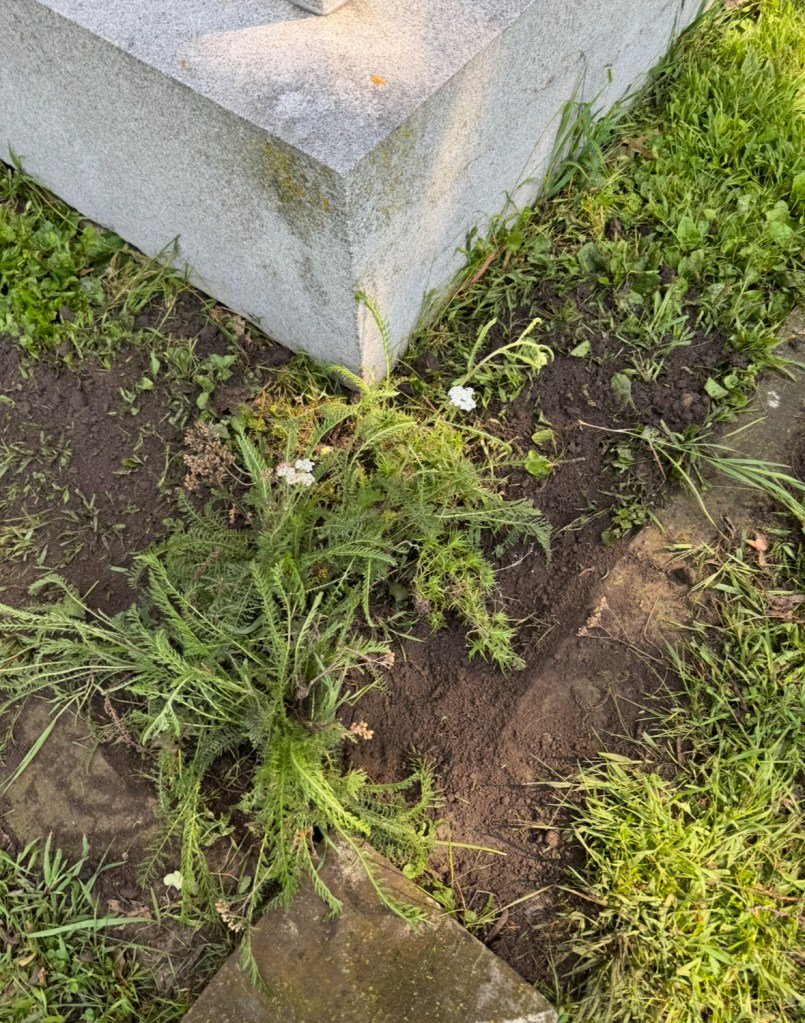
So what will the Fischer garden have? Rules of engagement are: no spend, critter resistant, full sun, no ongoing irrigation – so, drought resistant. So far the Fischer garden will start with yarrow transplants, because, well, we have already started it, and we know, so far, they are working. But we shall see when we stop watering the test plantings. Beyond that, in my mind I see tall purple accents throughout, and ground cover around the babies’ markers. But nature will ultimately decide what truly works. We honor the site, we go slow, and we listen to nature.
Here are pics of the tall purple and the ground cover options I am envisioning. I am going to try seedlings and transplants. We will go slow and see what nature decides.
Today is the last day for 2025 daylily blooms in our townhome gardens. Hello Yellow opened the 2025 daylily bloom season, and she is closing it out as well. She is AMAZING! And she is a mystery. I would be tempted to say a bird brought in a Stella De Oro seed, but a) she has repeatedly now typed out as a tetraploid, and today I harvested seed from one of those crosses, b) I planted her as a seedling from seed I harvested (I don’t own any Stella De Oros) and c) I haven’t been able to replicate her. So, she remains “Hello Yellow” with parentage as “sdlg” Her seedlings, if we are so blessed, will be fun – partially because she is not at all scientifically supportable. She is a gift. A reminder that I cannot support everything beautiful with data 🥰
And as the daylily bloom season at the townhome comes to a close, of course I have interwoven that eventuality with something new. Why wouldn’t I? And not something small like weeding or tossing worn out garden gloves or taking cloches off seedlings or moving rock that keeps overflowing into the grass or onto the sidewalk when it rains. No, no, nope. I need something much bigger. Multi-year, very challenging, requiring no money investment, but rather just repurposing and harvesting for new – exclusively, you guessed it – from and to the historic cemetery garden. How did I arrive at this set of requirements? Well funny you should ask. It has to do with 3 years of work there, studying, observing, seeing weird stuff (like things disappearing – ahem – Mahala Felton seedlings and purchased and planted daylilies), and a love for solving reasonable needs. Enter the Fischer project.
The Fischer project was born out of me not being able to keep my joy to myself and sharing that it only now takes one hour per week to weed the entire historic cemetery garden. And, by the way, since we are adding another garden, we need some refining nomenclature. Going forward, for my blogging purposes only, the left side of the wall garden at the historic cemetery will be referred to as the Mahala Felton garden. The right side of the historic cemetery garden will be referred to as the Shirley D garden. And the new garden will be the Fischer garden. So, I was sharing that I felt a bit guilty, not too bad, but a bit, that the historic cemetery garden in year 3 now only takes one hour per week to weed. Or one hour per side every two weeks, or, well you get the gist. And Shirley’s husband, who is an absolute rock star, who helps Shirley keep up the cemetery, said something to the effect of “Do you know the Fischer site?” Yep, kind of, I said. And off the project started. The Fischer site is definitely a long-term project. It will for sure take a couple years to turn into a garden that replaces grass with plants, that does not require mowing. And that is the need.
So, the challenge is a garden at the site that is deer, squirrel, bunny, and other critter – two and four legged – resistant, drought tolerant, very low maintenance (like cut it down at year end), no mulch, does not obscure markers (so ground cover in some areas), and (my requirement) feels healing, and peaceful, and, well, quiet. The Fischer site is the site of early settlers to this area, but their story was very different from the Feltons story.
And that is where this blog ends. But I (with the help of Shirley’s historical research) will share more as time goes on. About the Fischer story (history), about the new garden plant choices, about the new garden successes, and I’m sure failures, and about how things look as we go. Shirley just texted to say they are at Oakwood, and she will water the new plantings. They don’t look like much – a few bunches of transplanted yarrow from the Mahala Felton garden – but it’s our new work in progress. Now that the Mahala Felton garden and the Shirley Dalaska garden take so little effort, their gardens are going to fill the new Fischer garden. That I LOVE 🙂
We are deep into daylily season now, and I am seeing patterns regarding daylily crosses that will work this year. For instance, the cross that made the Mahala Felton dedication daylily will not have a repeat seed creation season this particular year. One of the parent daylilies is not sending up scapes right now. That happens. It is a healthy daylily, not crowded. It could be that I just overworked it last year. For this year, the Mahala Felton daylily seedlings are doing well and will start to be be planted this fall in various locations in the Oakwood Cemetery garden where Mahala Felton is interred.
I am also having challenges this year with getting the Molly Cowles dedication daylily cross to replicate. 60 seeds last year, and not a single success with that same cross this year. But that, too, is OK. I have so many Molly Cowles seedlings that some will probably even go up north. I will continue to try to replicate those crosses this year. There is still lots of runway ahead. And some things happen for a reason.
Those daylily seedlings are wonderful, and I hope they will bloom absolutely beautifully, but I knew there was more to come. It was forming in my mind. Something a bit different.
We were “getting there” when one of the daylilies I purchased and planted at Oakwood last fall began to bloom a few weeks ago. That daylily’s name is Red Volunteer.
“Volunteer” has layers of meaning. What a cool daylily to be at Oakwood. And it is stunning. I am hoping for way more blooms next year. I only caught two this year.
But something was still in my mind. It just was still in a “waiting” state. Something with ties to meaning. It finally arrived.
Dedication daylily “Shirley D” is a dedication to my good friend, long time historian and author, and fellow volunteer at Oakwood Cemetery. Shirley puts up with my relentless garden talk, endlessly long texts, and ridiculously ambitious ideas. And Shirley and her husband Mike dedicate uncounted hours of personal labor as well as their substantial leadership to Oakwood Cemetery. They are, in my humble opinion, the primary reason Oakwood Cemetery is in the renovated state it is in today.
Dedication daylily “Shirley D” is from 2022 harvested seed. 2022 was a tough year for me. It was the year my husband and I decided that the little home up in the mining town in northern Minnesota (that we had renovated and planned as our retirement home) was not truly a match. Our plans were upended. We were back to the townhome plan, and I was gutted. I wanted a yard to renovate into a garden. I wanted to be in that area. But it was just too small. My friend Shirley was a dear sweet comfort as I greatly grieved selling that house.
The following year, as I was looking for something I could pour myself into through gardening, Shirley, once again, reminded me of opportunities at our local historical society. While dedication daylily “Shirley Dalaska” was slowly putting roots down where I had planted her the previous fall, I joined the historical society, intending to mainly garden. I took a meandering route, but eventually I found my way (back) over to Oakwood, where I, once again, saw the old, abandoned garden I had seen before. Volunteers are not in plentiful supply, and no one had felt both a calling and the time to address it. And honestly, I too had no interest in that garden. The goats that had been at Oakwood to eat the buckthorn a few years before might have enjoyed it had they had access to it, but it did not really speak to me at all. I was looking at the huge expanse of a raised bed fence garden that so needed love. The old, abandoned garden had stuff that would look great in the fence garden, but the fence garden needed way more than weeding and transplants. What happened next is a testament to Shirley’s absolute genious. While I was working through what I was feeling called to do, Shirley didn’t give me her plan. She let me come up with a “Susan plan”. An impossibly ambitious plan to move the heaving rock and exposed plastic out and go to a mulched garden. I went to the store, bought three bags of mulch, put some in, took a picture and asked what she thought, and pretty soon Shirley and Mike were there doing garden days, sometimes even when I wasn’t there – moving rock, pouring out bags of mulch, putting up with my insistence that hostas would never survive there and that people who were increasingly plopping hosta donations in the newly renovated garden were going to be sorely disappointed when their hostas died. It was, after all, I said, a full sun garden, for goodness sakes 🙂 (Those hostas are thriving – lol) Shirley has stood beside me, even talked me out of really bad ideas, and still encouraged me in my efforts. She soooo gets me. She gets my intensity. She gets that I primarily want to make gardens. She gets that I am so pleased seeing the community appreciate the completed renovation. (Is a garden ever truly completed though? I don’t think so.) Shirley gets that I was pretty driven about getting the garden renovated but now am thrilled that I only need 1 hour per week to weed it because neighbors are weeding as they walk by. So cool!!! And she puts up with me saying, for the 900th time, that I am not going there every day to water plopped plants, which still happens lol. It’s OK, she says. Shirley really is a saint. I think she may be watering plops. I’m pretty sure she is 😉
This year, as the daylilies in my townhouse gardens started to come up and then show scapes and buds, dedication daylily “Shirley D” took her sweet time. Other South Seas self-seed creations were coming up, making it onto my blogs. Still created by our mutual neighborhood pollinators but looking “not Shirley”. And then the first bloom. Does “Shirley D” not have the “it” factor? Understated, yet undeniable presence. Like Shirley D the person, my dear friend.
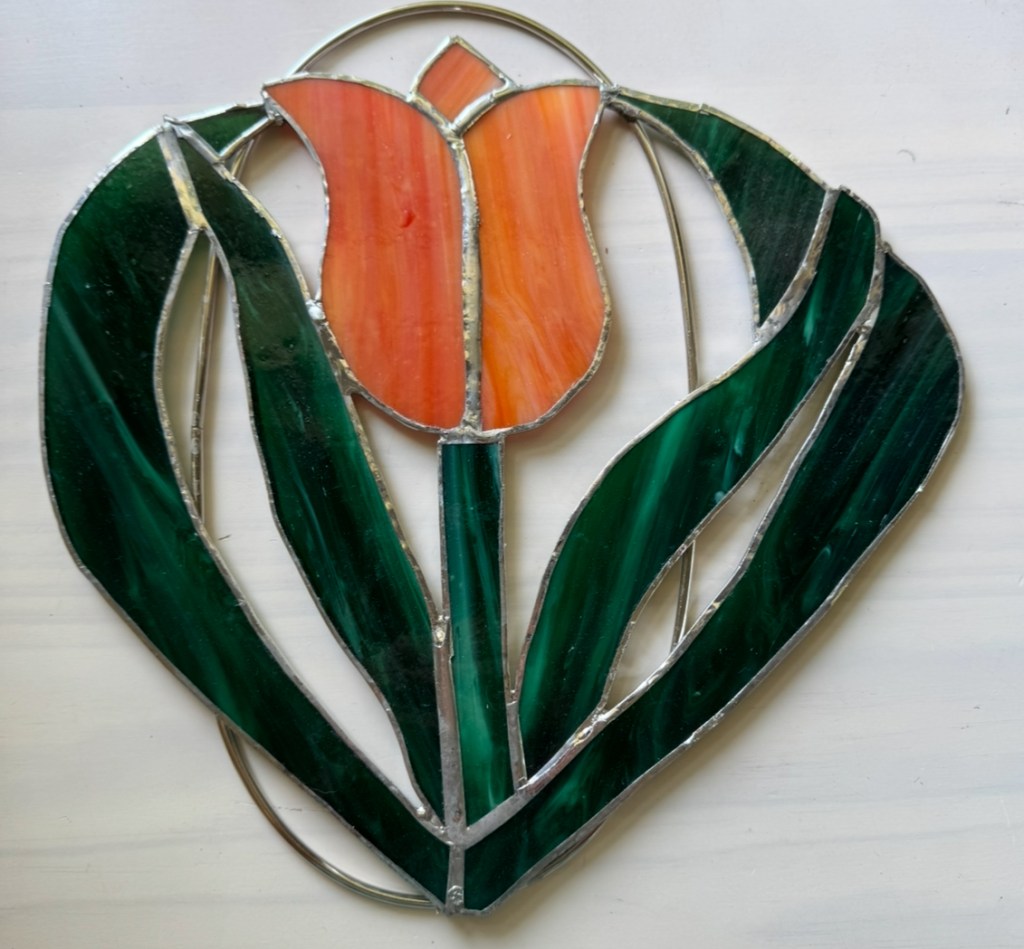
Among Shirley’s many contributions, Shirley does stained glass work.
Back at you, my friend, with another floral beauty.
Molly Cowles was the wife of SGT Asa Cowles, an American Revolutionary War patriot. SGT Asa Cowles and his brothers served in the Revolutionary War. One of his brothers did not return. His brother was taken as a prisoner of war and was assumed to have died in an English POW camp. The Cowles were patriots. How do I know this, and why? Well, it is a long story. I could give a short answer, but it really didn’t happen that way. In fact, I never would have researched anything about the Cowles had I not gone on the path I will share. The long answer to why I have this information really started many years ago with a grade school field trip I chaperoned for one of our sons’ classes. That is when history actually came alive for me. Before then I just could not get excited about paper maps being rolled down from the ceiling and wooden pointers showing us war locations and routes. I really tried. I did! But for some reason while math and English kept me wide awake, I kept dozing off in history class. Literally – dozing off. Arrggghhhh. But … I married a historian. Yah, absolutely true story. And one of our sons had that school field trip to a historic site and I agreed to be a chaperone. Well … I loved that site. Way more than our son did hahaha! It made history come alive for me. Next thing you know we were reenacting and doing historic rendezvous, in a tipi and then a wall tent. I know, crazy. So, you see, I was more interested in the everyday lives of the historic people at that point in my life, much more than the war maps in classrooms of my teen years. But everyday life history is harder to find. It is the bigger things that stand out, get documented – discoveries, settlements, births, wars. Sometimes occupation. Fast forward, many years later we moved to our current town, and my friend who is a long time historian got me hooked into local history. But wow, she is good! She got me back in through gardening. Yah, gardening. Probably because she knew this girl was not reenacting anymore. I was pretty clear about that 😉 And there you have it. Regarding history, I volunteer garden at a historic site cemetery and do garden stuff in honor of some pretty cool historic people. One of those people is Mahala Felton, the first white woman settler to our area. As that research project unfolded for me, I realized Mahala Felton’s incredible contribution to local history. I decided to name a daylily for her. And I shared the incredible history I had learned in a four part blog. I was thinking at that point that I would take a break from researching, but it was not meant to be. The answer to how I know about SGT Asa Cowles falls in the timeline at the end of my research on Mahala Felton. About that time my sister shared our ancestry chart. I was intrigued by a very unique name (Sempronia) in our family genealogy. I might have stopped there, and missed SGT Asa Cowles, but somehow the name Tirza popped up. A very unusual, yet very familiar name to me – Tirzah. As in Pink Tirzah, the daylily. Pink Tirzah has a very storied history in my garden that I shall not recount. But suffice to say, Pink Tirzah overcame many obstacles and today she is thriving. She is now knocking it out of the park. Pink Tirzah was my most successful pollen source last year. Go Pink Tirzah! But I digress, slightly. I found Tirzah Cowles but she was not in our lineage. Her brother was. And their father was SGT Asa Cowles. Now stick with me here, because I suspect, as we used to say while sitting around evening campfires at rendevous, telling stories, it will seem like this is a “smoke goes up, heads north, and makes a hard turn right” but it is not. This all ties together, I promise.
My husband and I agree on names for my daylilies. Some of my intentional crosses get female names. That’s just how it rolls. We chatted one morning about all this and agreed. The Pink Tirzah cross will be named Molly Cowles.
There may be more female names from our genealogy. I thought I saw a Civil War reference somewhere along the way but didn’t pull that url. It looks right now like our lineage goes back to Jamestown, but we shall see. We are still researching. I will write more as we go.
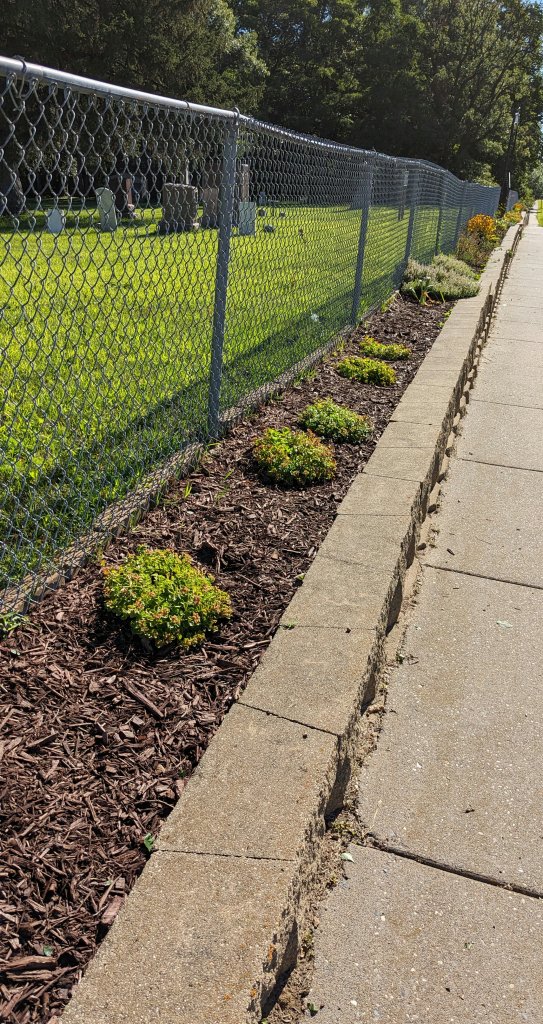
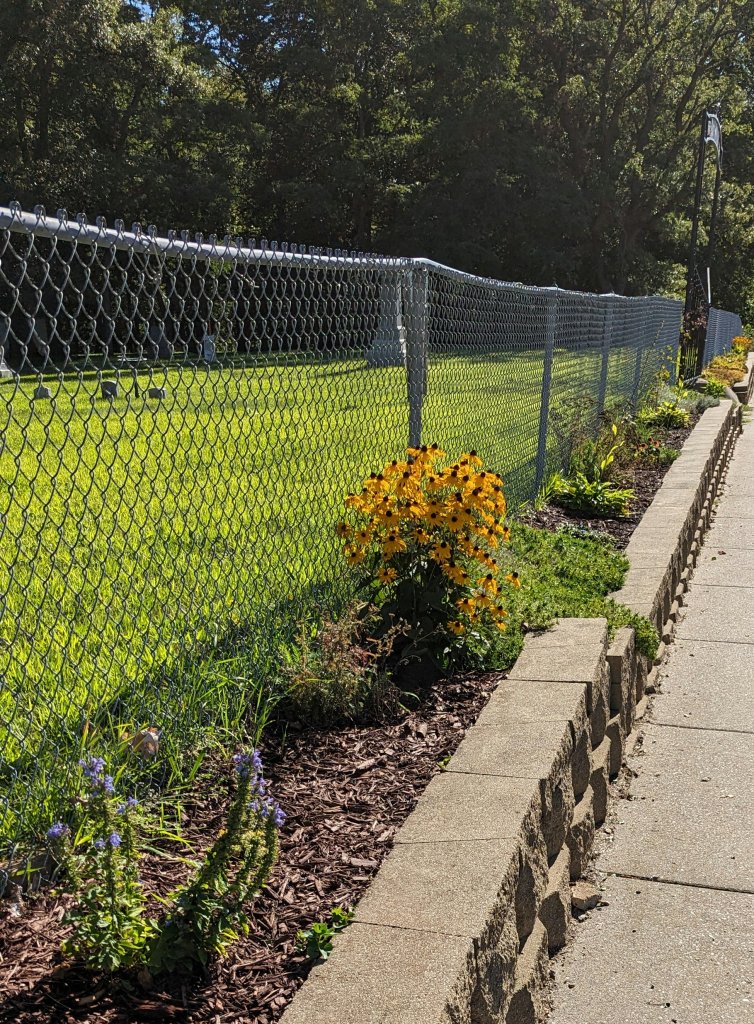
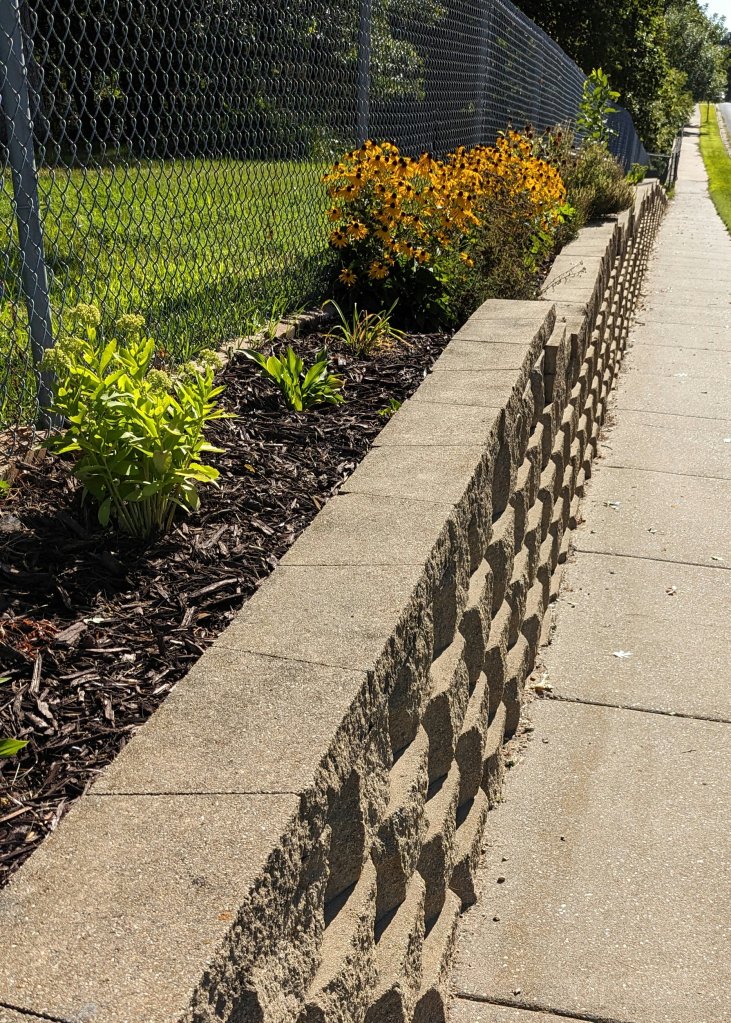
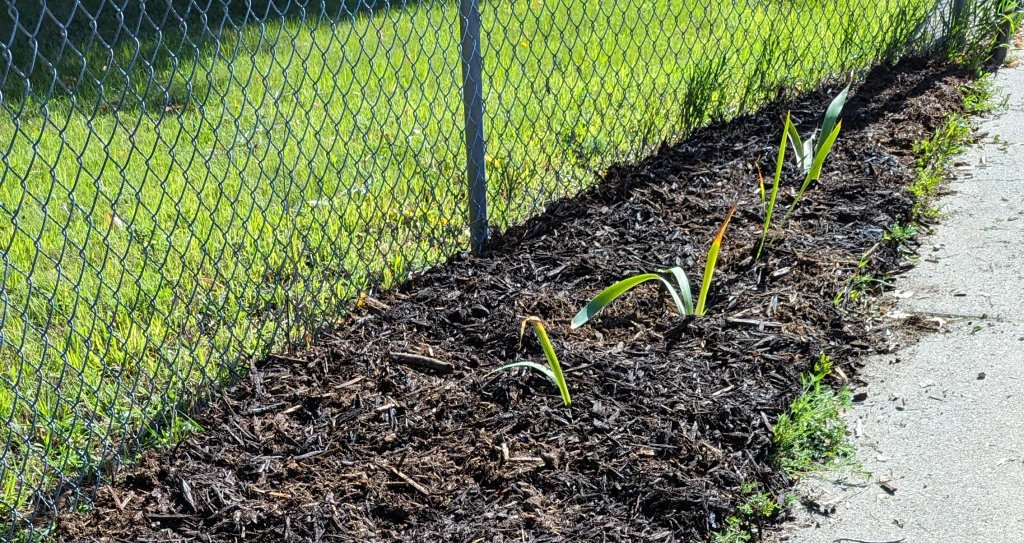
The rock to mulch conversion is complete at the historic cemetery! I lost count at 80 bags of mulch. I think it was in the high 80s.
What began as my (crazy, maybe 😂) brain child soon became an incredible team experience, and there is still more to be done – filling in with transplants and donations – but the rock to mulch conversion is done, and now we can play a bit. And maintain.
The neighbors, to a person, say it is so nice, a huge enhancement, and very enjoyable to walk by. Very rewarding to hear!
I hope you enjoy the view too!
And that is only one side, the shortest side at that! But first, a view of the resident turkeys
And now, the gates and the other side.
Almost there!
Still some more weeding and then fall trimming to be done, but the initial bedrock of mulch is laid, and now we can play.
I hear some more sun loving plants donations are on the way, and also ground plaques for every soldier.
What a treat to work at this site, along with so many others before and during, and Lord willing, to come!
At the historic cemetery there is what I have been calling “the iris bed”. It is an area that I understand was planted a while back by another volunteer. It is more of a naturalized garden, with grass within and no specific border except the line around it where the grass is cut. Right next to it, except separate, is another small area with another grouping of irises.
I absolutely love irises! I have the most fond memory of my mother and father-in- law coming to our first (owned) house, a new home, with no grass on the sides or back of the house yet. They arrived with a large tin bucket of 40 iris rhysomes they had dig out of their garden, which I love and admired each time we visited.
It was past October 1st because that was our closing date, so planting, everyone agreed, was a close call. We got down on our knees on the west side of the house, dug 40 holes, and planted those irises. The irises thrived there, I put in trim and wood chips the next year, and proceeded to build out my first garden area at that house. 3 years later there were almost 400 iris rhizomes in that garden! I dug out a bunch of those and put them along the whole back fence, I traded some with neighbors, and I even gave some away.
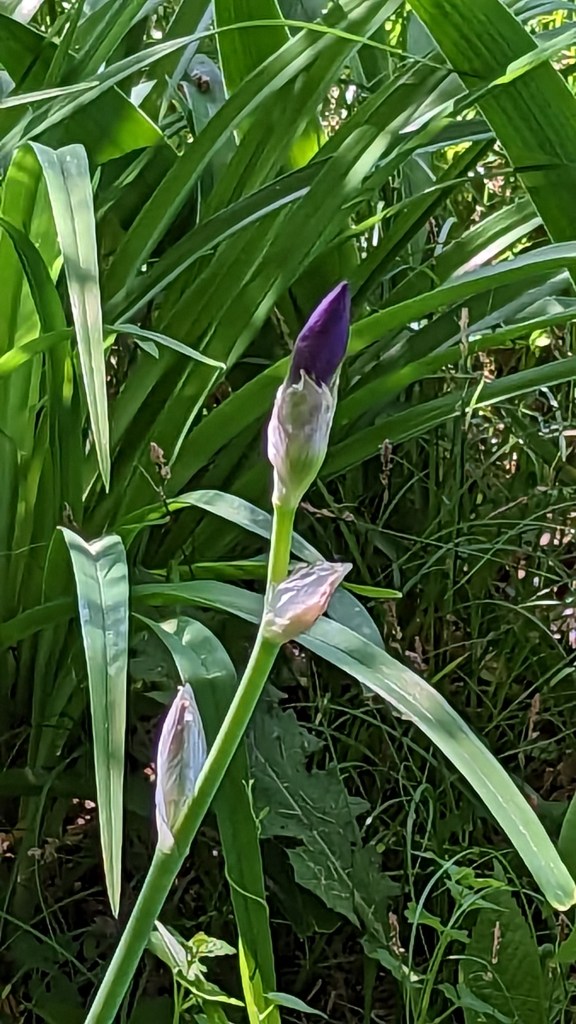
I have wonderful memories of those purple irises. But yet they do not grow here at the townhouse. And they also do not seem to grow consistently up north. You can probably imagine my delight yesterday, when I saw this in the “iris bed” at the historic cemetery.
I was doubtful they would bloom. They do not get much sun, do not look like they have been divided in quite a few years, and have a lot of competition for nutrients. But bud there is. Just one so far. We shall watch.










 Susan's Daily Garden