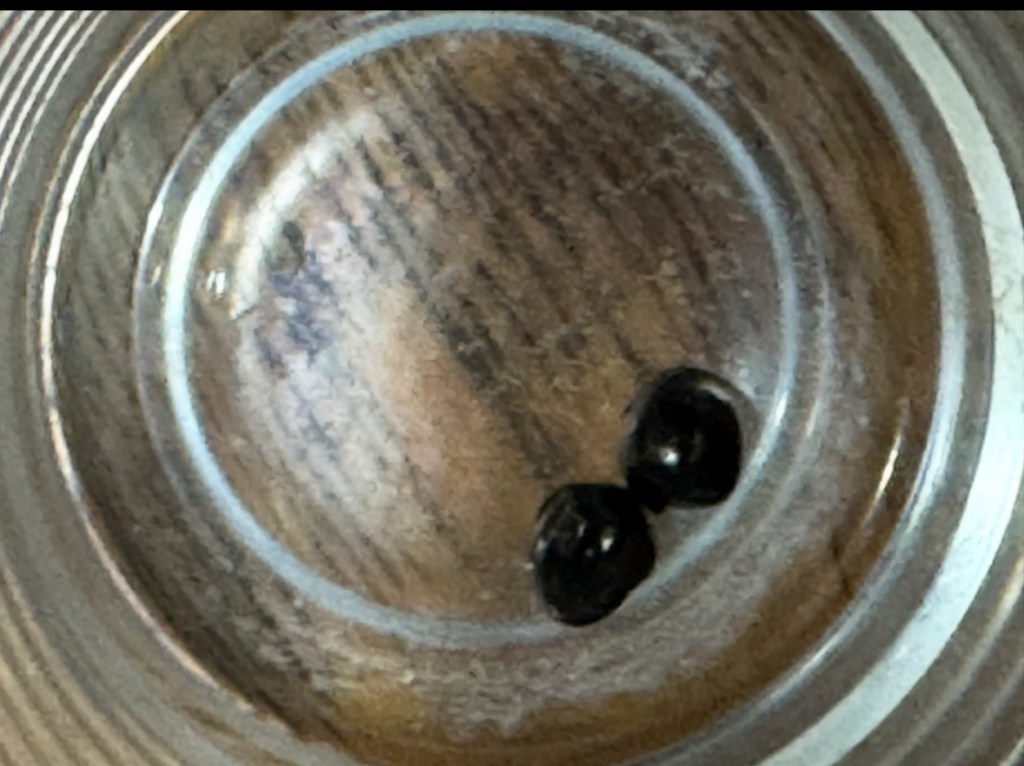
The daylily seed is all harvested at the historic cemetery

Yesterday I harvested the last of the daylily self seed at the historic cemetery. It was self seed from Red Volunteer, the only purchased and planted daylily from last fall that bloomed. One other Red Volunteer came up late but did not bloom this year.

A few weeks ago I harvested 78 Stella De Oro self seed from the historic cemetery, and those will be direct sown there in spring. It will all be in one patch, and then “survival of the fittest”. For the two Red Volunteer self seed, I will plant each seed in a seedling mini pot for germination and season 1 growth.

I do not do intentional crosses at Oakwood so there are none of those seeds to harvest.

So with the daylily seed harvest now done at the historic cemetery, all efforts turn to any remaining transplanting and then to starting the fall cutback.

It is hard to believe, I am wrapping up year 3 in those gardens!

Why I Go Slow

When creating gardens, I, most often, go slow. Yes, part of that is age, and energy. But a much more impactful reason is collaboration and testing.

Many years ago, a friend told me that we grow gardens for others. I had to think about that a while because I enjoy my gardens so much. It is, however, somewhat true. For the most part, the gardens we grow are enjoyed by many more people, and pollinators, than the gardener. In public gardens that is especially true. And so it is with the Oakwood (historic cemetery) gardens.

In both the Mahala Felton garden and the Shirley D garden, we inherited donations. For years, well before I came as a volunteer, people would find spots for their donations and come and plant them. When I took on the Oakwood garden, I did radically change the aesthetic and the maintenance, but I tried to leave the plants, especially those that were doing well. That took time to observe. 3 years of time.

Now I have a pretty good idea of what will do well in those gardens, and they both have a different feel. Against all odds, Shirley’s garden has quite a few hostas. The hostas I went on and on about needing to move, are thriving. In a full sun garden with no irrigation. Go figure. And the Asclepias a bird planted (or so the story goes ;)) survived despite my secret desire to pull them out. Yes, I know they are essential to the monarch population. Other things have also showed up in both the Mahala and the Shirley gardens that I know weren’t there the previous year. And they got to stay. Well, almost all of them got to stay. Lovingly, Oakwood is not an irrigated site, and I am not an irrigation system. I go to volunteer when I can. So, rules of nature – If you plop, you water. If plops fail, I am not heartless. Things that don’t make it still contribute to our compost pile, so they do not go to waste.

All of those learnings were part of a process – a 3-year process, including things I personally planted that did not make it. Nature (or others) sometimes also make those choices. But 3 years in, we have two beautiful gardens we ALL enjoy, for various reasons, and indeed, have taken an ownership stake in. I know for sure neighbors are weeding. Thank you :):):) Someone may have even weeded the Mahala Felton daylily seedlings at the gate, even though it had a marker. You just never know what will work, for a variety of reasons. The Oakwood gardens are a joint endeavor, and, so far, as a whole, it is working. We are growing a garden for each other.

So it will be with the Fischer garden. It will be of the two existing gardens, AND a standalone. It has its own needs, it will be unique to the site, and it may not ever even be seen by many who see the Mahala and the Shirley gardens. So far, for sure, we know it will not have any potted plants – those get inexplicably tipped over. For sure it will not have daylily seedlings – deer and turkeys may think they are appetizers, and they do kind of look like grass so others may think they should be weeded. For sure there will be no hostas – I already tried to make a woodland garden at Oakwood, and it got very “eaten” very quickly. Very sad. In my mind all the hostas from the Mahala and Shirley gardens were eventually going there. But alas! Nature chose.

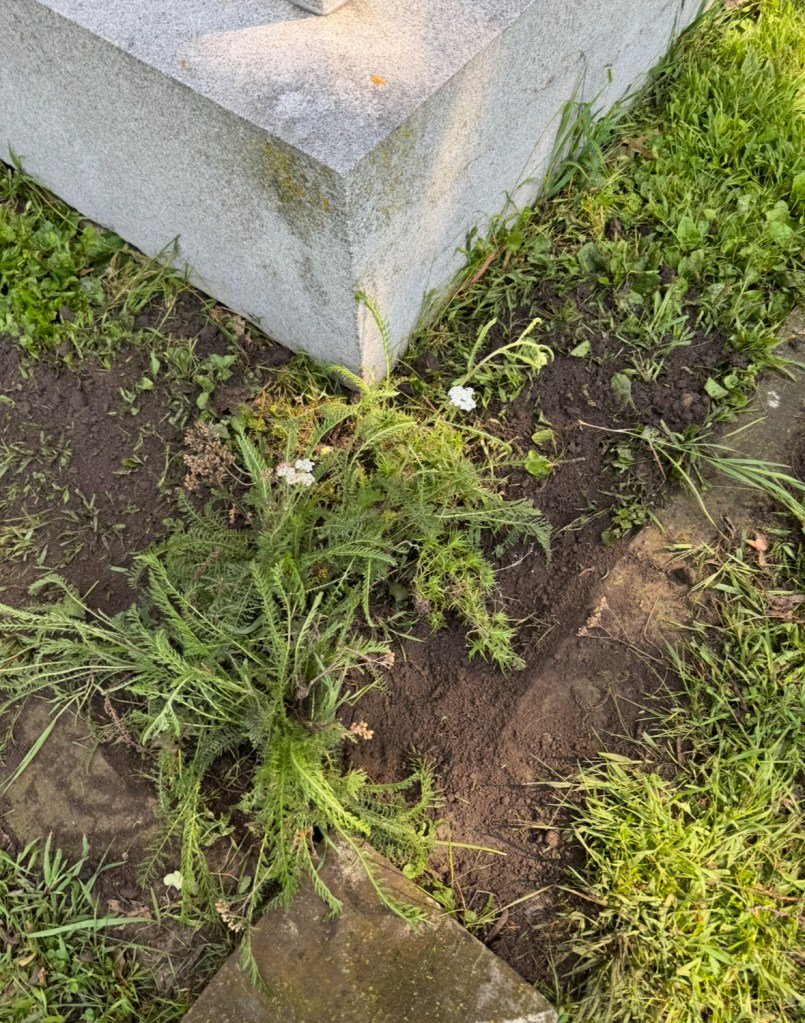
So what will the Fischer garden have? Rules of engagement are: no spend, critter resistant, full sun, no ongoing irrigation – so, drought resistant. So far the Fischer garden will start with yarrow transplants, because, well, we have already started it, and we know, so far, they are working. But we shall see when we stop watering the test plantings. Beyond that, in my mind I see tall purple accents throughout, and ground cover around the babies’ markers. But nature will ultimately decide what truly works. We honor the site, we go slow, and we listen to nature.

Here are pics of the tall purple and the ground cover options I am envisioning. I am going to try seedlings and transplants. We will go slow and see what nature decides.

Wrap Up, Start It Up

Today is the last day for 2025 daylily blooms in our townhome gardens. Hello Yellow opened the 2025 daylily bloom season, and she is closing it out as well. She is AMAZING! And she is a mystery. I would be tempted to say a bird brought in a Stella De Oro seed, but a) she has repeatedly now typed out as a tetraploid, and today I harvested seed from one of those crosses, b) I planted her as a seedling from seed I harvested (I don’t own any Stella De Oros) and c) I haven’t been able to replicate her. So, she remains “Hello Yellow” with parentage as “sdlg” Her seedlings, if we are so blessed, will be fun – partially because she is not at all scientifically supportable. She is a gift. A reminder that I cannot support everything beautiful with data 🥰

And as the daylily bloom season at the townhome comes to a close, of course I have interwoven that eventuality with something new. Why wouldn’t I? And not something small like weeding or tossing worn out garden gloves or taking cloches off seedlings or moving rock that keeps overflowing into the grass or onto the sidewalk when it rains. No, no, nope. I need something much bigger. Multi-year, very challenging, requiring no money investment, but rather just repurposing and harvesting for new – exclusively, you guessed it – from and to the historic cemetery garden. How did I arrive at this set of requirements? Well funny you should ask. It has to do with 3 years of work there, studying, observing, seeing weird stuff (like things disappearing – ahem – Mahala Felton seedlings and purchased and planted daylilies), and a love for solving reasonable needs. Enter the Fischer project.

The Fischer project was born out of me not being able to keep my joy to myself and sharing that it only now takes one hour per week to weed the entire historic cemetery garden. And, by the way, since we are adding another garden, we need some refining nomenclature. Going forward, for my blogging purposes only, the left side of the wall garden at the historic cemetery will be referred to as the Mahala Felton garden. The right side of the historic cemetery garden will be referred to as the Shirley D garden. And the new garden will be the Fischer garden. So, I was sharing that I felt a bit guilty, not too bad, but a bit, that the historic cemetery garden in year 3 now only takes one hour per week to weed. Or one hour per side every two weeks, or, well you get the gist. And Shirley’s husband, who is an absolute rock star, who helps Shirley keep up the cemetery, said something to the effect of “Do you know the Fischer site?” Yep, kind of, I said. And off the project started. The Fischer site is definitely a long-term project. It will for sure take a couple years to turn into a garden that replaces grass with plants, that does not require mowing. And that is the need.

So, the challenge is a garden at the site that is deer, squirrel, bunny, and other critter – two and four legged – resistant, drought tolerant, very low maintenance (like cut it down at year end), no mulch, does not obscure markers (so ground cover in some areas), and (my requirement) feels healing, and peaceful, and, well, quiet. The Fischer site is the site of early settlers to this area, but their story was very different from the Feltons story.

And that is where this blog ends. But I (with the help of Shirley’s historical research) will share more as time goes on. About the Fischer story (history), about the new garden plant choices, about the new garden successes, and I’m sure failures, and about how things look as we go. Shirley just texted to say they are at Oakwood, and she will water the new plantings. They don’t look like much – a few bunches of transplanted yarrow from the Mahala Felton garden – but it’s our new work in progress. Now that the Mahala Felton garden and the Shirley Dalaska garden take so little effort, their gardens are going to fill the new Fischer garden. That I LOVE 🙂

Shirley D

We are deep into daylily season now, and I am seeing patterns regarding daylily crosses that will work this year. For instance, the cross that made the Mahala Felton dedication daylily will not have a repeat seed creation season this particular year. One of the parent daylilies is not sending up scapes right now. That happens. It is a healthy daylily, not crowded. It could be that I just overworked it last year. For this year, the Mahala Felton daylily seedlings are doing well and will start to be be planted this fall in various locations in the Oakwood Cemetery garden where Mahala Felton is interred.

I am also having challenges this year with getting the Molly Cowles dedication daylily cross to replicate. 60 seeds last year, and not a single success with that same cross this year. But that, too, is OK. I have so many Molly Cowles seedlings that some will probably even go up north. I will continue to try to replicate those crosses this year. There is still lots of runway ahead. And some things happen for a reason.

Those daylily seedlings are wonderful, and I hope they will bloom absolutely beautifully, but I knew there was more to come. It was forming in my mind. Something a bit different.

We were “getting there” when one of the daylilies I purchased and planted at Oakwood last fall began to bloom a few weeks ago. That daylily’s name is Red Volunteer.

“Volunteer” has layers of meaning. What a cool daylily to be at Oakwood. And it is stunning. I am hoping for way more blooms next year. I only caught two this year.

But something was still in my mind. It just was still in a “waiting” state. Something with ties to meaning. It finally arrived.

Dedication daylily “Shirley D” is a dedication to my good friend, long time historian and author, and fellow volunteer at Oakwood Cemetery. Shirley puts up with my relentless garden talk, endlessly long texts, and ridiculously ambitious ideas. And Shirley and her husband Mike dedicate uncounted hours of personal labor as well as their substantial leadership to Oakwood Cemetery. They are, in my humble opinion, the primary reason Oakwood Cemetery is in the renovated state it is in today.

Dedication daylily “Shirley D” is from 2022 harvested seed. 2022 was a tough year for me. It was the year my husband and I decided that the little home up in the mining town in northern Minnesota (that we had renovated and planned as our retirement home) was not truly a match. Our plans were upended. We were back to the townhome plan, and I was gutted. I wanted a yard to renovate into a garden. I wanted to be in that area. But it was just too small. My friend Shirley was a dear sweet comfort as I greatly grieved selling that house.

The following year, as I was looking for something I could pour myself into through gardening, Shirley, once again, reminded me of opportunities at our local historical society. While dedication daylily “Shirley Dalaska” was slowly putting roots down where I had planted her the previous fall, I joined the historical society, intending to mainly garden. I took a meandering route, but eventually I found my way (back) over to Oakwood, where I, once again, saw the old, abandoned garden I had seen before. Volunteers are not in plentiful supply, and no one had felt both a calling and the time to address it. And honestly, I too had no interest in that garden. The goats that had been at Oakwood to eat the buckthorn a few years before might have enjoyed it had they had access to it, but it did not really speak to me at all. I was looking at the huge expanse of a raised bed fence garden that so needed love. The old, abandoned garden had stuff that would look great in the fence garden, but the fence garden needed way more than weeding and transplants. What happened next is a testament to Shirley’s absolute genious. While I was working through what I was feeling called to do, Shirley didn’t give me her plan. She let me come up with a “Susan plan”. An impossibly ambitious plan to move the heaving rock and exposed plastic out and go to a mulched garden. I went to the store, bought three bags of mulch, put some in, took a picture and asked what she thought, and pretty soon Shirley and Mike were there doing garden days, sometimes even when I wasn’t there – moving rock, pouring out bags of mulch, putting up with my insistence that hostas would never survive there and that people who were increasingly plopping hosta donations in the newly renovated garden were going to be sorely disappointed when their hostas died. It was, after all, I said, a full sun garden, for goodness sakes 🙂 (Those hostas are thriving – lol) Shirley has stood beside me, even talked me out of really bad ideas, and still encouraged me in my efforts. She soooo gets me. She gets my intensity. She gets that I primarily want to make gardens. She gets that I am so pleased seeing the community appreciate the completed renovation. (Is a garden ever truly completed though? I don’t think so.) Shirley gets that I was pretty driven about getting the garden renovated but now am thrilled that I only need 1 hour per week to weed it because neighbors are weeding as they walk by. So cool!!! And she puts up with me saying, for the 900th time, that I am not going there every day to water plopped plants, which still happens lol. It’s OK, she says. Shirley really is a saint. I think she may be watering plops. I’m pretty sure she is 😉

This year, as the daylilies in my townhouse gardens started to come up and then show scapes and buds, dedication daylily “Shirley D” took her sweet time. Other South Seas self-seed creations were coming up, making it onto my blogs. Still created by our mutual neighborhood pollinators but looking “not Shirley”. And then the first bloom. Does “Shirley D” not have the “it” factor? Understated, yet undeniable presence. Like Shirley D the person, my dear friend.

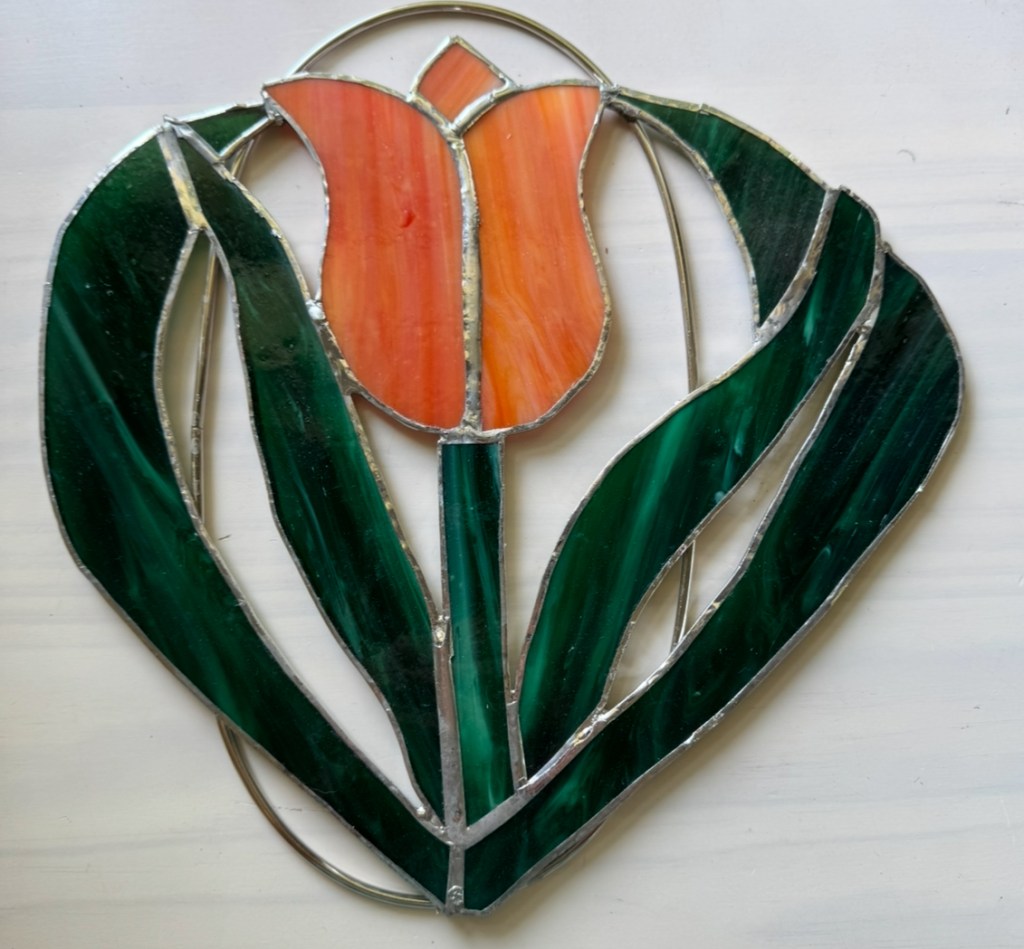
Among Shirley’s many contributions, Shirley does stained glass work.

Back at you, my friend, with another floral beauty.

Introduction to the historical account of Mahala Felton

In this post I am going to kick off a series sharing research I have done regarding the incredible history of Mahala Felton – the first white woman settler in what became Hastings, Minnesota, USA.


I became interested in researching the historical account of Mahala Felton as part of a winter endeavor to create posts for one of the local historic cemetery sites. It is the historic cemetery site I have shared so much about in my garden blog posts. It is the first cemetery that was established in our area and it is the final resting place of many of our area’s old settlers. Mahala Felton and her husband William are buried there, along with family who followed. Their story is amazing, and I just couldn’t stop researching, for months.

In these posts I will focus primarily on Mahala, but there is no way to not share all of the historical work William did, as well.


Now my disclaimer; I am only as good as my sources, and many of those sources are well over 100 years old. What I am hoping to do is get all of my findings out in one place, this blog, and I am also hoping others may add, adjust, correct with what they have found. I married a historian oh so many years ago, but I have never had so much interest in historical research as I have found in Mahala’s story. Interesting, and very engaging, but I am also aware that some of what I have found may have need of updates. I hope you will enjoy and, if so inclined, engage. Let’s go.

A person’s name can be very interesting. I had never heard the name Mahala before, and I was curious as to the meaning. Some words I found were tenderness, and even weak. After months of research, from what I can tell, Mahala Felton was kind and hospitable, but from every account I have read, we can cross off weak as a descriptor.

At 47 years young, after raising six children, Mahala Felton and her husband William headed out on a new adventure. genealogy trails.com citing History of Dakota County and the City of Hastings, by Edward D. Neill, North Star Publishing Co. Minneapolis, Minnesota, 1882, recounts, “In 1852 the Felton’s took a boat from Pittsburg, Pennsylvania, for Minnesota. The name of their craft was the Ben Campbell, and this was its first trip.” They were leaving Pennsylvania, and heading west.

Now, my historian husband will cringe at this, but we are going to go “human interest”. Can you imagine this? They had grown children. They could have stayed rooted, started to enjoy grandbabies … But they headed out, west. On a craft on its first trip. To Minnesota.


So far we already know William and Mahala are, for sure, pioneers.
Now we move on to settlers, original old settlers.

Enter Alexis Bailly. The account explains Alexis Bailly, “watchful of the signs of the times”, that the territory was soon to be made available for claims as a result of treaties, in this case with the Sioux, had established (licensed) a trading post in Olive Grove (that later became Hastings, MN). This was the only way to legally occupy the area. Alexis established a trading post in Olive Grove, but his son Henry, by and large, ran it for his father Alexis. (More details on that below.). Alexis did spend a lot of time in the area and was quite familiar with it, but he was primarily based out of Wabasha, and in charge of the trading post there for the American Fur Company. Wabasha was where the Feltons disembarked and that is where they drew the attention and approval of Alexis Bailly. The account states, “Alexis Bailly, as principal proprietor and general head, had seen, from his home at Wabasha, some slow but sure development of his plans. His son Henry had been faithful, constant and denying to a degree that challenges our admiration. He was growing weary of the solitude, the inaction and the humdrum of life alone, when William Felton, Mahala D. his wife and their son Elias left Pittsburgh, Pennsylvania, in June of 1852 for the west.”

William, Mahala, and their son stayed with Alexis Bailly upon disembarking. What happened next was pivotal to where the Feltons settled. The account explains that, Alexis Bailly “pleased with the appearance of his guests, and still hopeful of a future for Olive Grove”, offered the Feltons a deal to help his son Henry run the trading post (which became the hotel and eventually the meeting place for churches as well as the general meeting place for legal matters and city planning, but that is another post). After a few days journey of William and Elias being given a tour to and of the area of Olive Grove, it was decided. They would have not only a place to live, at the “Buckhorn”, but all the supplies they needed for themselves and for the trading post, and to run the hotel.

The Dakota County Historical  Society explains that H. G. Bailly’s trading post was a small log cabin at the corner of what is now Vermillion and 2nd St.  It “became the city’s first hotel and tavern, the Buckhorn”. https://www.dakotahistory.org/images/HistoryMaps/Hastings-History-Map.pdf

And Mahala Felton became the first white woman settler in what was to become Hastings, Minnesota, USA

In the next few weeks we will begin a deep dive of what I have found about the early years, but here is a sneak peak.

An article in the Star Tribune states, “Considered the first white woman settler in the Mississippi River town of Hastings, Felton ran a boardinghouse in the pre-statehood 1850s – feeding and housing as many as 43 people a night in a cramped log cabin.”https://www.startribune.com/1850s-hastings-pioneer-handed-down-the-hospitality-gene/417095093

Mahala’s husband, William, operated a rope ferry, was an elected justice of the peace in the area, and was the long time coroner. He was as busy as she was.

Mahala was often alone in the cabin while her husband was out, and there are accounts Sioux would stop in to visit while her husband was away. We will dive deep on those accounts, and also other notable visits when her husband was there.

Despite Mahala’s well documented contributions, it seems she was not considered as among the “Old” Settlers. In February of 1868, Mahala wrote a very polite but pointed protest letter at having been overlooked as an “Old Settler” of the area.  In addition to describing her and her husbands’s date of arrival, working conditions, a shortage of food for hotel guests, and her need to kill a hog after “old man Bailly” missed in his attempt and the wounded pig went running off, she also wrote, “Some may think it queer that I had to do all the work alone, but the reason was I left my girls all behind.”

And that is where we will end this week. There is so much more. And yes, her family did follow, and some are still in original homestead land. Oh, those maps were fun! But we will continue next week. Til then, happy trails, and of course, happy gardening! OK, yes, William was one of the original farmers on the dedicated farm land. But that really is all for now 😊

Figuring Stuff Out


Any perennial gardener will tell you that we are an interesting bunch this time of year.  We are raring to go, but the weather teaches us patience.  I am soooo there these past few months.  And compounding that is a not so little journey I have been on to get ready to retire. 

So this story goes back a few years.  I have known I needed a plan to successfully retire for quite a few years.  I have watched various female family members “fail” at retirement, and return to work.  I didn’t want to have that scenario, so I started to consider options.  I started to look at my bucket list.  We had done the camper on land up north.  But to do a garden up north we needed a well. That was tbd.  Our getaway, but potentially a retirement location to build out.  If I could handle not being in a neighborhood. We had also renovated a little house in a mining town off Lake Superior.  I could have turned the whole back yard into a garden and spent winters on lots of seed projects. It also had a neighborhood. All of that would have been a success from my viewpoint but my husband was very unhappy.  Not with the location, but with the house.  After we sold that house, I needed to do more definition of the items on my bucket list.  I kind of stalled out there.  More like gave up for a while.  But eventually I got back into gear and came up with next steps.

I had started to volunteer garden for a local historic cemetery. I knew I could stay very content from the beginning of May to the end of October, gardening between the townhouse and the historic cemetery.  I had bumped up against my energy limit last fall while planting all those new daylilies and divisions, but I knew that was a big season finale.  With everything planted and the historic cemetery garden switched over from rock to mulch, I knew 2025 and forward were right-sized – enough challenge but not too much either.  Where the problem came in was November through April.  I simply didn’t have room for big seed projects, and I needed something to do in our long cold winters, preferably with a neighborhood or some type of consistent socialization.

Now admittedly, I am not a spring chicken with unlimited energy, and I also have some health stuff.  But our house is pretty clutter free, so it stays pretty easy to clean, and the garage only takes a day in spring and a day in fall to get into maintenance shape.  There is just not enough to keep me busy November – April in retirement.  But I came up with a plan for that too.  I would work toward going back to contracting, and look for 6 month contracts November through April, when I was ready, and see how that went.  

Simultaneously, as part of my volunteering, I had a plan to do posts for our local historical society to keep me busy this past winter and to bring more proactive attention to the historic cemetery.  Between contracting and writing, I knew I could keep a good level of challenge.  And, of course, normal life has normal family and friend activities.  All was in hand.  

What I did not expect was the level of historical research I got interested in.  I wrote a few high level, season appropriate posts and then I started on a deep dive.  And that, my friends, was how the Mahala project was born.  That project has kept me very busy, through the deep of winter, past a layoff I suspected was coming but may have shortened my runway to retirement, and now almost a month into spring.  The research is now done, and I need to start writing. And I need to get what I hope are the “Mahala” seeds to go to seedling and, hopefully bloom.  But before I plant those 28 seeds there is a second baby shower to attend for our third grandson, and then Easter.  And it would help if I could get the shamrocks outside so I can have that indoor space for seed planting, but it needs to be consistently 40 degrees Fahrenheit at night before that can happen.  Oh, bother 😘

I am applying for jobs that really look super interesting, as they come up, but my guess is this is either retirement time, or a winter contract will pop up in due time.  We shall see.  There is a lot that is out of my hands.

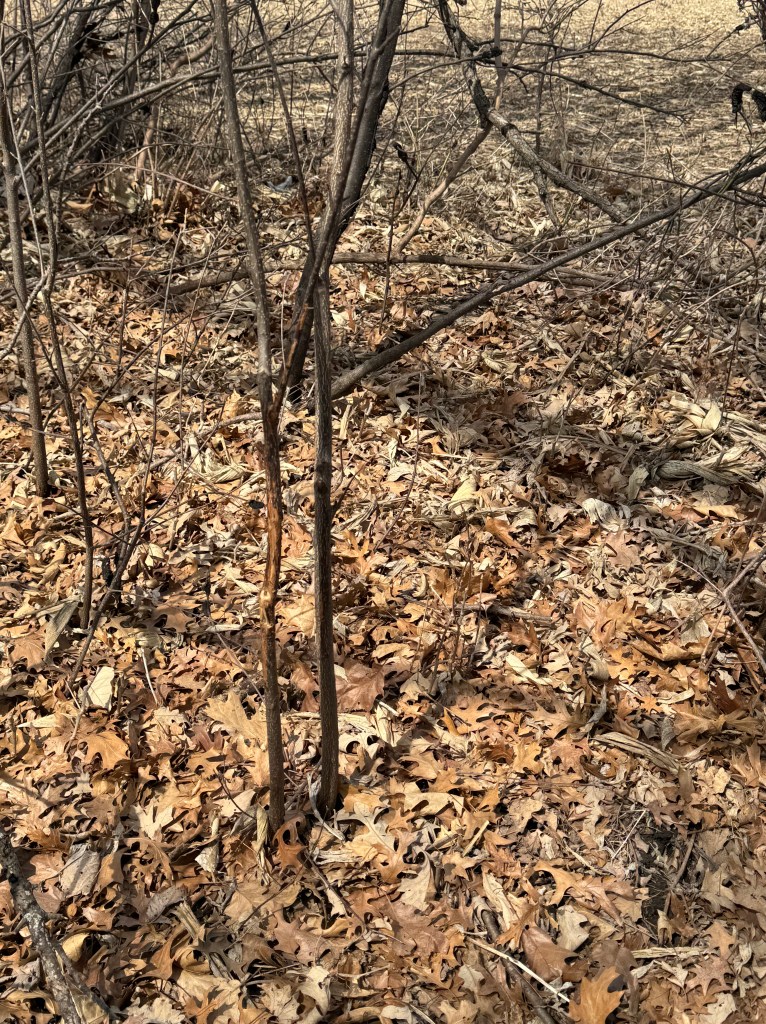
Yesterday was cool. All that got done, garden-wise, was a walk over at the historic cemetery. My husband showed me some new things in the woods – a buck rub,

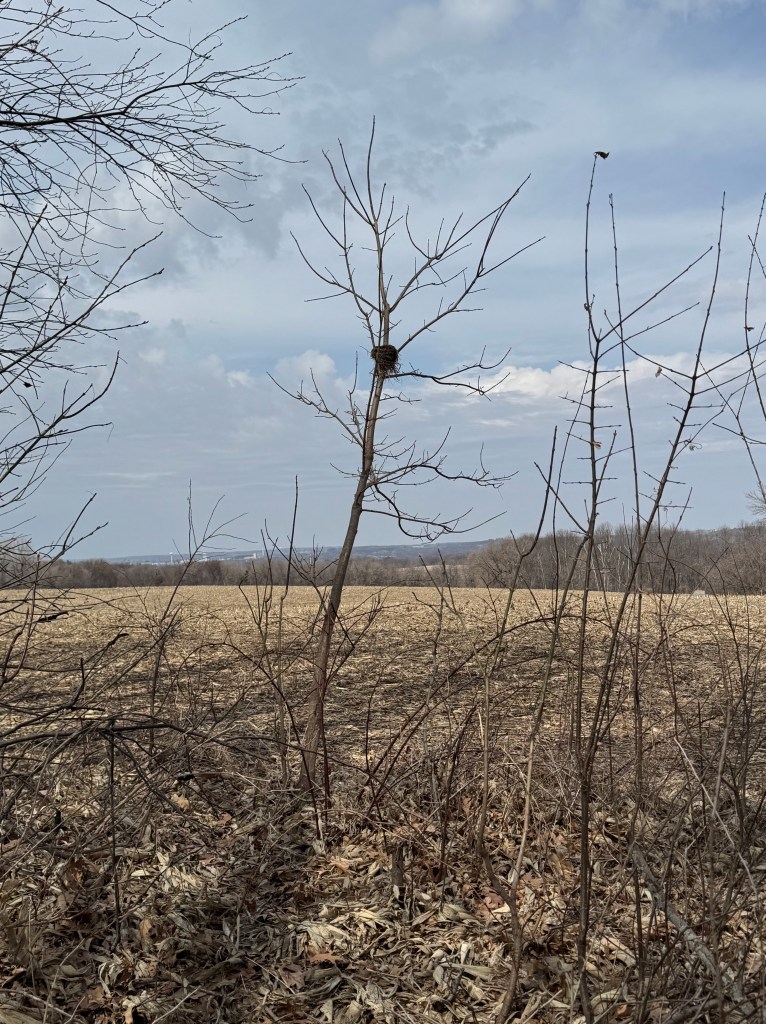
and I noticed a bird has a very nice nest in a tree along the edge of the adjacent corn field.

I also noticed the old garden has turned into a food plot for the deer lol


More to come. 

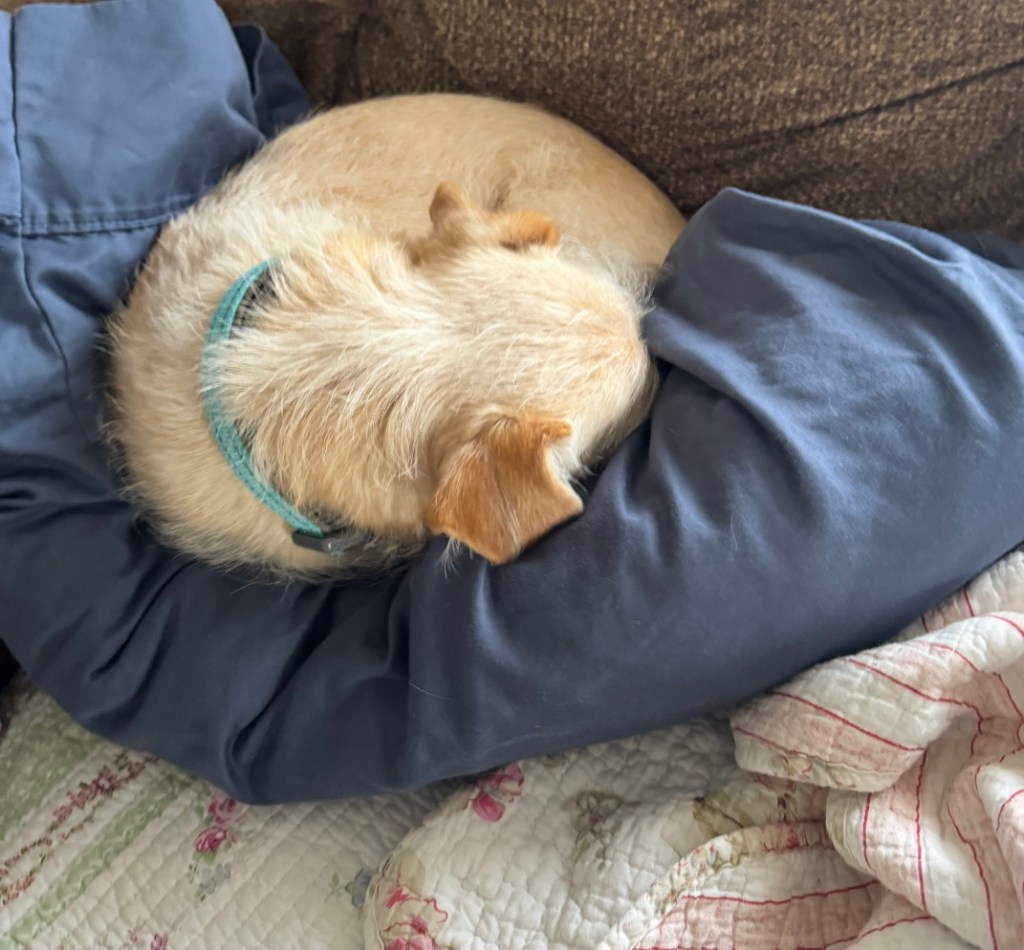
My trusty side kick is here to spur me on.  I guess when you are a centenarian in dog years you can nap on a pillow, on blankets, on a recliner 😂