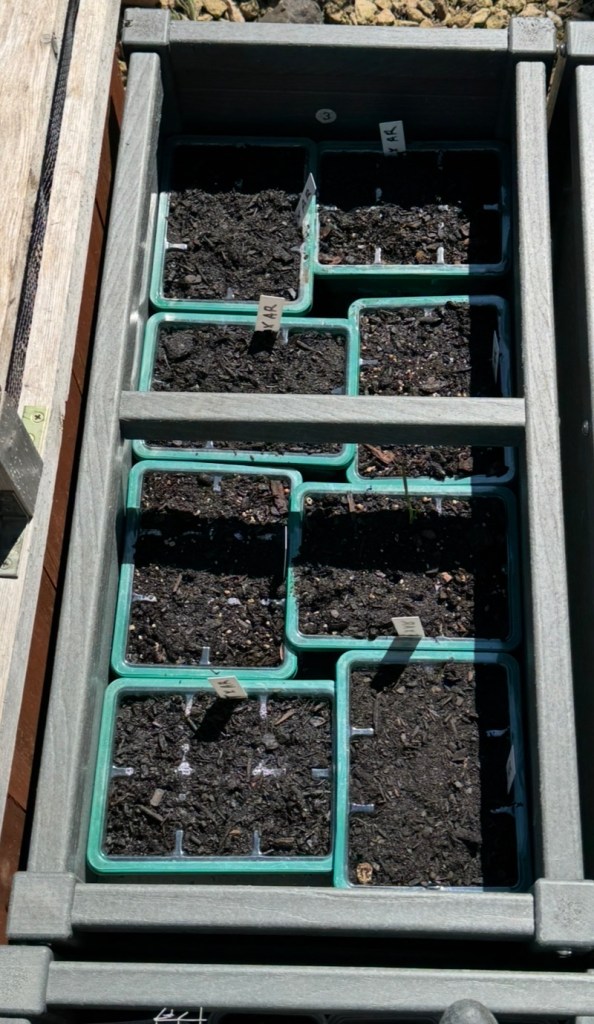
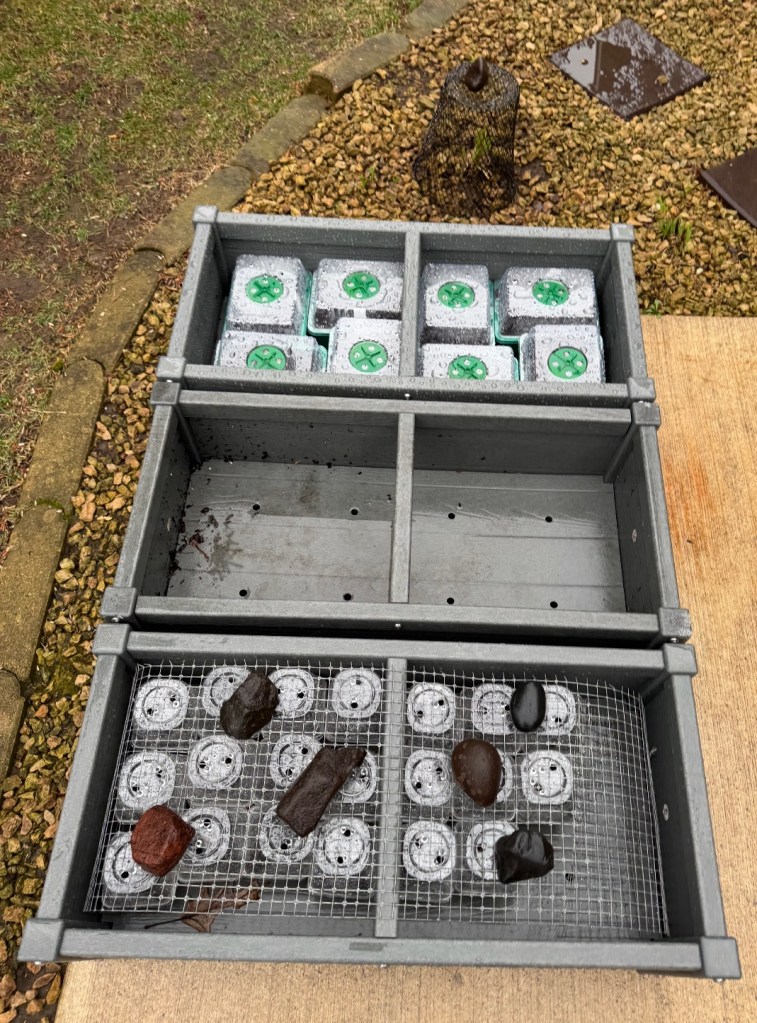
These trays were planted indoors on March 23rd and went outdoors on April 12th. On April 24 I saw the one seedling (in the shadow of the cross bar) and since then nothing else has come up.
Here’s reasons I can think of for the failure:
The seeds need more time out in warmer weather. (Maybe. I will give them a couple more weeks.)
The trays are horrible (I’m going with this one. These trays are not staying. Way too putzy for me, and so far, the results stink.)
The one seed that did germinate was the only viable seed. (They all looked good when I planted them.)
Here’s some positives:
Even though these may be a 98% bust, there is one seedling, so far. It only takes one.
This batch was a test of a reverse cross of a wildly successful cross from last year. The pod parent is one of my favorite daylilies, Pink Tirzah, but the data available is a bit scant. Most of what I know about Pink Tirzah is what I have proven out myself, including even ploidy. Now I am working on fertility. The pollen from Pink Tirzah has been awesome, but as a pod parent, not so much. I have only had one other cross that went to seedling with Pink Tirzah as the pod parent. I am hoping for bloom on that one this year. I do love Pink Tirzah, so the work continues. This year, besides seeing how this cross goes, I am hoping to get Pink Tirzah self-seed, as I will not be doing intentional crosses with Pink Tirzah this year.
And there is still hope. I have a medium pot of seeds of this same (reverse) cross I planted and put out a few days ago, using my usual very successful, albeit quite lazy, method 😉
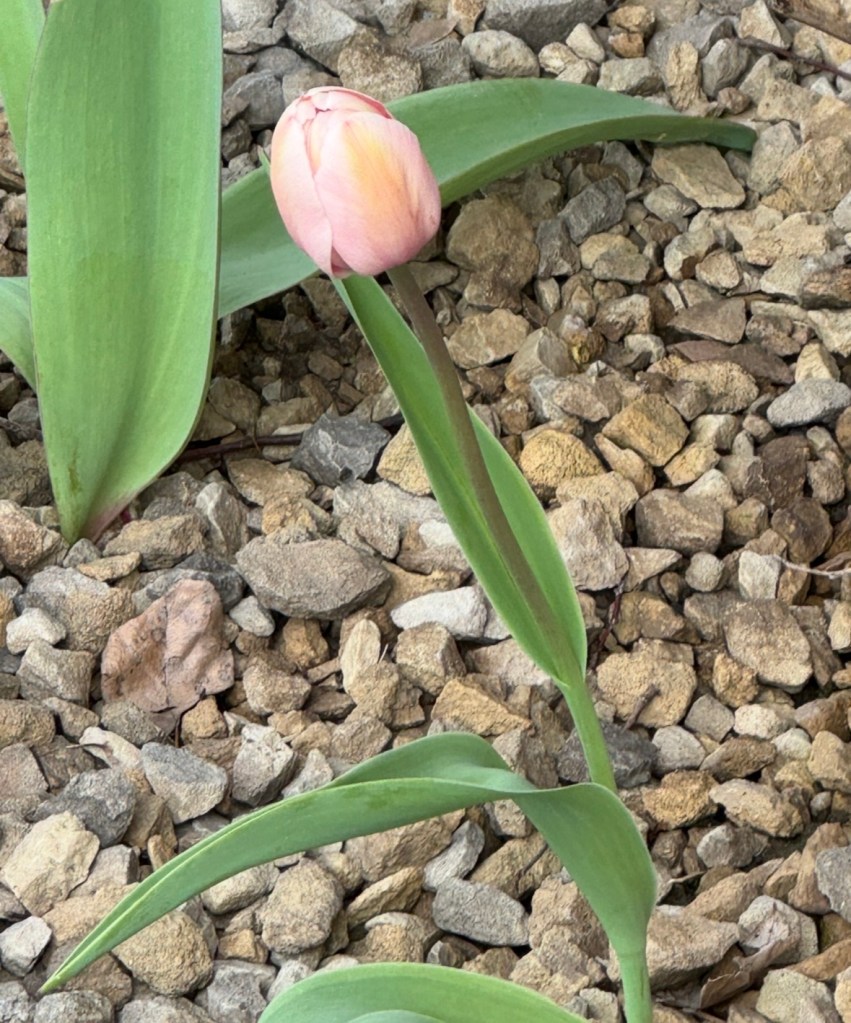
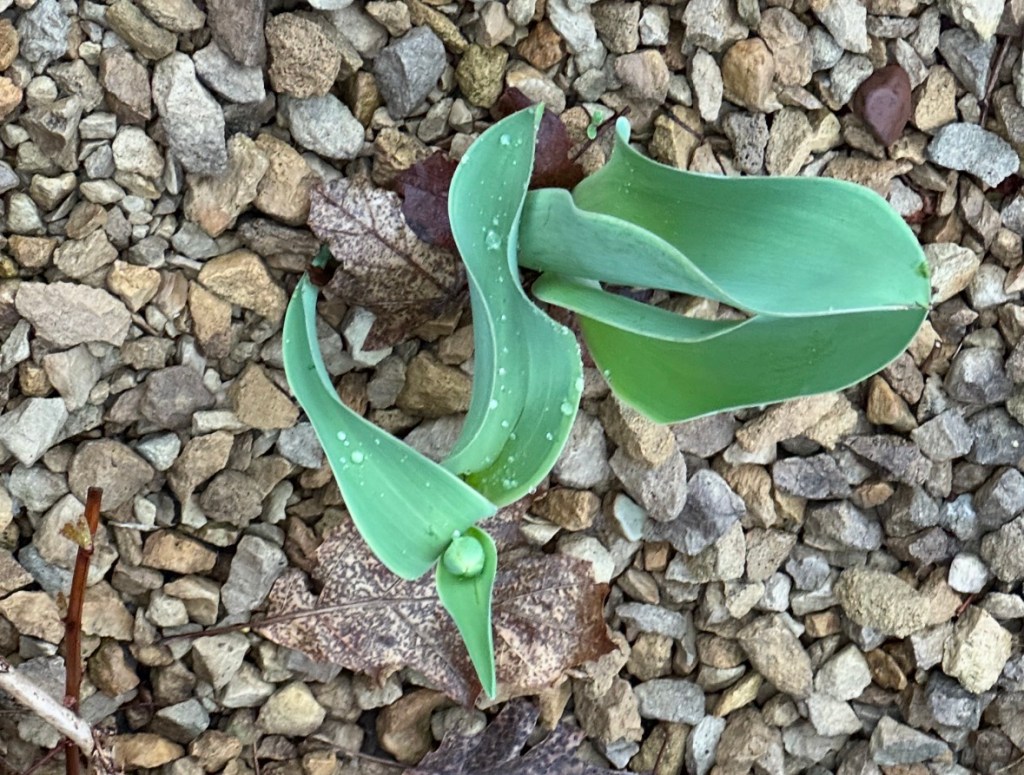
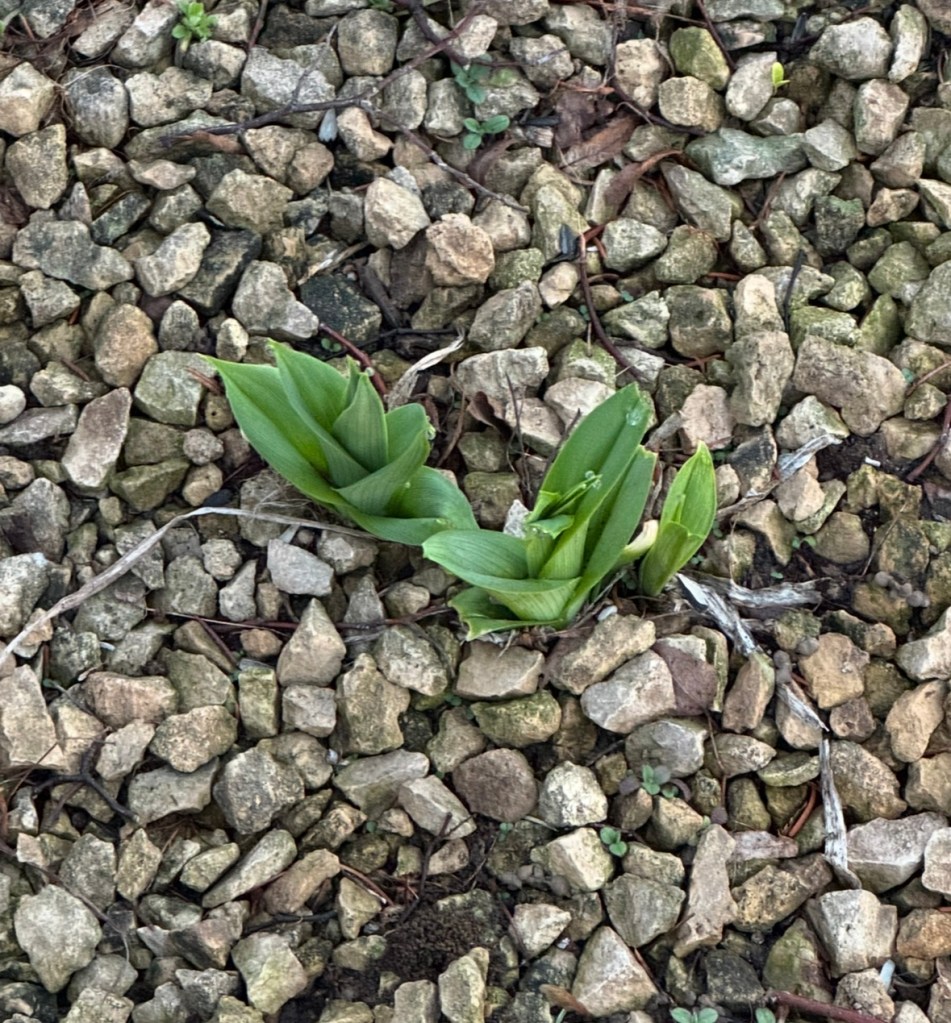
I have planted lots of tulips over the years. They bloom a variety of successive years and then fizzle out. This year only one bloomed. That is down from two last year.
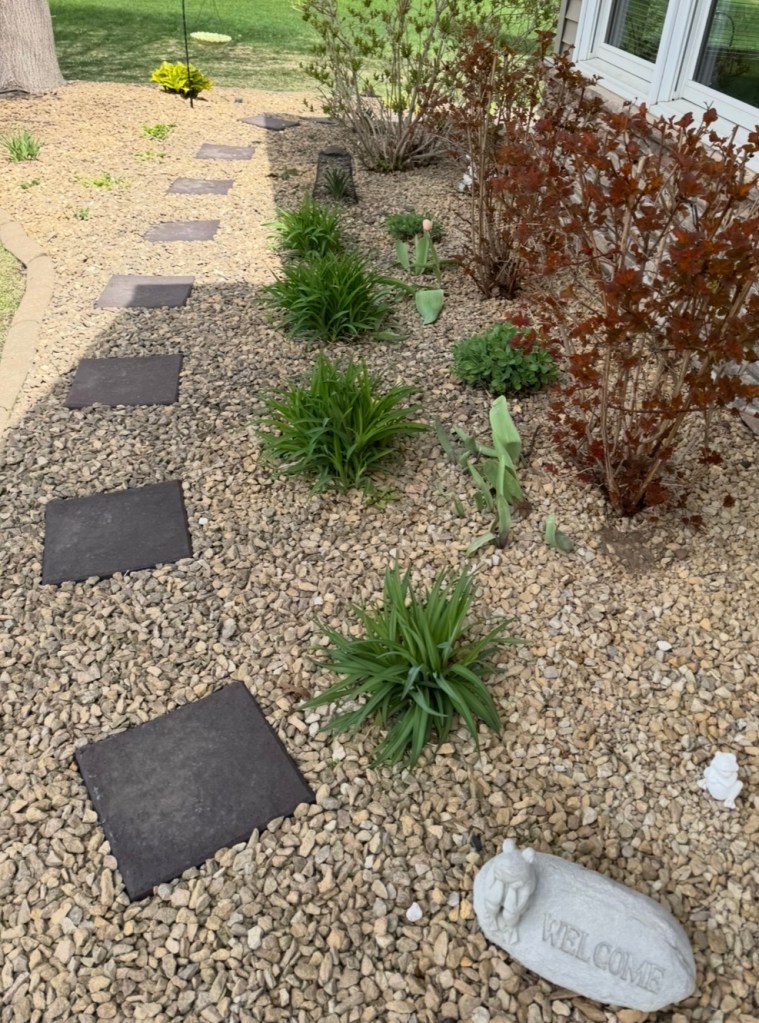
Part of me says I could dig out the old greens to tidy up. Currently unproductive tulip bulbs only get removed when I want the space, and nowadays that is exclusively for daylily seedlings. Unfortunately, I have tried daylily seedlings in this area, and they get stepped on:( But, wheels turning … Maybe a certain Pink Tirza and Autumn Red cross will bloom this year and be the first seedlings turned daylilies to move to this area. To join their parents? It’s a thought.
In the meantime, we will enjoy our one tulip bloom 🙂
We are at the end of April now, and what a difference the last week has made!
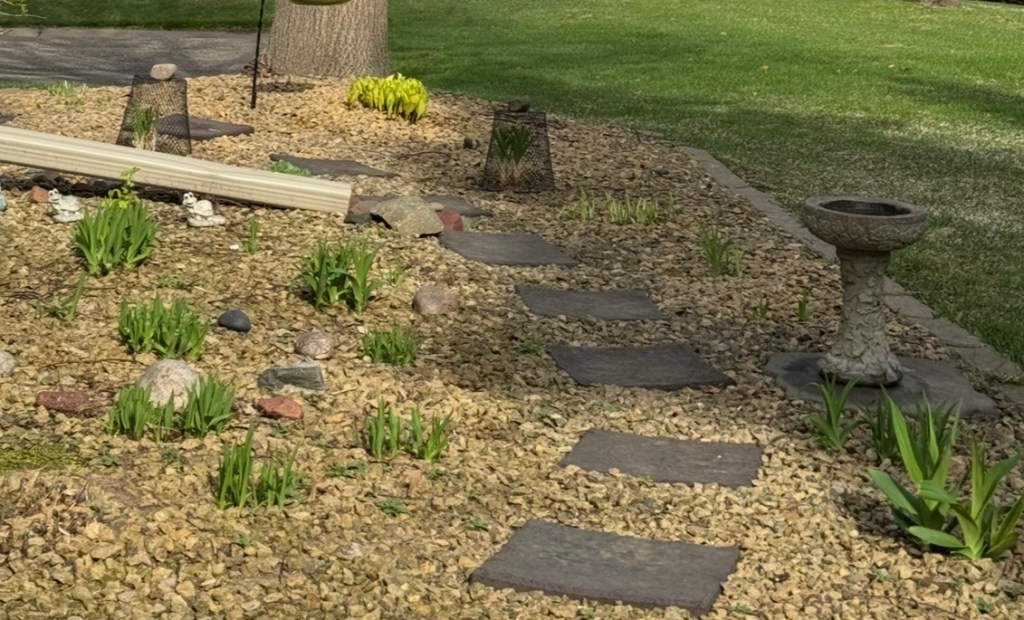
Sandy’s Corner is really filling out.
The daylilies look great.
Last year’s seedlings are much farther along than in previous years when I was still working at finding out what they liked best.
The hostas are even looking much fuller this year.
And our volunteer shrub does indeed look like a currant. It can stay, at least for now. The birds will probably love it.
On the flip side, I could kick myself for buying those tiny little 6 cell seed planting setups. They definitely fit perfectly into the grey seedling boxes, but the seeds are not germinating like they do when I plant medium pots of up to 20 “same” seeds together. I think I know someone who might appreciate them for starting veggie seeds next year 😉
Overall, I am finding that I really like what I have going on in the townhome gardens this year. It has been fun to see the new look and focus come up, and I am more convinced than ever that scaling way back on the crosses this year is the right plan. I can always scope up if I want to, but I am definitely not enjoying that I have so much work yet to go on getting last year’s seeds going. A lighter scope next year continues to sound fabulous.
The historic cemetery gardens are really filling out as well.
This past weekend my husband and I went over and did some spring cleanup at the historic cemetery gardens. They are really looking good! I do suspect our phantom weeders have been helping as well, because I kind of remember it being a little messier a week or so ago. So, thanks to them!
There is one sad thing. Over the past couple years, I have added purchased bare root daylilies to the historic cemetery gardens, as well as added seedlings from crosses I did at the townhome gardens. When I walked though a week or so ago, it looked like they were not there. This past weekend that was confirmed. There are moles or gophers over there, but the markers are almost all missing too, so that is odd. At any rate, I do have the seeds I harvested from there last fall, and I will direct sow those to do one final try with seeds and seedlings, but I think I have my answer. Bare root planting is a no go there. And probably seed and seedling planting as well.
On the upside, the daylily from South Seas self-seed that I planted at the historic cemetery last fall is thriving, so additions like that may be an option, go forward.
Sandy’s Corner is coming along. Each morning it looks greener and fuller. A majority of the daylilies in that area are daylilies or seedlings from self-seed or from crosses I did. And each day we get closer to scape and then bloom.
This morning as I was reviewing my pictures from years past, I realized it was a milestone day. That milestone day eventually prompted me to start this blog. And, I realized, I am starting my 9th year of blogging. That is crazy pants.
Some days I think I should call it quits on the blogging. Goodness gracious, I have shared and shared and shared. Down to tiny garden details. I’m not sure there is a lot more to share. But the daylilies …
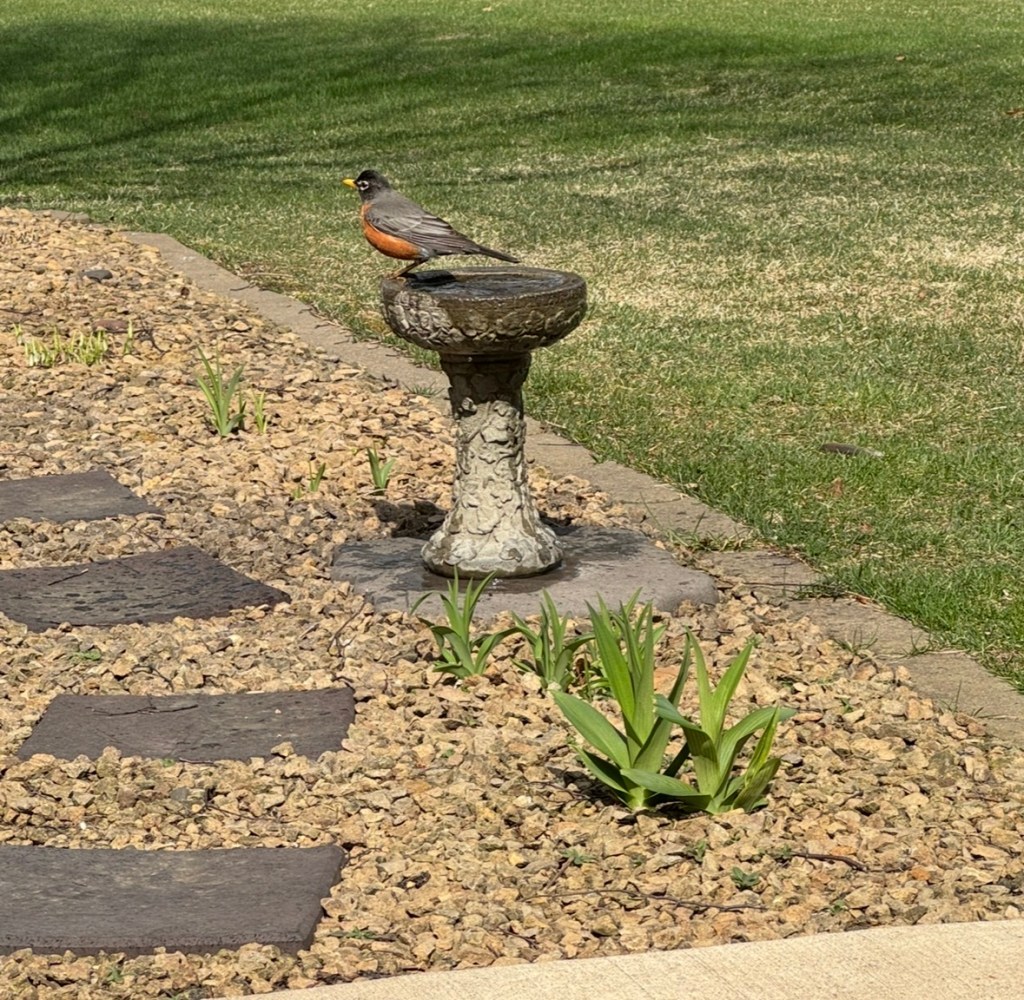
I wrote a detailed blog today – and deleted it. Much more fun to share that Sandy’s Corner is continuing to be a very enjoyable place to look out over that portion of the daylilies and daylily seedlings as the continue on their Spring growth. That I am hoping for more first-time blooms from seedlings again this year. That I am looking forward to more blooms from our prior years’ seedlings turned daylilies. And that the robins were very trusting this morning.
This morning the forecast said rain. I was sincerely hoping it would hold, as the first wave of seeds are now going outside and some natural watering is always a bonus.
I was not disappointed.
The seedling boxes
Starting seeds indoors this year reminded me of why I don’t do that. It was sooo time for them to go outside.
Sandy’s Corner
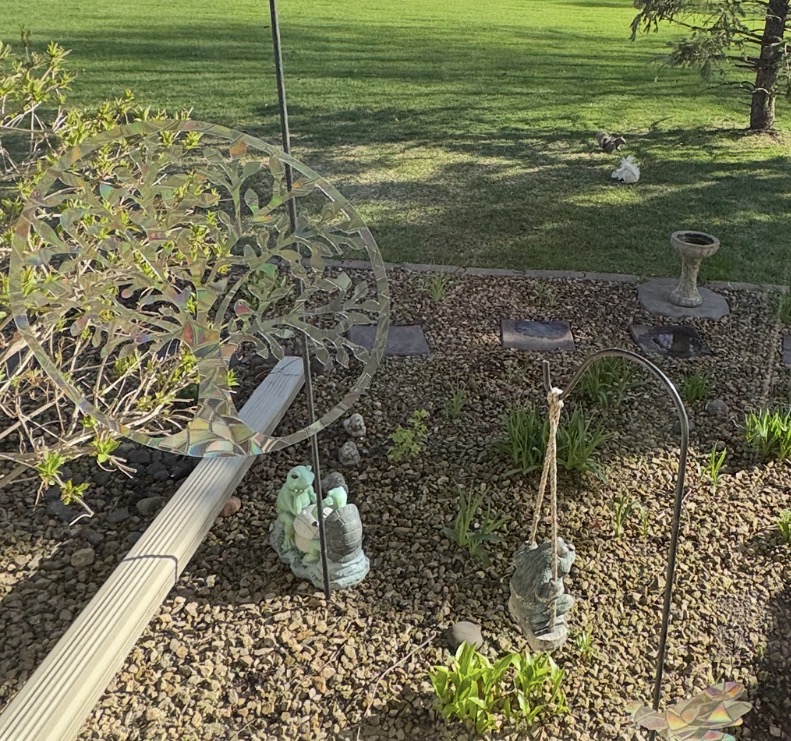
Sandy’s corner
The gardens are missing one little chihuahua terrier this spring and that is definitely sad for us. It is a little extra poignant because Sandy was our last dog. We have decided after 30 years of being rescue dog owners that it is time for that chapter to end. A new chapter is upon us, but our memories of Sandy’s long life with us remain.
We have such wonderful memories of Sandy in the gardens. Specifically, “Sandy’s Corner” is where he liked to sunbathe – on the path, on the grass right outside the garden, or, in his later years, in a dog bed outside the garden on the patio.
That garden area has also changed a lot over the years with the Linden growing and casting different shade patterns. And it is where our successive Traeger shadow has grown.
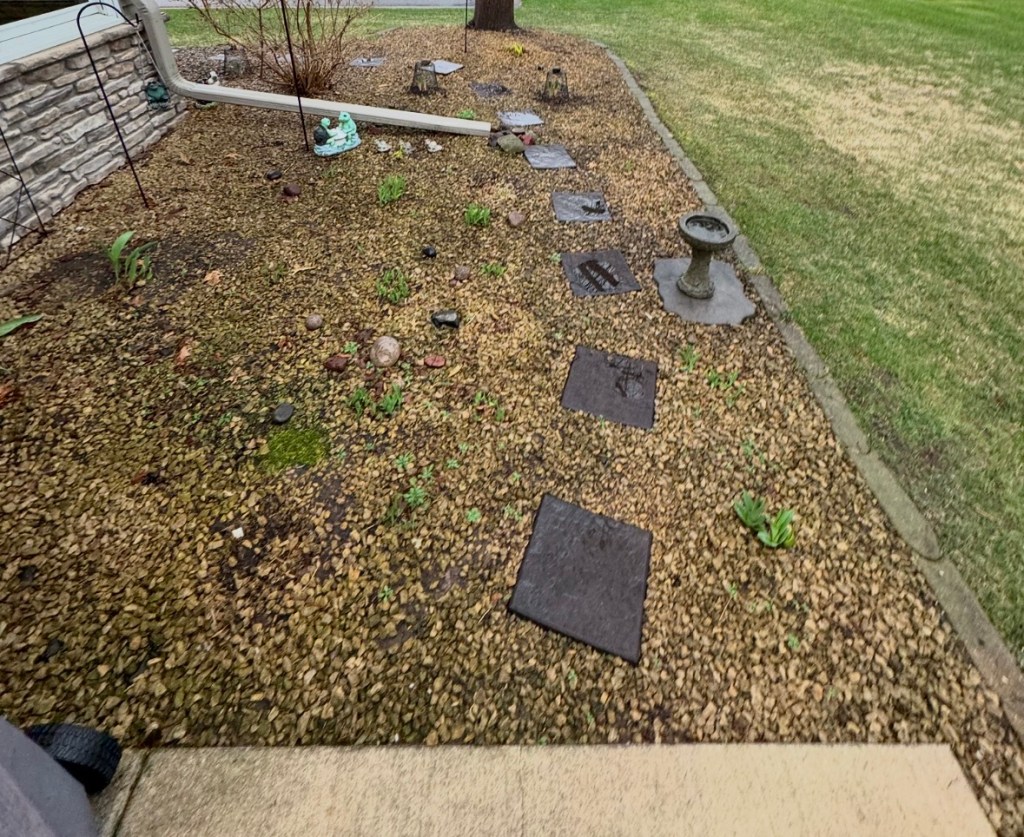
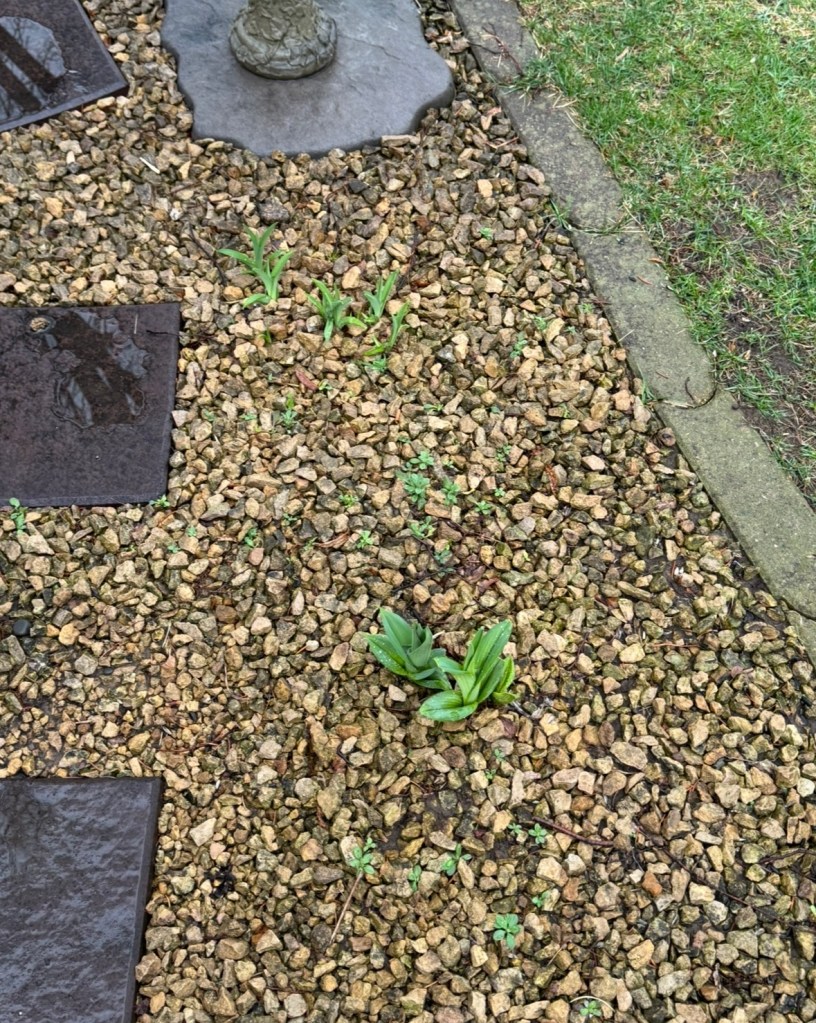
The area closest to the house gets the least amount of morning sun, and I used to, many years ago, have big hostas back there. Gradually over the years I moved those big hostas out and did more with tulips. But tulips around here only bloom a few years, and then they just come up as greens each year. Nowadays the tulip greens are primarily early season bunny food.
When I want to reclaim a space with tulip greens, I simply dig them out. Such will be the case with the tulip greens in Sandy’s Corner this year. I know the hostas work in that area, and I have a large hosta I need to move. It will be a nice backdrop to the daylily seedlings that do exceptionally well with the longer sun exposure farther out.
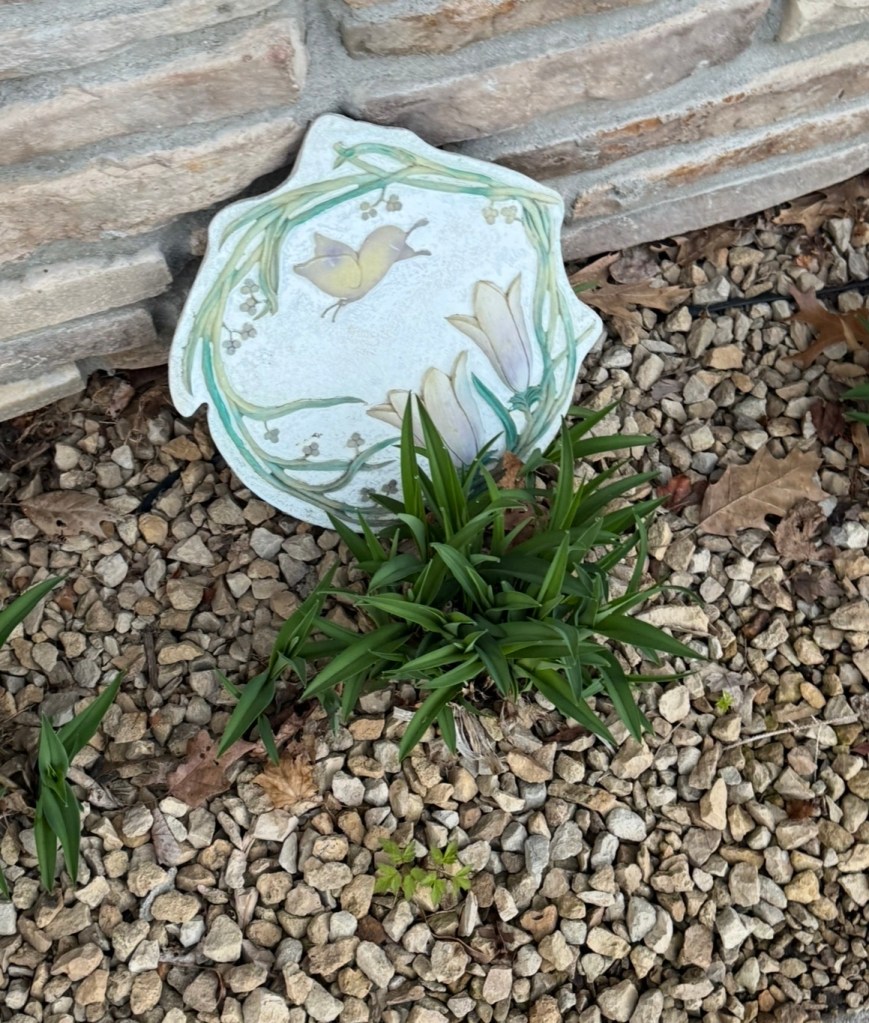
And the little garden accents, as whimsical as they are, will also move out soon. Their short-term job is to remind me not to put anything there. That is the corridor to the hummingbird feeder, and, for that reason, last fall I removed some daylily seedlings from that area. My husband maintains the hummingbird feeders – that we both love to watch, and which should not cause “fear of stepping on daylily seedlings” stress 😉 And no worries, the seedlings I moved are doing very well in their new location.
This sweet tulip is in another area, and it will stay. Hopefully the bunnies leave it alone 🙂
One of two tulip buds this Spring
One spot that will not change is this corner. This is the corner in which Sandy most often sat on the path. There used to be hostas there, but when they began to fail, we moved them, and I reclaimed the space for daylily seedlings. Those daylily seedlings bloomed last year and are back stronger than ever this year (way more fans). They are in the right exposure.
There are also forget-me-nots in that area. I like a smattering of those, but not a mat. Last year I began selectively weeding those out after they bloomed (not letting them go to seed). A little seed is the perfect amount.
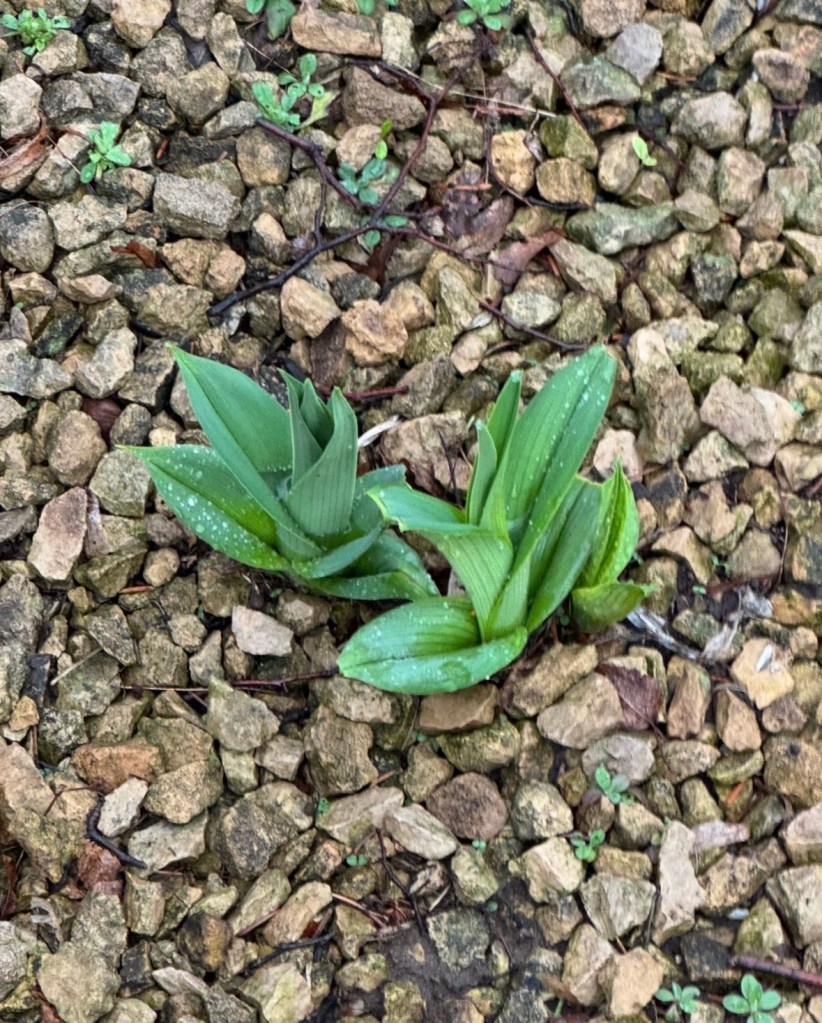
I will never tire of this. Daylilies coming up in SpringA close up
And with that, it is Friday, and I am ready to relax. My husband tells me he is going to make his signature smoked nachos on the grill. My stomach is already growling 🙂
After months of watching and waiting, we are finally into outdoor gardening season 🙂
Top of mind this week in our gardens:
The Hyperion daylilies arrived and have been added to the garden
The Hyperion daylily shipment arrived, and they are now planted in one of our garden areas. I am hoping they do well in their new home here, and live good long lives as our most historic daylilies.
Hyperions are one of two diploid forms I am looking to work with. In addition, their cheery yellow color will definitely be welcome, and their hardiness and deer resistance is something I plan to test up north. That they are fragrant is also a bonus.
In researching how Hyperion daylilies do best, and look best, I found that waves, or groupings, were the recommendation. I did consider alternating them with the Autumn Red daylilies but ultimately decided against that idea in favor of a solid Hyperion wave.
The daylily seedlings in the townhome gardens are all up
This week brought excellent news on the daylily and daylily seedling front. We did not lose any of our daylily seedling varieties. Every variety that I planted in 2025 from our 2024 harvested seed is now up in the 2026 gardens. Additionally, all of the previous years’ seedlings (that have not yet bloomed) and the daylilies from seed (that have bloomed) are also all up.
The realization that the propagation work I started in 2017 is now an annual rolling new creation was … beyond a minor moment. I am very excited to be at this point. Besides personally enjoying the daylily creations, I am looking forward to sharing the resulting blooms in a variety of ways – blogging, caring for them in our gardens, and starting the daylily work up north.
The scope of this year’s daylily crosses in the townhome gardens
With all of the South Seas self-seed daylilies back up, and with Hello Yellow back up, my propagation plan for 2026 is waiting on one thing – 2026 blooms. That will be a few months out.
I would like to say this year will be the first year my propagation work will be exclusively with daylilies created from seed harvested in our townhome gardens, but alas, I will still be using one purchased daylily for this year’s crosses.
I will use one AHS registered daylily for crosses this year, and that will be Marque Moon. Marque Moon has been in our gardens for almost 20 years. It has successfully crossed with our South Seas daylily and now I want to see what it can do with the South Seas self-seed daylilies.
The daylily seedlings at the historic cemetery
While the established daylilies at the historic cemetery overwintered very well, the seedlings, sadly, did not. That, coupled with what happened with the purchased daylilies I planted in 2024 (very few came up in 2025), tells me the historic cemetery garden needs a more restrictive palate with primarily divisions from things that already do well there. It will take longer to fill the empty spaces with that approach, but that’s ok. Community gardens are a unique challenge, and different sites need different things. Go with the flow.
And with that, it’s a wrap for this week.
Here’s a few more early greens pics around the townhome gardens.
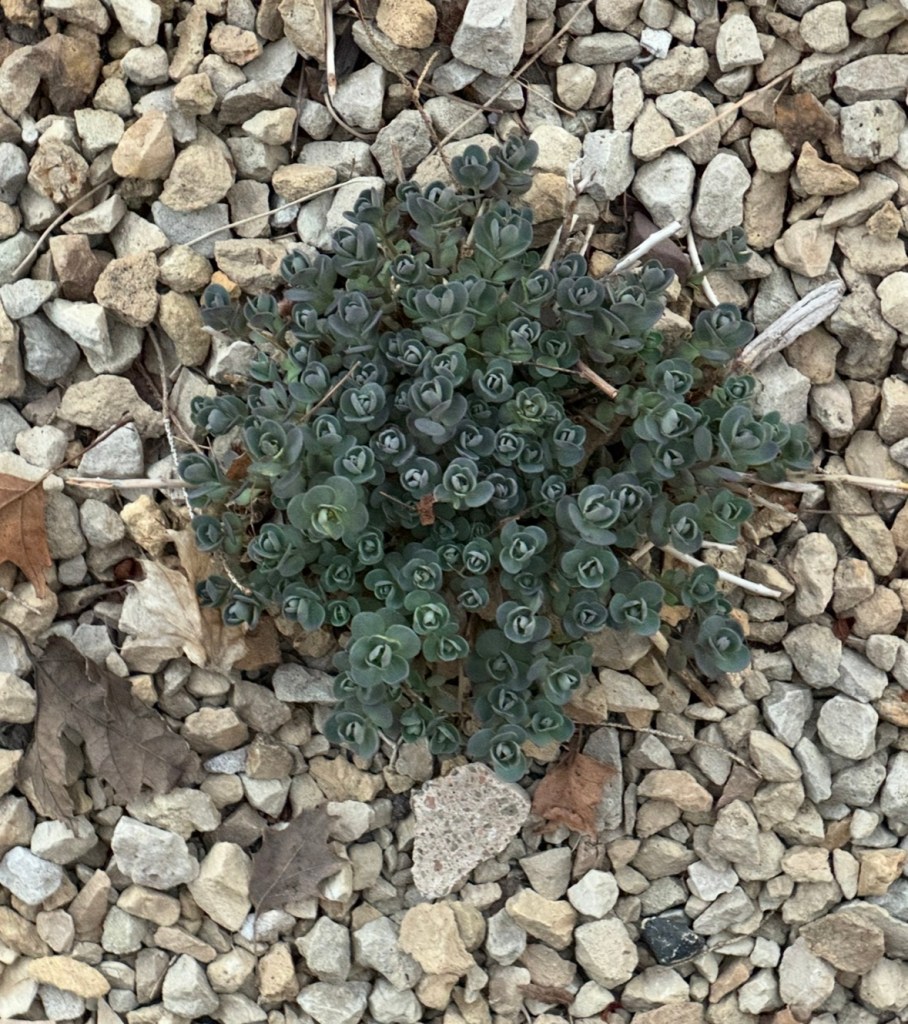
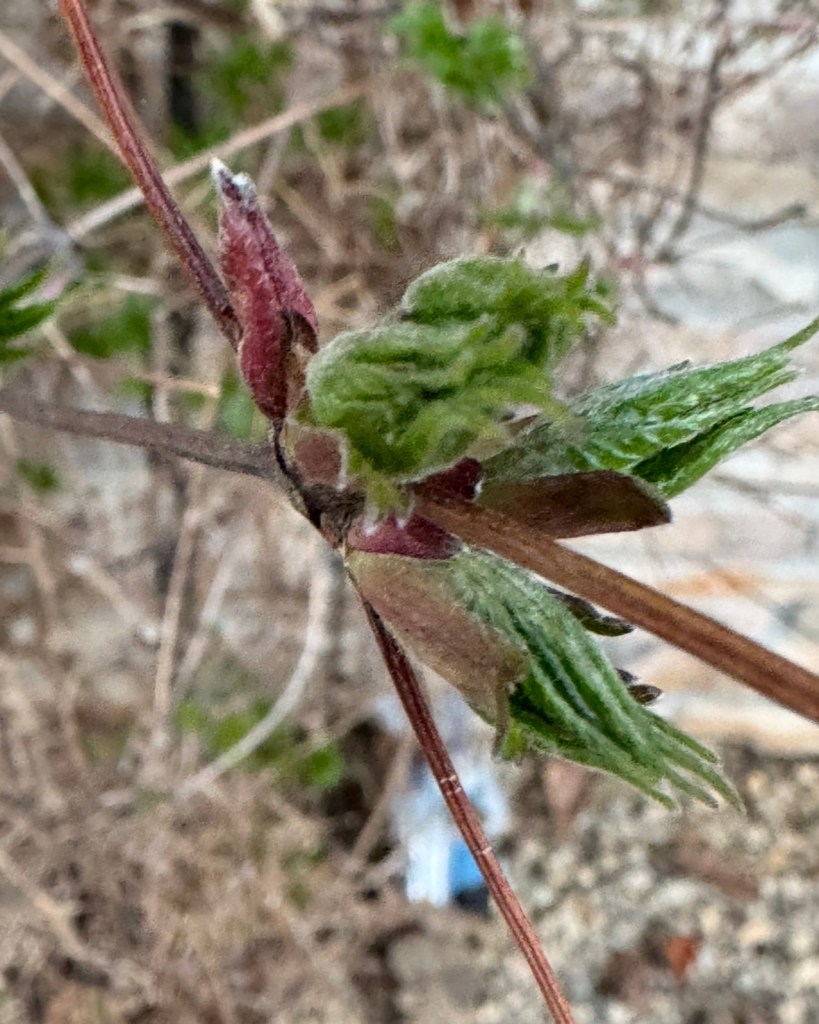
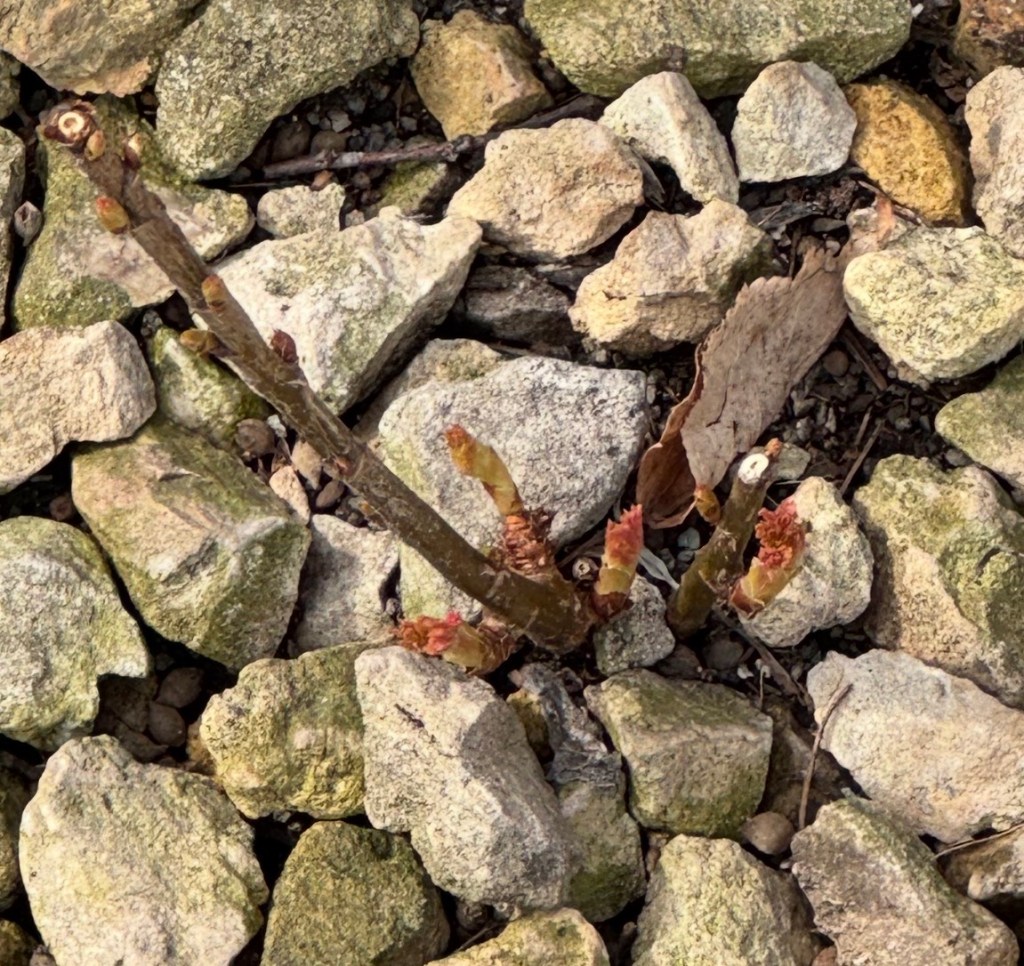
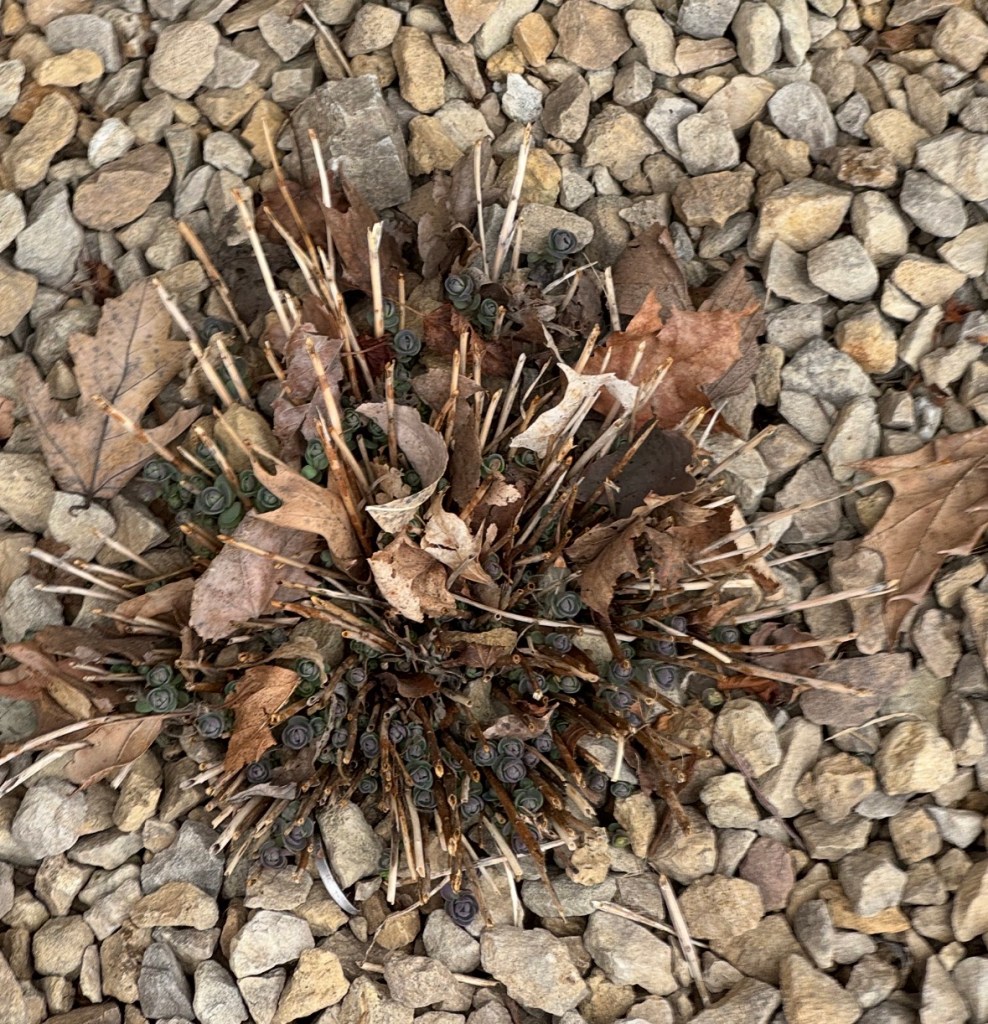
South Seas self-seed daylily back upOne of the StonecropThe Bluebells clematis is greening upIn with the daylilies is a clematis volunteer
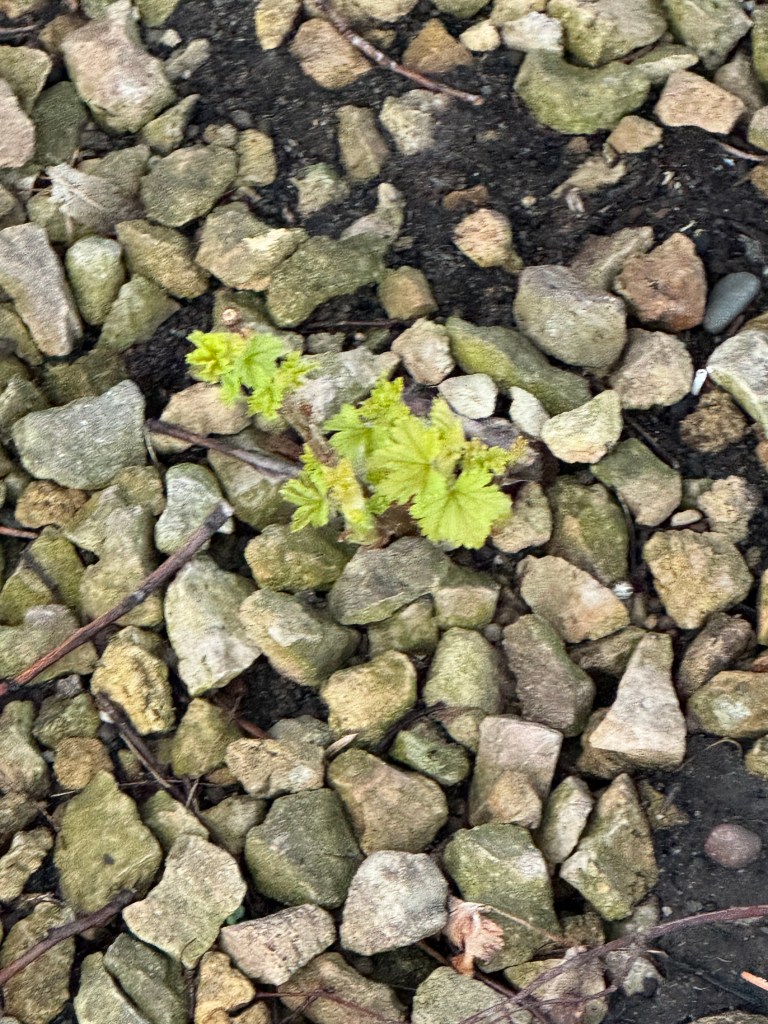
And last of all, our mystery volunteer bush is probably a currant of some type. I will keep watching to see what it does.
The snow is finally all gone here. Even the snow from the “blizzard” last week, although crummy at the time, is gone. We are firmly in April, with some enduring March winds.
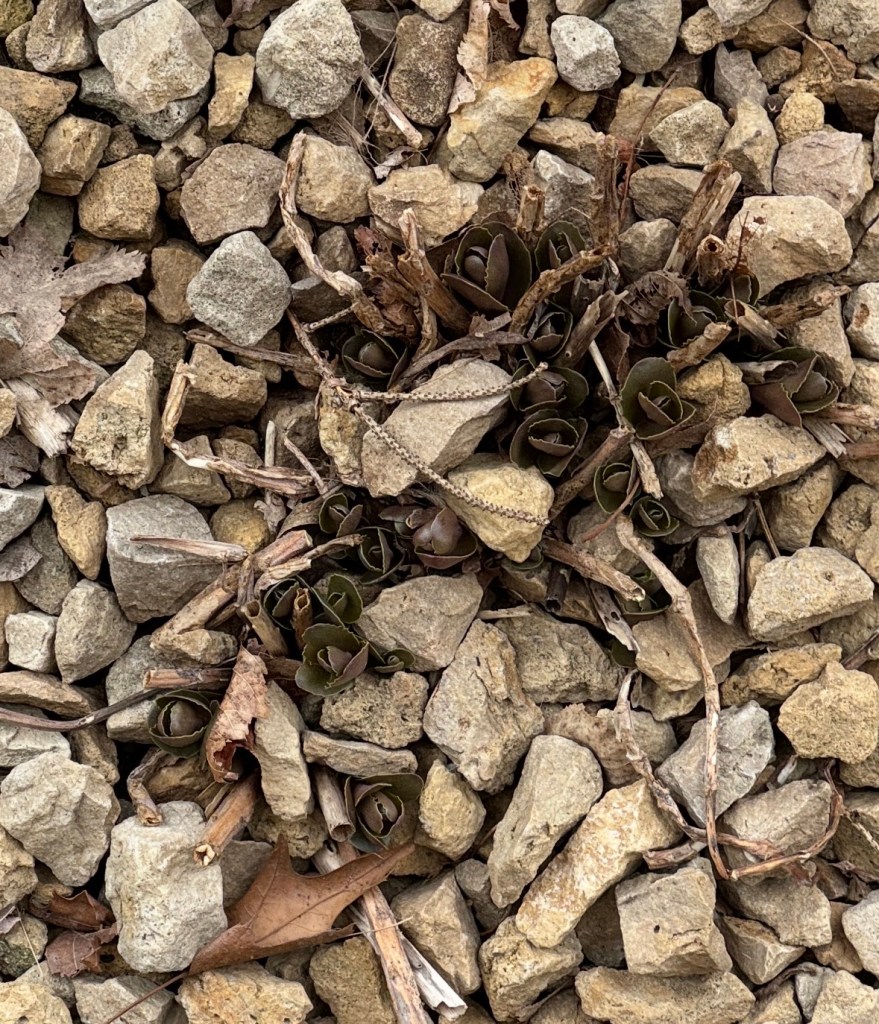
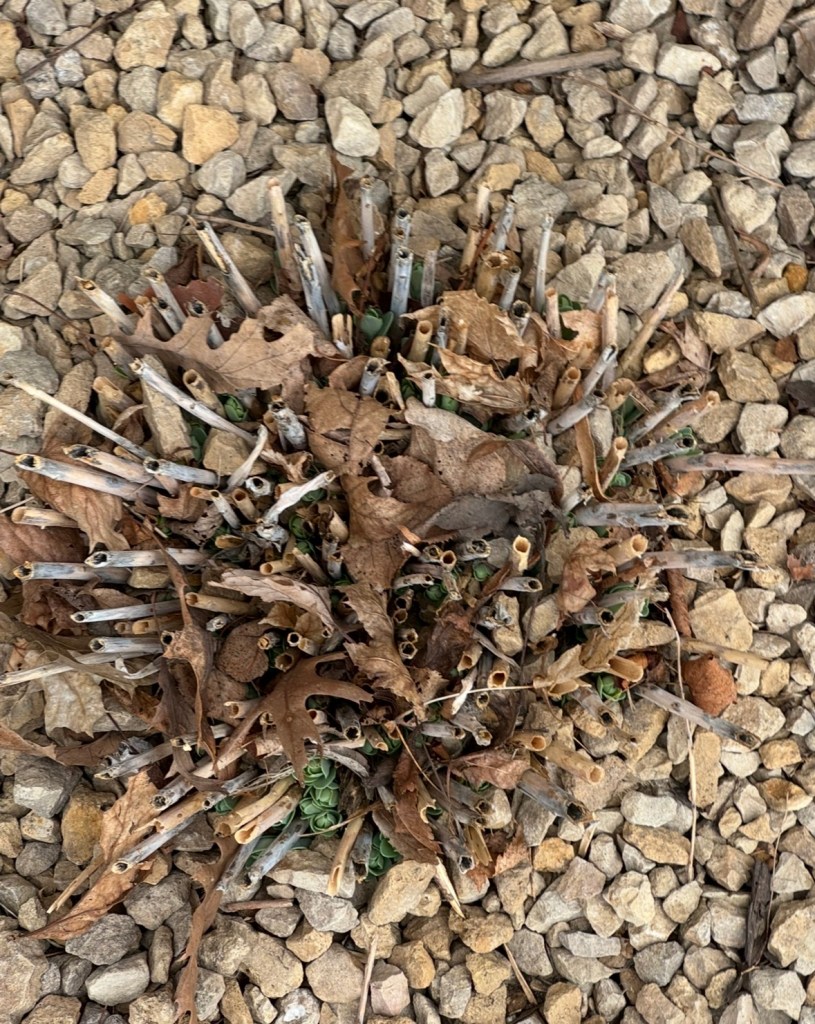
More daylilies are coming up each day, and all of the sedum are now up. It is better than waiting for Spring, but I am still having such a hard time waiting to get the seeds outside in the seedling planters. For now:
Annual Spring Cleanup continues.
The daylilies and sedum are getting their annual sprinkling of used coffee grounds. It gives them a little boost and seems to repel critters and slugs. Eventually the hostas will get the same treatment when they start popping up.
The sticks that fell from the Linden over the winter are pretty much all picked up and the birds are starting to sort through what we saved for them to make nests.
We are continuing to move back any landscape rock that migrated over the winter.
Hints of what may change this year are emerging.
Something that is surprising me a bit this year is that the 3 Autumn Red daylilies closest to the Linden still haven’t shown up. They should be up. The other Autumn Reds are up. The tulip greens around the Autumn Reds in that area are well up. I know the sun exposure very well in that area, it is perfect for daylilies, and they have done well there in the past. Last year their flowering, compared to the other Autumn Reds, was a bit lighter, so it may be time for a move, but not because of roots or sunlight because the Marque Moons are even more challenged with roots and sun exposure and they are up. Something is going on. I’m just not sure what it is. For now, it is watch and wait. We can move them if need be.
I don’t see any sign of surviving clematis seedling transplants. It was a fun, multi-year experiment, but it is time to move on. Surprisingly, for that area my mind is wandering back to a time when, many years ago, I grew huge (5 foot plus) Aureomarginata hostas there. I think, for that mostly shaded area it is time to go back to that type of easy solution. Something substantial like a large anchoring hosta will be a nice backdrop to the daylilies further out in Sandy’s (sunny) Corner. I think I have the perfect hosta, already in our garden, that needs to be divided and moved this fall.
I am also a bit surprised at how few Asian lilies are showing up out back. Sometimes they are late, so we shall see. Unfortunately, the area they are in is not sunny enough for daylilies, but I already planned to move more of the Blue Mouse Ears into that more shaded area this fall. They would be perfect next to the hosta transplant mentioned above. It would be great if the Asian lillies came up. They have been in the garden for around 20 years. But if not, that area will still look nice with the Blue Mouse Ears.
A final surprise is that the volunteer seedling berry bush from last year is back, and much stronger. I think it was a bird “donation” so I am not sure exactly what it is. I will let it stay for now and see how it fits in.
Speaking of birds – the mornings are so wonderful again with their full surround sound chorus, and over the winter we even added an owl to the mix. It is truly delightful!
And finally – the daylily seeds update. The longer I go, the more I realize – I am not set up to grow daylily seeds indoors. We have a moderate townhome, and I am not willing to store a lot of supplies. Definitely not grow lights and shelving for the seedlings. So … the daylily seeds I planted indoors are still not coming up. There is simply not enough sun and heat. I cannot wait to get back to the medium pots in the seedling planters – outdoors. Unfortunately, the forecast is still a bit sketchy yet to start those. We’re probably looking at another week, at least.
Other than that, we did a quick pass by the historic cemetery, and the garden there is starting to pop up. Soon it will be time to add the annual mulch topper. This year it will be a “daylily seedling additions only” year at the historic cemetery while I see how the daylilies shape up from the past two years’ plantings. Quite a few of the purchased daylilies I planted in fall of 2024 never showed up in 2025. I am, probably a bit optimistically, hoping they will make an appearance in 2026. We shall see. Either way, any daylily seedlings that I add to that garden this year will be self-seed I harvested from that garden last year, so that will be a fun “first”. I am looking forward to that!
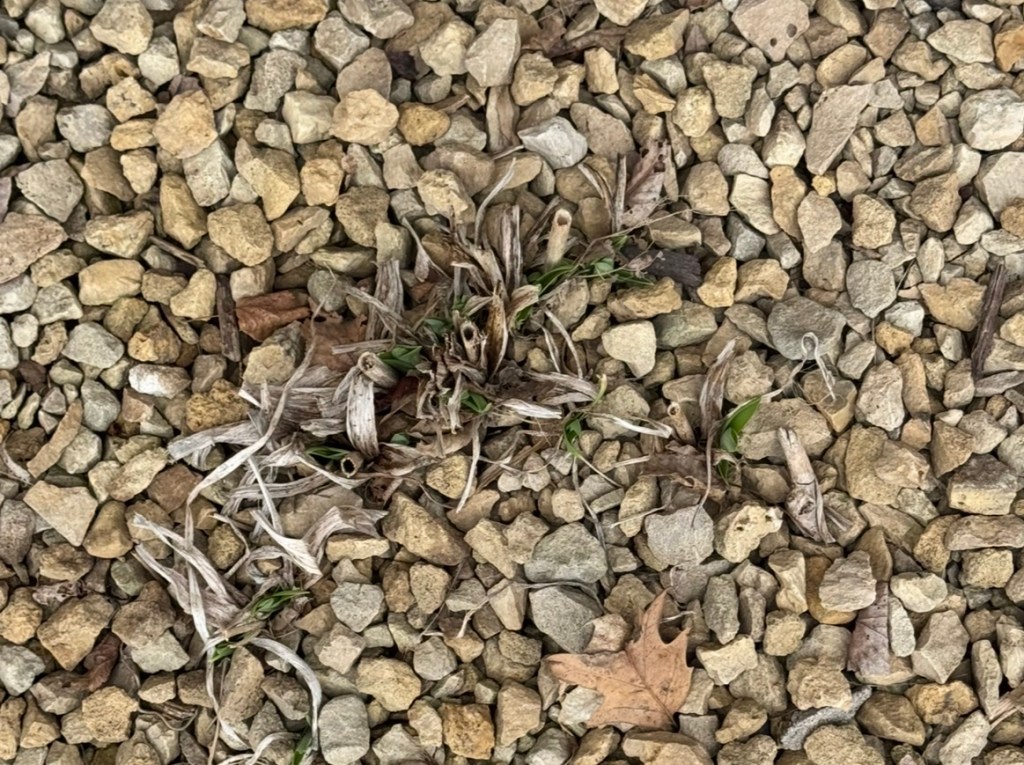
The daylilies are continuing to pop up, and the sedum are coming along.
We have snow coming tonight and tomorrow, but they, like the daylilies, are hardy and should be fine.
I don’t see any hostas up yet. That is because they are mostly in the shadier areas. It takes a while longer for those areas to warm up.
And I am still on seedling watch for the 84 seeds I planted in the mini-greenhouse trays and pots. I don’t use grow lights so the only sun they get is through the windows. In a few weeks they will go out into the seedling planters outside, and then they will get much more sun.
The spring kickoff checklist of maintenance items has also begun. This week it was:
Pick up linden sticks, leaving the smallest sticks in the rock for the birds to make their nests, and
Start putting coffee grounds around the daylilies, sedum, and hostas to give them a boost and repel slugs and four-legged buddies.

 Susan's Daily Garden