To trim or not to trim daylily scapes

Last year I had a bit of an issue with daylily scapes being pulled down and eaten by something. Probably something with four paws, but you never know, right? I used quite a few deterrents, all safe, and it was minimally effective. Minimally.

When I put all my 2024 notes and daylily crosses info onto my 2025 daylily tracking spreadsheet, I was reminded again about how much of an issue it was in 2024 – and how much it wasn’t in 2025. At least at the townhome. The historic cemetery, well, I have shared what happened with the Mahala Felton daylily seedlings that I planted by the gate. But that is a bit different, I think. And for this post we are focusing on daylily scapes.

As the 2025 daylily season was starting to produce spent scapes, I began to have the urge to tidy up. I did not, however, do that. This year it occurred to me to me that perhaps my habit of trimming spent scapes was actually attracting playful snackers. Against my preference to clean as the garden matures, I left all scapes on all daylilies until the pod harvest season was complete for that full area.

I also introduced another deterrent this year, and that is lemongrass essential oil (diluted and sprayed on the pavers). And, of course, there are the forget-me-nots, which are also a deterrent.

We are to the end of the daylily seed harvesting season, and I can report – no daylily scapes were pulled down and eaten by critters this year, even the shorter daylilies. All pods made it maturity and were harvested by … me 🙂

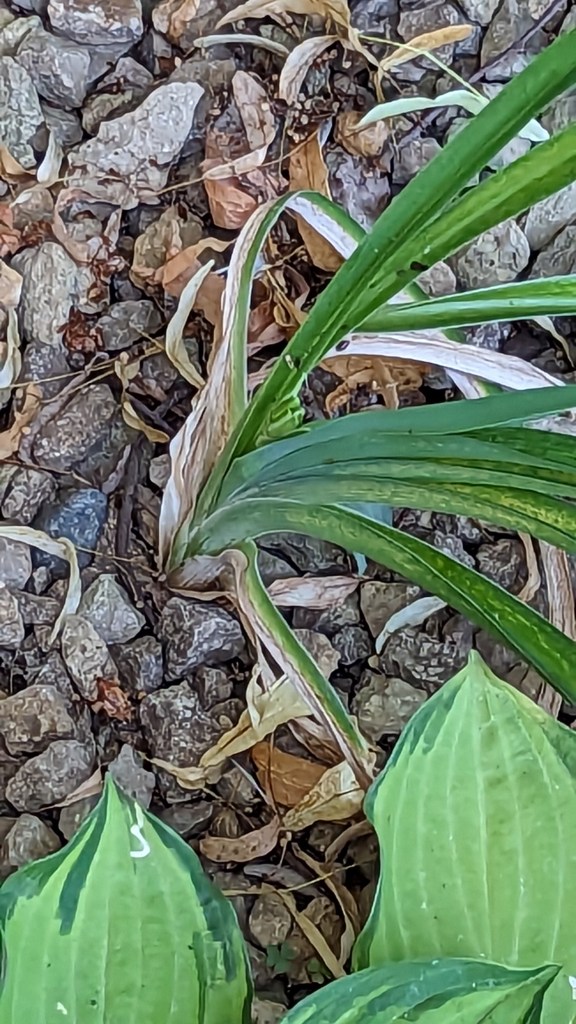
I also discovered something new. Spent daylily scapes, when completely dried in place, are very easy to pull. I have a few things in the garden that share that feature, and it is very welcome. Not all of the scapes had dried when the pod harvest wrapped up, so some were cut back when I started the daylily cutback out front, but in the true garden, out back, almost all the scapes were able to just be pulled. There remains just a few from the very last pod harvests.
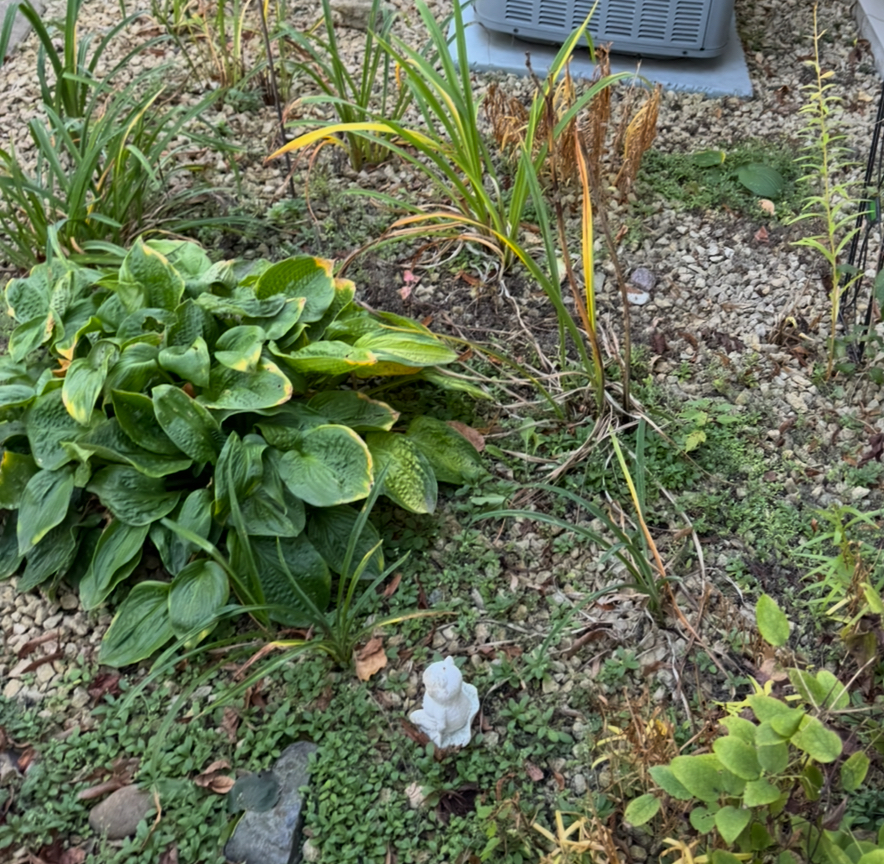
And with that, the greens are getting another week or so of photosynthesis before I come through and cut everything back. And trim the shrubs. And say sweet dreams. And call it a wrap.

For now, cheers to not trimming spent daylily scapes, to lemongrass essential oil, and to forget-me-nots. I am thankful for no critter interference in the seed maturing process this year.

First daylily seedling with scapes

Albeit fun, and a great challenge, it has been a multi-year process to get the first daylily seedling to produce scapes in our townhome gardens. And even so, it is pollinator created, from Marque Moon, not an intentional cross. But I am very C C pleased. It is progress. And I have learned a bunch that should help get our intentional crosses from 2023 on better footing than their predecessors.

Here was my happy discovery today

I am expecting blooms that look like Enchanted April or Admiral’s Braid, the parentage, but we shall see.

I have taken a bit of a meandering path to get to today’s happy discovery. Here is a bit of history and my personal experience so far:

Planting direct sow, into the ground, is a slow boat. My first daylily seedling attempt was doing that with pollinator created seeds from our South Seas daylily 5 years ago. Those seeds were viable, but produced a very slow growing daylily clump. Less than 6 hours/day of sun exposure probably also had a small impact. I moved it into more sun last fall and it now looks more robust, but still no scapes.

Planting daylily seedlings in a raised bed, in a sunny location, without watering beyond rain, even if it is hugelculture, does not work. Also not protecting from deer does not work. I did that combo 4 years ago. None survived. I wish I had that money back! Those frames are now disassembled and what was remaining of the hugelculture decomposing has been smoothed out.

Planting daylily seedlings in a sunny, perpetually somewhat moist area probably did work, but we sold that little house so I cannot say for certain. It looked successful when we were there.

Planting daylily seedlings into a well watered garden with less than 6 hours of sun produced slow growing seedlings that are now only turning around because they were transplanted into more sun this spring.

Transplanting daylily seedlings into a well watered and well drained very sunny location produced very robust 2nd year plants this season so far. One of those is the daylily with scapes, year 2.

Trying intentional crosses without planning and looking up ploidy doesn’t work. Nuf said there.

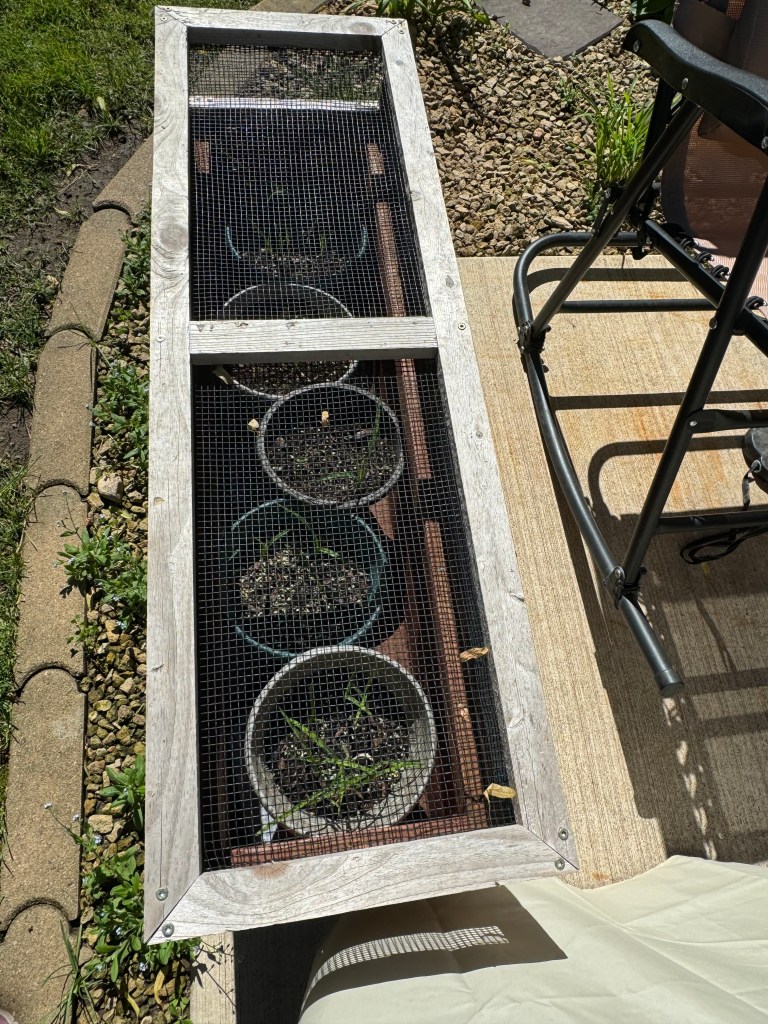
I stratify in Feb/March, and then after Easter, I plant the same type/species/crosses seeds together in a pot, indoors, covered with plastic. Yah, I know, unconventional. I have tried all the conventional methods without success. Can you say gross, mold, dead seeds? In May I usually put the pots out in the outdoor seedling box, covered loosely in plastic, with the screened cover over top. I have been fooled, and put them out too early (think late snow), but the seeds and seedlings seem to be smart. They just take their good sweet time, and commence growing when it is consistently warmer again.

I do need to get back to being much more diligent with my labeling and record keeping (diagrams). For labeling, I was careless this year and tucked the empty envelopes with the seed info into the seedling box. The ones written in pencil washed off in the rain. That I do regret. I also need to keep diagrams of where I plant in the garden. My record keeping workaround is going to be a printed out photo with labeling. My planting is in clumps, so that should be a satisfactorily resurrected method from my past to re-employ 😊

Hopefully more of the seedlings will produce scapes this year.


Success, Squirrels, and Pencils

Last year was my second year of trying intentional crosses to create new daylilies. This is something just for fun for me, and an opportunity to learn more and try out new challenges. I am not doing it to create anything certified. Nothing fancy. I put all the “same cross” into one pot. This is, as the old saying goes, “for kicks and giggles”.

The crosses between Marque Moon and China Doll were definitely the most successful last year. Of 38 seeds, we have eleven seedlings. We also have other seedlings – of the pencil mishap variety. I labeled some batches in pencil and it got washed away. On those I can guesstimate, but I cannot say for absolute certain what they are. Although a bummer, I’m still happy those worked, and if/when they bloom I will have fun guesstimating what they were.

And then there are the squirrel mishaps – where they seedlings were outside the box and the squirrels dug in the dirt. Those were a loss. Those very naughty squirrels!

Learning as we go here. This year I will do only two or three types of intentional crosses so that everything fits in the planter, protected by the screen.


4 years

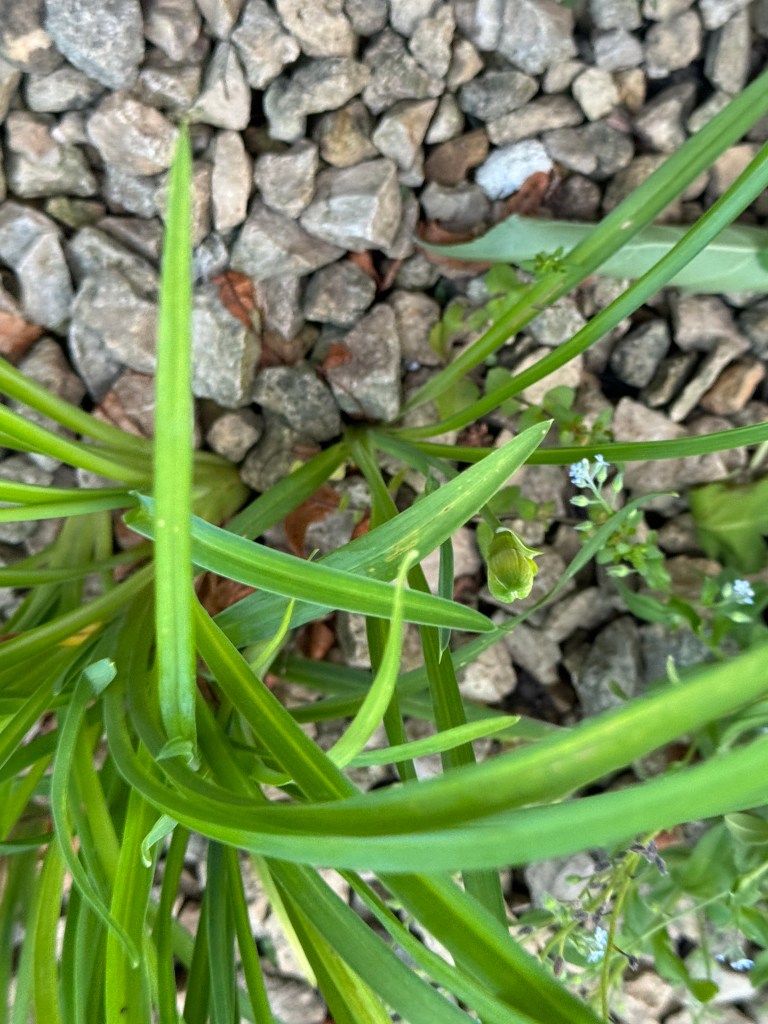
This is my first ever daylily seedling to have a scape. It is not our first seedling – that one is still TBD. But when I saw this today my gardener heart was happy. It is from a pollinator created seed, and it got repeatedly trampled on from the lawn maintenance, but I moved it last fall and IT SURVIVED!

So much else also going on, and I will put a post together tonight hopefully with all that.

For now, here’s pollinator created Purple D’Oro seed seedling first scape. I will follow up with progress too. Bunny better stay out!

And hopefully this is the springboard to successful intentional crosses.

We’re running now – here and up north

As I enjoyed my “putz and pamper” time this past weekend, I had time to reflect on the gardens so far this year.

After a very long winter, and months of feeling like a horse at the gate, we are running quite fast now – both here and up north.

The cherry trees wrapped up their bloom here quite a while ago, but a pleasant surprise was that we got a  glorious “re-do” during one of our trips up north.  Such a treat to get multiple blooming schedules.

At the townhouse, sadly, my favorite long-lived bunch of purple tulips has faded.  They were an icon each spring.  I will try to find something just as iconic, but maybe a different species.  Not sure what yet, but it might be harvested daylily seeds.  Just thinking at this point.

The new tulips I planted here last fall were glorious this spring.

Now the blooming season of early clematis has also passed and the weigelia has hit it’s peak bloom.  Soon the asian lilies will start blooming.

What I did not expect was a hosta bloom so early – yet here it is, beginning to form.  And on the ground in that garden the forget-me-nots are beginning to pop up.

20190621_200745-1.jpg

To watch here this year – two plants from 2017 harvested daylily seeds – both from ‘South Seas’ – one of my favorites.  We’ll hopefully see a bloom or two on them this year, and discover what we got with the help of our pollinator friends. What I know for sure is that daylilies are deer munchies, so I have decided they will not be making the trip up north, as divisions or as seedlings.

In pots, the hibiscus and the gladiolas here are squirrel favorites.  I have put chicken wire around a number of the potted plants and bulbs – not a flattering look – but needed.

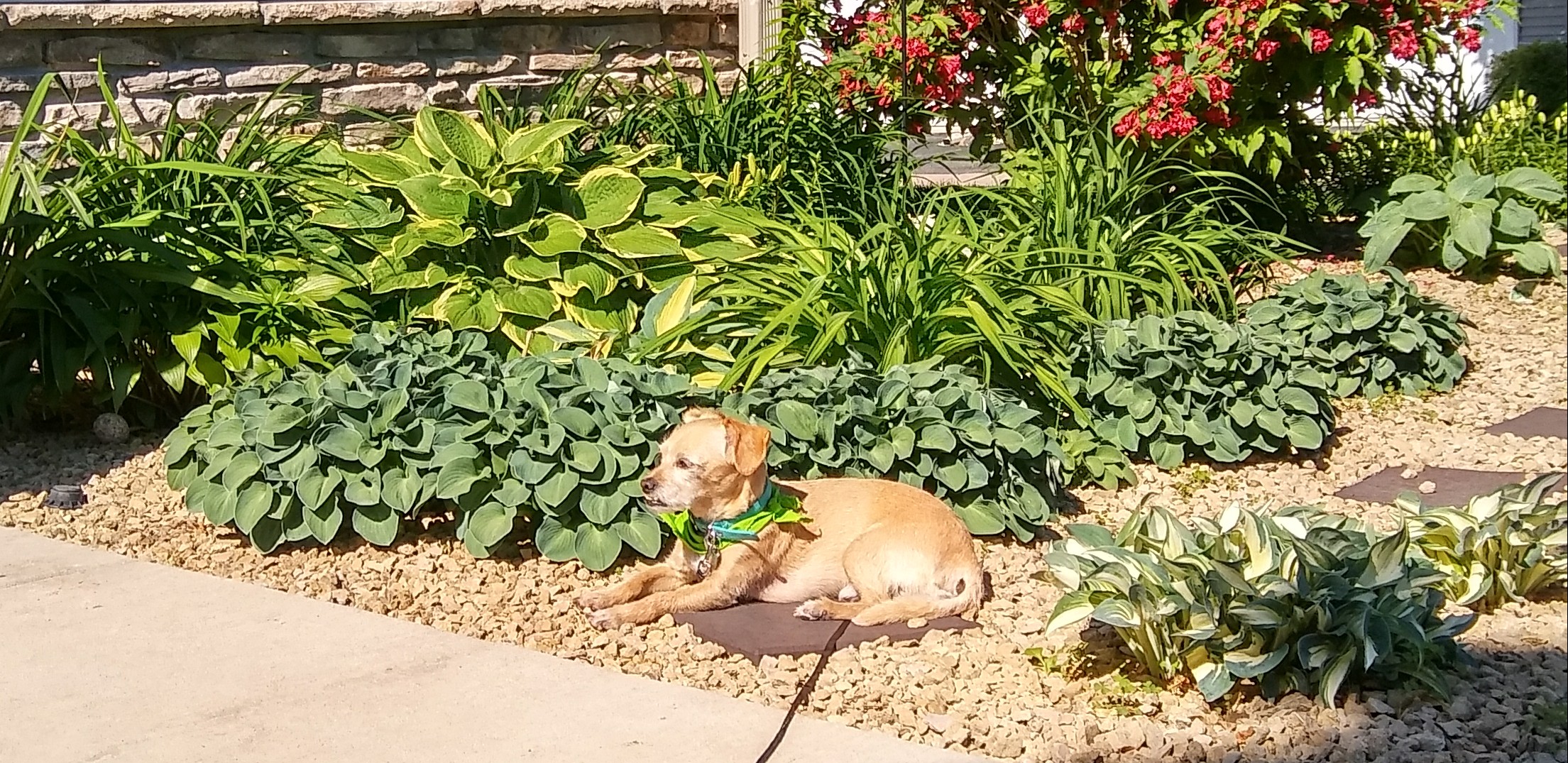
The Aureomarginata hostas here are gigantic again this year, the daylilies I added last year are looking good, and the Blue Mouse Ears are more full than ever.

20190622_093931-3

Which leads me to options.  Up north, the trail cams are showing us oodles of deer, a coyote, lots of bunnies, and a bear.  Makes sense – there’s lots to eat, including wild strawberries all over the property that just wrapped up their season.  I wanted to divide the Aureomarginata hostas and bring them up there but it’s probably not the smartest.  I will be fighting a munching battle that will only make me sad.

There’s also a sedum that has been crowded here for a couple years.  I wanted to bring it up north and put it in the sunny garden to let it shine.  But despite web lists that say sedum is on the list of “deer-resistant” plants, I am hearing reports that they too are tasty morsels up north.

What did work in the year one test garden up north is two types of seeds directly sown into the raised beds – malva zebrina hollyhock, and cinnamon mint.  Some free carrot seeds are also sprouting, and two asclepias plants have survived, so far. Coneflower seeds did not sprout, asclepias seeds did not sprout, and all of the kale and asparagus died back.  I think it needs more water than we can provide.  We are just depending on watering when we are up there, and rain.

And, after much deliberation, and my husband mentioning he doesn’t think he’d like the look, I have given up the idea of using a dog kennel as a critter-proof option.   Alas, I don’t like the look of chicken wire here.  I probably wouldn’t really like a dog kennel asthetic up north.

So the lesson so far is – some things will stay townhouse garden plants, and we will embrace what’s already on the land up north, plus seed sown additions that can survive with just rain, and that are not attractive to critters.

I heard lupines may be an option.  They do naturalize beautifully …