We are in the middle of rain, rain, rain here for the past week or so and now we are heading into almost another whole week of rain lol. But Saturday I got a bunch of work done on the garden. That felt great!
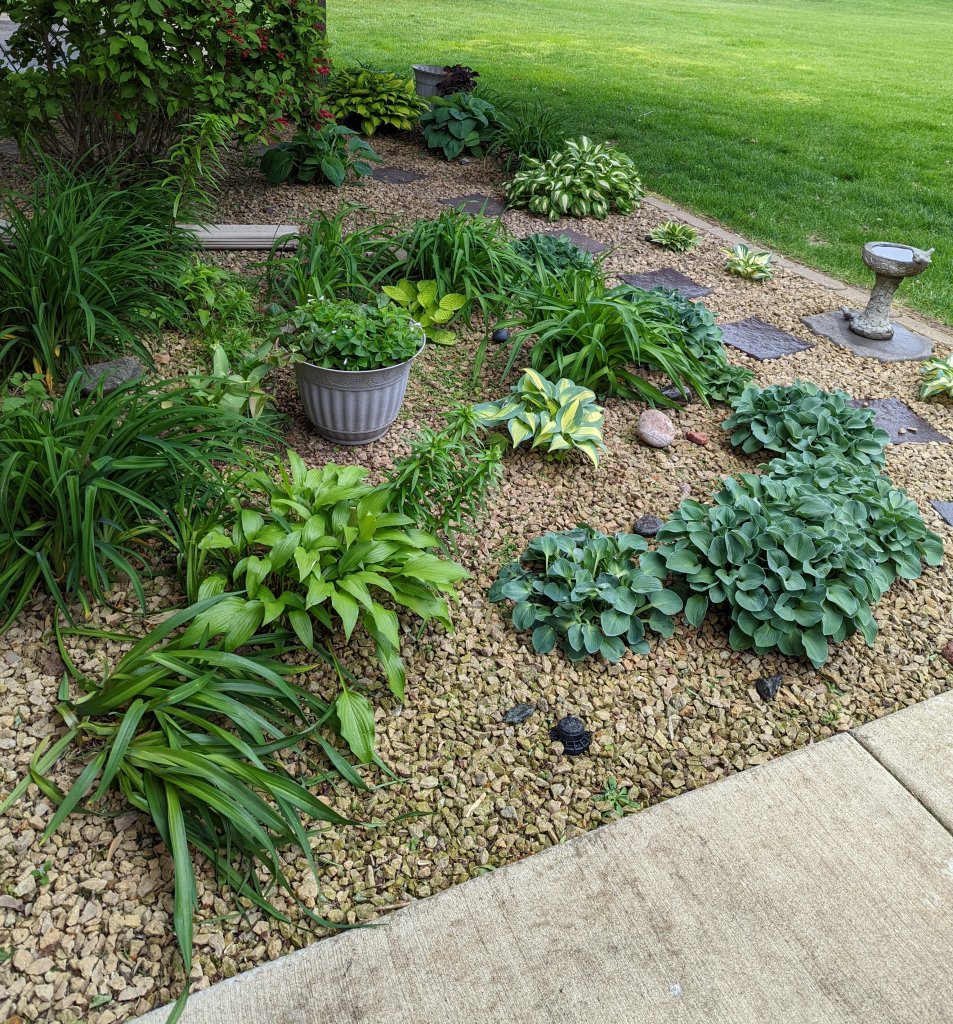
Recently I shared that we lost a bunch of hostas. Those losses have spurred on change. Those losses made me rethink a lot about our garden set up. We lost those hostas because of of a number of reasons – fertilizer and herbicide overspray and then a few of them were expected because I knew tree roots were getting quite close. And because those reasons will not be going away, I am not replacing any of what was lost.
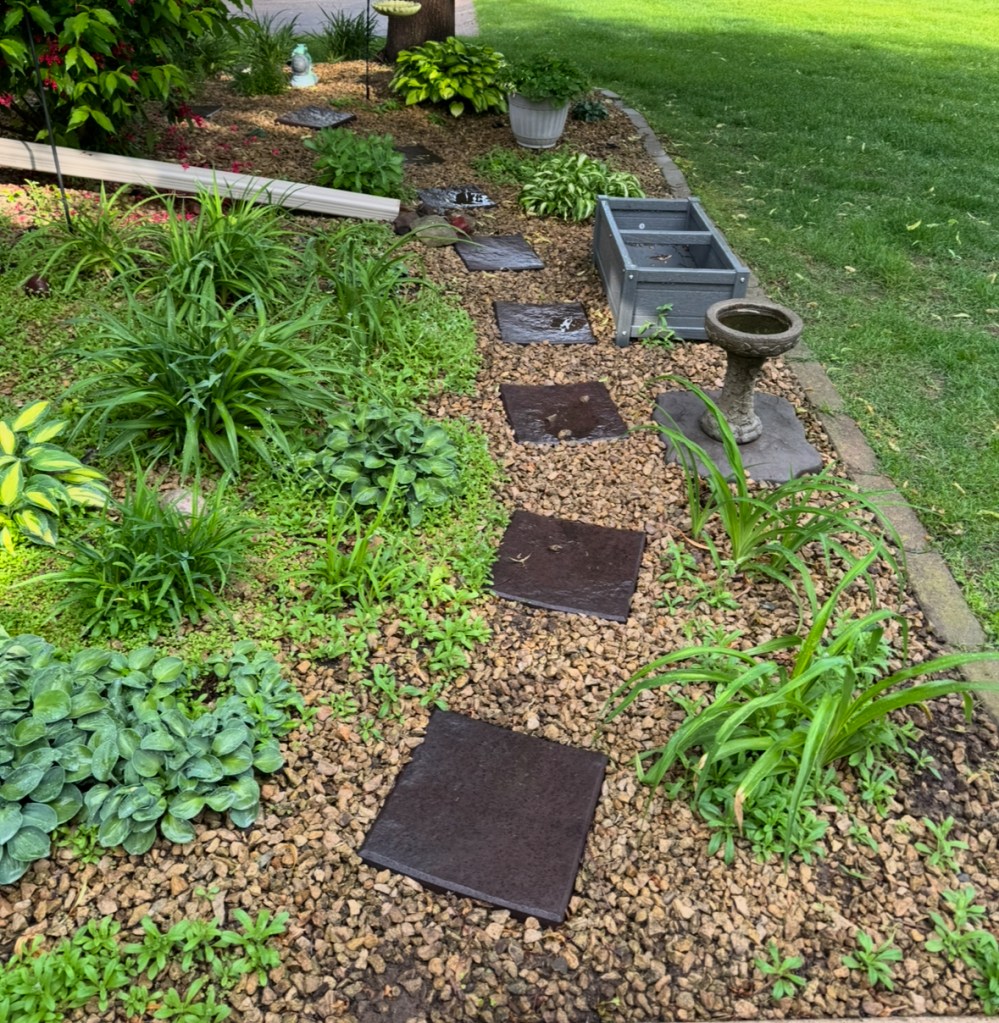
But that was not the end of the story. The space did not look “right”, and because there had been so many hostas there, other things that were previously minor parts of the garden – the forget-me-nots and the clover – began to flourish. Think no barriers like plastic underlayment under the rock …
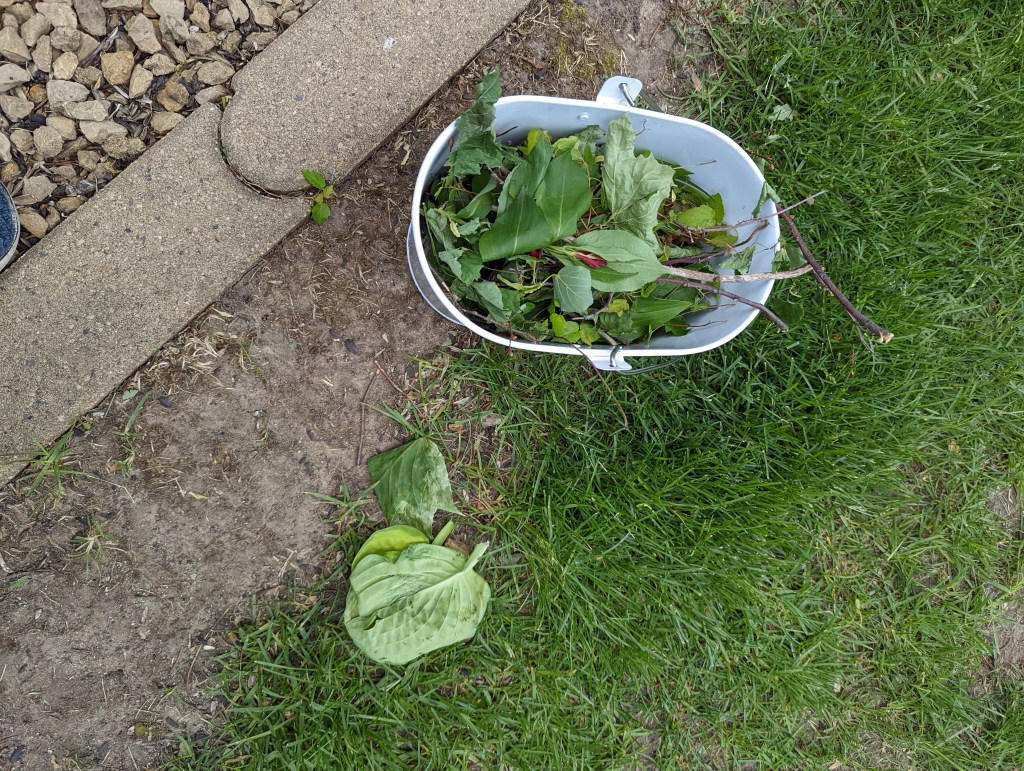
Saturday I spent time paring back the forget-me-nots and the clover (and quite a few bunny planted raspberry seedlings) in prep for where I want to go with my next garden phase – expanding my daylily propagation work, needing more planter space. Just like anything, times are changing. I am in a new phase of my gardening, just like we all get to new phases of our life, and I need to have a little bit of reassessment of what will work for this.
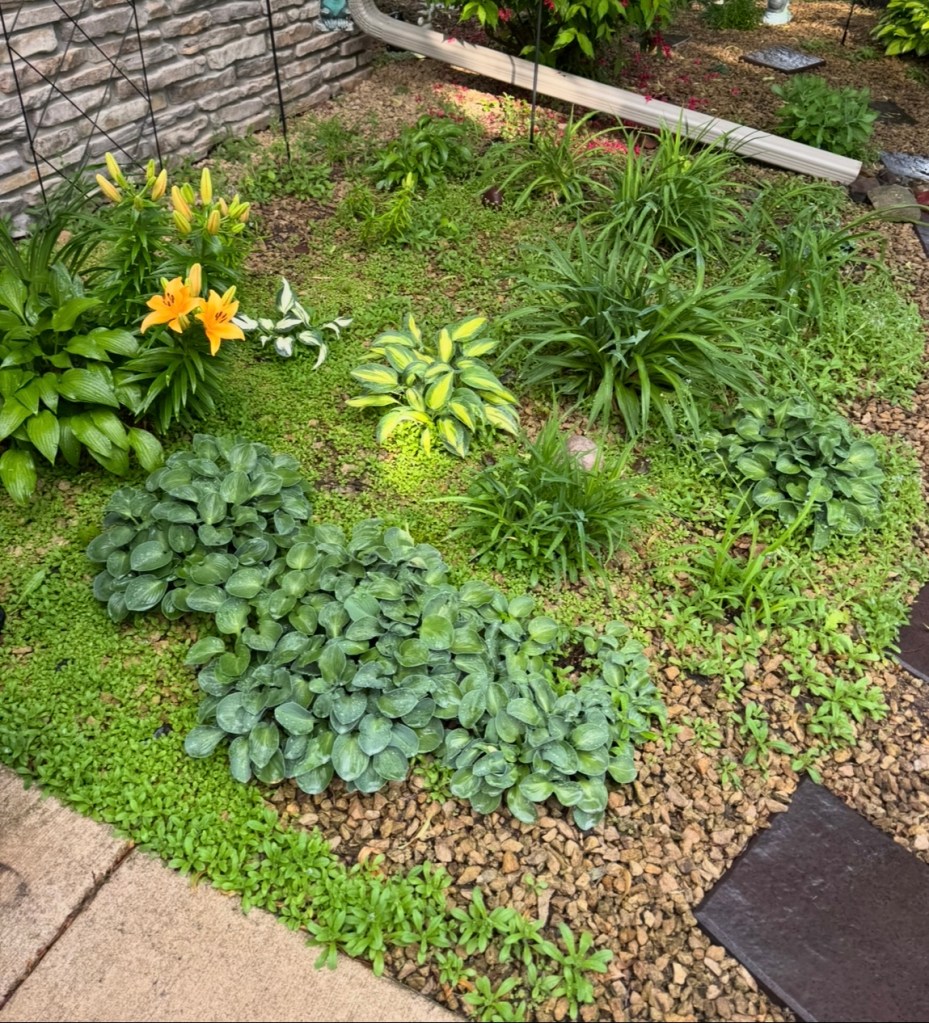
Saturday I cleared all clover and forget-me-nots out of the front, left very little of it in the corner where the linden is, and cleared it away from the path out back.
I was unsure of what I wanted to do in the area that sustained the largest number of hosta losses, so I left just a little patch of clover and forget-me-nots there. This morning I decided. I moved the green shamrock into that area, and I like it, so the remaining clover and forget-me-not patch in that round of the corner will go.
And then I will tackle this.
I planted the forget-me-nots the year my father-in-law and a sweet neighbor friend passed weeks apart. The forget-me-nots are sentimental. And I have kept them inside the paver trim. Inside 😊 But I hardly think that stepping on forget-me-nots is a great way to remember those we have lost, and stepping on forget-me-not is definitely not part of my daylily propagation “vision ”, so, as they bloom and begin to fade, they will be pared way back. A heartwarming sprinklng that enhances the daylilies and remaining hostas out back.
The long wait is now over. Things are popping all over the gardens, and I am starting to see what made it, what didn’t, and what work there is to do.
At the townhome gardens, sadly, it looks like we lost two sedum. How that happened for one of them is a mystery to me. That one was our only variegated sedum, and I will miss it. It had been there for a long time, maybe over 10 years, so I am a bit surprised. I won’t replace it with another sedum, but I may put a daylily there this fall. Potentially a seedling. But first I want to refresh my memory on how strongly the sprinklers hit that area. I don’t think the variegated sedum died from sprinkler damage, but I want to make sure it is a safe place. The other sedum that didn’t come back was under the linden. That one never did well. It just never took off. I won’t put anything in that spot to replace it because the daylilies are also starting to underperform there. There are a lot of linden roots. It is a spot I will leave as “rock only” as things fail.
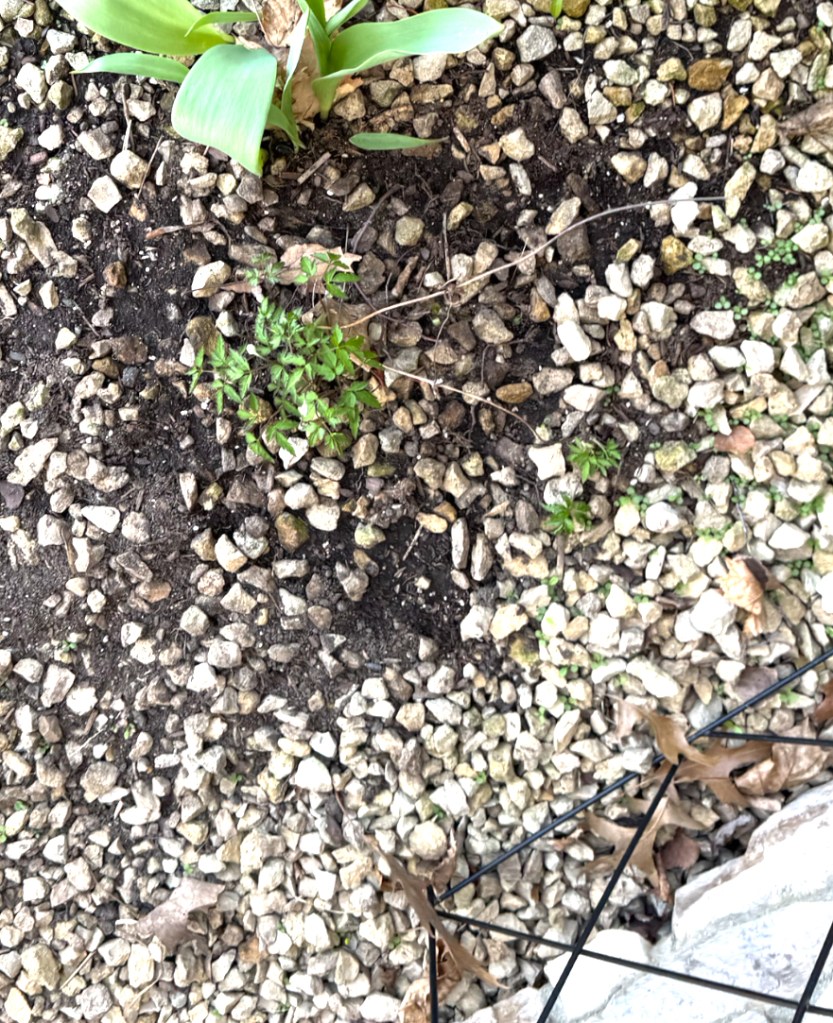
On the flip side, we have a bumper crop of Bluebells clematis volunteers, and those are in the “work” category. I need to transplant them to another area. This area is not optimal 😂
The volunteers are from our large Bluebells clematis that always performs very well, and I suspect I will continue to have volunteers over the years now that it is well established. Last year I allowed one to grow around the red daylilies, and this past weekend I dug that out and transplanted it into the spot where another clematis volunteer (different type) was way underperforming. Hopefully this volunteer does well. So far so good.
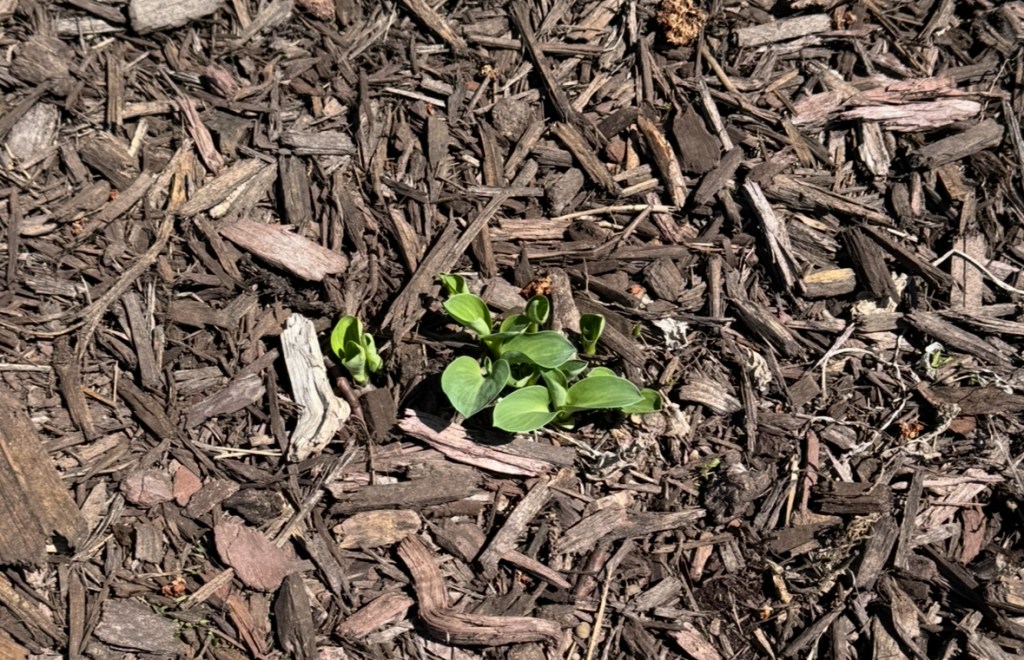
And then there are the missing hostas. There are three in particular that have no sign of anything, and that is a bit concerning. Two I was going to give to my Dad, but the third was one of my long-time faves, and if it doesn’t come back, I will miss it. BUT I have made a decision. If it doesn’t come back, I will convert that real estate to daylily space. That hosta really always amazed me because it should never have done so well there for so many years. That spot really is more of a … daylily sunny spot. But I put it there in my early years of creating our gardens, and it went to town for well over a decade. Probably 15 years. So if that hosta is gone, I will greatly miss it, but it will be replaced by a purchased daylily this fall. (Yes, I have my sites on a few candidates.) Then that entire area will be daylilies, with a few remaining Asian lilies, a few remaining tulips, and a legacy Autumn Joy Sedum. For the other two “missing” hostas, if they do not come back, I will not replace them. The area where they were was getting way overcrowded, hence why they were going to find a new home with my Dad. And, my Dad just had a bunch of trees removed so they may have not done well there anyway.
Which leads me to story time. When I started our gardens at the townhouse many many years ago, I was head over heels in love with hostas. I planted boatloads of different hostas. I visited hosta gardens. I bought “hosta of the year” varieties I liked. I was gifted hostas. My Dad even bought me hostas from a neighborhood gardener he called the “hosta masta” (master, that is 😊). I have grown and divided all kinds of hostas for over two decades. I even tried my hand at harvesting hosta seeds and seeing if I could grow hostas from seed. (Not for me.) I love hostas. And I will keep the hostas I have that are still doing well. But that era was that era, and the garden “container” is the garden “container” (not getting any larger), and I am not getting any younger. So … in a finite space garden … hosta attrition makes way for daylilies, if the space is sunny. (Amazingly, I did have some huge hostas that did very well in relatively sunny spots. Go figure). In this new era, I have my daylily seedling beds, and they are doing well. Those were solidified as the plan last fall. I also have one 6th year non-blooming daylily seedling in a different area, and I just can’t seem to move that one out, but we shan’t dwell on that. I figure at some point when the garden “container” is full, I will know it is time to stop doing daylily crosses, and then I will sit in my patio rocker, with a beverage of choice, and just enjoy. Haha, I can hear family and friends alike laughing uproariously. But that will be a few years yet. Hopefully quite a few. Because goodness! I have 60 “same cross”seeds I still need to get into pots in the seedling planter, and if even half of those go to seedling, oof! Realistically, experience tells me “probably not” and I will most likely end up with optimistically, 10 seedlings from that 60, to be planted in the 2025 seedling bed this fall, and watched for bloom starting next year.
At the historic cemetery, I am gonzo in love with what I see so far – legacy plants are doing so much better in year 3 of the mulch bed. The iris bed is in year 3 now, year 2 for watch to bloom, and I already see multiplication. Daylily seedlings I planted last year from here look great. Daylily purchases I planted last fall are coming up. Even the Blue Mouse Ears hostas made it.
Overall, so far, so very good.
Weeding time at the historic cemetery is down to an hour per week – amazing what the mulch bed tamps down. The only thing I want to work on is the aging creeping thyme. It needs some cleanup, and I may grab some irises from the old garden bed and do some fill in there. Otherwise, one hour per week weeding, watch for the garden to do its thing, and maybe, optimistically, try a few crosses.
The buckets and plant pots that protected the daylilies, hostas, and sedum during the roofing project are off, but will have one more appearance in the next couple weeks when the gutter and fascia work is going on.
After that very long, hard to wait but dreading the potential collateral damage May, it was great to get back in the garden.
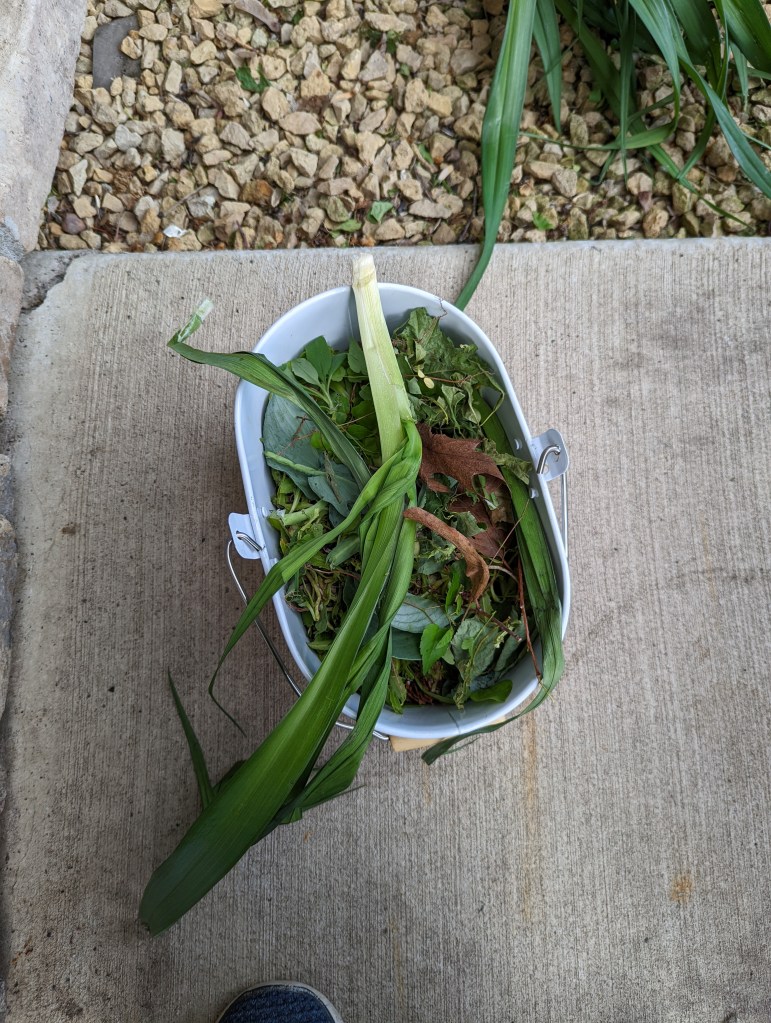
First up was removing the remainder of the tree seedlings. That got done yesterday. The total of buckets this year was down from the past few years – 5, compared to the usual 7. Hurray!
The dying tulip greens that got smooshd also got pulled. They were done anyway. sadly, also a daylily piece from the project smoosh, but next year …
Then the pollinator created, harvested daylily seeds from 2021 finally got planted. Another post on that coming soon.
The sunflower seedlings also all got pulled. They were an experiment, but the rolling roofing dumpster made that decision for me. My husband was very happy – hahaha!!!
Today my thoughts turned to the front entry garden. It needs love.
One of the Blue Mouse Ears hostas out back also got a little smooshed with the roofing project. That was ok because it needed to be divided anyway, and the flowers get hit by the sprinkler, so moving the whole plant is probably a good idea. Blue Mouse Ears are the perfect size for the entryway area, and with dappled sun due to the Amur Maple they will look great for years to come. That area also had the remnant of a Rainforest Sunrise hosta I mostly moved up north, but it got a bit smooshed too so this will not be it’s shining year. I had to cut away the smooshed leaves. No worries, it will pop back next year. But besides a center hosta and the few Blue Mouse Ears divisions, and the low growing sedum, what to put in that area for color? No to annuals I think. Daily watering – ugghhh. That is for bird baths – haha! No to sedum divisions – the two low growing sedum are enough. Asian lilies seem to die out there, and the stems are not great after bloom either. They require layering to cover those up. So it may be daylilies. I am concerned about the dappled sun, but maybe. Still contemplating.
Finally, the center of one of the back garden areas was pretty bare. Plenty of baby forget-me-nots that will bloom next year, but it needs something additional. I pulled a nice daylily from there to go up north last year, and right afterward I saw how bare that area was and regretted it. Bummer. So that area needs love. But low investment. Trying out the green shamrock. Not sure. Might need a trip to the garden store.
So that was the weekend garden fun. Super enjoyed it.
Last fall when my husband planted the five daylilies in the front of the little house up north, he put the dirt and grass he removed into a plant pot in the garage. Today I was doing the final weeding of the year, and needed a plant pot to throw the weeds in. I dumped the dirt and dry grass into an even larger pot, and went about weeding. When I was done weeding I realized there was a fair amount of mulch I had pulled with the weeds.
Before I had even started weeding I had moved two earthworms from the driveway to the grass. They would have died. They were drying out. I like earthworms. They are great for the soil.
So I had saved a couple earthworms and they were now on their way back to do what they do, I had half a plant pot of weeds and mulch, and some dirt and dry grass in another plant pot. Where did my mind go? Compost.
I put everything together, minus the two worms of course :), put it in an area where I am going to finish a lasagna style garden next year, and walked away knowing I didn’t end up putting all that into the garbage. It’s not official compost, but the weeds and the mulch and the dry grass will mix together with the dirt and the rain that is coming and it will decompose. Go forth and make a good foundation for next year’s completion!
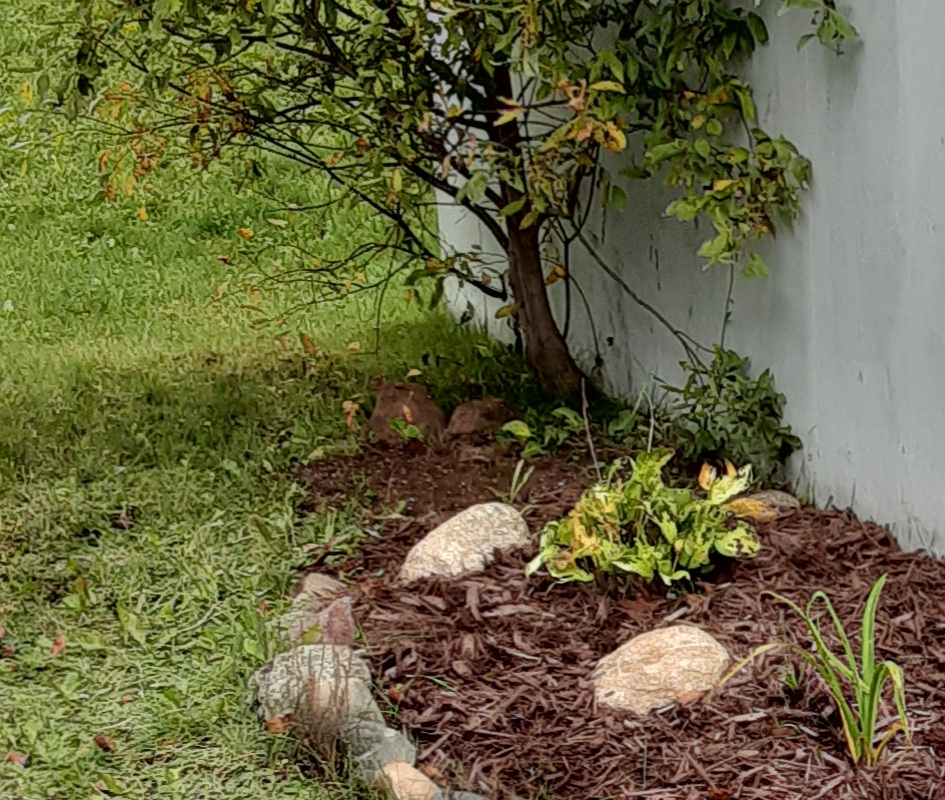
(That tree you see by the base of the shed is coming out. It was there when we bought the house, I didn’t get on that, and my husband knew I was wavering. But that’s no place for a tree, so … )






 Susan's Daily Garden