
As a student, I was definitely not drawn to history. Seemed like an awful lot of talk that may or may not be factual. Math, now there you have something! My love of math turned into a love of data. I am an analyst at heart, and by trade, with a whole lot of love for data driven project planning and implementation (“DO”) in the mix. Analysis is for a purpose – to inform on a course for future “DO”. And, yes, at the root, we analyze data based on history.
I fell in love with a history and political science guy, oh so many years ago. What a pair we have made all these years. Me wanting to dig deeper, find patterns, analyze trends, and him exposing me to things in history and politics which, to me, often make absolutely no logical sense.
Along the way I got interested in gardening and was particularly interested in the gardens at historic forts we visited. Those made sense – food, beauty, for the family, for the community. I used my love of data to study what would work in different areas of our yard. I started building out gardens. I found I liked plants with history, plants with a story to tell.
Alas! The kids grew up, we made the bumpy transition to townhome living, and my sprawling, sometimes out of control gardens came to an end. Townhome bylaws. But my analytical mind said why not petition the board to put in our own landscaping? What’s the worst they can say? No? They said yes – three times – initial plantings to augment the shrubs, and two expansions.
I have pretty decent gardens now at the townhouse – ones that kept my gardening mind busy for 18 years, gave me 9 months per year of exercise, and one that neighbors and friends say they enjoy. Remember we garden as much for others as ourselves. Wherever we may be.
We have also spent a couple decades now of time in northern Minnesota, and it is me who digs into the history there. It gives me perspective, appreciation of a much more rugged, challenging time, and really makes me appreciate all the incredibly hard work, personal sacrifice, and an attitude of resourcefulness that was exemplified in that time. It is a thing of beauty that explorers can come to areas that are maintained for them, purely enjoy, spend little to no money, experience time away from the stress of the city, and then drive away with no committment to better, or even maintain it. The “right” to enjoy all that now is because of all the “DO” respecting nature, yet making that beauty accessible, that was forged by those before us, and is done on a continual basis on our behalf . I am grateful.
And now we come to my latest thoughts. On my micro scale, I always wonder what positive, lasting, move forward “DO” I can contribute to continue what others before us have accomplished. I like to do that through gardening. I love to leave tiny trails of garden love and share abundance. I am reasonable with what can be used, and cognizant of what I can physically accomplish, but I still love to share and “DO”.
So I have a friend who quietly goes about this. She researches history, she shares her findings, and she and her husband have maintained the grounds of a historic cemetary when others walked away, when there is little money for “DO”. There is money for supplies, but “DO”, like cut the grass, trim the trees – that is volunteer. They fight for preservation of that history in a beautiful way that honors those interred there. Those that gave their lives to country, those that gave generously and served community selflessly, those whose place of interment would be left unmaintained because there is no money attached. And those whose contributions and life lessons would be lost as part of history informing further “DO”.
My friend and her husband challenge me. I have things to give. I have more plants to divide. Plants I won’t use at the little house gardens up north. They might look nice at the cemetary. A little trail of positive contributions. We garden just as much for others as ourselves.
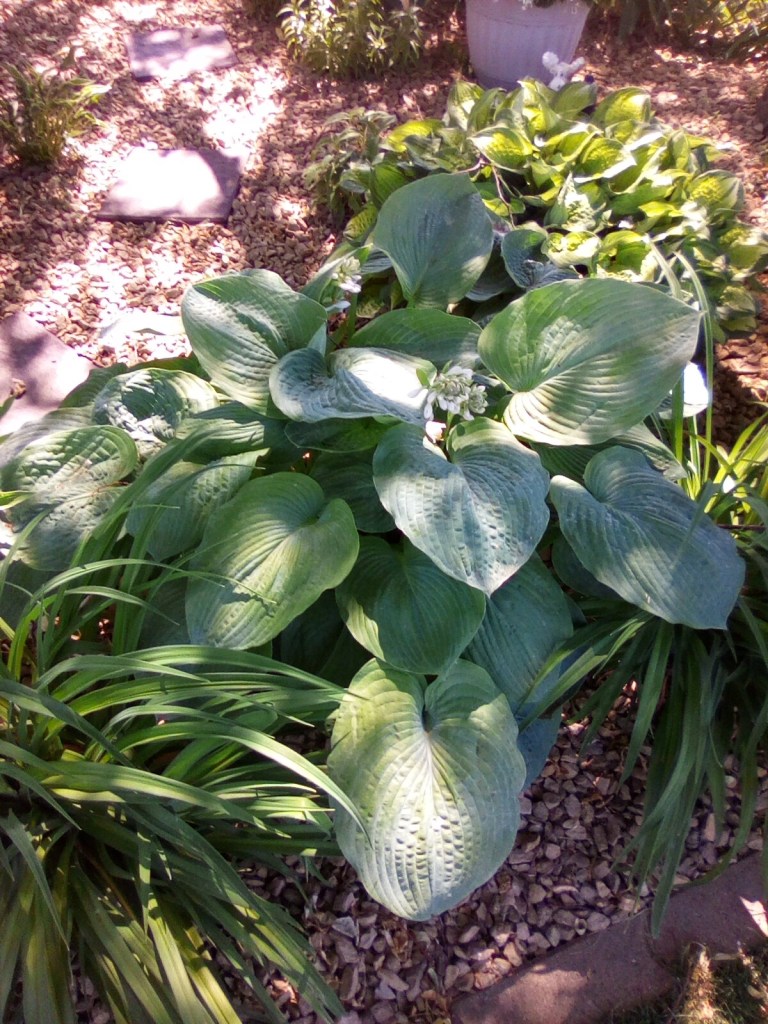
The hosta pictured below can go to the cemetary in the spring, if they want it. It is an “Elegans” hosta. It could be divided into 3 pieces and form a lovely start to a woodland edge garden, away from the beaten path and not adding to any mowing complexity. Some cardboard, three hostas, some mulch. A little “DO”. We’ll see what spring brings as far as additional ideas and “DO”.



 Susan's Daily Garden
