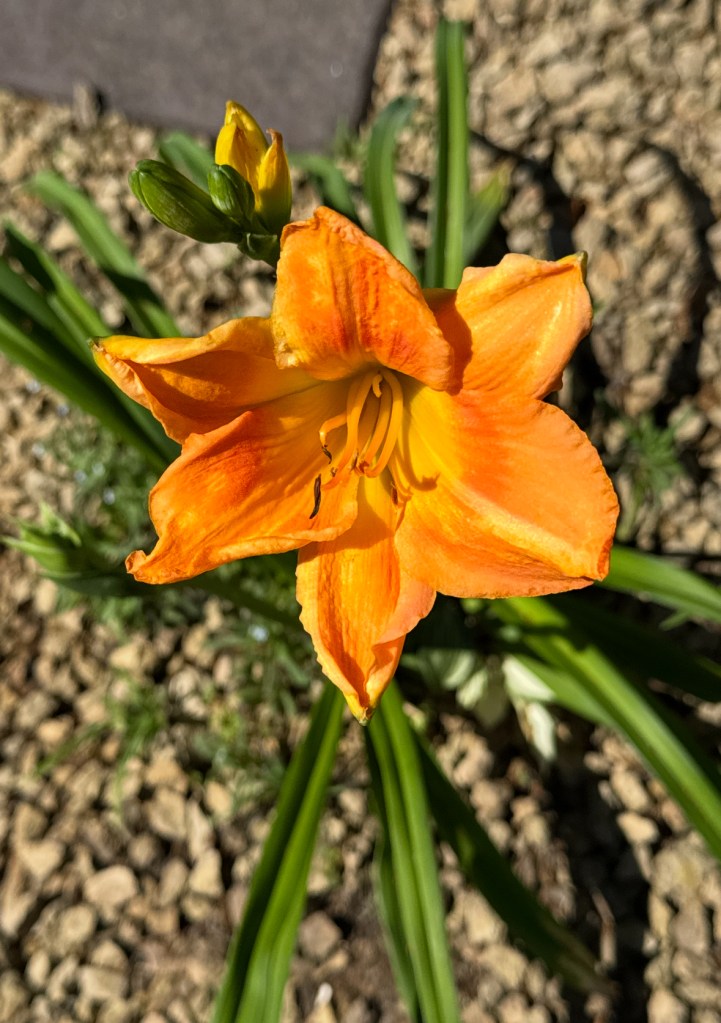
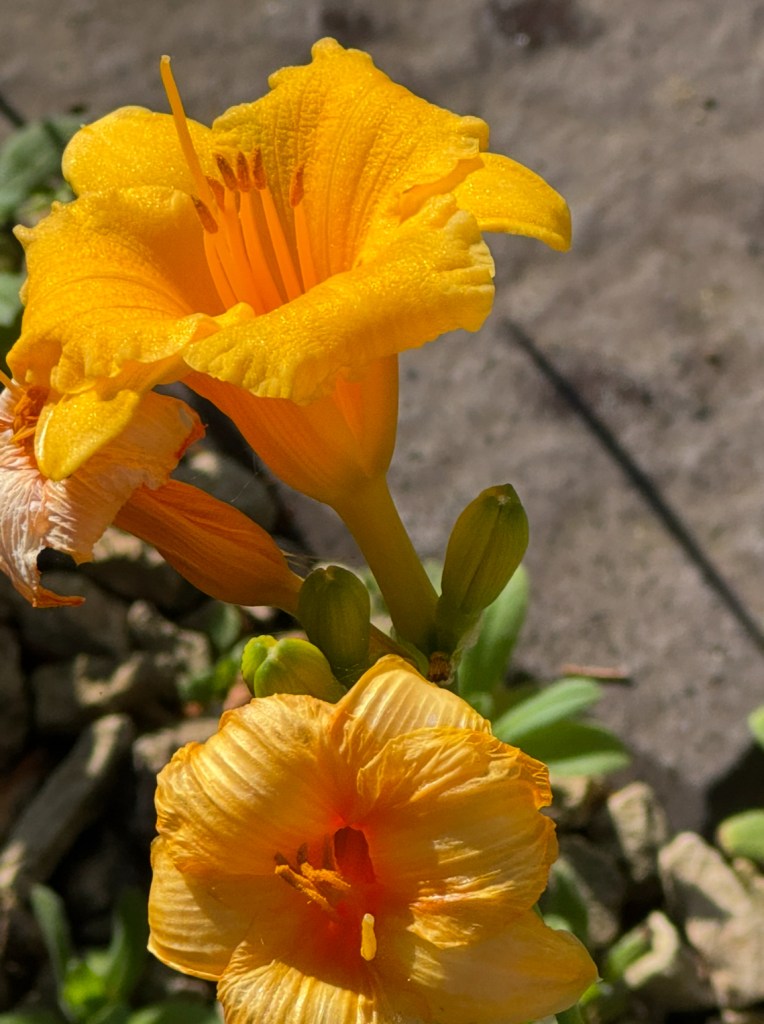
Equal Opportunity will be this daylily’s name. It is a South Seas self seed and I think it is from 2020 seed. (I was way less concerned about documentation back then.) Equal Opportunity has everything on it’s debut – pleats, ribs, ruffles, smooth petals, “seersucker” type petals, along with many patterns. She’s kind of trying it all out. Equal Opportunity will, no doubt, work all of that out over the successive blooms and the year. We saw that with Hello Yellow too, and year 2 she is much more consistent. Oh goodness, she has it going on! It’s almost like she’s got some Pink Tirzah in her genetics. (I think she does shhhh)
About this time of year I start to make my fall list of garden changes/updates/refreshes. It can get to be quite ambitious in my mind, so getting it in black and white is important. To set healthy limits, I have a moratorium on in-ground to in-ground transplanting from late June to the beginning of September. That timeline gives me time to focus on the daylilies during bloom, and it helps give me a chance to fully assess the gardens’ future needs. It also keeps me remembering that the September heat adds to the transplanting effort and curbs my “enthusiasm”, which in turn keeps the list manageable. So the list has begun. #1 at the townhouse is dividing and transplanting more of the Blue Mouse Ears hostas. This one is already part of a long-term change for the gardens. Those Blue Mouse Ears started fairy ringing a few years ago. I divided and transplanted a few clumps last year and they are doing well, even scaping out and blooming.
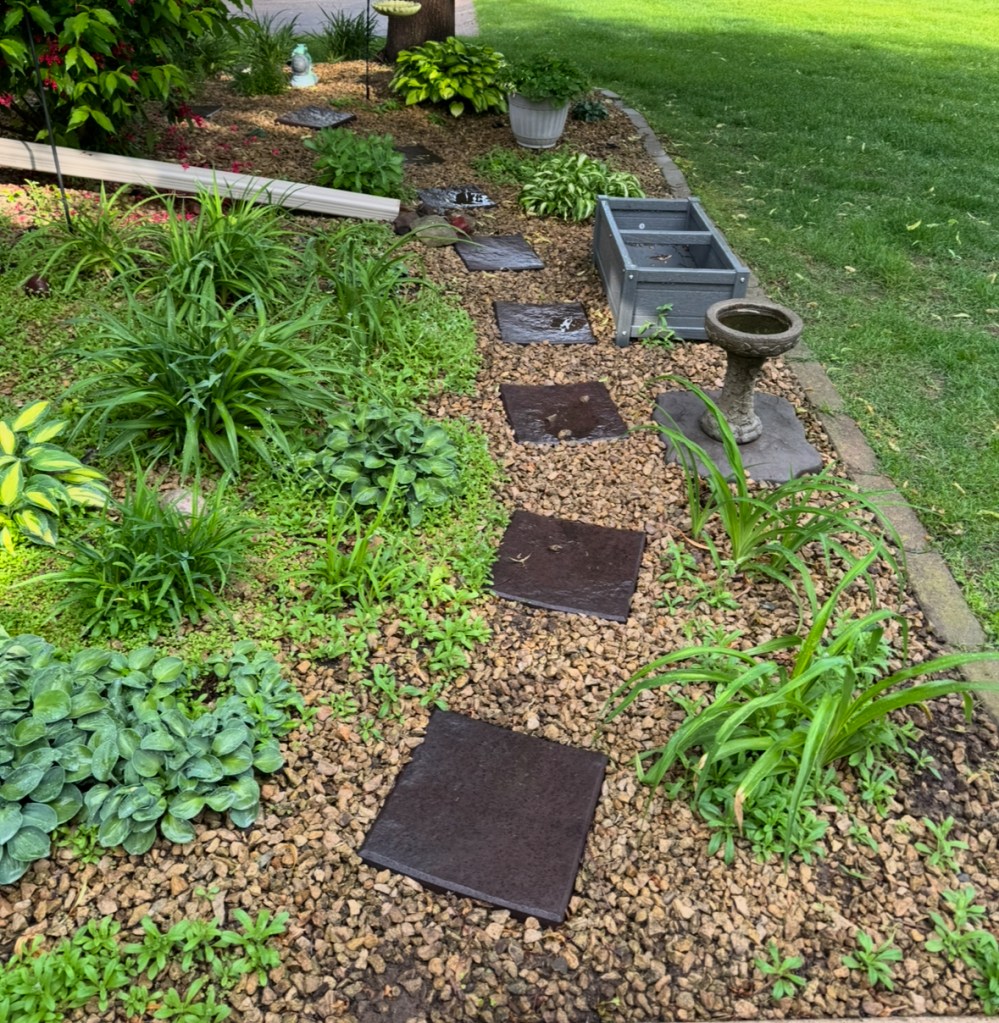
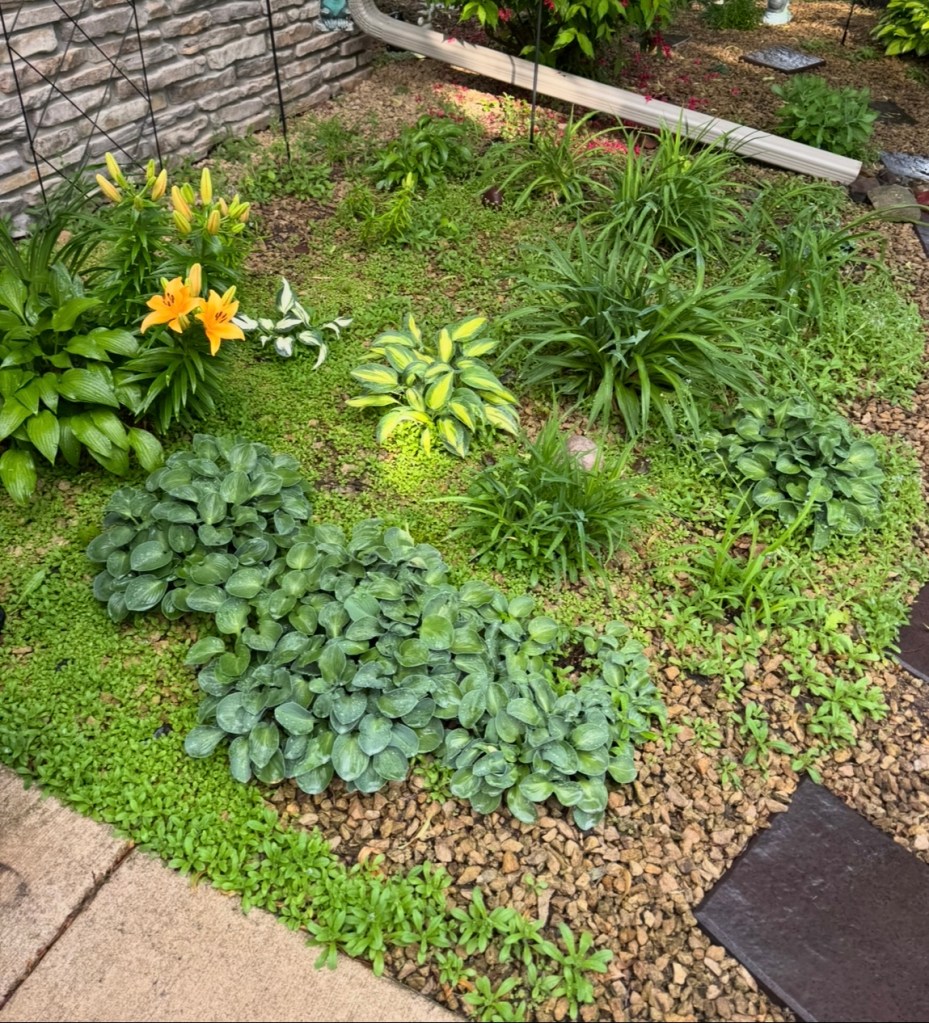
The divisions this year will follow last year’s pattern, moving them more into the shade. I want to reestablish a path to the back of the garden again, so the hostas I divide will move into that area, giving more layering, which also keeps weeds down, and then the space where the Blue Mouse Ears hostas will come out of will become a footpath again.
The forget-me-nots are winding down their bloom and getting pulled out. They are biennials so as I pull more and more, only leaving them for a bunny deterrent, they will stay – but in significant moderation. I do miss them a bit, but you can imagine what I don’t miss. I don’t miss how the tall stems cling to anything fabric. So the decision is – they are awesome bunny repellent but they are not going to be taller parts of “bouquets” going forward. They can stay low. A sweet sentimental part of our garden.
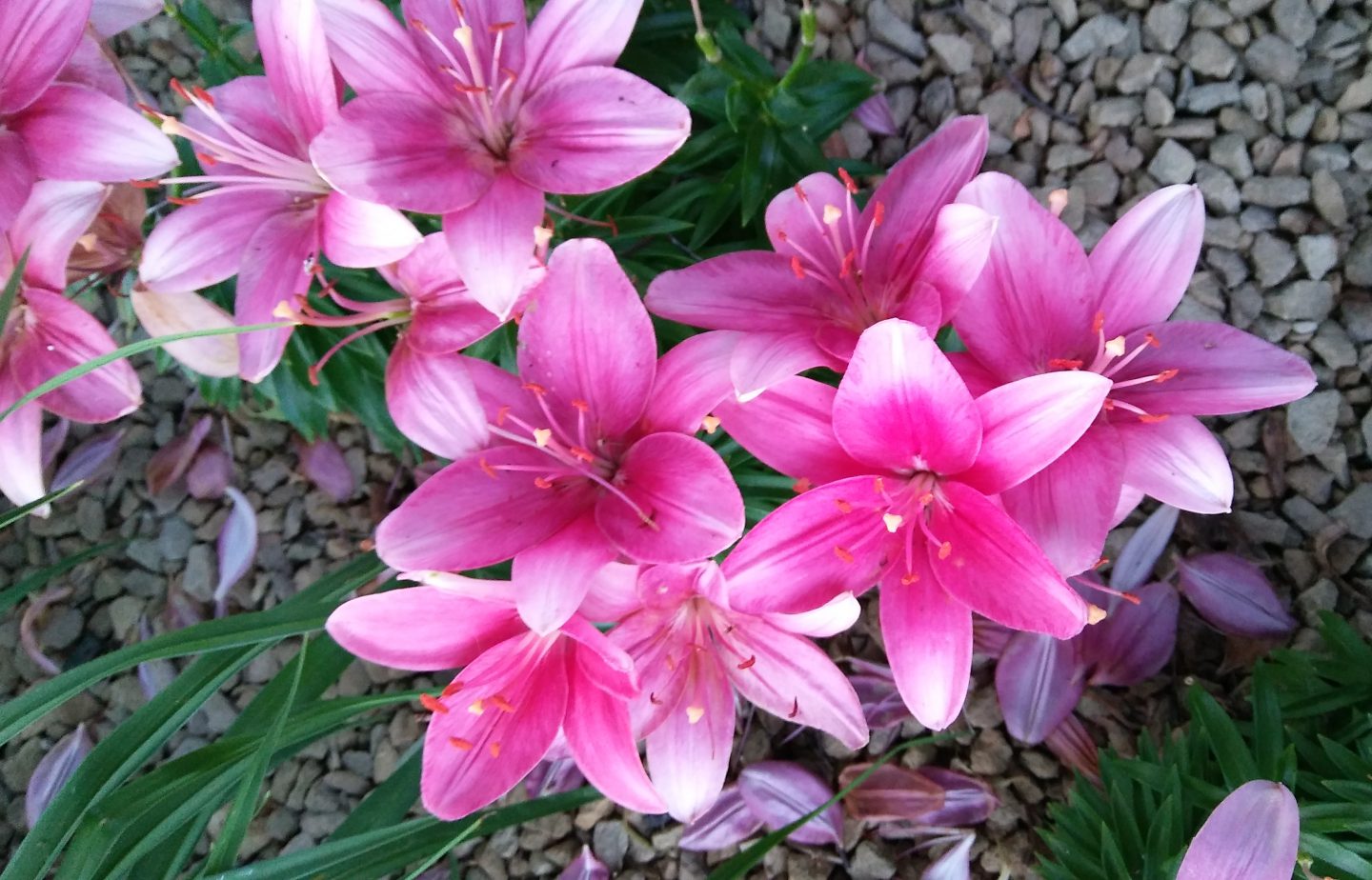
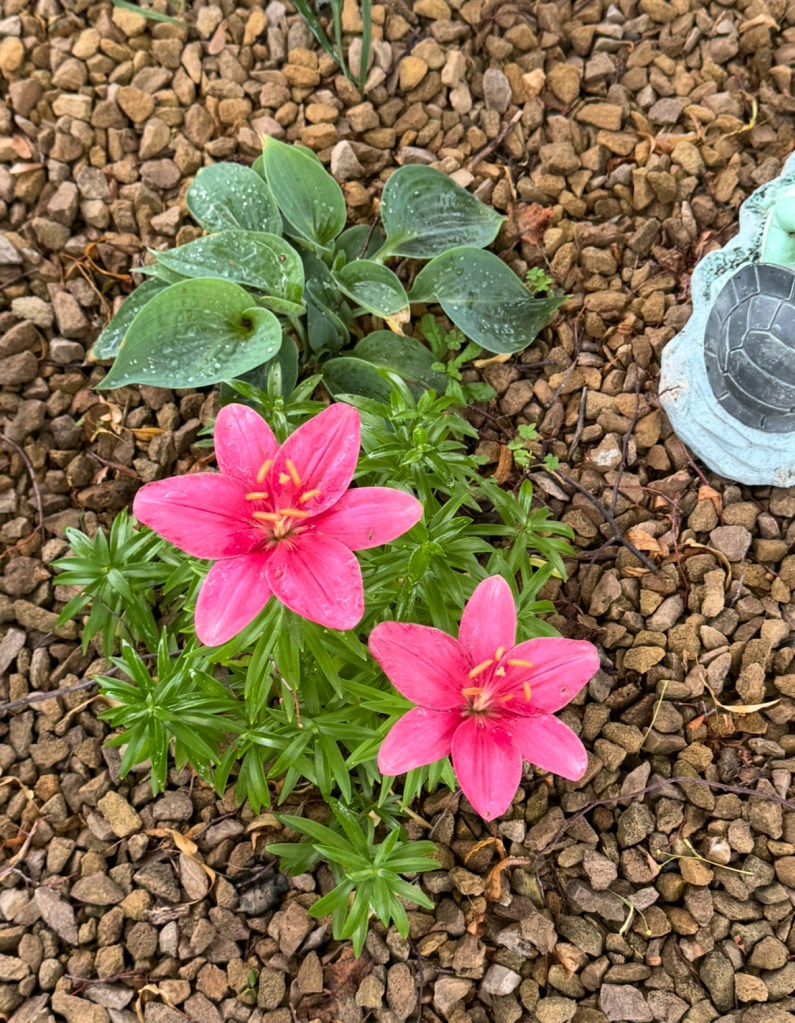
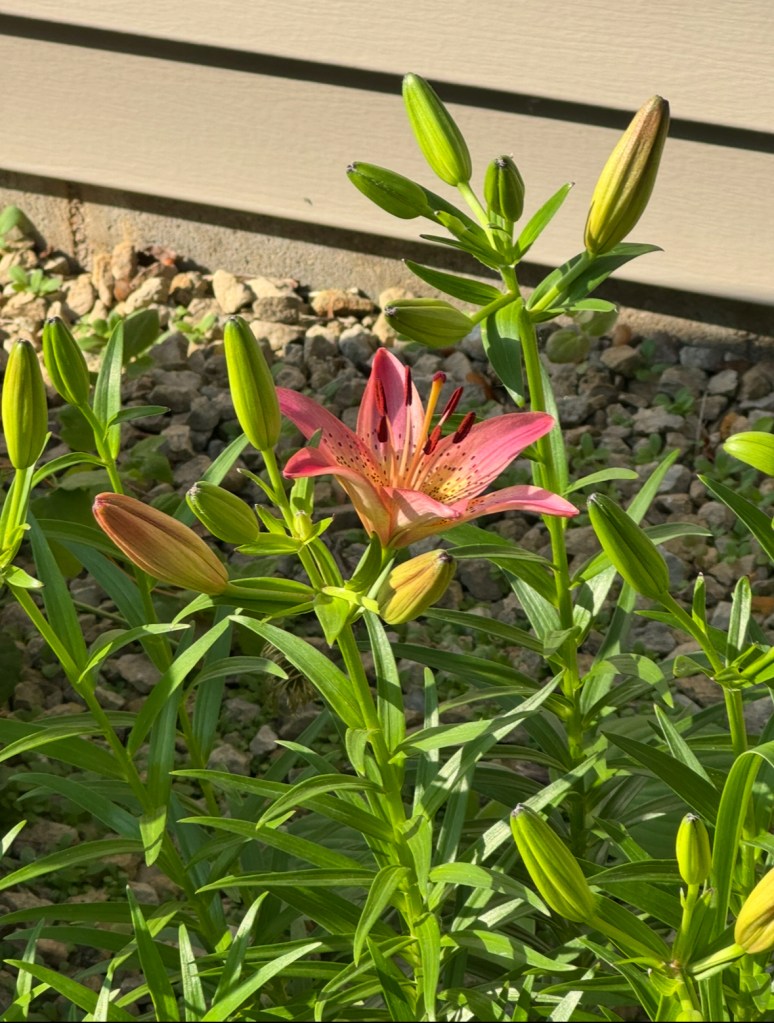
The peach asian lilies are done blooming, and they have now been cut back to half height. All except one I missed. I do like that they not only look tidier but that cutting them back preserves their energy from going to seed. Oh, believe me, I am tempted to let the one I missed go to seed, but I researched to remind myself on why I don’t grow Asian lilies from seed, and to get success with bringing harvested Asian lily seed to bloom it takes a series of stratification steps, followed by 3-7 years as a seedling, before bloom. I think I may say no to that wonderful opportunity this year at least. Probably longer.
Speaking of years, 7 years in to my daylily propagation journey, I am now growing enough daylily seedlings, to bloom, to keep me (and the historic cemetery) more than good. This year we have three new daylily seedlings with scapes, and the 2024 seeds are popping up more for the future. The cloches are on the seedlings, and the Mahala Felton seeds that don’t germinate this week are going into the shamrocks with their dirt. They still will have a chance, just not a dedicated space.
And the shamrocks? I don’t know what is going on there. Birds or bunnies or squirrels or something are starting to dig at those pots again, so I am going to do an experiment. I am going to put them in the ground in a spot where we lost a hosta. That spot is already growing some shamrocks from bird, bunny, or squirrel damage I missed collecting earlier this spring. We had a friend who somehow managed to grow them perennially, outdoors, in the ground, here in Minnesota, even though they are not supposed to be winter hardy. At this point they are getting distroyed anyway, and I have plenty saved in the house, so no big. It will be an adventure. Could be I grow them as annuals in our garden forward. Or we could have a new perennial. We shall see.
Finally, I have a seedling from the early years when I was doing uneducated crosses that is baffling me. I have looked and looked at pics and notes, and it sure looks like I successfully crossed Pink Tirza with a tetraploid. That’s what the envelope said (my handwriting) when I planted it. That should not have worked, as Pink Tirza is supposed to be a diploid. Very odd. Maybe something got crossed before I did the cross. We shall see how that matures.
Other than that, Red Volunteer bloomed its first bloom since I planted it last year at the historic cemetery, and I missed it. Hey, that’s how it goes. It has another bud that looks like it might bloom soon – maybe the 4th of July 😊
And finally, July 2nd was the 162nd anniversary of Gettysburg where one of the historic cemetery’s residents, James Akers, was killed in action.
This year I finished up adding purple irises to both sides of the fence garden. I am hoping they bloom for Memorial Day next year.
Wishing you a wonderful 4th of July if you are in the United States, and a beautiful week ahead.
Molly Cowles was the wife of SGT Asa Cowles, an American Revolutionary War patriot. SGT Asa Cowles and his brothers served in the Revolutionary War. One of his brothers did not return. His brother was taken as a prisoner of war and was assumed to have died in an English POW camp. The Cowles were patriots. How do I know this, and why? Well, it is a long story. I could give a short answer, but it really didn’t happen that way. In fact, I never would have researched anything about the Cowles had I not gone on the path I will share. The long answer to why I have this information really started many years ago with a grade school field trip I chaperoned for one of our sons’ classes. That is when history actually came alive for me. Before then I just could not get excited about paper maps being rolled down from the ceiling and wooden pointers showing us war locations and routes. I really tried. I did! But for some reason while math and English kept me wide awake, I kept dozing off in history class. Literally – dozing off. Arrggghhhh. But … I married a historian. Yah, absolutely true story. And one of our sons had that school field trip to a historic site and I agreed to be a chaperone. Well … I loved that site. Way more than our son did hahaha! It made history come alive for me. Next thing you know we were reenacting and doing historic rendezvous, in a tipi and then a wall tent. I know, crazy. So, you see, I was more interested in the everyday lives of the historic people at that point in my life, much more than the war maps in classrooms of my teen years. But everyday life history is harder to find. It is the bigger things that stand out, get documented – discoveries, settlements, births, wars. Sometimes occupation. Fast forward, many years later we moved to our current town, and my friend who is a long time historian got me hooked into local history. But wow, she is good! She got me back in through gardening. Yah, gardening. Probably because she knew this girl was not reenacting anymore. I was pretty clear about that 😉 And there you have it. Regarding history, I volunteer garden at a historic site cemetery and do garden stuff in honor of some pretty cool historic people. One of those people is Mahala Felton, the first white woman settler to our area. As that research project unfolded for me, I realized Mahala Felton’s incredible contribution to local history. I decided to name a daylily for her. And I shared the incredible history I had learned in a four part blog. I was thinking at that point that I would take a break from researching, but it was not meant to be. The answer to how I know about SGT Asa Cowles falls in the timeline at the end of my research on Mahala Felton. About that time my sister shared our ancestry chart. I was intrigued by a very unique name (Sempronia) in our family genealogy. I might have stopped there, and missed SGT Asa Cowles, but somehow the name Tirza popped up. A very unusual, yet very familiar name to me – Tirzah. As in Pink Tirzah, the daylily. Pink Tirzah has a very storied history in my garden that I shall not recount. But suffice to say, Pink Tirzah overcame many obstacles and today she is thriving. She is now knocking it out of the park. Pink Tirzah was my most successful pollen source last year. Go Pink Tirzah! But I digress, slightly. I found Tirzah Cowles but she was not in our lineage. Her brother was. And their father was SGT Asa Cowles. Now stick with me here, because I suspect, as we used to say while sitting around evening campfires at rendevous, telling stories, it will seem like this is a “smoke goes up, heads north, and makes a hard turn right” but it is not. This all ties together, I promise.
My husband and I agree on names for my daylilies. Some of my intentional crosses get female names. That’s just how it rolls. We chatted one morning about all this and agreed. The Pink Tirzah cross will be named Molly Cowles.
There may be more female names from our genealogy. I thought I saw a Civil War reference somewhere along the way but didn’t pull that url. It looks right now like our lineage goes back to Jamestown, but we shall see. We are still researching. I will write more as we go.
For the past few weeks the Asian lilies have been blooming, the remaining hostas have been scaping out, and every day I have seen more daylily scapes. The spots where we lost all the hostas have been reassigned to match our new phase of gardening here, clover has increasingly been removed, and bunny deterrents are in place.
Did you know that forget-me-nots don’t even need to bloom to deter bunnies? It is the leaves that emit a scent that the bunnies don’t like. So I am plucking away on blooms as the stems start to fall over. The flowers are pretty, and make nice little bouquets with the daylilies, but the leaves are what deter snacking bunnies.
That being said, I am also judiciously pulling the forget-me-nots where I want paths to legacy daylilies I want to use for crosses. Lots of transition in place, and the forget-me-nots are at the very top of that list. They will definitely stay, just more strategically placed.
Another fun fact – Did you know that gardens also bake donuts? Yes indeedio! Here is proof.
I have a number of layering (bouquets) in the garden, and I am embracing them more and more as I move into this next phase of the townhome gardens. Maybe the donut will get some friends. We shall see.
On the daylily scene, all daylily seeds harvested here in 2024 are now planted, and the seedling boxes are full, protecting them from the squirrels. I also still have a tray of planted seeds inside. I could make room in the current seedling boxes, but I want to give the Mahala seeds that haven’t germinated just a little more time. You never know.
Sadly, a few of our legacy daylilies don’t seem to be scaping out this year. That means it is division time for them this fall. More shifting. More adjusting to this next phase. And as the garden ages out on legacy plants and adds more daylily seedlings, eventually there will be a whole new look. Free as far as buying plants. And neat to see what is created. Kinda fun.
Daylily season is definitely here. Scapes are popping up on the daylilies, and two seedlings that have never put up scapes before are sporting buds this year. Our longest seedling holdout is even looking like it will finally bloom this year. Very good!
The ninebarks and the weigelia are wrapping up their blooms (at least the first flush), the asian lilies are blooming,
and the first hosta scape appeared a few days ago.
I continue to learn about propagating daylilies in the northern United States. Recently I read that in northern states it can take up to 10 years for a seedling to produce scapes and bloom! I almost gave up on our year one (holdout) seedling! I am so glad I didn’t! Now we wait to see what our pollinators created with that one. (I harvested daylily seeds from pollinator creations for a few years before I started to do intentional crosses.)
Regarding intentional crosses, we now have a 5th and 6th Mahala seedling. I am shocked! Those were the ones I planted in little seedling pots 8 weeks ago! I guess it just goes to show that daylily propagation really does take serious patience.
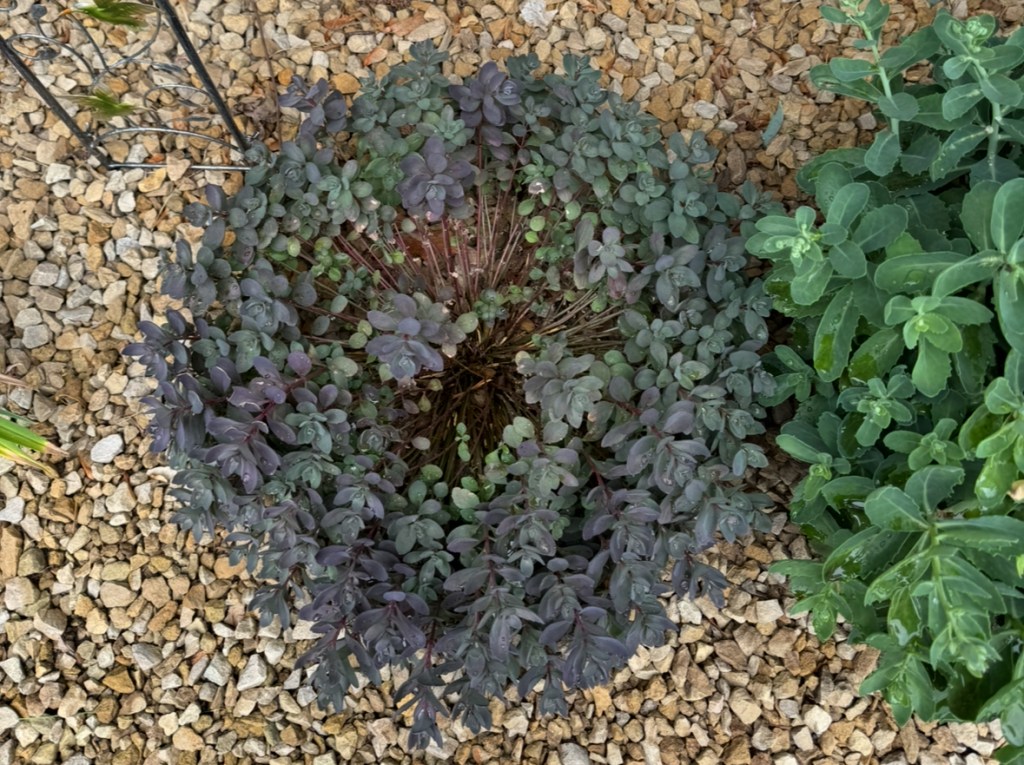
Out front, the stonecrop have reached their max height before they start to “donut”. I probably should divide them this year, but I have nowhere to put divisions. Maybe a few could go to the historic cemetery. We shall see how much energy I have in September when it is time to divide and transplant. I just transplanted 7 more irises into the cemetery garden, and it is getting pretty full. But maybe …
All of the Blue Mouse Ears hosta divisions and transplants seem to be doing well, even in the sun at the historic cemetery gardens. Very good news! I will continue to monitor them. I need to divide some more of the more mature ones here again this fall. Last year I was scrambling and tucking them in as tests. But they did so well, now I know what they can handle.
Lastly, the progress on the forget-me-nots. I did a bunch of research and it turns out they are a bunny repellant. That does seem true, and that strategy lends itself to useful ideas, both for where to keep them and where to pull them. They are very pretty amongst the daylilies and hostas. A little bouquet.
We are in the middle of rain, rain, rain here for the past week or so and now we are heading into almost another whole week of rain lol. But Saturday I got a bunch of work done on the garden. That felt great!
Recently I shared that we lost a bunch of hostas. Those losses have spurred on change. Those losses made me rethink a lot about our garden set up. We lost those hostas because of of a number of reasons – fertilizer and herbicide overspray and then a few of them were expected because I knew tree roots were getting quite close. And because those reasons will not be going away, I am not replacing any of what was lost.
But that was not the end of the story. The space did not look “right”, and because there had been so many hostas there, other things that were previously minor parts of the garden – the forget-me-nots and the clover – began to flourish. Think no barriers like plastic underlayment under the rock …
Saturday I spent time paring back the forget-me-nots and the clover (and quite a few bunny planted raspberry seedlings) in prep for where I want to go with my next garden phase – expanding my daylily propagation work, needing more planter space. Just like anything, times are changing. I am in a new phase of my gardening, just like we all get to new phases of our life, and I need to have a little bit of reassessment of what will work for this.
Saturday I cleared all clover and forget-me-nots out of the front, left very little of it in the corner where the linden is, and cleared it away from the path out back.
I was unsure of what I wanted to do in the area that sustained the largest number of hosta losses, so I left just a little patch of clover and forget-me-nots there. This morning I decided. I moved the green shamrock into that area, and I like it, so the remaining clover and forget-me-not patch in that round of the corner will go.
And then I will tackle this.
I planted the forget-me-nots the year my father-in-law and a sweet neighbor friend passed weeks apart. The forget-me-nots are sentimental. And I have kept them inside the paver trim. Inside 😊 But I hardly think that stepping on forget-me-nots is a great way to remember those we have lost, and stepping on forget-me-not is definitely not part of my daylily propagation “vision ”, so, as they bloom and begin to fade, they will be pared way back. A heartwarming sprinklng that enhances the daylilies and remaining hostas out back.
I did it! I have been talking about maybe doing this for a while. On and off for 3 years. But with the loss of the 11 hostas, I finally made the decision. The daylily “farm” can be handled with raised boxes. It can. Truly.
Now, I say “farm” very lightly. I know it is not a farm. Of course I do. And if I could, I would have a great big daylily farm. But it ain’t happening. Our land up north is for our off-grid time, and that is not changing any time soon. So, my personal townhome style daylily “farm” is going to expand, but just not in a conventional farm way. I am going to work with what I have, to do the most I can do with what is in my heart. And that is to continue to be creative, do intentional crosses, harvest those seeds, and work to bring them to seedling, plant, and something new and hopefully fun for bloom. I also am fascinated by what the birds, bees, and butterflies accomplish with the daylilies, and I am not going to count out continuing to harvest those seeds as part of my daylily “farm” effort 🙂
Hello Yellow is a self seed daylily, and it has a very special place in my garden mama heart.
So there you go. A townhome style daylily “farm”, doing intentional crosses and harvesting the bird, bee, and butterfly contributions as well. As our oldest grandson says, “Do It!” Yes, I think I will 🙂
In a previous post I fully discussed the loss of 11 hostas in the townhome gardens. Although I miss the big, beautiful hostas, I shall not be replacing them. It would be foolish. The same issues that most likely led, or at least added to their demise, remain. Fertilizer and herbicide overspray will not be going away, and growing tree roots were already expected to make part of the garden ground unusable at some point in time. We love those big beautiful trees as well! Bottom line, the time is now here. I need a new format. I can think and think and think, but I still come up with the same solution for my daylily “farm” – raised box containers. That is the only way I can see this working, long term.
So, decision one is made – raised box containers are needed. I have one, a wonderful cedar container with a wire mesh lid that my children made me for my 60th birthday. It is wunderbar! But they aren’t making me more, so I went shopping. Here were my “must haves” when shopping for the raised box container(s):
Must be secure from squirrels, bunnies, and birds who dig. (We will assess if birds try to nest there. I hope not.)
Must be low maintenance. Nothing “fussy”. No need to continually paint or stain, not flimsy.
Preferably can be left outside year-round. Maybe I will holiday decorate with them. Aw, who am I kidding? Probably not. Maybe I will put bird food in them lol
Must have drainage.
Not metal. I want a daylily “farm” but not a livestock metal trough look.
Must be raised enough to miss as much applied fertilizer and herbicide overspray as possible, and in fact, it would be great if it stopped those granules in their tracks, so they didn’t go farther into the garden.
The options available are pretty impressive! I ended up choosing an HDPE raised bed box. One at first, as a test, to see if I like that particular product. Yes, plastic. It is made of the same type of materials as my path, which is 20 years old and no problem. I get it, plastic is a dirty word, but I bought eco-friendly and sustainable. No, I did not research the company to see if it really is eco responsible … I am hoping what they claim is true, but I am not growing food, and I do not expect to need to continually replace them 🙂
The new raised box(es) will hold all daylilies in progress, from seed to season’s end seedling. (It will be an expansion of my existing seedling box.) I am keeping my tried and true one pot per harvested seed type method. The boxes will hold those pots. There may be exceptions where I use multiple pots per seed type. Right away I am thinking about the 60 seeds I harvested from the same cross type last year. But by and large, one pot per harvested seed type. I will use cloches (wire baskets) over the top of the pots that are designed to protect the seedlings from diggers and mess makers. I already have those. And, best of all, the raised bed/box is not slotted nor elevated on legs. It will make a border on the inside edge of the rock that acts as protection from granular fertilizer and herbicide overspray on the garden on the other side of the raised box. Hurray!!!
So that is my next steps plan. Nothing is perfect, but it is directionally correct, and we shall hope it is successful. Plus, it is portable, meaning I can take it if we ever do move to another home.
I will begin with the first box this weekend, and if I am pleased, I have room for another box right away this year. As mentioned above, I have 60 seeds of the same intentional cross to get planted by the beginning of June, plus all the other assorted intentional crosses and self-seeds. They all need a summer home to get started, and whatever goes to seedling will need protection once they get planted this fall. Fingers crossed, the solid raised box with cloche method takes care of all of that.
And yes, if all 60 same cross seeds germinate and go to seedling, I am fine with that. I did some significant family genealogy this past week and the results had an unbelievable tie in to the parents of that daylily seed. Almost freaky weird uncanny. So that seed is now also dedicated, and seedlings will be shared 🙂
As I looked at my photos of previous years this morning, it became crystal clear – the townhome gardens are changing. A lot.
It is a bit of a shock this year with the loss of a number of hostas. OK, 11. A large number of large hostas. The full realization is here. The edges of the gardens probably are not the safest place anymore – fertilizer and herbicide overspray and drift. And the aging of the garden by the linden, with its roots, has arrived.
I should probably be more upset. The big beautiful hostas! Why am I not very upset? Did I not really care about the hostas?
And then it occurs to me that nature is giving me cues. It is time to pivot. A pivot I have been thinking of accomplishing in other ways. Nature just beat me to it.
Likewise, a big portion of my time allocation has also pivoted this year. Again, the change outcome is something I was already working toward. It is just different timing and a different path.
So, where am I with the gardens?
At the townhome gardens, I greatly miss the 11 hostas, but I will not replace them. Something benefitted from them and they returned to nature. Their time here is done.
I am firmly on the path with the daylily propagation. I don’t expect that to change before I hang up my gardening hat, whenever that may be. I have longed for a space to daylily “farm” for a while, and my mind is reminding me words have power, be careful what you put out there, what you share as your desire for next steps, what you wish for.
So the space is now there, admittedly needing a new configuration or format. More portable if I want. But the timing. Is the timing right? It feels like nature has run ahead of me this time. I need to make the next move but I am not quite ready. I am not “for sure” on what I want as the next step format. I am going slow, checking things out, how I want them longer term.
So let’s see – What is right in front of me? What do I already have in motion? Let’s start with the “Mahala” seedlings. What???, you say! Did some seeds go to seedling? Yes, but only two. Out of 25 seeds. Not my usual yield ratio, but ok. And maybe nature is saying that is enough. One for either side of the historic cemetery gate. But wait! Mahala was not about the historic cemetery. In fact, nothing I have read about her mentions her involvement in the acquisition or care of the historic cemetery. I wished. I was hoping it was part of her and William’s homestead, but I cannot find anything at all to support that. Everything I have found leads to an understanding that it was entirely someone else’s land before it became the historic cemetery. So then – the “Welcome” is like the welcome she extended to those who stayed at the Buckhorn. The Buckhorn was not on William and her land nor was it their building, but where they were based out of, where their presence was first established in this area. Perhaps my tiny part was to decide which harvested seed was to be dedicated and named for Mahala, and then nature decided, and will decide, how much “presence” those daylilies have. Perhaps a very simple “Welcome” duo of daylilies in Mahala Felton’s honor have been initially chosen by nature to move forward. I have done my part. Now we wait a few years and see how they develop.
And that may also be the townhome garden message overall for this time. I have done my part, I have things still to do with the daylily seeds harvested in 2024, and the seedlings from previous years. Now we see how things develop.
For sure the rest of the 2024 daylily cross seeds need to go in the seedling box by the beginning of June. That means the Mahala seeds need to get into the ground by the beginning of June, and for that I invested in cloches. I bought a set of 20 for long term planning, so I have plenty. A couple could even go to the historic cemetery. But watering there is manual, and markers for the daylilies I planted last year are also disappearing, so I may keep the seedlings here until fall. TBD.
One thing is for sure, I am done with the “one seed in a little pot” method. I have done it my last time. I should know better. There is a reason I stopped doing that. It is way too tedious and, for whatever reason, for me it yields way less results. It looks nice, little pots all lined up in a tray, with covers to start, but no. Done with that. All harvested daylily seeds, intentional crosses or volunteers, will go in a pot – one pot per type. Easy peasey lemon squeezey 😊
Two weeks ago it seemed like the gardens were on hold. This week things were full speed ahead. But today with a rain and cooler weather, I am once again spending my time indoors. No worries. It is a good time to finish this blog post. It is a longer one. I need to cut it off, wrap it up, insert the pics, add the tags and categories, and get it out there. Here goes.
Top of mind is still the prospective “Mahala” daylily seeds – With the seed planting underway, I am trying to figure out what I will do to protect the seedlings when they need to go into the ground. The seedling box is not a season-long option with the small seed starter cups I used for those seeds. I used special seedling cups for them, with little greenhouse style covers. I am hoping that will be very successful for germination, but if so, they will need to get into the ground within a month. The little cups will be too restrictive for their roots.
If they are successful and germinate and go to seedling, where I think I am heading is something called a “cloche”. It is a wire mesh cage topper that is placed over the seedlings to protect them. In our case that protection time would be the 2025 gardening season. The cloche solution would allow any seedlings a full season to grow and mature in the ground. Then in the fall the cloche would be removed and in year 2 forward the “Mahala” seedlings would be just like any other daylily in the gardens.
I like the cloche idea as a next step. It keeps with “simple”, and it looks nice. It is also a sustainable one-time purchase if I want to continue the early seedling process in future years, for future dedicated seeds. And it doesn’t add another seedling box to be stored over the winter, a definite bonus.
For right now I am still watching to see if we get seedlings. If we don’t get seedlings, we don’t need cloches. But, fingers crossed, we will need them.
In the meantime, the established gardens are popping, so there has been plenty to do.
In the townhome gardens, everything except two late daylilies, a few missing hostas, and two sedum, have popped, including the bushes. One day the ninebark bushes didn’t even look like they had buds. Two days later they were leafing out. And yesterday I noticed the weigelia bush is taking off too.
For daylilies, all the longtime daylilies, including those I divided and transplanted, are back. There are two daylilies from last fall’s order that I am still watching for. In a funny twist, they are supposed to be part of my “control” daylilies to compare against what works at the historic cemetery, and also, an easier way to do and monitor crosses. It is much easier to step out the door at the townhouse and do a cross than get in the car and drive to the historic cemetery. Not that I don’t intend to do crosses there. I do. But it will just be a little more time consuming. Full transparency, though? The historic cemetery garden is easily two weeks ahead of the townhouse gardens. It is an all-day sun, retaining wall, mulched garden. The two control daylilies that are missing from the townhome gardens are already up at the historic cemetery garden. I am kind of bumming, kind of thinking, “can you say extended crossing season?” We shall see what actually blooms. Hopefully both of the missing control daylilies will still show at the townhome gardens as well. One is a tetraploid, and one is a diploid. The tetraploid is one of my faves. It is one of the “parents” that are waning in the townhome gardens and also one of the “parents” of a cross I am watching to bloom this year. I was hoping to use the newly planted one this year, but eras change, and the torch may be passing to a new “rock steady”. Long story short, it will be a bit before I can fully say what we have to work with at each location for 2025.
Regarding daylily seedlings, awesome news … at all of the gardens the seedlings are back. I am especially excited to see one particular set of 2024 seedlings (an intentional cross), and am hoping it blooms this year. As I had also hoped, all of the 2023 seedlings are quite a bit larger. Hello Yello is three times larger! She will be a focus again this year. I think she is a tetraploid, as a tetraploid cross went to pod last year whereas a diploid cross didn’t. But that tetraploid cross pod started to fail, and then Bunimous Rex (our beloved neighborhood resident very large bunny) or a naughty squirrel got it. I know for sure it was not one of the white squirrels. Na-ah. They are very well behaved. Maybe this year some of the shorter crosses also need cloches lol. We shall see.
On the hosta scene, Blue Mouse Ears continue to amaze me. Last year’s divisions are popping up.
I think if I could only have one type of hosta, it would be Blue Mouse Ears. Yes, Rainforest Sunrise and Guacamole and Elegans and Praying Hands and Touch of Class. But goodness! Blue Mouse Ears year after year after year checks all the boxes – sun tolerant, disease free, drought hardy, and they reproduce very well. So well that they got divided and placed all over last fall. They are now coming up where we transplanted divisions – both here at the townhome, and at the historic cemetery.
The Asian lilies are also coming back.
Not terribly strong. They are quite old. But they are returning. And … the clematis the lawn maintenance guy tried to pull last year? Back! Hahaha! I thought it was a goner, but nope. It’s back.
The daffodils I planted last fall are largely a no show. There are a few coming up at the historic cemetery, but most of the daffodils coming up there are the ones I planted in fall of 2023. And yes, I planted them correctly lol. It seems they did deter moles, as was my primary reason for planting them. They just didn’t bloom well. And that’s OK. The bags of 50 are coming to the end of an era. This fall I want to change things up a little and force grape hyacinth this coming winter. They also deter moles. And I can do smaller pots for forcing. If I want to.
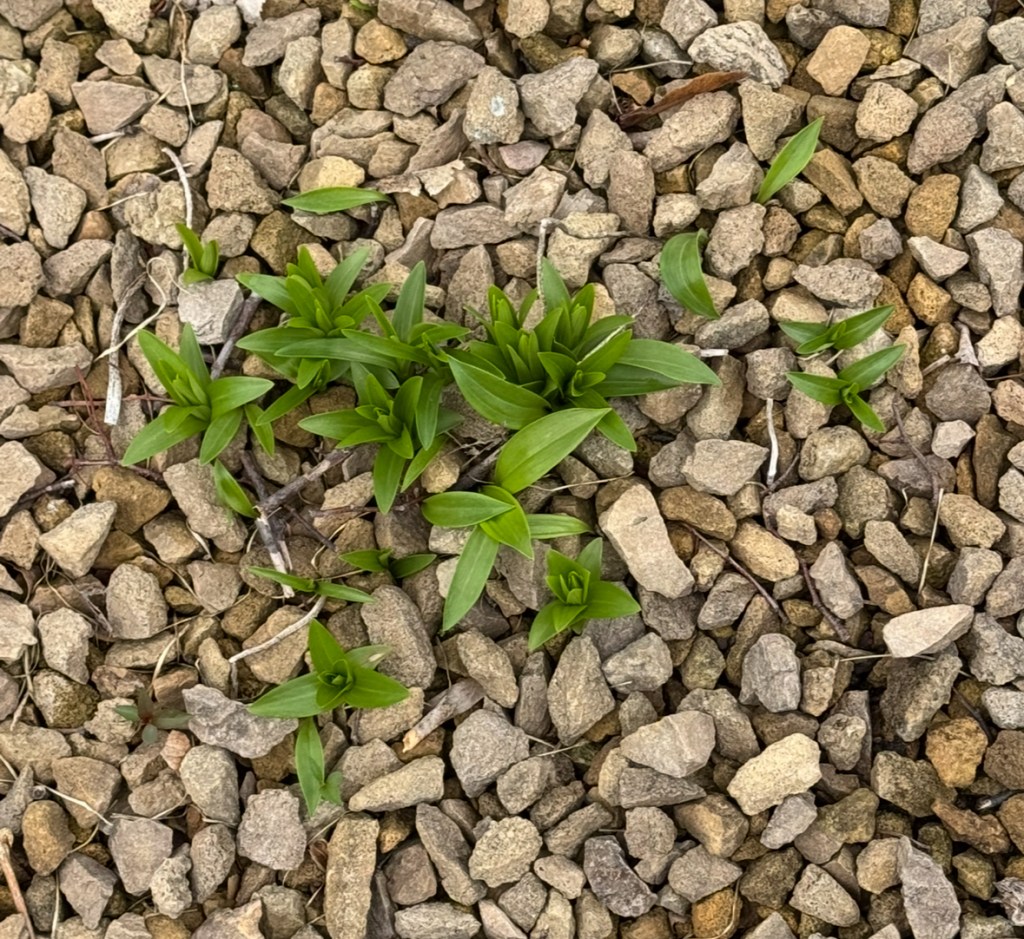
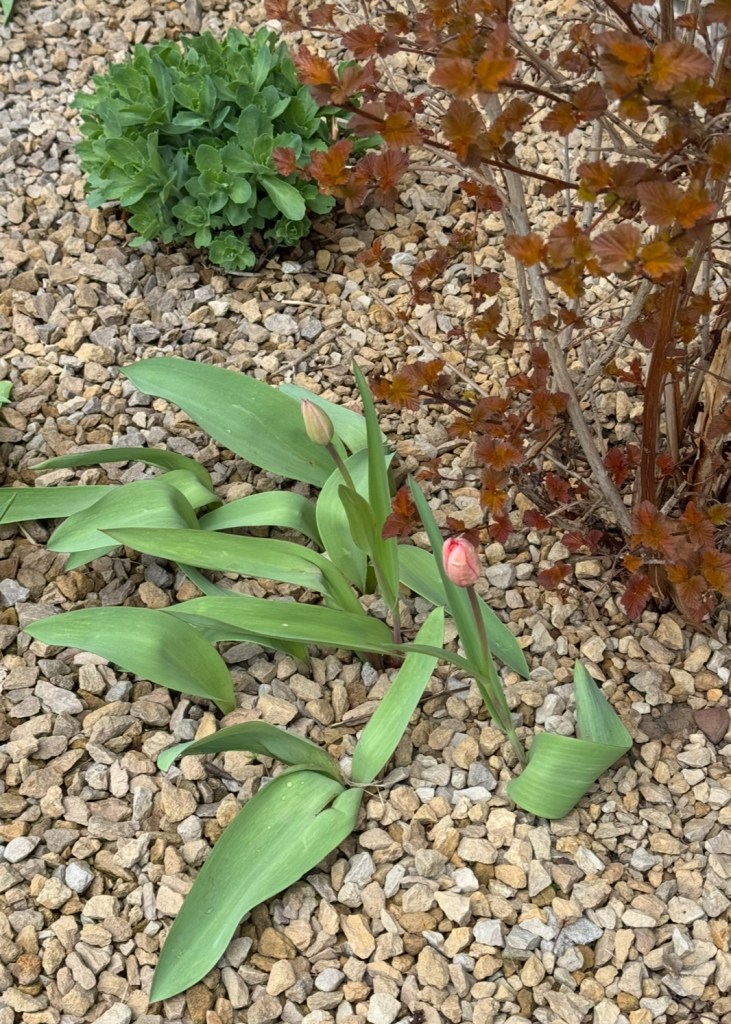
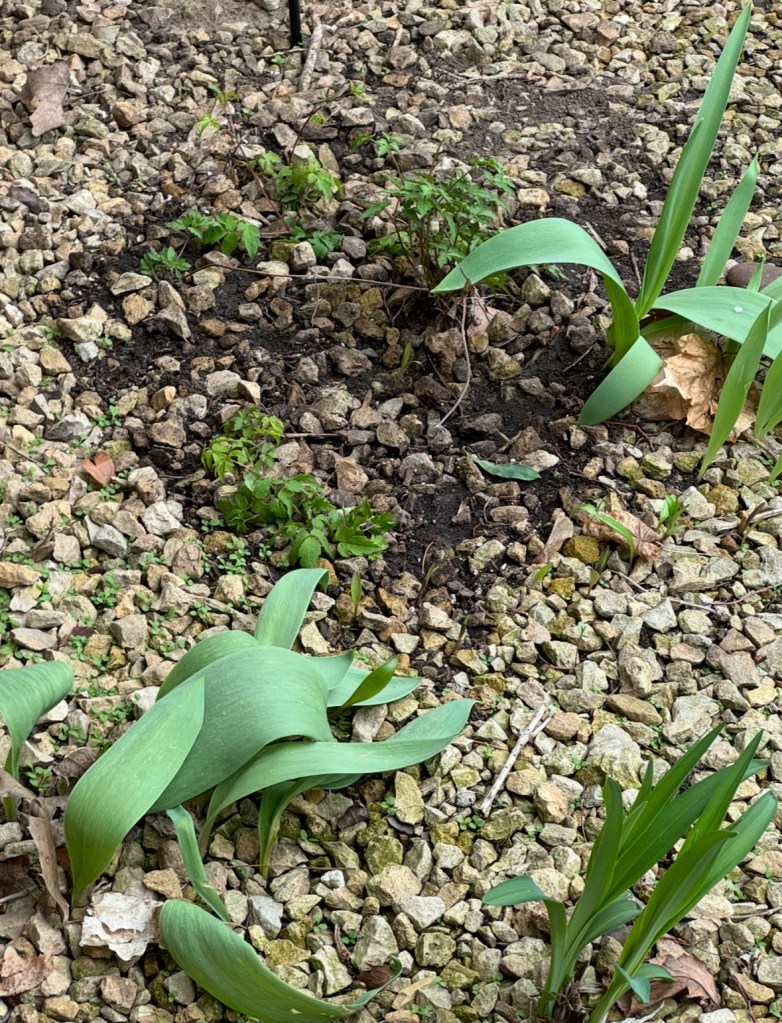
And then there are the tulips. Of all the multiple (lots of) tulip bulbs in the townhome gardens that produce greens, only two have buds.
Yesterday after the greens of a few got stepped on while we cleaned the windows, I tested digging one out. I had kept my hand shovel out after digging and transplanting Blue Bells clematis volunteers.
I thought I might be able to dig the non-blooming tulips and consolidate them to one area (or bring them up north to naturalize or be deer food). Well, I probably should have gotten out the full-sized shovel. Instead of the bulb coming up, the stems broke off first. At which point I thought, “Why are you doing this? Pull the other stems and be done with it for another year.” I would like to say I did that immediately. I did for one more bulb. And then I remembered the next one I went to pull actually bloomed last year. They can fade back. Maybe next year I will feel differently.
To wrap up the afternoon yesterday, while I was in a cleanup mood, I tested to see if the variegated sedum (that it looked like we lost) was really a goner. It pulled out super easy, but wouldn’t you know it, there were little green sprouts. Dang! So, I searched around for a place where I could put it to give it one last chance. Aha! A swaparoo! A two-for. I moved the small Pink Tirza I want to use for crosses again this year to a more accessible spot,
and the variegated sedum went to a more secluded spot to R&R and hopefully come back stronger next year.
With that done, I called it quits. I was kind of still working off a crummy mood from something else. (What is it that makes normally sane drivers turn road risky on rummage sale days? Yikes!) I got myself a sweet tea and sat and looked at how nice the newly relocated Pink Tirza fit into its new home. That was a very good choice 🙂
And then, this morning on my walkabout I noticed … we did not lose the Guacamole hosta, as I feared. It is slowly coming up. The two Elegans, not looking good. Oh well. The circle of life.
Have a great weekend. I may take some time off early next week to put the finishing touches on something I will be kicking off next weekend – the Mahala Felton historical blog series. One post per week will be devoted to getting all the Mahala Felton research I have done out into the public domain. It has been a worthy endeavor, and I really want to share. The tie in is to the historic cemetery. More to come on that.