Change, Big Change

As I looked at my photos of previous years this morning, it became crystal clear – the townhome gardens are changing. A lot.

It is a bit of a shock this year with the loss of a number of hostas. OK, 11. A large number of large hostas. The full realization is here. The edges of the gardens probably are not the safest place anymore – fertilizer and herbicide overspray and drift. And the aging of the garden by the linden, with its roots, has arrived.

I should probably be more upset. The big beautiful hostas! Why am I not very upset? Did I not really care about the hostas?

And then it occurs to me that nature is giving me cues. It is time to pivot. A pivot I have been thinking of accomplishing in other ways. Nature just beat me to it.

Likewise, a big portion of my time allocation has also pivoted this year. Again, the change outcome is something I was already working toward. It is just different timing and a different path.

So, where am I with the gardens?

At the townhome gardens, I greatly miss the 11 hostas, but I will not replace them. Something benefitted from them and they returned to nature. Their time here is done.

I am firmly on the path with the daylily propagation. I don’t expect that to change before I hang up my gardening hat, whenever that may be. I have longed for a space to daylily ā€œfarmā€ for a while, and my mind is reminding me words have power, be careful what you put out there, what you share as your desire for next steps, what you wish for.

So the space is now there, admittedly needing a new configuration or format. More portable if I want. But the timing. Is the timing right? It feels like nature has run ahead of me this time. I need to make the next move but I am not quite ready. I am not ā€œfor sureā€ on what I want as the next step format. I am going slow, checking things out, how I want them longer term.

So let’s see – What is right in front of me? What do I already have in motion?
Let’s start with the ā€œMahalaā€ seedlings. What???, you say! Did some seeds go to seedling? Yes, but only two. Out of 25 seeds. Not my usual yield ratio, but ok. And maybe nature is saying that is enough. One for either side of the historic cemetery gate. But wait! Mahala was not about the historic cemetery. In fact, nothing I have read about her mentions her involvement in the acquisition or care of the historic cemetery. I wished. I was hoping it was part of her and William’s homestead, but I cannot find anything at all to support that. Everything I have found leads to an understanding that it was entirely someone else’s land before it became the historic cemetery. So then – the ā€œWelcomeā€ is like the welcome she extended to those who stayed at the Buckhorn. The Buckhorn was not on William and her land nor was it their building, but where they were based out of, where their presence was first established in this area. Perhaps my tiny part was to decide which harvested seed was to be dedicated and named for Mahala, and then nature decided, and will decide, how much ā€œpresenceā€ those daylilies have. Perhaps a very simple ā€œWelcomeā€ duo of daylilies in Mahala Felton’s honor have been initially chosen by nature to move forward. I have done my part. Now we wait a few years and see how they develop.

And that may also be the townhome garden message overall for this time. I have done my part, I have things still to do with the daylily seeds harvested in 2024, and the seedlings from previous years. Now we see how things develop.

For sure the rest of the 2024 daylily cross seeds need to go in the seedling box by the beginning of June. That means the Mahala seeds need to get into the ground by the beginning of June, and for that I invested in cloches. I bought a set of 20 for long term planning, so I have plenty. A couple could even go to the historic cemetery. But watering there is manual, and markers for the daylilies I planted last year are also disappearing, so I may keep the seedlings here until fall. TBD.

One thing is for sure, I am done with the ā€œone seed in a little potā€ method. I have done it my last time. I should know better. There is a reason I stopped doing that. It is way too tedious and, for whatever reason, for me it yields way less results. It looks nice, little pots all lined up in a tray, with covers to start, but no. Done with that. All harvested daylily seeds, intentional crosses or volunteers, will go in a pot – one pot per type. Easy peasey lemon squeezey 😊

That I know for sure.

And just like that

Two weeks ago it seemed like the gardens were on hold. This week things were full speed ahead. But today with a rain and cooler weather, I am once again spending my time indoors. No worries. It is a good time to finish this blog post. It is a longer one. I need to cut it off, wrap it up, insert the pics, add the tags and categories, and get it out there. Here goes.

Top of mind is still the prospective “Mahala” daylily seeds – With the seed planting underway, I am trying to figure out what I will do to protect the seedlings when they need to go into the ground. The seedling box is not a season-long option with the small seed starter cups I used for those seeds. I used special seedling cups for them, with little greenhouse style covers. I am hoping that will be very successful for germination, but if so, they will need to get into the ground within a month. The little cups will be too restrictive for their roots.

If they are successful and germinate and go to seedling, where I think I am heading is something called a ā€œclocheā€. It is a wire mesh cage topper that is placed over the seedlings to protect them. In our case that protection time would be the 2025 gardening season. The cloche solution would allow any seedlings a full season to grow and mature in the ground. Then in the fall the cloche would be removed and in year 2 forward the “Mahala” seedlings would be just like any other daylily in the gardens.

I like the cloche idea as a next step. It keeps with ā€œsimpleā€, and it looks nice. It is also a sustainable one-time purchase if I want to continue the early seedling process in future years, for future dedicated seeds. And it doesn’t add another seedling box to be stored over the winter, a definite bonus.

For right now I am still watching to see if we get seedlings. If we don’t get seedlings, we don’t need cloches. But, fingers crossed, we will need them.

In the meantime, the established gardens are popping, so there has been plenty to do.

In the townhome gardens, everything except two late daylilies, a few missing hostas, and two sedum, have popped, including the bushes. One day the ninebark bushes didn’t even look like they had buds. Two days later they were leafing out. And yesterday I noticed the weigelia bush is taking off too.


For daylilies, all the longtime daylilies, including those I divided and transplanted, are back. There are two daylilies from last fall’s order that I am still watching for. In a funny twist, they are supposed to be part of my ā€œcontrolā€ daylilies to compare against what works at the historic cemetery, and also, an easier way to do and monitor crosses. It is much easier to step out the door at the townhouse and do a cross than get in the car and drive to the historic cemetery. Not that I don’t intend to do crosses there. I do. But it will just be a little more time consuming. Full transparency, though? The historic cemetery garden is easily two weeks ahead of the townhouse gardens. It is an all-day sun, retaining wall, mulched garden. The two control daylilies that are missing from the townhome gardens are already up at the historic cemetery garden. I am kind of bumming, kind of thinking, “can you say extended crossing season?” We shall see what actually blooms. Hopefully both of the missing control daylilies will still show at the townhome gardens as well. One is a tetraploid, and one is a diploid. The tetraploid is one of my faves. It is one of the ā€œparentsā€ that are waning in the townhome gardens and also one of the ā€œparentsā€ of a cross I am watching to bloom this year. I was hoping to use the newly planted one this year, but eras change, and the torch may be passing to a new “rock steady”. Long story short, it will be a bit before I can fully say what we have to work with at each location for 2025.


Regarding daylily seedlings, awesome news … at all of the gardens the seedlings are back. I am especially excited to see one particular set of 2024 seedlings (an intentional cross), and am hoping it blooms this year. As I had also hoped, all of the 2023 seedlings are quite a bit larger. Hello Yello is three times larger! She will be a focus again this year. I think she is a tetraploid, as a tetraploid cross went to pod last year whereas a diploid cross didn’t. But that tetraploid cross pod started to fail, and then Bunimous Rex (our beloved neighborhood resident very large bunny) or a naughty squirrel got it. I know for sure it was not one of the white squirrels. Na-ah. They are very well behaved. Maybe this year some of the shorter crosses also need cloches lol. We shall see.

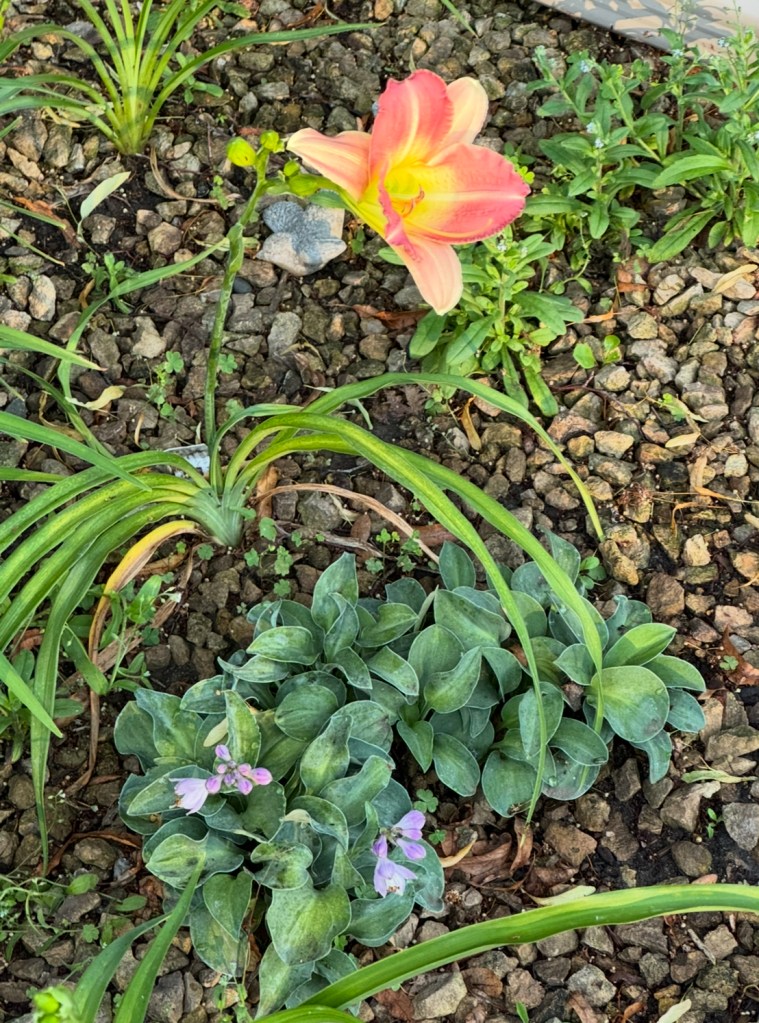
On the hosta scene, Blue Mouse Ears continue to amaze me. Last year’s divisions are popping up.

I think if I could only have one type of hosta, it would be Blue Mouse Ears. Yes, Rainforest Sunrise and Guacamole and Elegans and Praying Hands and Touch of Class. But goodness! Blue Mouse Ears year after year after year checks all the boxes – sun tolerant, disease free, drought hardy, and they reproduce very well. So well that they got divided and placed all over last fall. They are now coming up where we transplanted divisions – both here at the townhome, and at the historic cemetery.


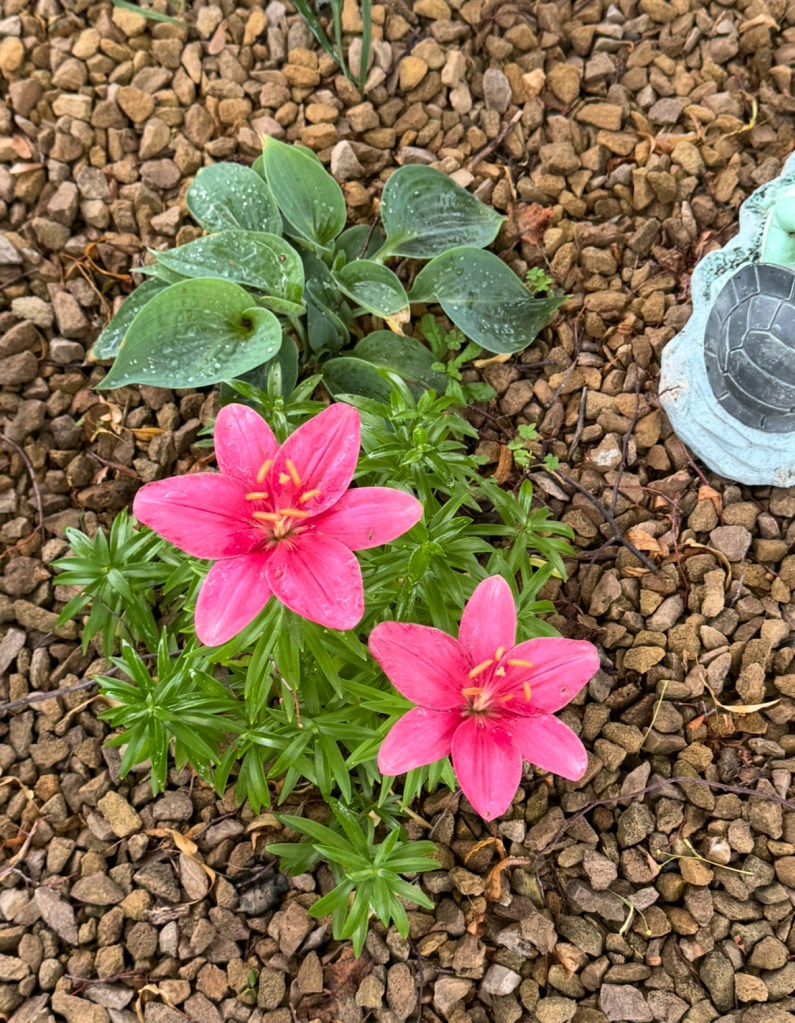
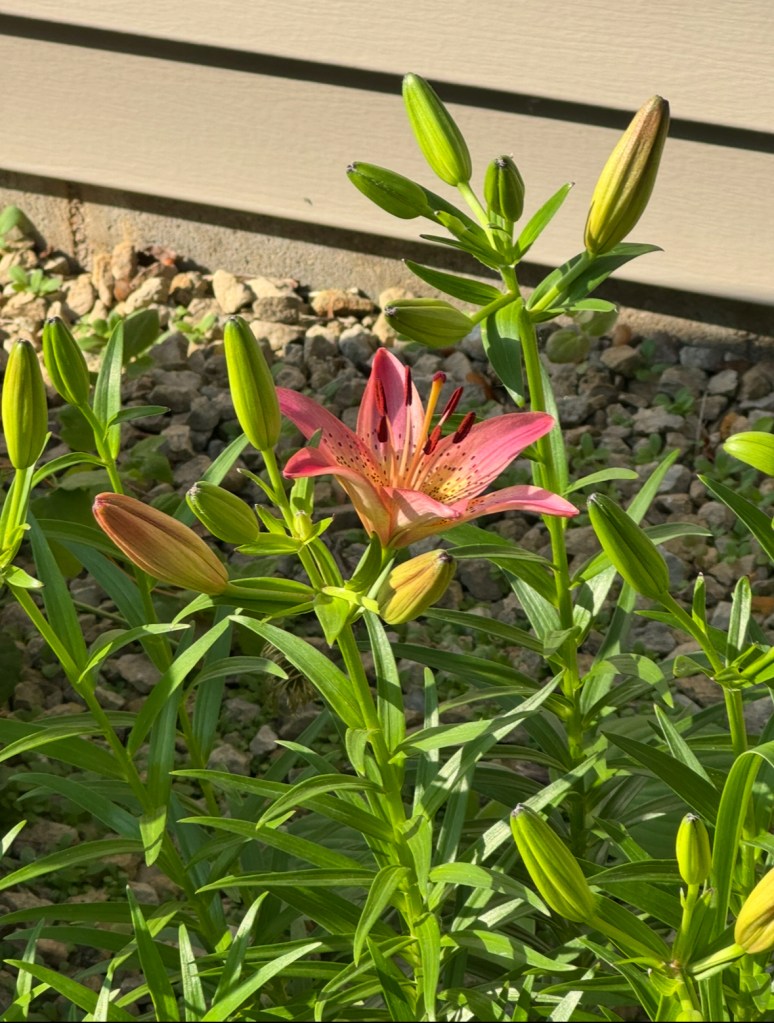
The Asian lilies are also coming back.

Not terribly strong. They are quite old. But they are returning.
And … the clematis the lawn maintenance guy tried to pull last year? Back! Hahaha! I thought it was a goner, but nope. It’s back.

The daffodils I planted last fall are largely a no show. There are a few coming up at the historic cemetery, but most of the daffodils coming up there are the ones I planted in fall of 2023. And yes, I planted them correctly lol. It seems they did deter moles, as was my primary reason for planting them. They just didn’t bloom well. And that’s OK. The bags of 50 are coming to the end of an era. This fall I want to change things up a little and force grape hyacinth this coming winter. They also deter moles. And I can do smaller pots for forcing. If I want to.

And then there are the tulips. Of all the multiple (lots of) tulip bulbs in the townhome gardens that produce greens, only two have buds.

Yesterday after the greens of a few got stepped on while we cleaned the windows, I tested digging one out. I had kept my hand shovel out after digging and transplanting Blue Bells clematis volunteers.

I thought I might be able to dig the non-blooming tulips and consolidate them to one area (or bring them up north to naturalize or be deer food). Well, I probably should have gotten out the full-sized shovel. Instead of the bulb coming up, the stems broke off first. At which point I thought, ā€œWhy are you doing this? Pull the other stems and be done with it for another year.ā€ I would like to say I did that immediately. I did for one more bulb. And then I remembered the next one I went to pull actually bloomed last year. They can fade back. Maybe next year I will feel differently.

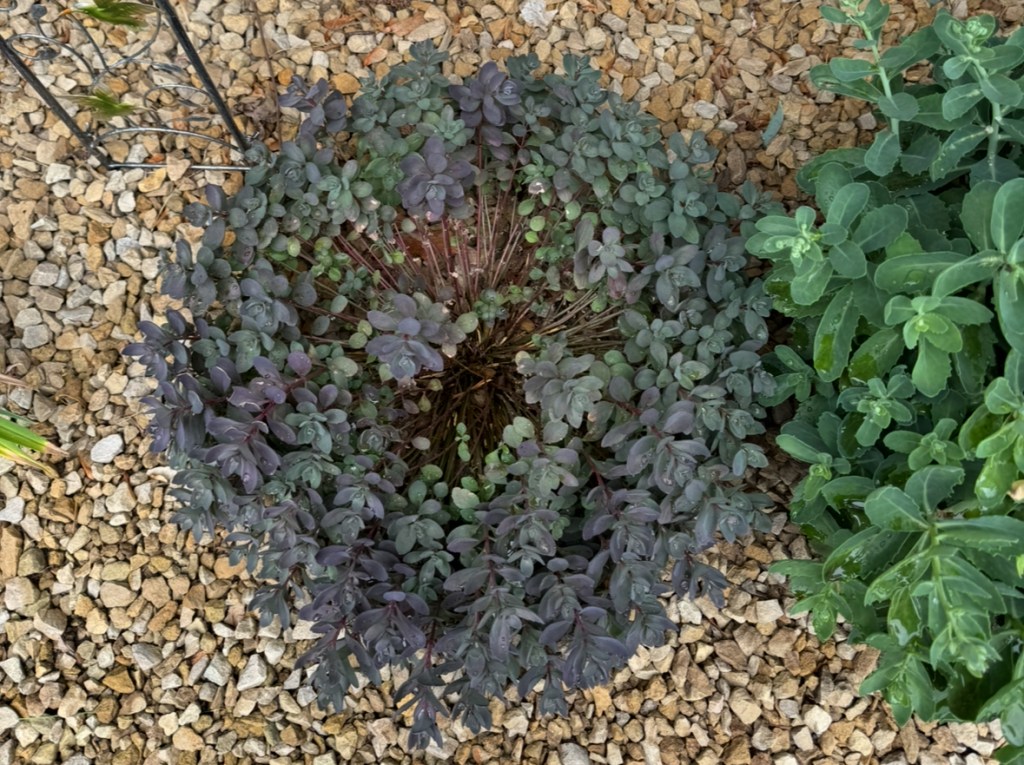
To wrap up the afternoon yesterday, while I was in a cleanup mood, I tested to see if the variegated sedum (that it looked like we lost) was really a goner. It pulled out super easy, but wouldn’t you know it, there were little green sprouts. Dang! So, I searched around for a place where I could put it to give it one last chance. Aha! A swaparoo! A two-for. I moved the small Pink Tirza I want to use for crosses again this year to a more accessible spot,

and the variegated sedum went to a more secluded spot to R&R and hopefully come back stronger next year.

With that done, I called it quits. I was kind of still working off a crummy mood from something else. (What is it that makes normally sane drivers turn road risky on rummage sale days? Yikes!) I got myself a sweet tea and sat and looked at how nice the newly relocated Pink Tirza fit into its new home. That was a very good choice šŸ™‚

And then, this morning on my walkabout I noticed … we did not lose the Guacamole hosta, as I feared. It is slowly coming up. The two Elegans, not looking good. Oh well. The circle of life.

Have a great weekend. I may take some time off early next week to put the finishing touches on something I will be kicking off next weekend – the Mahala Felton historical blog series. One post per week will be devoted to getting all the Mahala Felton research I have done out into the public domain. It has been a worthy endeavor, and I really want to share. The tie in is to the historic cemetery. More to come on that.

Inching Closer

It is about this time of year that I start to see the daylily seedlings visibly emerge from the soil. The well-established ā€œparentā€ plants emerge first. But then, inevitably, I will see something that really jazzes me. A couple weeks ago it was the re-emergence of last year’s Hello Yellow. Hello Yellow was our first seedling that progressed from harvested seed to seedling to bloom, and in record time (year 2). Coincidentally, I find it quite fun that our oldest grandson, who knows nothing of my daylily work, has made it quite clear that his favorite color is yellow. Grandmas notice these things.


In the past couple weeks, my most promising seedlings from 2024 (2023 harvested seed from crosses) emerged. They are what I hope will be ā€œPink Moonā€, an intentional cross that yielded 11 seedlings, and it looks like 7 winter survivors. Potential ā€œPink Moonā€ is on watch for bloom this year, but daylily propagation from seed is a long game. It may be a few years yet until bloom. I hope we see ā€œPink Moonā€ bloom this year, but it may be longer, or never. For reference, I have a South Seas self-seed that is on year 6 with no bloom. I keep saying if it doesn’t bloom ā€œthis yearā€, it’s going up north to feed the deer, but … I just can’t seem to do it. Maybe this fall, but doubtful. I have my 2, 3, and 4 year seedling beds established, and it is nowhere near where the 6-year-old non-blooming South Seas self-seed plant is located. Maybe it will surprise me. Please surprise me 6 year old South Seas self seed daylily.

Now to 2025. This year’s seedling project is what I hope will be ā€œMahalaā€. The Mahala Project is named for a history making pioneer woman for this area. Mahala Felton was the first white woman settler in our area. She and her husband William and one of their sons came to our area when there was no hotel, no railroad, not really any way of getting anything substantial across the Mississippi in our area. She was well respected by native and settler alike as she and her husband ran the first ā€œhotelā€ (which was a converted, multiple purpose trading post). I began my research as what I thought would be a 15–20 hour endeavor to write a facebook post for our local historical society. But there was so much history that kept unfolding. So much that I went on a discovery that kept me happily busy for a great portion of the deep of winter. The more I discovered, the more questions I had. Eventually though, my project management skills turbo-charged and I realized I was having scope creep. I was amazed and impressed with all I had discovered about Mahala Felton, but it was time to stop the research. I had dozens of resource citations, and what will probably be at least a dozen pages of excerpts when I finally write it all up. We shall see. But along the way, I decided to name a daylily seedling ā€œMahala Feltonā€ and plant it in the historic cemetery garden. Full transparency, I had entertained the daylily dedication idea previously, but now I had more pieces to the puzzle. Funny how things unfold, all in good timing, if you listen to your gut, and your heart.

This past week I took 25 of the 28 harvested (and now proposed as ā€œMahalaā€) daylily seeds and planted them to seedling pots. This is a huge (and probably not to be oft repeated) departure from my normal process of putting all of a type of cross’s seeds in one pot and seeing what comes up. I try to keep things simple, but for this one I decided to give conventional practices one more try before I abandon it all together. I have my doubts as to its efficacy, so, just in case, I kept three of the seeds aside and will plant them with my normal process when it is warm enough to do that. With that process I have a seedling box that protects them from bunnies and squirrels and all those types of dangers, a necessity around here, and I will need to employ that with whatever comes up from the 25 as well. I hope at least a few seeds are successful, as I would like to plant one on each side of the gates, as a nod to the hospitality Mahala shared with all. A ā€œwelcomeā€ of sorts. And I would like to plant one in the garden down by their marker.

We shall see how it goes. All 28 seeds could decide not to go to seedling. In that case, I have another cross from last year that produced 60 seeds (yes, 60) and maybe that is destined to be named ā€œMahalaā€. You never know. You do the crosses and you see what happens. It’s an adventure.

The good, the sad, and the work to do

The long wait is now over. Things are popping all over the gardens, and I am starting to see what made it, what didn’t, and what work there is to do.

At the townhome gardens, sadly, it looks like we lost two sedum. How that happened for one of them is a mystery to me. That one was our only variegated sedum, and I will miss it. It had been there for a long time, maybe over 10 years, so I am a bit surprised. I won’t replace it with another sedum, but I may put a daylily there this fall. Potentially a seedling. But first I want to refresh my memory on how strongly the sprinklers hit that area. I don’t think the variegated sedum died from sprinkler damage, but I want to make sure it is a safe place.
The other sedum that didn’t come back was under the linden. That one never did well. It just never took off. I won’t put anything in that spot to replace it because the daylilies are also starting to underperform there. There are a lot of linden roots. It is a spot I will leave as ā€œrock onlyā€ as things fail.

On the flip side, we have a bumper crop of Bluebells clematis volunteers, and those are in the ā€œworkā€ category. I need to transplant them to another area. This area is not optimal šŸ˜‚

The volunteers are from our large Bluebells clematis that always performs very well, and I suspect I will continue to have volunteers over the years now that it is well established. Last year I allowed one to grow around the red daylilies, and this past weekend I dug that out and transplanted it into the spot where another clematis volunteer (different type) was way underperforming. Hopefully this volunteer does well. So far so good.

And then there are the missing hostas. There are three in particular that have no sign of anything, and that is a bit concerning. Two I was going to give to my Dad, but the third was one of my long-time faves, and if it doesn’t come back, I will miss it. BUT I have made a decision. If it doesn’t come back, I will convert that real estate to daylily space. That hosta really always amazed me because it should never have done so well there for so many years. That spot really is more of a … daylily sunny spot. But I put it there in my early years of creating our gardens, and it went to town for well over a decade. Probably 15 years. So if that hosta is gone, I will greatly miss it, but it will be replaced by a purchased daylily this fall. (Yes, I have my sites on a few candidates.) Then that entire area will be daylilies, with a few remaining Asian lilies, a few remaining tulips, and a legacy Autumn Joy Sedum.
For the other two ā€œmissingā€ hostas, if they do not come back, I will not replace them. The area where they were was getting way overcrowded, hence why they were going to find a new home with my Dad. And, my Dad just had a bunch of trees removed so they may have not done well there anyway.

Which leads me to story time. When I started our gardens at the townhouse many many years ago, I was head over heels in love with hostas. I planted boatloads of different hostas. I visited hosta gardens. I bought ā€œhosta of the yearā€ varieties I liked. I was gifted hostas. My Dad even bought me hostas from a neighborhood gardener he called the ā€œhosta mastaā€ (master, that is 😊). I have grown and divided all kinds of hostas for over two decades. I even tried my hand at harvesting hosta seeds and seeing if I could grow hostas from seed. (Not for me.) I love hostas. And I will keep the hostas I have that are still doing well. But that era was that era, and the garden ā€œcontainerā€ is the garden ā€œcontainerā€ (not getting any larger), and I am not getting any younger. So … in a finite space garden … hosta attrition makes way for daylilies, if the space is sunny. (Amazingly, I did have some huge hostas that did very well in relatively sunny spots. Go figure).
In this new era, I have my daylily seedling beds, and they are doing well. Those were solidified as the plan last fall. I also have one 6th year non-blooming daylily seedling in a different area, and I just can’t seem to move that one out, but we shan’t dwell on that. I figure at some point when the garden ā€œcontainerā€ is full, I will know it is time to stop doing daylily crosses, and then I will sit in my patio rocker, with a beverage of choice, and just enjoy. Haha, I can hear family and friends alike laughing uproariously. But that will be a few years yet. Hopefully quite a few. Because goodness! I have 60 ā€œsame crossā€seeds I still need to get into pots in the seedling planter, and if even half of those go to seedling, oof! Realistically, experience tells me ā€œprobably notā€ and I will most likely end up with optimistically, 10 seedlings from that 60, to be planted in the 2025 seedling bed this fall, and watched for bloom starting next year.

At the historic cemetery, I am gonzo in love with what I see so far – legacy plants are doing so much better in year 3 of the mulch bed. The iris bed is in year 3 now, year 2 for watch to bloom, and I already see multiplication. Daylily seedlings I planted last year from here look great. Daylily purchases I planted last fall are coming up. Even the Blue Mouse Ears hostas made it.

Overall, so far, so very good.

Weeding time at the historic cemetery is down to an hour per week – amazing what the mulch bed tamps down. The only thing I want to work on is the aging creeping thyme. It needs some cleanup, and I may grab some irises from the old garden bed and do some fill in there. Otherwise, one hour per week weeding, watch for the garden to do its thing, and maybe, optimistically, try a few crosses.

Hello Yellow

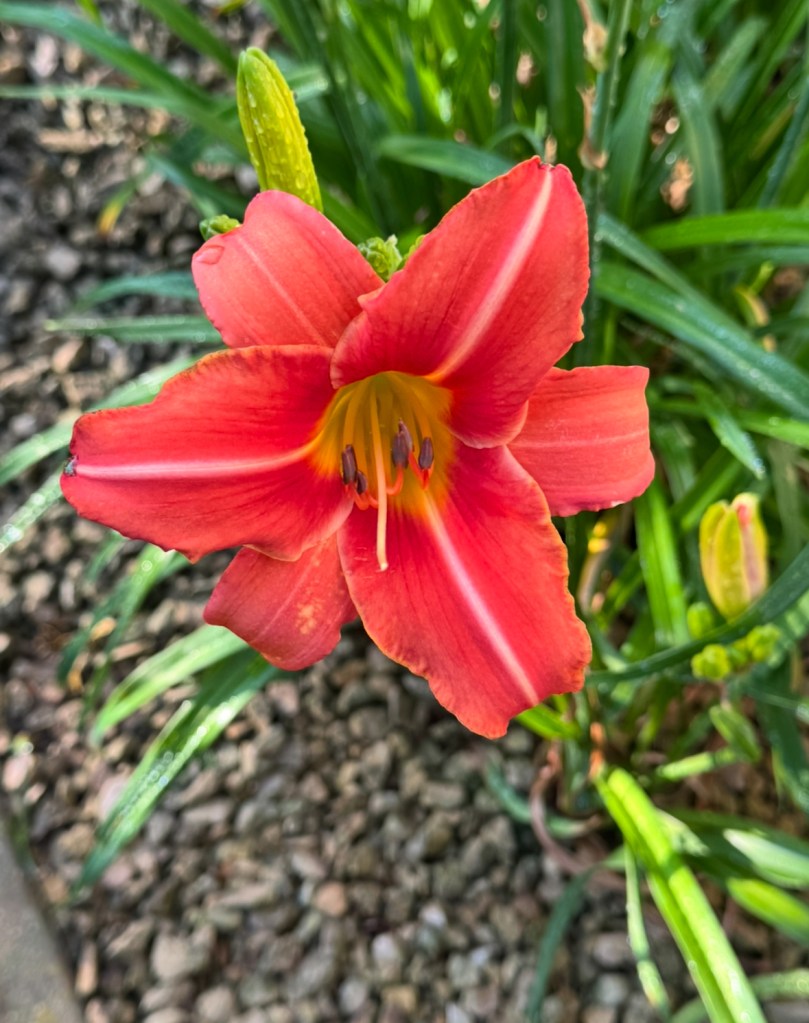
Hello Yellow, our first seedling from harvested seed to bloom in our garden, is up for the third year. Year one she was a seedling, year two (last year) she bloomed – amazing for year two! And now she is up a third year.

My notes are she successfully crossed with Just Plum Happy to form a seed pod (so as a tetraploid) but then the pod started to fail and then a bunny got it.

Hello Yellow is of unknown parentage. Nevertheless, she has a special place in my heart, and will remain in our garden.

Harvesting daylily seeds, planting last two pots of seedlings, starting the fall cutback, migrations

The daylily seed harvest is wrapping up. This year I have eight different types that survived the bunnies, squirrels, and sprinklers. Two are self seed and one is an ā€œunknownā€ after a save from critter curiosity. That leaves five, and the daylily seedling box fits five pots, so, whew! we probably don’t need to put an addition on the daylily seedling ā€œinnā€ next spring. After discovering what looks like a self seed, self plant, seedling bloom (more on that at the end), I now have a much greater level of confidence that the self seeds and unknowns can go straight into the ground in May. Where they will go, I have no idea. We are choc-a-block full. Time will tell.

The ā€œcountdown to season endā€ planting and transplanting list is also done, and early at that, as the daylily shipment came earlier than I expected. That sprint was something else! Very rewarding, but very exhausting.

After the linden trimming brought a previously shaded area back into the sun, there was no more room for Blue Mouse Ears hostas. I ended up planting the two remaining Blue Mouse Ears hosta divisions into the historic cemetery garden. A little worse for wear after sitting in the garage for a week and a half, but better than to the compost pile.

I hope they make it. They are such a beautiful hosta, and it would be nice to have them in that garden.

All of the other plantings I have put into the historical cemetery, save the clematis that never bloomed and eventually died, are doing well. The sedum rootings are even blooming pink. And the baby daylily pieces are sprouting new fans. For all of that, I am thankful. They love the sun, and the mulch seems to keep them in enough moisture.

I also started the fall cutback at the historic cemetery – the largest patch of Black-Eyed-Susans, the remainder of the milkweed, some irises, and more hosta scapes.

At the townhome gardens, the garden is starting to look more like fall. I decided the little scarecrows would be fun to be put out again this year. I almost feel like they could use some little hay bales. But I don’t do hay (achoo!!!) so … Blue Mouse Ears will have to do.

Sadly, the hummingbirds are pretty much done coming through and we will soon take down the feeders. There are enough flowers for late travelers. They have really loved the second bloom of the Weigelia this year (below) as well as the late blooming Rainforest Sunrise hosta.

The huge flocks of small migrating birds have also wound down. We have been seeing quite a few butterflies now, so we are assuming that is also migration. And seagulls! I wonder if we just never noticed them before here. We had flocks of them at our little house in the mining town on Lake Superior, but never here.
I am thinking that soon the dark eyed juncos will arrive for the winter.

So time is marching on. But for today, on this beautiful fall day, a day of PTO from work, I will just putz in the garden, enjoy what looks like our last week before the cooler weather, and look at our newest addition – totally unplanned, unplanted, a full on surprise until I saw the buds last week and the bloom today – ā€œPanacheā€. We are calling her Panache because she appears to be a reversion to the grandparents of Just Plum Happy, the daylily in that space. Welcome to our garden, Panache! You are the new latest blooming daylily here!

Panache?


We have multiple Just Plum Happy daylilies in our gardens. Not once have we had a seedling from Just Plum Happy, much less a flowering seedling. In fact, the self seed pods usually fail. If any self seed pods open and the seed doesn’t look good, I just put it back into the area of the daylily, food for birds or whatever. But somehow either one of the pods let a self seed out before I saw the open pod, or one of the seeds I didn’t think was viable actually was. Or maybe a bunny or squirrel or sprinkler got the pod before I did and it made a seedling some time in the past few years and now this year it bloomed. In late September. What??? Crazy pants!!!

I seriously doubt it is a rebloom, as I don’t deadhead them, our Just Plum Happy daylilies have never rebloomed, and – it looks so different from Just Plum Happy.

It looks like a grandparent of Just Plum Happy, named Panache. So it shall be called Panache in our garden. And it shall stay, and be the new latest bloomer. Panache is a late bloomer, so …

The Semi-Finals

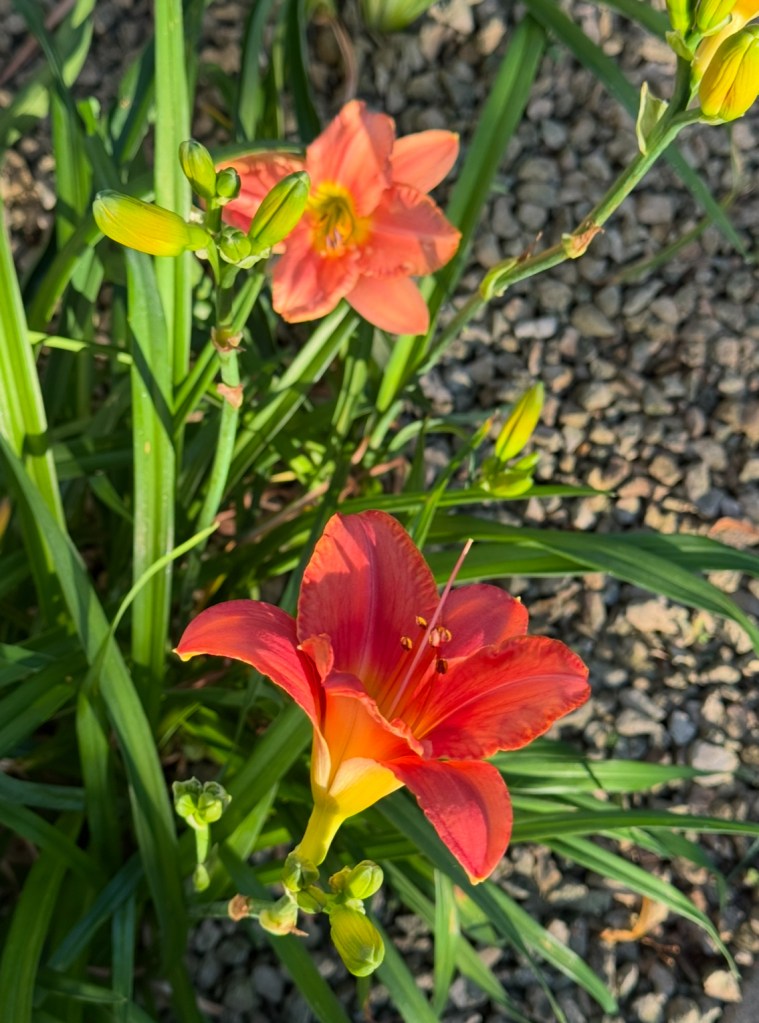
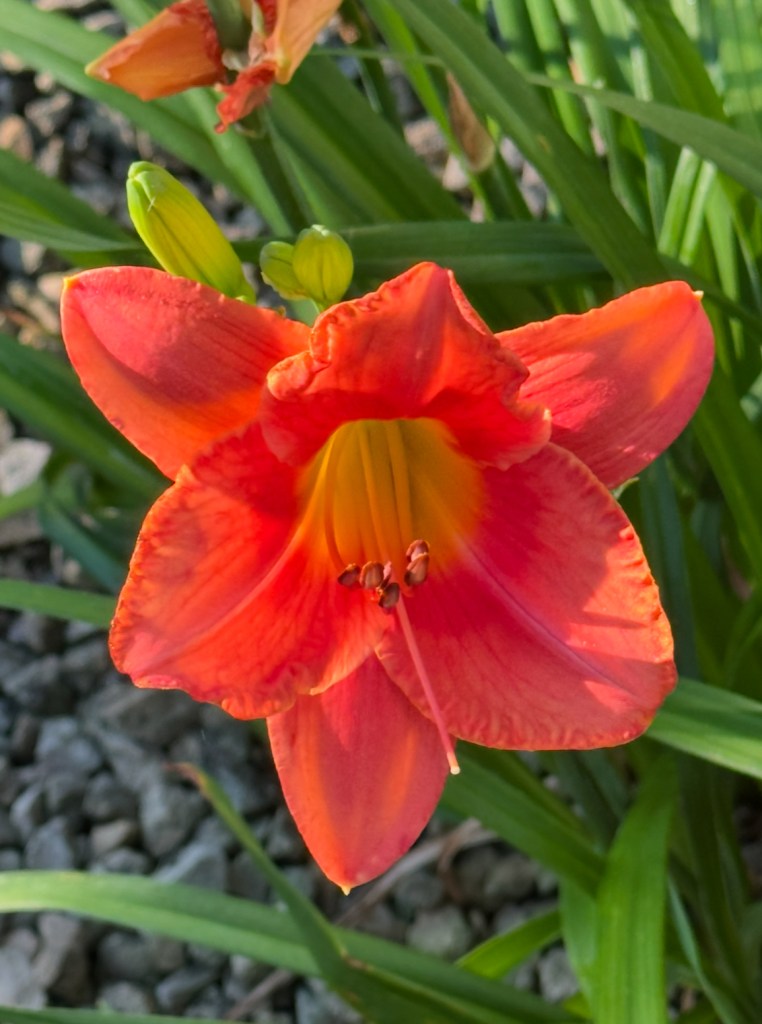
All the daylilies are done blooming here, and we are going into the Semi-Finals for seed production. In first place by a long shot is Pink Tirza X red daylily with 8 healthy pods. Woohoo! Now I have to go back into my records to figure out that red daylily type. Or not. If the seeds pods are viable to seed, and the seeds are viable to seedling and they bloom (2-3 years out) they will still just be an ā€œenjoyā€ scenario. A whole lotta ā€œenjoyā€ scenario. Maybe a go to the historic cemetery ā€œenjoyā€ scenario. If all of that happens, I will probably just give them a fun name for our use and conversations 😊 Just like Hello Yellow.

So Pink Tirza is the new Purple D’Oro here. And that is a good thing because the ā€œdeerā€ we were guessing was eating her pods turns out, we are pretty sure, to be due to a sprinkler haha! Either way, even if it was something else, good experience and knowledge gained this year. In addition to her coming in first place for bloom start, she blooms a LONG time, and is gorgeous. Her new working role is to be a pollen producer.

In second place, yep, you guessed it Coral Majority. It would have taken 1st place but I only crossed it a bit, with Cedar Waxwing, with excellent success. And Coral Majority is a self seeder too, although I expected that. The bees love that area and Coral Majority tends to have a lot of pollen and the pistil, or stigma, I guess, is often uncrossable. I seriously don’t know what to do with Coral Majority. It is a wild child. Of one of my faves, South Seas, no less. I hope its children are pretty, and well behaved lol. Because there will be A LOT of them if the pods are all viable. They are all still green and it will be a while that they still need to stay on the scape to mature the seeds. Hopefully the bunnies, squirrels and sprinklers let that happen. I have had pods come off too early in the past and tried to save them to seed but to no avail.

Marque Moon X South Seas was in 3rd place with two green pods and a third that was starting to dry but the bunnies and/or squirrels got those. The squirrels and bunnies have had a lot of fun with South Seas. And also with Naomi Ruth. I think I also over-taxed them. Pods were failing. Next year they get a rest.
Only one Pink Tirza pod survived. ā€œSprinkler deerā€ got her pods lol. And Mystery Yellow Freebie has a drying pod but it looks not too viable. I will be surprised if it has seeds.
And that’s it. Crazy good results from one diploid and one tetraploid this year. But we have a very long way to go. We shall see.


The transplants from two weekends ago are doing phenomenally.

No losses. I did make one mistake, I realized, and I put a daffodil bulb UNDER a Blue Mouse Ears division transplant. So I will have a daffo-mouse. Should be interesting, but fine. If the daffodil does bloom it will be done when the Blue Mouse Ears (hosta) starts to come up. Still … silly of me. Keep daffodils to the daylilies. Oh well.
And last of all, sadly, I have a sedum and a hosta that I think need to come out. They just look like they are struggling. The hosta is quite old and never been divided. The sedum is a cutting. Stuff happens. I’d rather be safe. I can put Blue Mouse Ears divisions over there, and maybe a daylily.


Did it – with big help from hubs

Weekend four on the ten week countdown dawned rainy, but the forecast correctly predicted clear up by mid morning. Good thing, because the week four list was the heftiest list by far. Some coffee, the word from hubs that he was ready, and we were off and running.

First up was a dig out. This is an at least 7 year old Purple D’Oro daylily clump that has been languishing in the increasing shade of hostas under the linden. The hosta garden is a look I love, but that daylily definitely needed new digs. The past 2 years it did not bloom at all and the few years before that its bloom was sparse. It deserves more love – a bit of dividing (into three clumps) and full sun. It may miss its sibs but it is just moving across town to hang out with some Stellas in the historic cemetery garden. Maybe make some new little D’Oros. And be amongst other sun lovers like daffodils and sedum.

So – daffodils … I know I said probably no more daffodils at the historic cemetery, and no more buying for the townhouse gardens. But, well …. You see …. We have Sir Bunimous Rex (a gigantic bunny) who roams the neighborhood at all hours of the night, and baby squirrels with voracious appetites and zero manners, and maybe a deer, although we haven’t seen it yet (but what else eats seed pods without even slightly bending the scape?) Anyway, the assumed trifecta that we actually do enjoy are having a field day with my seed pods, which, ok, is fine. They have mostly eaten failing pods. And the process this year has been beyond fun, I am building quite a knowledge base just from trial and error, plus it is free. Additionally, I actually would like to see a deer roam through here. I miss them from our little house up north, and their nighly parades. My husband probably is relieved, near term, that the assumed trifecta probably has eaten enough seed pods now that I probably don’t need to add on to the inn (the daylily seedling box) next year. If I ever got super serious about this hobby, we could get a well up north. But, here and now, given we know the munching issue, we need a bit ā€˜o prevention, and protection, for new plantings. So daffodils and coffee grounds go around all new plantings here and at the historic cemetery (where there are moles), and then ongoing peppermint oil is also being used as a deterrent at the townhouse. I HAVE found infrared deterrents, but, sigh, they also deter dogs, and sigh, I need my dog to go outside …

So back to the Purple D’Oro – my husband dug it out, I divided it, and it went in a bag to the historic cemetery, along with the 2024 Purple D’Oro self seed seedlings (from 2023 harvested seed), where I planted them, and some languishing Asian lilies, along with daffodils, today.

And with that, the left side of the historic cemetery garden is a wrap. That just makes my heart so happy – even though there is no rain in the forecast for the next week, and that means daily trips to water them. The next 90 degree day in the forecast looks like a week out. A daily trip over there will be fine, short term.

What’s left at the historic cemetery garden? Waiting for the (right side) daylily order to arrive in September. And weed and trim each side alternately. Have I mentioned how AWESOME the mulch is? Sooooo easy to weed. Not necessarily so fun in heat and humidity, but way easier than the rock and heaving plastic that was there before. And people absolutely love it! A couple stopped to talk again today when I was there. They said they can really see the passion for gardening that we all are putting in there. Wowee Wow! Very humbling, and rewarding.

You may also notice I am not saying ā€œfence gardenā€ anymore. The large overgrown garden has been donated to the rain gardens at the historic mansion in town. They needed things that were budget friendly and would come back every year. Yes, and yes. So the only garden at the historic cemetery will be the formerly known as ā€œfenceā€ garden. Woo Hoo! Now if this ā€œcrazy ladyā€ can stop coming up with new projects! Hahaha! I think I’d better. The current state is ā€œjust rightā€.

But wait! Why was weekend four so hard? Dig out a daylily at the townhouse and go dig and plant four holes at the historic cemetery? Big honking deal! Oh no, no, no, no! That was just the cemetery part.
Back to yesterday, I had other daylilies and seedlings, and fairy ringed hostas to dig and divide and find new locations for. Swapping locations for sun scorched Blue Mouse Ears and sun starved Purple D’Oros. And moving a failing set of Asian Lilies (they went in with the daylily divisions and the daffodils-layering-to the cemetery). And then last was moving a regularly stepped on Praying Hands hosta. I’m thinking the stepper-oner is four pawed and goes by the name of Bunimous Rex. That Bun does not eat it, I am amazed.

So today wraps up weekend four of the townhome side of the 10 week countdown. We did it! Hallelujah!!! So glad that is now done! And so thankful for ibuprofen and a nap!

I leave you with some end state pics at the townhome.

More to come, and yes that is chicken wire around Tender Love. Bun broke off and ate the scape with the cross from Pink Tirza. No more for you, Bun!