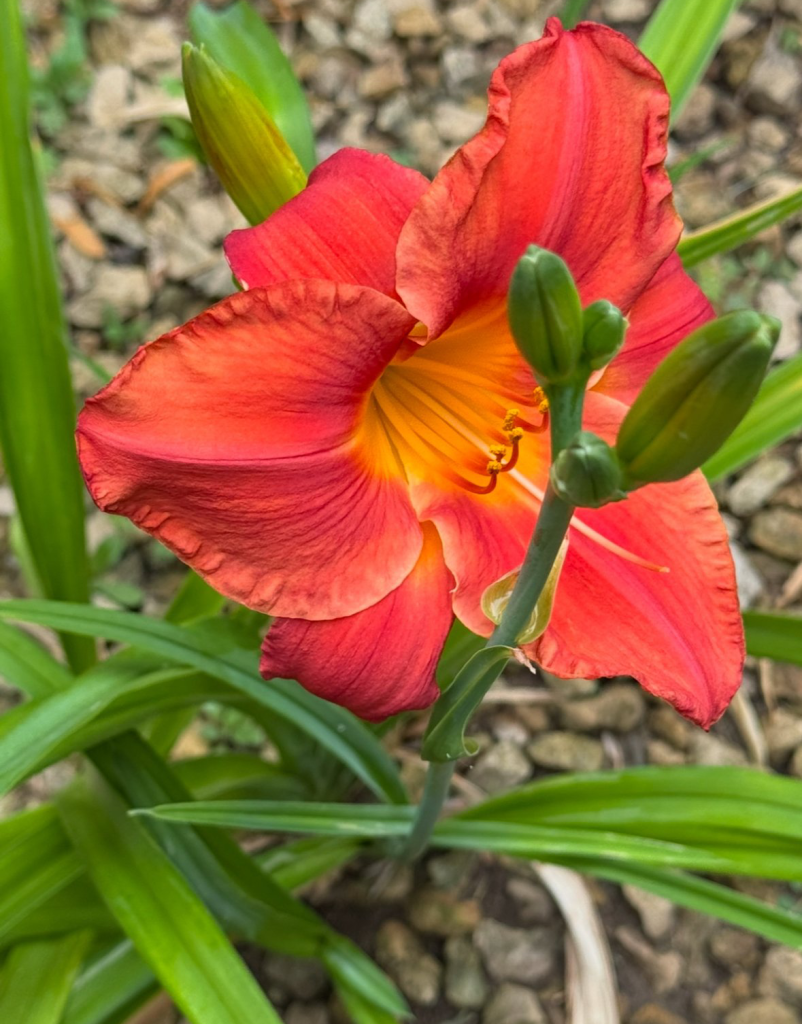
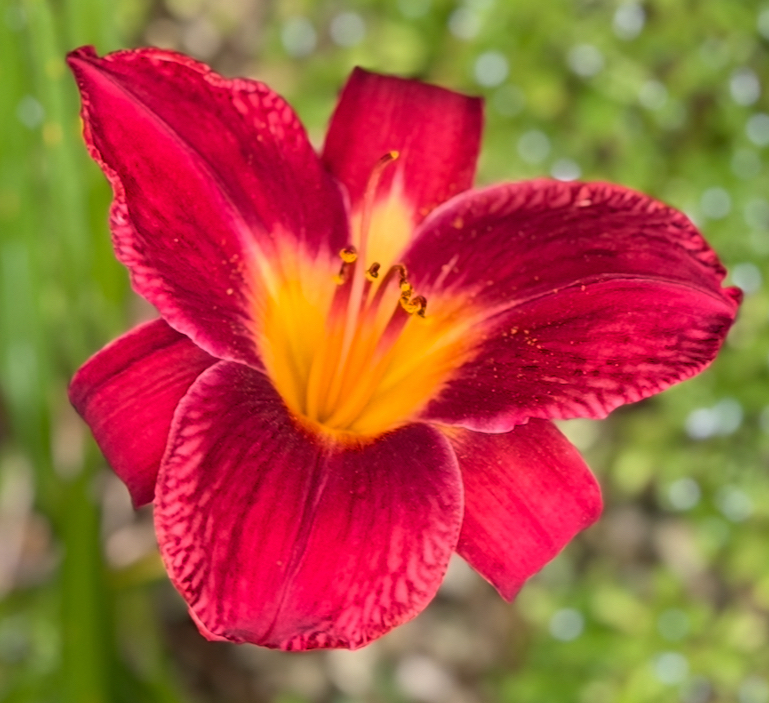
This bloom was another beauty. It was from a harvested pod from South Seas self-seed. The South Seas bloom was in 2022. It went to seedling in 2023 and bloomed for the first time in 2025. I dedicated it to my friend Shirley D. I also crossed its last bloom of the season with ‘Red Volunteer’. I have 7 seeds from that cross. If it goes to seedling (in 2026) we would see the first bloom(s) from that cross in 2028-2032. Hybridizing daylilies is a long game. Soooo worth the wait, right?
Last year I had a bit of an issue with daylily scapes being pulled down and eaten by something. Probably something with four paws, but you never know, right? I used quite a few deterrents, all safe, and it was minimally effective. Minimally.
When I put all my 2024 notes and daylily crosses info onto my 2025 daylily tracking spreadsheet, I was reminded again about how much of an issue it was in 2024 – and how much it wasn’t in 2025. At least at the townhome. The historic cemetery, well, I have shared what happened with the Mahala Felton daylily seedlings that I planted by the gate. But that is a bit different, I think. And for this post we are focusing on daylily scapes.
As the 2025 daylily season was starting to produce spent scapes, I began to have the urge to tidy up. I did not, however, do that. This year it occurred to me to me that perhaps my habit of trimming spent scapes was actually attracting playful snackers. Against my preference to clean as the garden matures, I left all scapes on all daylilies until the pod harvest season was complete for that full area.
I also introduced another deterrent this year, and that is lemongrass essential oil (diluted and sprayed on the pavers). And, of course, there are the forget-me-nots, which are also a deterrent.
We are to the end of the daylily seed harvesting season, and I can report – no daylily scapes were pulled down and eaten by critters this year, even the shorter daylilies. All pods made it maturity and were harvested by … me 🙂
I also discovered something new. Spent daylily scapes, when completely dried in place, are very easy to pull. I have a few things in the garden that share that feature, and it is very welcome. Not all of the scapes had dried when the pod harvest wrapped up, so some were cut back when I started the daylily cutback out front, but in the true garden, out back, almost all the scapes were able to just be pulled. There remains just a few from the very last pod harvests.
And with that, the greens are getting another week or so of photosynthesis before I come through and cut everything back. And trim the shrubs. And say sweet dreams. And call it a wrap.
For now, cheers to not trimming spent daylily scapes, to lemongrass essential oil, and to forget-me-nots. I am thankful for no critter interference in the seed maturing process this year.
I have now had time to sit with the data on the 2025 daylily crosses. I am a bit shocked, but not totally. I harvested 422 seeds from our gardens here. 277 seeds are from diploids. That is not surprising, as I know what Pink Tirza does. There is a reason Pink Tirza is my diploid line. This year Pink Tirza was an incredible pod parent. Last year it was the opposite – Pink Tirzah was our top pollen producer in 2024. Naomi Ruth and Pink Tirzah don’t do fantastically well together, but Naomi Ruth was a top pollen producer this year, as well. Peach also typed out as a diploid (which did surprise me – a lot), and we have seeds from Peach. And with the Red daylilies in the mix and at an overwhelming quantity of 8 clumps, red boosted the diploid numbers.
Then there are 111 tetraploid seeds. Not surprisingly, South Seas took the prize for tetraploids. South Seas is my tetraploid line for a reason. South Seas is a powerhouse. And Coral Majority, one of her children (which I did not know when I purchased Coral Majority, but bonus!) continues to amaze. In fact, South Seas may have daylily grandbabies in the next few years in our garden due to Coral Majority. Fingers crossed. We have seed. It would be kind of cool. We shall see.
And then we have 34 self-seed from our gardens. Mostly – South Seas and Coral Majority, but a few Red and Just Plum Happy.
Not in the above numbers are 99 seeds harvested from Oakwood – 78 of which are Stella De Oro and look kind of iffy, but maybe they will do something for those gardens. I will try. There are 2 Red Volunteer seeds I harvested from a Red Volunteer I planted there last fall, and then 17 seeds from some new daylilies I don’t remember from last year, but they did very well this year.
So – 521 seeds. Oof! Yah. But I have my thinking cap on. I will figure it out. Lots of other people do this, at a much bigger scale. We shall be creative. There are 4 large success crosses. The rest can go in little seedling pots. Maybe direct sow the self-seed.
All the daylily pods are harvested and there are just a few still drying. With that, I am back in one of my happy places, cleaning data on the tracking spreadsheet, creating pivot tables, slicing and dicing the data. I have a pretty good idea of the top performers – pollen and pod, diploid and tetraploid, and also what I was able to replicate, at least to seed again, from previous years crosses. Soon the 2025 seeds will all go to storage until next March when I set them for stratification.
And it occurs to me, yes, I am definitely back in my happy place. It is full of some things I have loved for years, but it includes an expansion. It includes a new happy place I created last year when I embarked on the Mahala Felton historical research. And so my new “normal” thinking was at work when I began a new search a few days – wondering about daylily history, and specifically what type of daylilies might have been around during the historical times I have been researching. A little AI inquiry ensued, and the results were confirmed. Daylily ‘Apricot’ was the first recorded daylily hybrid, in 1893. And on it went as I was fully in daylily research mode. ‘Apricot’ was the first recorded hybrid 133 years ago, with parentage in still available ‘Flava’. Flava’s origin is listed with a registration date of 1762, and that is probably about as far back as I will get, as the registrar was none other than Carolus Linnaeus, the Father of Taxonomy.
So, fun fact, ‘Flava’ was probably grown in homesteads around this area when it was being settled, but ‘Flava’s child, ‘Apricot’, would not have been in Mahala Felton’s garden, as it was registered the year after she passed, by a school teacher, George Yeld, in England.
Next, my mind went to possibly owning a ‘Flava’ daylily. ‘Flava’ (Hemerocallis lilioasphodelus) looks so sweet and is supposed to be lemon fragrant. Who wouldn’t like that? What would self-seed look like? Would it even go to seedling? Would seedlings ever bloom? And what could I do with that?
‘Apricot’, when researched, makes quite a family tree. I could get lost. I probably will at some point lol. History x Daylilies? Yeah. I will find myself hours later, emerging to find my tea is cold and I need to rest my eyes.
I see the best chance of getting a ‘Flava’ is spring. That means I have all fall and winter to research and dream. And anything I would do would be years out for results anyways. But it is a line I think would be worth at least investigating. It is a diploid, and although Pink Tirza is my diploid line, I could have a “historical line”. Right? Could I rein in to self-seed only and make room for that? It is an intriguing thought.
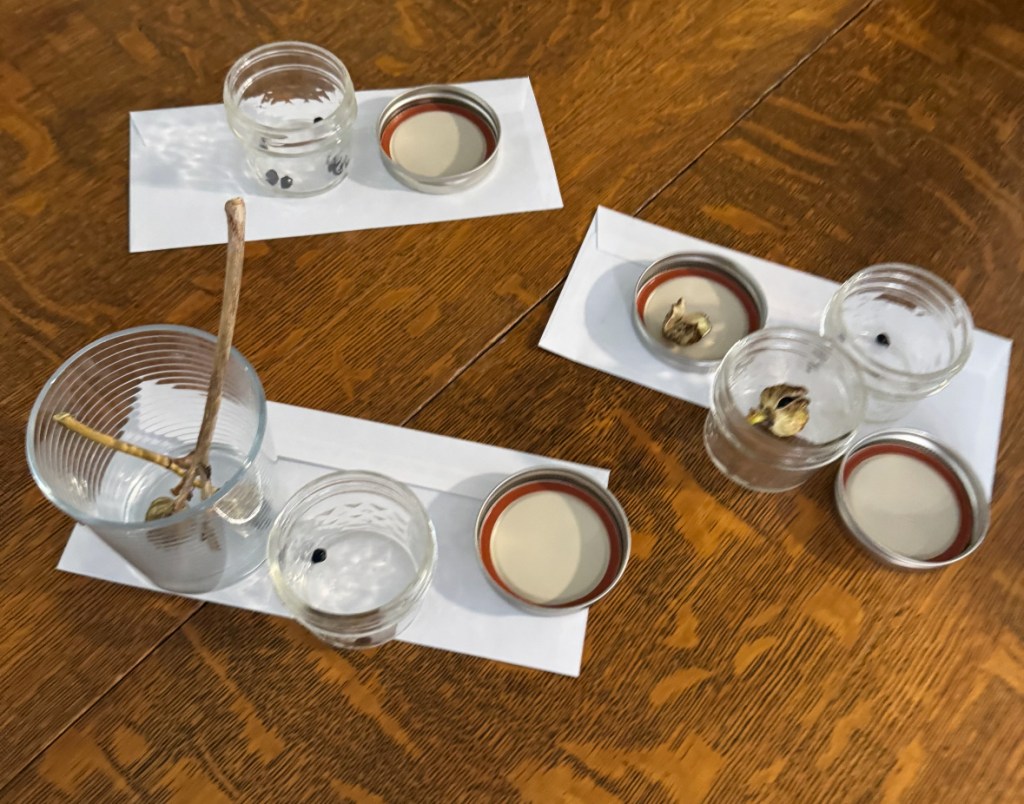
For now, I leave you with pictures of the last three seed pods, pulled a bit early probably, due to circumstances, but still hovering around 60 days maturity. They should be OK, and if not, they are duplicates of others that did fully mature.
The past few day I have finally felt like I have entered the land of fall in Minnesota. It has been a while coming. And there is a reason. But first –
The 2025 gardening season started out a bit tough, but ended very well – in a significantly different direction.
Earlier this year I shared that we lost 18 hostas sometime between last fall when I cut them back and when they should have been up this spring. Some were huge and all were very healthy the previous year (2023). In fact, I had offered two in particular to my Dad, and he was excited to get them. It was a bit disconcerting to have them vanish.
We have had a full spring/summer now to watch for any sign of the hostas to return. What can I surmise? The vast majority are gone. We will probably never know for sure what happened, but they are definitely gone. There was one that did somewhat recover. And there were two that sent up baby leaves that have endured. The consolation was they were from the ones I was planning to bring to my Dad. So that’s good.
The hosta losses were sad, but the daylilies were crazy good this year, both in bud and flower production, and in pod success. There are quite a few seed pods from self-seed but the vast majority are from crosses I did – hybridization. My tracking spreadsheet tells me I was successful in getting 21 different cross types to seed pod. That is a lot. And I have been feeling it all of September. I have come to the conclusion that the scope of what I did this year is not where I want to land next year. Here’s why:
I absolutely love daylily season. Head over heals, in my very happy place. But I also really love late summer and early fall in Minnesota. I like freedom to enjoy it outdoors. I don’t want to be spending a lot of time sitting indoors during that time, documenting daylily info and storing seeds, and I try to plan for that preference. Knowing that, and suspecting I had gone a bit far with making daylily crosses by mid-July, I made a conscious decision to stop doing crosses on the last day of July. I knew I already had a lot of pods, and that very few were failing, so I knew I would be busy, but I don’t think I fully understood the implications. On September 28, I am still harvesting, labelling, documenting, and storing seeds. And here is the twist – I have discovered it is not my favorite of favorite activities at the scope at which I am now doing daylily crosses. Additionally, based on what I have read over the past year, left to my own very curious and daylily loving devices, the work will only mushroom from here. Think exponential since I literally have already produced hundreds of daylily seedlings and if even 50% of the seeds I am harvesting this season go to seedling, I will be in a sea of daylilies. And 50% is not unrealistic. My success ratio from 2024 seeds to 2025 seedlings was much higher than 50%.
I have thought about this situation ad infinitum. I have even hinted at some ideas in my posts. The most appealing option to me at this point is to take 2026 as a self-seed only year. So let’s get the self-seed discussion out of the way first. I could harvest daylily self-seed for the rest of my life and still keep my fall seasons free for anything I want to do. Yahoo! Self-seed harvesting is very easy. There is no documenting until I harvest. I just enjoy the progression – the scapes to buds to gorgeous blooms. I watch the pollinators come to visit and imagine the wonderful work they are doing. The wind blows, different daylilies make their own crosses easily… There are lots of factors at work. None require anything but admiration from me. No planning, no overheating my brain with what pollen fertile daylilies are blooming that day that could be crosses with compatible pod fertile daylilies that are blooming that day. No documenting endlessly, first on my notes on my phone and then into a spreadsheet with 13 columns of data. The pollinators or the wind or whatever, do their thing, I see what pods mature, collect the seed, put them in an envelope marked xyz daylily breed-year, and I’m done. Maybe I add the count (how many seeds from that daylily type) to refresh my mind when I put them in the refrigerator to stratify and start planning for planting. I keep some and I plant some in other gardens. However, I do not have a say in what goes into that seed. But, so far, I have been delighted.
Hybridizing is a lot more work. A lot. I’m not talking just doing the crosses. Oh no! There is documenting, documenting, documenting from that point on, and then more documenting and labelling for storage. And even crosses of the exact same pollen to the exact same breed of daylily on the exact same day in the exact same bunch (just different blooms) can mature on very different days. Sometimes a week apart, sometimes more. And then when I do 8 identical crosses on one day, 6 on another, four on another, oh yah. The spreadsheet gets longer and longer with more and more of those red corner notes, where I try to put into words something that will make sense six months from now, when I have a question on what I harvested. I am not teasing when I say all that collecting and documenting and storing ate up a lot of my freedom in September. (I made 21 different crosses this year with multiple pods each.). But if I don’t do that documentation work, I get the mysterious “maybe” cross between Pink Tirza (a diploid) and Marque Moon (a tetraploid) that created something that looks pretty close to a Stella De Oro. And I, on purpose, do not have any Stella De Oros here, so … What’s worse, I can’t duplicate it and my other suspected crosses for that outcome produced no pods. Soooo. Document I do. For Hybridizing.
So, where have I landed? I have come to the conclusion that unless I go for a scope where I am selling what I produce, hybridizing is interesting work in small batches, but “not for me” at the scope I expanded to this year.
I know. Sad. But I will still do a few intentional (hybrid) crosses each year. Just at a much smaller scale. The scale I have enjoyed in previous years. And I still will have all the daylilies created up to this point. I just need to stop the mushroom effect.
The other option is to start a real daylily farm, like a business. And then I would be sitting at farmers markets, because I am not going to start mailing things around. The fact is, I am a gardener, not a marketer 😉
One thing is for certain, spreadsheet documentation is worth continuing:
Since I am keeping a spreadsheet for all of this documenting, and the beauty of spreadsheets is you can slice and dice data a lot of ways, eventually optimal options will start to come forward. Without adding new daylily breeds to my garden, there is a finite amount of crosses – diploid to diploid, tetraploid to tetraploid, early, mid, late season. I also have a certain palate I am looking for so that narrows things, which is helpful. Where I could get in trouble is the infinite number of crosses with new seedlings that bloom. That is where I will need to discipline myself.
So back to the start of the blog. The past few days I pulled myself together, and I allowed myself to get into “I am going to enjoy fall” mode. I spent a huge chunk of the days outside. I did some garden cutback, and I did some fall projects. I even took an old bird feeder and made a lantern using a battery operated votive. And I harvested the 6th to last daylily pod yesterday. The others have to be harvested by Sept 30th because the furnace and AC annual maintenance person is coming that day, and they will need the space where the pods are still maturing to be clear. It will be tight. Those pods may be a loss. No, I will not reschedule the maintenance appointment to save 5 daylily pods. I know. Sad.
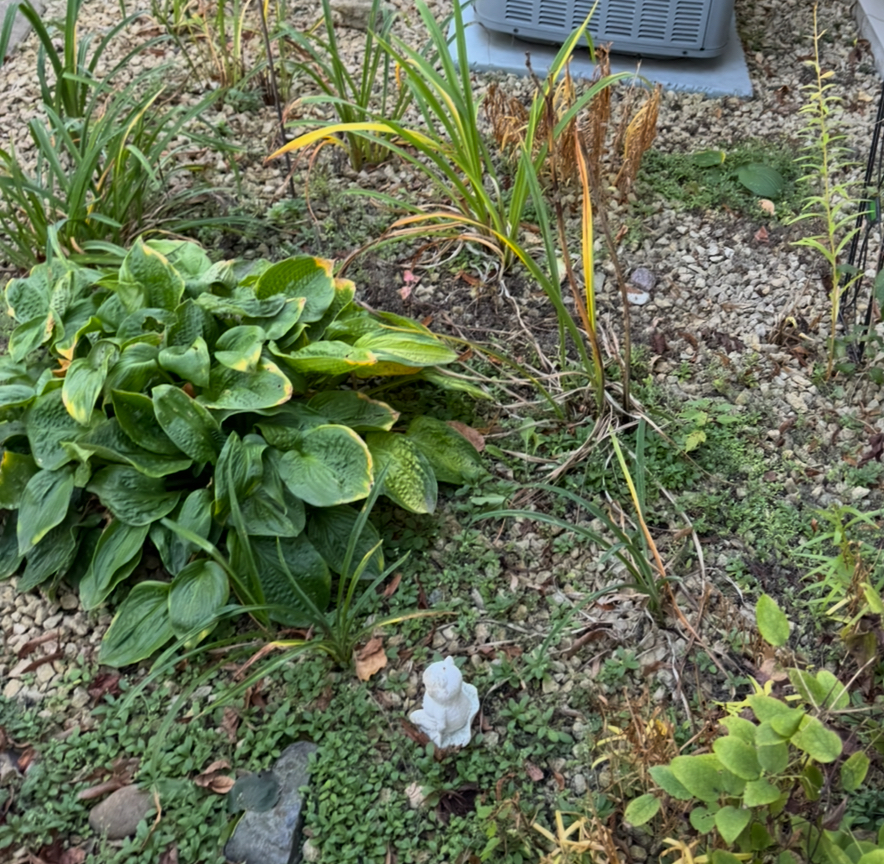
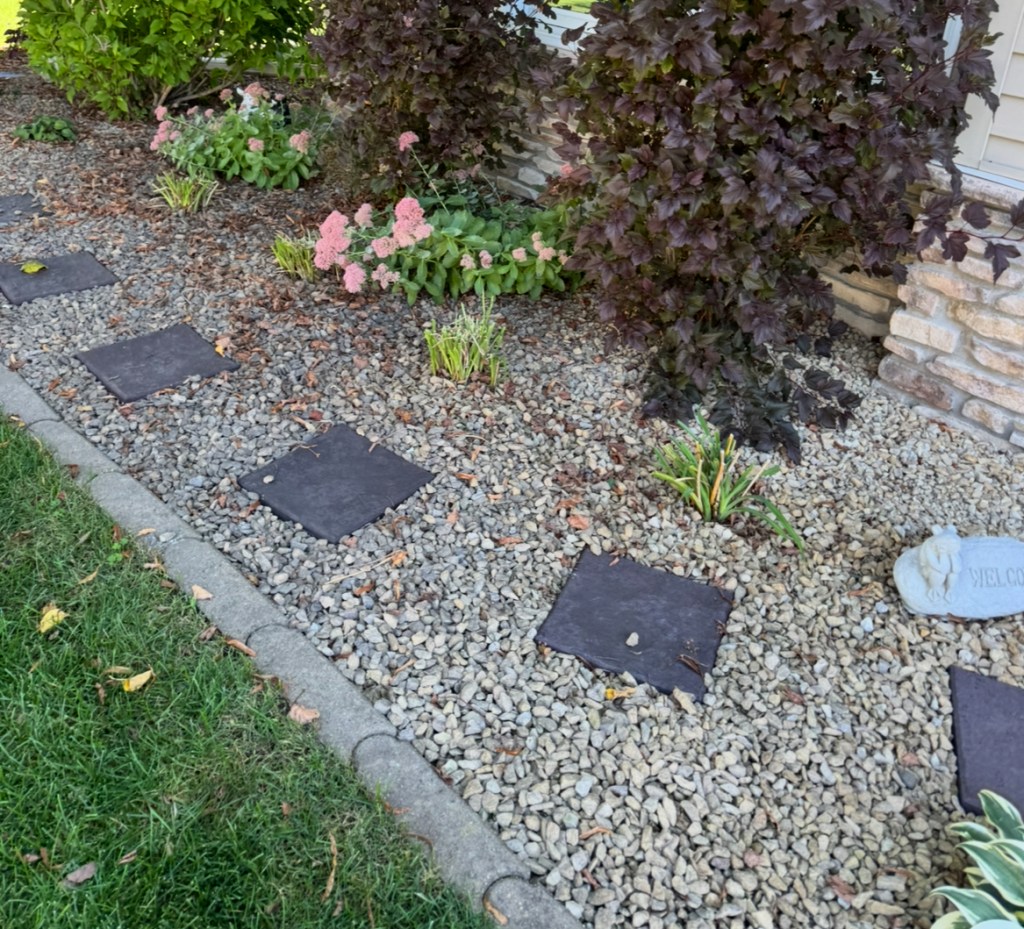
For today’s pics, I cut my “landscaping” daylilies back yesterday. They were dying back, and they were obscuring the Autumn Joy sedum. Can’t have that.
Before
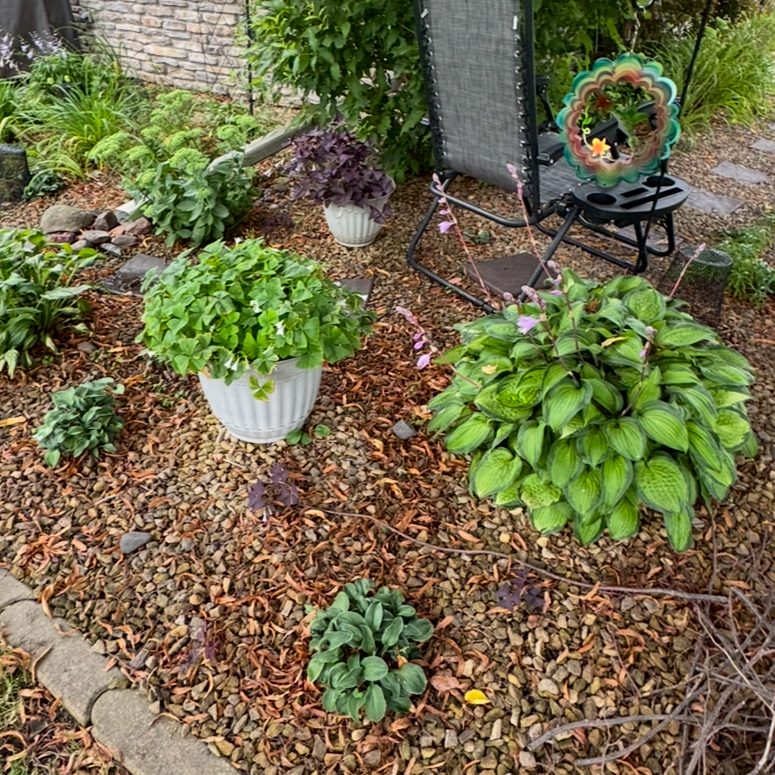
After
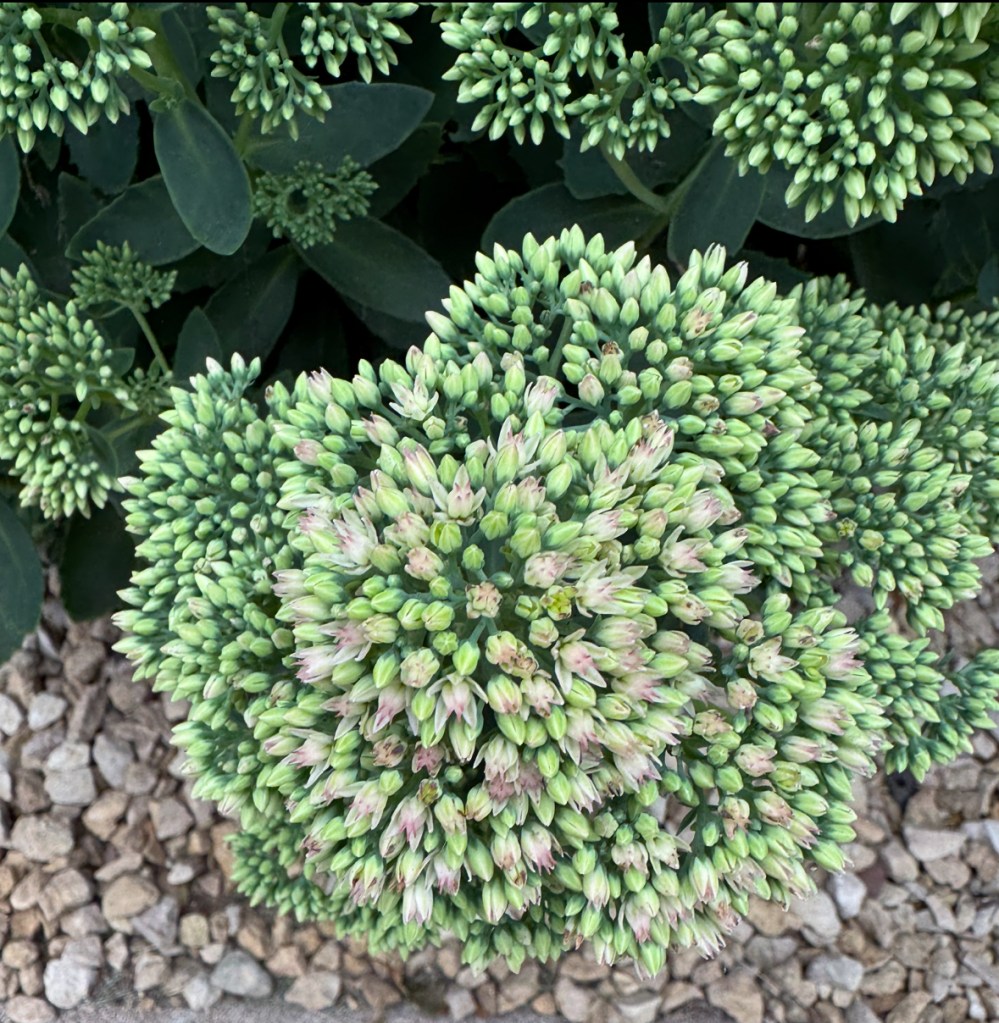
Oh, there you are beautiful Autumn Joy sedum! That I can propagate in weeks with cuttings and no documentation whatsoever. And have. A lot 🙂
It has been a bit since my last blog. The daylily blooms have all wrapped up, except Hello Yellow, which is re-blooming. As I watch the bees, the hummingbirds, and the butterflies enjoying their journey through the hosta blooms in the garden, it occurs to me I ought to be doing the same thing – enjoying the late summer garden.
Yes, I miss the daylily blooms, but the beautiful hosta blooms and the very start of the Autumn Joy sedum color is also now on.
Since I last blogged, I have planted all of the seedlings except the seedlings that will go to the historic cemetery. The gardens are a sea of pods, very fall-ish. There are 55 pods maturing. Well, 53 as of yesterday when I harvested 2. I expect we will not have any true need to buy daylilies – for the townhome, for the historic cemetery, for anywhere – go forward. I may buy one here and there that I want for crossing, but even that is to be determined. When I was looking at my wish list from spring, I went ahead and deleted it because everything on that list was very similar to what I saw come up in our self-seed seedlings this year. I think I am good for now.
Full disclosure, another part of my decision to delete my buy list is because, sadly, a good portion of the daylilies and daffodils I bought and planted last year did not come up at all this year. It was a much worse scenario at the historic cemetery, but even in the townhome gardens I had a few “no shows”. That is very unusual for me. But so is losing 18 hostas this spring. It remains a mystery. We may never know for sure what the reason(s) were. But, I am re-doing the look of the townhome gardens due to the unplanned changes, and we are moving on. It might have been meant to be.
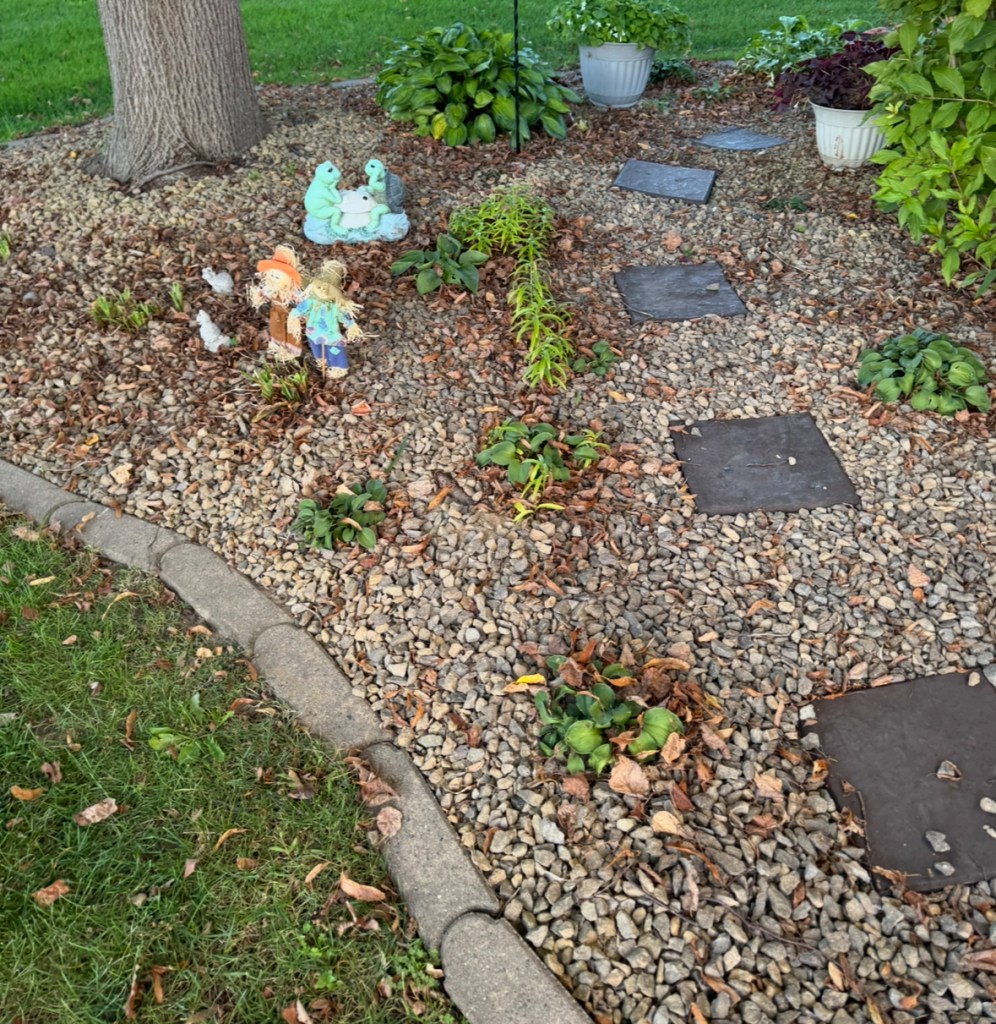
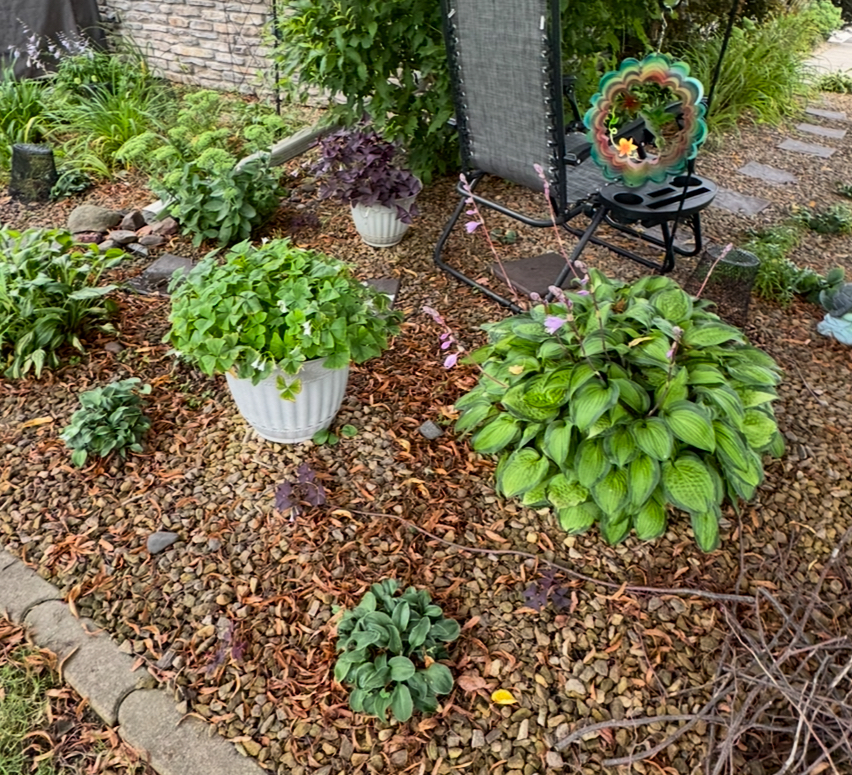
The new garden “look” includes continuing to transplant the Blue Mouse Ears hostas. I dug, divided, and transplanted a large clump of those hostas into their new spots, and I really like it. If there is time, I have one more clump of Blue Mouse Ears to move, but if I don’t, it can stay as is until next year. I also am seeing some purple shamrocks come up from this spring’s, shall we say, squirrel curiosity, ahem.
See purple shamrocks in the front
There are also a few daylily moves in scope. “Unknown Yellow Daylily Freebie with Order” out front does not like her current location and has only bloomed one out of the past three years. I have a spot for her out back. Yellow is not a large part of the front daylily palate, so moving it is a good decision on the color scheme, as well.
Which brings me to the Bluebells clematis out front – it is re-blooming. The hummingbirds and butterflies are loving it. I am very glad I saved the Bluebells clematis volunteers this spring and planted them out back. They are doing very well there, and I am guessing by next year the hummingbird will find those blooms too. The bees already did.
Which leads me to the changing color scheme out back.
This year with the “surprise!” of the red daylily seedling out back, I had some considering to do. I have thought a lot this year about the color scheme going forward – about what I primarily see from my favorite rocking chair on the patio, about how different times of the day are spent on the patio, and about what I want to head towards with future years of daylily crosses. These past two years of so much success with crossing the reds has been fun, and some of those, when they mature, will even be moved up front, but it was this year’s self-seed colors, and form, that was on my mind for the future of the gardens out back. The self-seed seedlings were tall, many were trumpet shaped, substantial, and I really like the colors of the ones with South Seas lineage. The front landscaping has a wave of red, but it has been on my mind to find a transition color from the front to the back gardens, where I want minimal red. I knew that one red daylily seedling surprise was part of the story. I just wasn’t coming up with the answer.
Then one recent night I was relaxing out in the back, for a while – sitting on my favorite rocker, watching the dragonflies, and a bunny, and the sunset, hearing the crickets and the tree frogs start up, and seeing the bats come for the mosquitos (farther out from the patio 🙂 ) while watching all the fireflies close to the ground. The word “quiet” popped in my head. Not the hearing sort of quiet, as the crickets and the tree frogs were singing themselves (and me) very happy. The “quiet” was a feeling. After I came in for the night, I looked up quiet gardens. Indeed, there was some good stuff, but not really a match for what was floating around in my mind – quiet color.
Over the next couple days it occurred to me – lavender is the transition color from front to back. It will soften the red impact. We have some lavender already, as part of different daylilies, and we have the Purple D’Oros that we can let self-seed again. The forget-me-nots and the Blue Mouse Ears both have the blue early on, but mid-July that color starts to fade. We need a touch of lavender that will transition the red in front, past the Marque Moons to the South Seas line out back. And with that, a lot of other decisions are now made as to where I want to go with crosses going forward.
For now, last night I harvested the first two seed pods. They were opening up quickly, and I am guessing I lost a few into the ground before I noticed. It’s OK. They are the reds, and crossed with Naomi Ruth, which did not germinate this year from last year’s seeds. I am guessing these won’t either as the seeds are only 34 days. Yes, it’s a bummer and yes, I will plant them next spring and see what happens, but decision made – next year I will trim down the number of crosses I do. I don’t need to cross the few reds out back. I already do red crosses out front. South Seas will be the dominant line out back, with both crosses and self-seed. Pink Tirzah will be the secondary line, and where I expect the lavender to come from, but we shall see. And if I just so happen to come across a Paul Voth, I might add it. Just one. I had one at the little house up north, and they draw the eye, for sure. But it would be my delight to do a cross that results in lavender.
So, what’s next, besides seed collection, enjoying the late season hosta blooms, and the Autumn Joy sedum colors? After Labor Day (US), I will plant the Mahala Felton daylily seedlings over at the historic cemetery and watch them for a week or so for water need. After that I will begin the seasonal cleanup there.
Today is my cutoff day for doing daylily crosses. I am, admittedly, a little bit sad, but I know it is a good decision. I don’t want to overwork the daylilies with pods, I am fatigued myself on all the planning and crossing and documenting, and I want to have a fall, too. If I stop now, all the pods should be through the maturity window by the time I want to stop watching for pods that are opening.
So today is it. I had all the crosses done by 10am, and now I watch and wait.
Although I do shudder a bit at the volume of crosses I have done this year, I have lots of good notes and lots of all types of pics. I also have been very pleased with the new seedling planters. I am set up with space for seeds that go to seedling next year, plus ways to protect the seedlings.
I am also reminding myself this is not the end of daylily bloom season, just the end of the crossing season. In fact, the late daylilies are not even at peak. I do, however, have all the crosses I want on those as well. So now I get to enjoy. Just enjoy. And get my creative mind going again on my fall list. What needs to be divided, what needs to go to a new location, what worked with the seedling boxes and what next year will pivot to on that setup.
I am also reminding myself this has been is a big change year for me. This hobby is now solidly very deliberate. I don’t random buy anymore. I don’t walk garden stores, seeing what they have chosen to stock. I like to see what is available through hybridizers and propagators, but I seriously consider things I did not before – timing, color compatibility, height, pollen and pod fertility, ploidy, parentage … It is still super fun, but with a specific focus I did not include before.
What happens next, yet this year? Divisions and transplanting work starts tomorrow. Not of the daylilies with pods, but of seedlings that need to come out of pots and go into the ground, and of hostas that need to be relocated. I am also looking at making sure I have paths for next year’s accessibility. If it is too hard to get to something I won’t use it for crosses. Totally OK, but again, needs to be intentional.
So tomorrow turns the corner to all that. I will continue to share as I go.
Happy wishes to you for good garden time until then!
Volunteer. What a wonderful concept. Freely giving time and energy to accomplish something meaningful for and with others is a noble activity. It often gives back to the volunteer every bit as much as is given to the recipient. It is very humbling, and very rewarding. I highly recommend it.
The term Volunteer when speaking of daylilies brings an equally wonderful feeling for me. That a daylily seed from a daylily I own can fall to the ground, find a suitable place to germinate, and survive to seedling and eventually bloom is a wonderful treat for me. A gift.
I have been thinking about this. 1) Why would I not want those? 2) What can I do to encourage that (as another source of daylily creations) and still track the source? 3) Is self-seed not a form of volunteering? How wonderful is that?
Today Red Volunteer, the daylily, bloomed for the second time in our townhome garden. I bought 3 Red Volunteer daylilies last year and planted two at the historic cemetery and one at the townhome. 2 of 3 bloomed this year. That in itself is awesome! Then the Red Volunteer that bloomed at the historic cemetery made – you guessed it – a self-seed. Oh yah. If that pod makes it to maturity, you can bet I will harvest it. And if the seeds are viable and go to seedling, you can bet I will plant the seedlings at the historic cemetery. Maybe even name them (all the same for the seedlings from that one pod of course). And what if it self-seeds again next year? The same? Could we run out of volunteer names? Not sure. But it would be wonderful to try!
Here at the townhome, I did deliberate crosses with the two Red Volunteer blooms this year. The first one – you guessed it – already has a pod. I am hoping the cross I did today is equally successful. Know why? Well … today I crossed Red Volunteer with Coral Majority. Coral Majority is very interesting. She is a super giver of pollen, she frequently self-seeds, and most often I cannot deliberately use her as a pod parent. She just isn’t built for that. She has very bold coloration, very often looks like she is tie-dyed, and is not a messy daylily. She drops her spent blooms pretty quickly if they don’t produce pods. Now doesn’t that have a lot of possibilities? And she is a child of South Seas, with a diploid in the parentage although both Coral Majority and Red Volunteer are tetraploids. Limitless ideas come to mind.
For this year, it only has the one chance. We shall see what is meant to be.
It is the time of year where I get to start relaxing my mind and start just following the palette of daylily crosses I have put together for the year, crosses put together depending on how and when each daylily bloomed. Yes, it is still a lot of work, but the template has been made, and now I get to spend more time really, deeply enjoying the second half of our daylily season.
Last Friday was our apex. The daylilies were blooming like crazy for days, and there were also spent blooms in various stages, still on the scapes, making pods. It is not my favorite “look”, but it is my craft. I let them do their best work, even if it means blooms that follow get a little compromised. It is actually my cue that the garden is about ready to move into the second half of the season. It is also a very good reminder to me that I am not the only one working on the garden. And nowhere is that more evident than in the self-seed blooms. They are all over the garden, too.
Side note – I need a spreadsheet to keep track of which daylilies are pollen producers only, pods only, and especially when I do a “one up” cross, either as a test or because I could not resist. And remember, not everything that worked last year is working this year, for both pollen and pod, and then there is rain and sprinkler patterns and location and age. It is … a lot. A lot that my very busy mind really enjoys. But there is even a point at which I say enough. This year it was the apex.
So back to self-seed. I cannot resist harvesting self-seed. This year we had quite a few South Seas self-seed seedlings go to bloom for the first time. I started this daylily propagation journey by harvesting self-seed, and South Seas is really good at self-seeding. (It could also be because I use South Seas pollen a lot, and that may cause self-seeding.)
All of the South Seas seedlings for all of the years up to 2023 seed harvest/2024 seedling, bloomed this year. And although I separated the years into separate plantings, I stored all of the South Seas self-seed harvest together, and the next year when they went to seedling, I planted them together, as a group, by year.
I am starting to see very different “looks” in the different yearly planting groups. The most dramatic has come through Equal Opportunity. Below are two scapes, and two different looks.
I love them both.
After seeing this year’s blooms, I get the feeling there is definitely a message go-forward. First, “Please don’t stop harvesting self seed!” (I won’t) and maybe even, “When harvesting self-seed – save, store, and plant each self-seed pod separately” (yet to be determined).
All the daylilies are done blooming here, and we are going into the Semi-Finals for seed production. In first place by a long shot is Pink Tirza X red daylily with 8 healthy pods. Woohoo! Now I have to go back into my records to figure out that red daylily type. Or not. If the seeds pods are viable to seed, and the seeds are viable to seedling and they bloom (2-3 years out) they will still just be an “enjoy” scenario. A whole lotta “enjoy” scenario. Maybe a go to the historic cemetery “enjoy” scenario. If all of that happens, I will probably just give them a fun name for our use and conversations 😊 Just like Hello Yellow.
So Pink Tirza is the new Purple D’Oro here. And that is a good thing because the “deer” we were guessing was eating her pods turns out, we are pretty sure, to be due to a sprinkler haha! Either way, even if it was something else, good experience and knowledge gained this year. In addition to her coming in first place for bloom start, she blooms a LONG time, and is gorgeous. Her new working role is to be a pollen producer.
In second place, yep, you guessed it Coral Majority. It would have taken 1st place but I only crossed it a bit, with Cedar Waxwing, with excellent success. And Coral Majority is a self seeder too, although I expected that. The bees love that area and Coral Majority tends to have a lot of pollen and the pistil, or stigma, I guess, is often uncrossable. I seriously don’t know what to do with Coral Majority. It is a wild child. Of one of my faves, South Seas, no less. I hope its children are pretty, and well behaved lol. Because there will be A LOT of them if the pods are all viable. They are all still green and it will be a while that they still need to stay on the scape to mature the seeds. Hopefully the bunnies, squirrels and sprinklers let that happen. I have had pods come off too early in the past and tried to save them to seed but to no avail.
Marque Moon X South Seas was in 3rd place with two green pods and a third that was starting to dry but the bunnies and/or squirrels got those. The squirrels and bunnies have had a lot of fun with South Seas. And also with Naomi Ruth. I think I also over-taxed them. Pods were failing. Next year they get a rest. Only one Pink Tirza pod survived. “Sprinkler deer” got her pods lol. And Mystery Yellow Freebie has a drying pod but it looks not too viable. I will be surprised if it has seeds. And that’s it. Crazy good results from one diploid and one tetraploid this year. But we have a very long way to go. We shall see.
The transplants from two weekends ago are doing phenomenally.
No losses. I did make one mistake, I realized, and I put a daffodil bulb UNDER a Blue Mouse Ears division transplant. So I will have a daffo-mouse. Should be interesting, but fine. If the daffodil does bloom it will be done when the Blue Mouse Ears (hosta) starts to come up. Still … silly of me. Keep daffodils to the daylilies. Oh well. And last of all, sadly, I have a sedum and a hosta that I think need to come out. They just look like they are struggling. The hosta is quite old and never been divided. The sedum is a cutting. Stuff happens. I’d rather be safe. I can put Blue Mouse Ears divisions over there, and maybe a daylily.









 Susan's Daily Garden