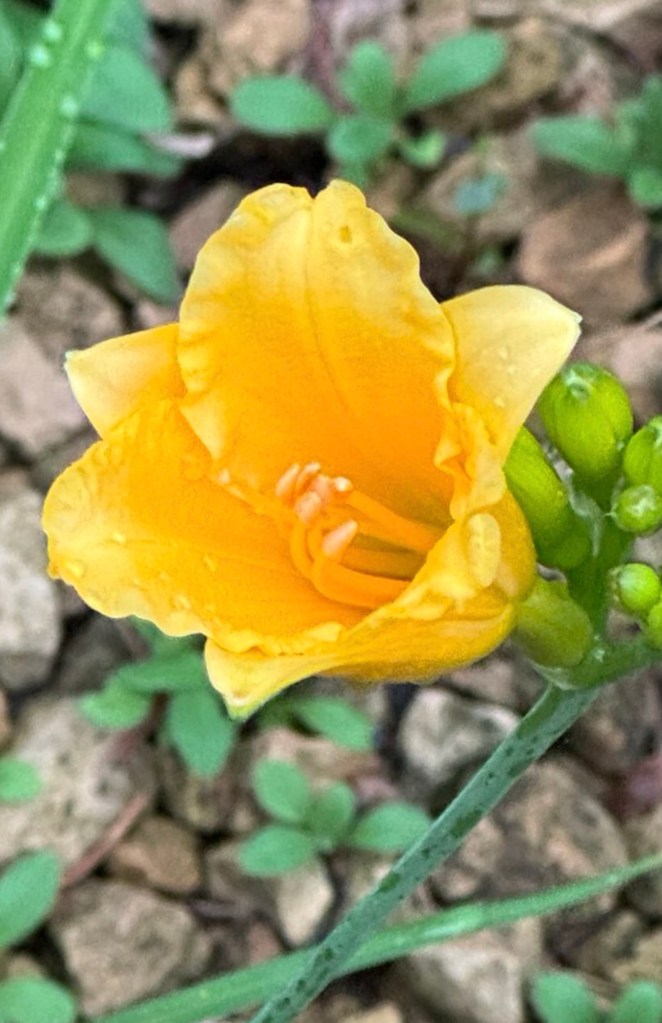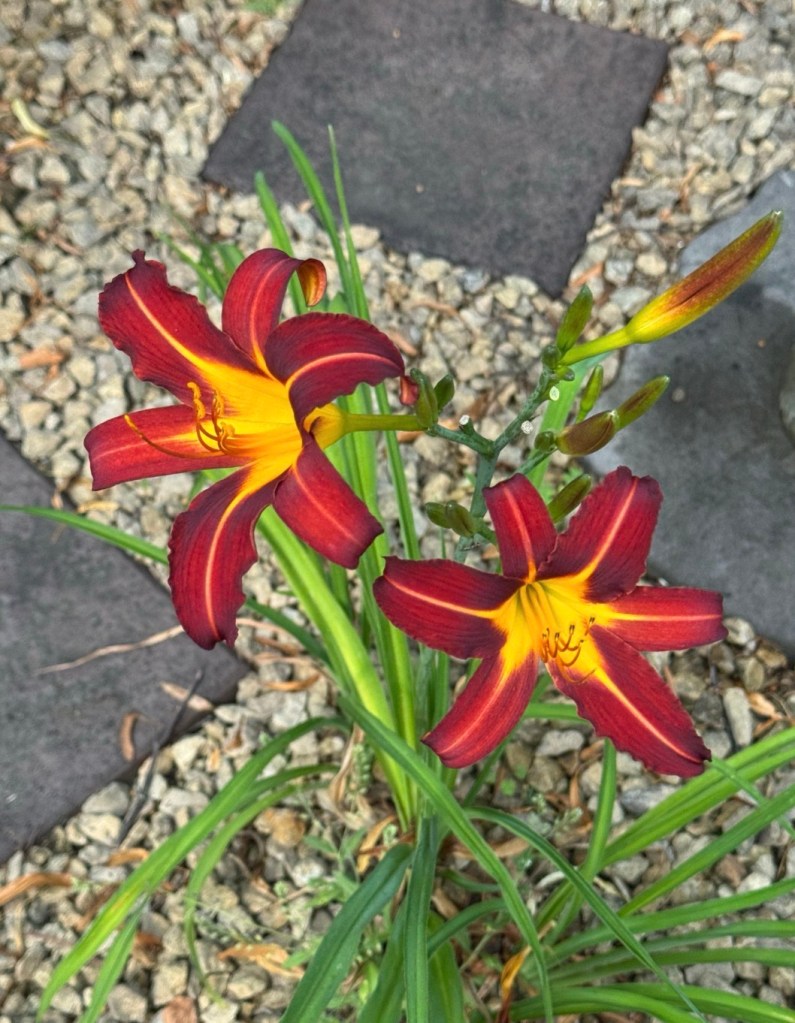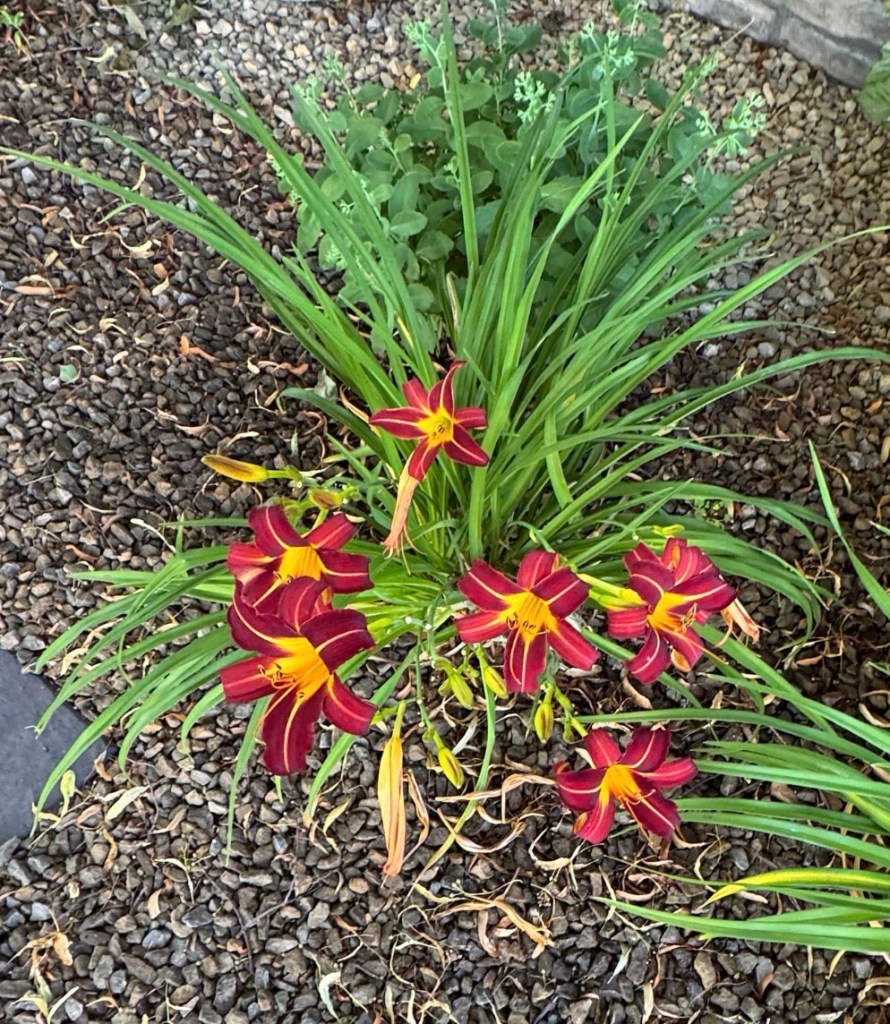
Every year I save a few daylilies and hostas from the main cutback. Not many any more because, like I mentioned in my last post, I don’t like cutback with frozen fingers. 🥶
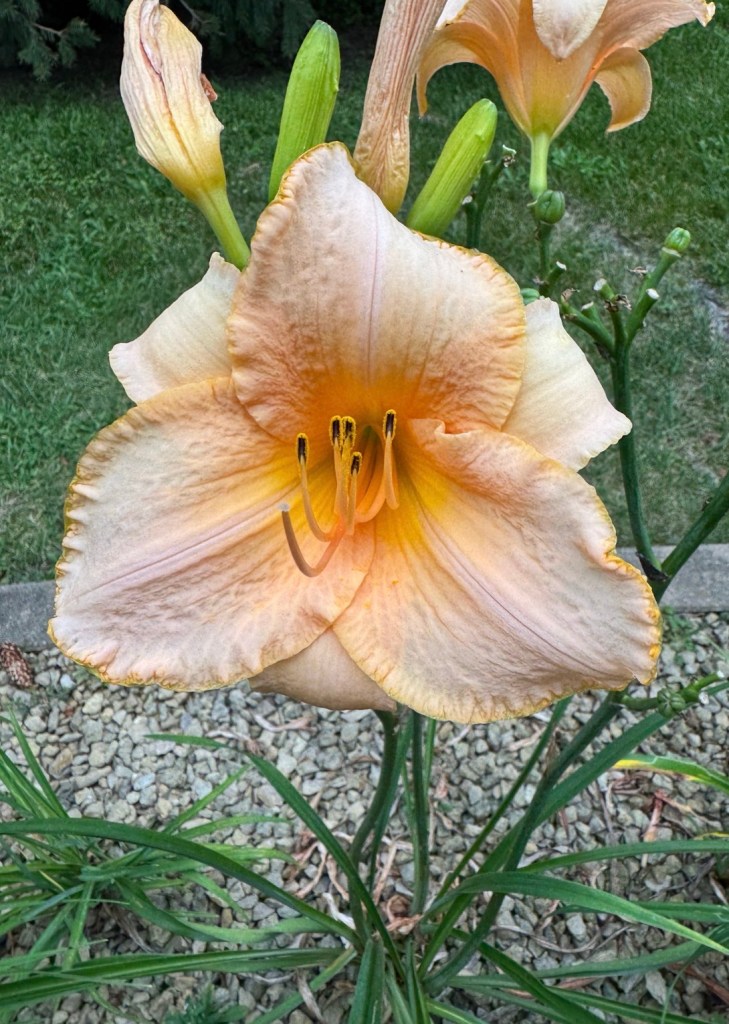
This year. I chose the ones in the pic above.
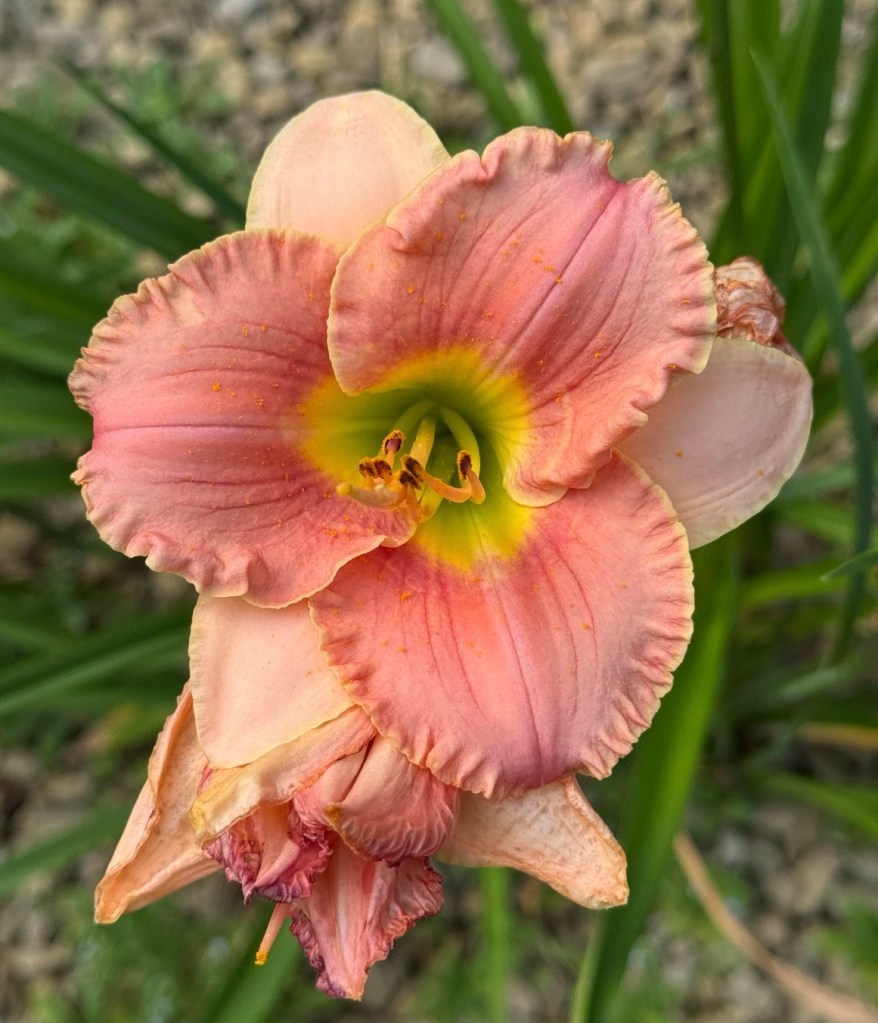
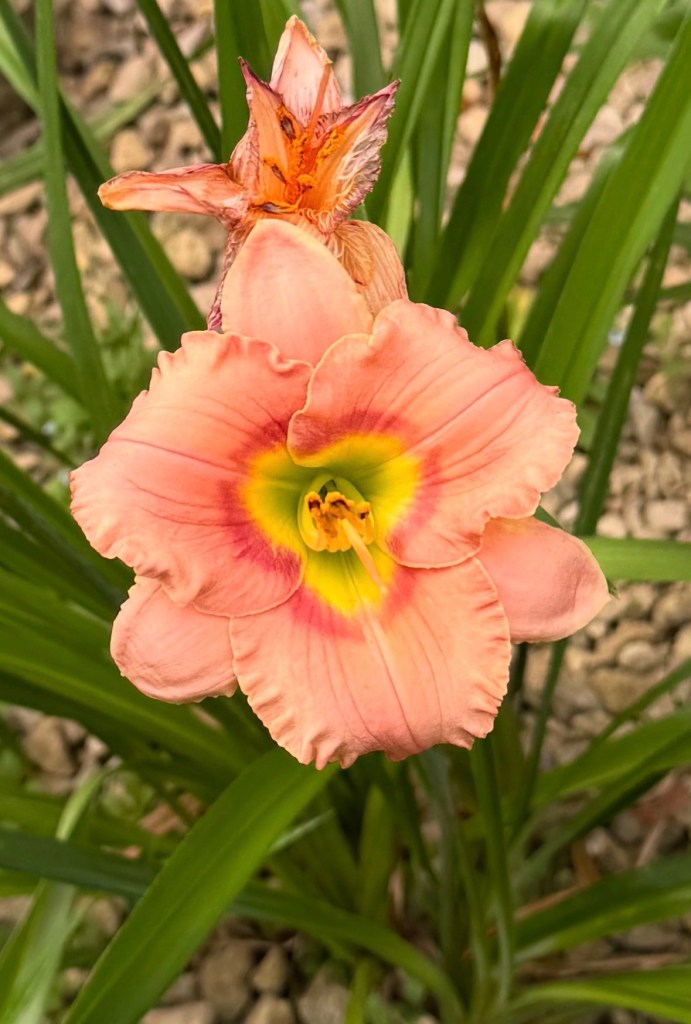
Is this not a wonderful fall daylily depiction? Wrapping up with their last bit of color 😊They just get fall-er and fall-er.
Well … the gardens are done for the year. I knew it was coming. Our DIL had the end of their harvest up north, and I knew our second hard frost was coming here.
It did. Late last week we dipped to 28F.
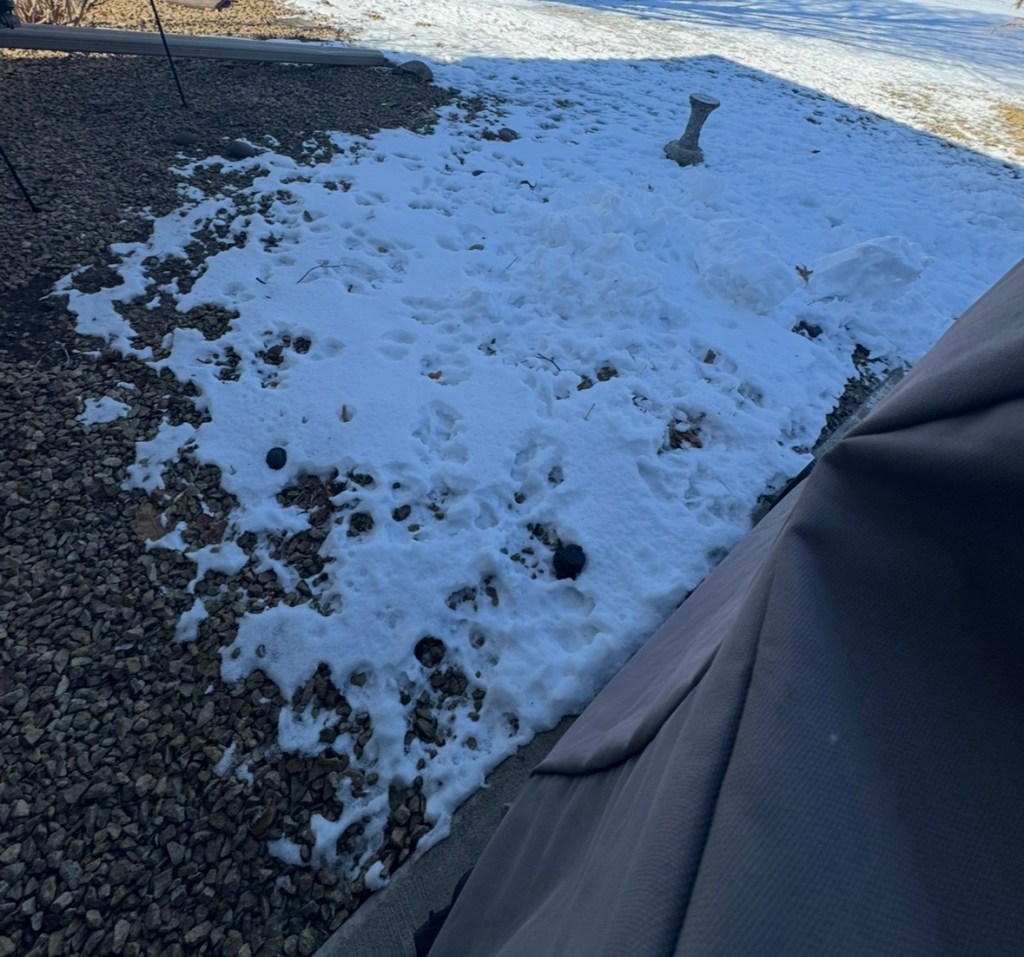
The next morning, I saw the frost. I watched as the trees rained leaves. I enjoyed the beauty, the crisp air … and eventually I started at the cutback work. I have a 60 degree-ish high temperature threshold for the cutback timing. When I see the extended forecast high temperatures start to dip below that, it is time. A little can remain, things that aren’t quite ready, but it is not my favorite thing to cut the gardens back with freezing fingers. So with that, I hit it hard.
It’s a bummer that we are done for 2025.
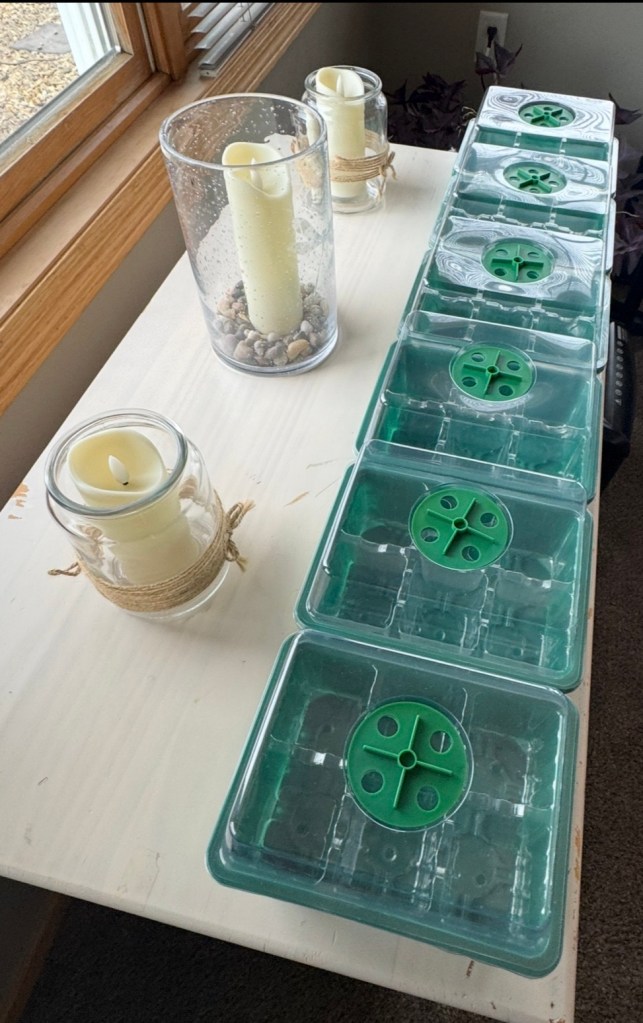
At the same time, however, there is a “happy” bubbling up. My winter activities ideas list is full – enough that I have a comfort level I will have both fun and challenging things to keep me good. And I have started to bring out the hygge for the next six months. The (battery operated) window candles with timers are up, the few strong scented (windows open) candles are being replaced with my favorite white unscented candles, and we have already enjoyed the gentle scent of few rauchers (German incense “smokers”). Bratapfelduft (baked apple) is my personal favorite.
I have also made a pivotal daylily scope decision. I reached out to a provider of the 1762 daylily I want, and they ship in late April/May. I am adding that daylily in 2026 and starting to pivot toward the intersection of historical with my daylilies. This will be a significant change in my daylily work. I think it will be a fun challenge.
To be fully transparent, this decision all started this year with falling in love with a number of daylilies I grew from self-seed to flowering. I loved their form and simplicity. I seriously started to wonder what might happen if I ditched all the busy-ness of hybrid crossing and noting and tracking and giving up early fall freedom due to late harvesting. What would happen if I went back to just letting the pollinators and the wind and the daylilies anatomical tendencies create seeds? I analyzed my spreadsheet for exactly what space my 2025 hybridized seedlings will need in 2026 and what the 2025 seeds would need as 2026 seedlings. A LOT! I listened while my family started to call the cabin up north the hunting shack. (By now I was grumpy.) My idea of a daylily “farm” up north was fading. And I saw the tide turn. What exactly was I doing expanding my daylily work so exponentially? I was already pretty sure I didn’t want to do farmer’s markets to sell my excess plants. I knew for sure I didn’t want to ship stuff around. And the fam was increasingly sending “not really that interested in the daylily farm idea, but hey, if you want to do it, good luck” vibes. 😉 Love them! My conclusion – my life could be so much simpler!
I slowly, and yes sadly, and sometimes crankily (is that a word?), but rationally assessed the scope of daylily hobby work I LIKE to do, year-round, and I decided – “2026 goes to a historic daylily focus” – researching, gardening, and planning included.
Now, I am not trashing the work I have already started. I think that will be fun to see unfold. These things take years. The 2025 seeds, if they germinate, if they go to full seedling, if they survive the first winter, will, at earliest, here in Minnesota USA, bloom for the first time in 2027, probably longer. But I am shaping, refining, what I already have as I weave things together between the seasons and our reality. I am part of a family. And in a marriage. And hobby daylilies were starting to suck planned time and create problems. Not cool. No desire to repeat.
So that’s it. That’s why I’ve been quiet. I was enjoying early fall after the extended seed harvest debacle pushed our fall plans way too close to our family’s hunting season. I was delaying the garden cutback. And I was ultimately deciding how to move forward with the daylilies.
Here’s some fun cloud pictures to words. I was figuring out how to work with the volcano, ‘er fountain 😉
Last year I had a bit of an issue with daylily scapes being pulled down and eaten by something. Probably something with four paws, but you never know, right? I used quite a few deterrents, all safe, and it was minimally effective. Minimally.
When I put all my 2024 notes and daylily crosses info onto my 2025 daylily tracking spreadsheet, I was reminded again about how much of an issue it was in 2024 – and how much it wasn’t in 2025. At least at the townhome. The historic cemetery, well, I have shared what happened with the Mahala Felton daylily seedlings that I planted by the gate. But that is a bit different, I think. And for this post we are focusing on daylily scapes.
As the 2025 daylily season was starting to produce spent scapes, I began to have the urge to tidy up. I did not, however, do that. This year it occurred to me to me that perhaps my habit of trimming spent scapes was actually attracting playful snackers. Against my preference to clean as the garden matures, I left all scapes on all daylilies until the pod harvest season was complete for that full area.
I also introduced another deterrent this year, and that is lemongrass essential oil (diluted and sprayed on the pavers). And, of course, there are the forget-me-nots, which are also a deterrent.
We are to the end of the daylily seed harvesting season, and I can report – no daylily scapes were pulled down and eaten by critters this year, even the shorter daylilies. All pods made it maturity and were harvested by … me 🙂
I also discovered something new. Spent daylily scapes, when completely dried in place, are very easy to pull. I have a few things in the garden that share that feature, and it is very welcome. Not all of the scapes had dried when the pod harvest wrapped up, so some were cut back when I started the daylily cutback out front, but in the true garden, out back, almost all the scapes were able to just be pulled. There remains just a few from the very last pod harvests.
And with that, the greens are getting another week or so of photosynthesis before I come through and cut everything back. And trim the shrubs. And say sweet dreams. And call it a wrap.
For now, cheers to not trimming spent daylily scapes, to lemongrass essential oil, and to forget-me-nots. I am thankful for no critter interference in the seed maturing process this year.
I have now had time to sit with the data on the 2025 daylily crosses. I am a bit shocked, but not totally. I harvested 422 seeds from our gardens here. 277 seeds are from diploids. That is not surprising, as I know what Pink Tirza does. There is a reason Pink Tirza is my diploid line. This year Pink Tirza was an incredible pod parent. Last year it was the opposite – Pink Tirzah was our top pollen producer in 2024. Naomi Ruth and Pink Tirzah don’t do fantastically well together, but Naomi Ruth was a top pollen producer this year, as well. Peach also typed out as a diploid (which did surprise me – a lot), and we have seeds from Peach. And with the Red daylilies in the mix and at an overwhelming quantity of 8 clumps, red boosted the diploid numbers.
Then there are 111 tetraploid seeds. Not surprisingly, South Seas took the prize for tetraploids. South Seas is my tetraploid line for a reason. South Seas is a powerhouse. And Coral Majority, one of her children (which I did not know when I purchased Coral Majority, but bonus!) continues to amaze. In fact, South Seas may have daylily grandbabies in the next few years in our garden due to Coral Majority. Fingers crossed. We have seed. It would be kind of cool. We shall see.
And then we have 34 self-seed from our gardens. Mostly – South Seas and Coral Majority, but a few Red and Just Plum Happy.
Not in the above numbers are 99 seeds harvested from Oakwood – 78 of which are Stella De Oro and look kind of iffy, but maybe they will do something for those gardens. I will try. There are 2 Red Volunteer seeds I harvested from a Red Volunteer I planted there last fall, and then 17 seeds from some new daylilies I don’t remember from last year, but they did very well this year.
So – 521 seeds. Oof! Yah. But I have my thinking cap on. I will figure it out. Lots of other people do this, at a much bigger scale. We shall be creative. There are 4 large success crosses. The rest can go in little seedling pots. Maybe direct sow the self-seed.
All the daylily pods are harvested and there are just a few still drying. With that, I am back in one of my happy places, cleaning data on the tracking spreadsheet, creating pivot tables, slicing and dicing the data. I have a pretty good idea of the top performers – pollen and pod, diploid and tetraploid, and also what I was able to replicate, at least to seed again, from previous years crosses. Soon the 2025 seeds will all go to storage until next March when I set them for stratification.
And it occurs to me, yes, I am definitely back in my happy place. It is full of some things I have loved for years, but it includes an expansion. It includes a new happy place I created last year when I embarked on the Mahala Felton historical research. And so my new “normal” thinking was at work when I began a new search a few days – wondering about daylily history, and specifically what type of daylilies might have been around during the historical times I have been researching. A little AI inquiry ensued, and the results were confirmed. Daylily ‘Apricot’ was the first recorded daylily hybrid, in 1893. And on it went as I was fully in daylily research mode. ‘Apricot’ was the first recorded hybrid 133 years ago, with parentage in still available ‘Flava’. Flava’s origin is listed with a registration date of 1762, and that is probably about as far back as I will get, as the registrar was none other than Carolus Linnaeus, the Father of Taxonomy.
So, fun fact, ‘Flava’ was probably grown in homesteads around this area when it was being settled, but ‘Flava’s child, ‘Apricot’, would not have been in Mahala Felton’s garden, as it was registered the year after she passed, by a school teacher, George Yeld, in England.
Next, my mind went to possibly owning a ‘Flava’ daylily. ‘Flava’ (Hemerocallis lilioasphodelus) looks so sweet and is supposed to be lemon fragrant. Who wouldn’t like that? What would self-seed look like? Would it even go to seedling? Would seedlings ever bloom? And what could I do with that?
‘Apricot’, when researched, makes quite a family tree. I could get lost. I probably will at some point lol. History x Daylilies? Yeah. I will find myself hours later, emerging to find my tea is cold and I need to rest my eyes.
I see the best chance of getting a ‘Flava’ is spring. That means I have all fall and winter to research and dream. And anything I would do would be years out for results anyways. But it is a line I think would be worth at least investigating. It is a diploid, and although Pink Tirza is my diploid line, I could have a “historical line”. Right? Could I rein in to self-seed only and make room for that? It is an intriguing thought.
For now, I leave you with pictures of the last three seed pods, pulled a bit early probably, due to circumstances, but still hovering around 60 days maturity. They should be OK, and if not, they are duplicates of others that did fully mature.
The past few day I have finally felt like I have entered the land of fall in Minnesota. It has been a while coming. And there is a reason. But first –
The 2025 gardening season started out a bit tough, but ended very well – in a significantly different direction.
Earlier this year I shared that we lost 18 hostas sometime between last fall when I cut them back and when they should have been up this spring. Some were huge and all were very healthy the previous year (2023). In fact, I had offered two in particular to my Dad, and he was excited to get them. It was a bit disconcerting to have them vanish.
We have had a full spring/summer now to watch for any sign of the hostas to return. What can I surmise? The vast majority are gone. We will probably never know for sure what happened, but they are definitely gone. There was one that did somewhat recover. And there were two that sent up baby leaves that have endured. The consolation was they were from the ones I was planning to bring to my Dad. So that’s good.
The hosta losses were sad, but the daylilies were crazy good this year, both in bud and flower production, and in pod success. There are quite a few seed pods from self-seed but the vast majority are from crosses I did – hybridization. My tracking spreadsheet tells me I was successful in getting 21 different cross types to seed pod. That is a lot. And I have been feeling it all of September. I have come to the conclusion that the scope of what I did this year is not where I want to land next year. Here’s why:
I absolutely love daylily season. Head over heals, in my very happy place. But I also really love late summer and early fall in Minnesota. I like freedom to enjoy it outdoors. I don’t want to be spending a lot of time sitting indoors during that time, documenting daylily info and storing seeds, and I try to plan for that preference. Knowing that, and suspecting I had gone a bit far with making daylily crosses by mid-July, I made a conscious decision to stop doing crosses on the last day of July. I knew I already had a lot of pods, and that very few were failing, so I knew I would be busy, but I don’t think I fully understood the implications. On September 28, I am still harvesting, labelling, documenting, and storing seeds. And here is the twist – I have discovered it is not my favorite of favorite activities at the scope at which I am now doing daylily crosses. Additionally, based on what I have read over the past year, left to my own very curious and daylily loving devices, the work will only mushroom from here. Think exponential since I literally have already produced hundreds of daylily seedlings and if even 50% of the seeds I am harvesting this season go to seedling, I will be in a sea of daylilies. And 50% is not unrealistic. My success ratio from 2024 seeds to 2025 seedlings was much higher than 50%.
I have thought about this situation ad infinitum. I have even hinted at some ideas in my posts. The most appealing option to me at this point is to take 2026 as a self-seed only year. So let’s get the self-seed discussion out of the way first. I could harvest daylily self-seed for the rest of my life and still keep my fall seasons free for anything I want to do. Yahoo! Self-seed harvesting is very easy. There is no documenting until I harvest. I just enjoy the progression – the scapes to buds to gorgeous blooms. I watch the pollinators come to visit and imagine the wonderful work they are doing. The wind blows, different daylilies make their own crosses easily… There are lots of factors at work. None require anything but admiration from me. No planning, no overheating my brain with what pollen fertile daylilies are blooming that day that could be crosses with compatible pod fertile daylilies that are blooming that day. No documenting endlessly, first on my notes on my phone and then into a spreadsheet with 13 columns of data. The pollinators or the wind or whatever, do their thing, I see what pods mature, collect the seed, put them in an envelope marked xyz daylily breed-year, and I’m done. Maybe I add the count (how many seeds from that daylily type) to refresh my mind when I put them in the refrigerator to stratify and start planning for planting. I keep some and I plant some in other gardens. However, I do not have a say in what goes into that seed. But, so far, I have been delighted.
Hybridizing is a lot more work. A lot. I’m not talking just doing the crosses. Oh no! There is documenting, documenting, documenting from that point on, and then more documenting and labelling for storage. And even crosses of the exact same pollen to the exact same breed of daylily on the exact same day in the exact same bunch (just different blooms) can mature on very different days. Sometimes a week apart, sometimes more. And then when I do 8 identical crosses on one day, 6 on another, four on another, oh yah. The spreadsheet gets longer and longer with more and more of those red corner notes, where I try to put into words something that will make sense six months from now, when I have a question on what I harvested. I am not teasing when I say all that collecting and documenting and storing ate up a lot of my freedom in September. (I made 21 different crosses this year with multiple pods each.). But if I don’t do that documentation work, I get the mysterious “maybe” cross between Pink Tirza (a diploid) and Marque Moon (a tetraploid) that created something that looks pretty close to a Stella De Oro. And I, on purpose, do not have any Stella De Oros here, so … What’s worse, I can’t duplicate it and my other suspected crosses for that outcome produced no pods. Soooo. Document I do. For Hybridizing.
So, where have I landed? I have come to the conclusion that unless I go for a scope where I am selling what I produce, hybridizing is interesting work in small batches, but “not for me” at the scope I expanded to this year.
I know. Sad. But I will still do a few intentional (hybrid) crosses each year. Just at a much smaller scale. The scale I have enjoyed in previous years. And I still will have all the daylilies created up to this point. I just need to stop the mushroom effect.
The other option is to start a real daylily farm, like a business. And then I would be sitting at farmers markets, because I am not going to start mailing things around. The fact is, I am a gardener, not a marketer 😉
One thing is for certain, spreadsheet documentation is worth continuing:
Since I am keeping a spreadsheet for all of this documenting, and the beauty of spreadsheets is you can slice and dice data a lot of ways, eventually optimal options will start to come forward. Without adding new daylily breeds to my garden, there is a finite amount of crosses – diploid to diploid, tetraploid to tetraploid, early, mid, late season. I also have a certain palate I am looking for so that narrows things, which is helpful. Where I could get in trouble is the infinite number of crosses with new seedlings that bloom. That is where I will need to discipline myself.
So back to the start of the blog. The past few days I pulled myself together, and I allowed myself to get into “I am going to enjoy fall” mode. I spent a huge chunk of the days outside. I did some garden cutback, and I did some fall projects. I even took an old bird feeder and made a lantern using a battery operated votive. And I harvested the 6th to last daylily pod yesterday. The others have to be harvested by Sept 30th because the furnace and AC annual maintenance person is coming that day, and they will need the space where the pods are still maturing to be clear. It will be tight. Those pods may be a loss. No, I will not reschedule the maintenance appointment to save 5 daylily pods. I know. Sad.
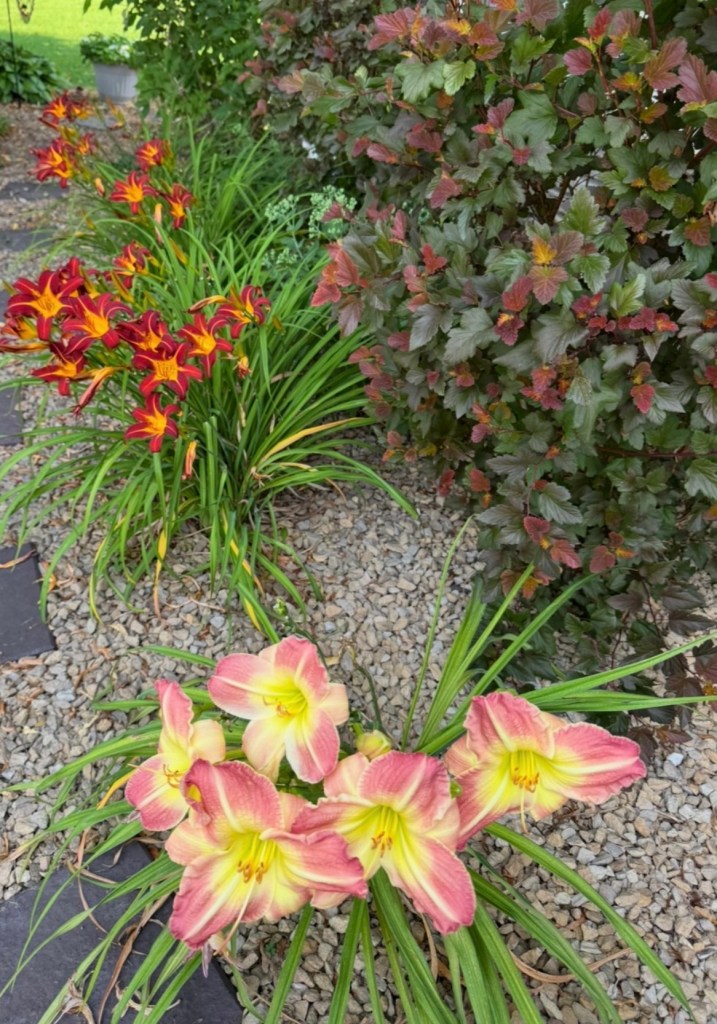
For today’s pics, I cut my “landscaping” daylilies back yesterday. They were dying back, and they were obscuring the Autumn Joy sedum. Can’t have that.
Before
After
Oh, there you are beautiful Autumn Joy sedum! That I can propagate in weeks with cuttings and no documentation whatsoever. And have. A lot 🙂
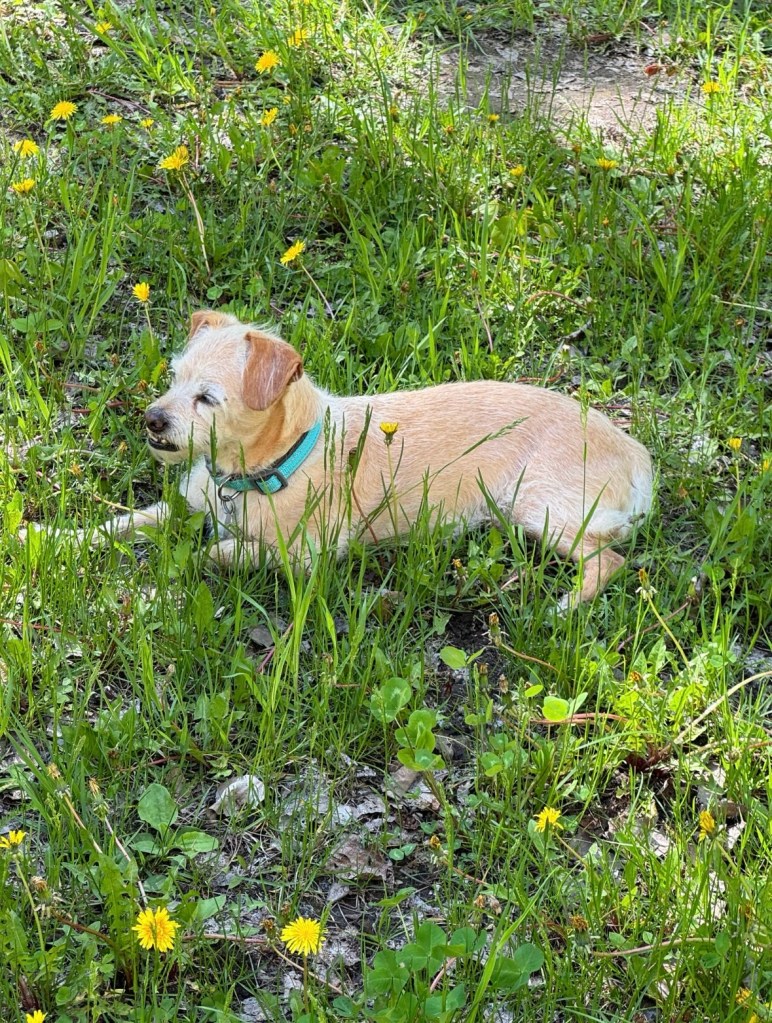
It took a bit today to finally get this blog decided on. There was “Envelope, Please” where I started to share about harvesting the daylily seeds, what was looking good for next year’s potential. There was “Very little left to do in the townhome gardens” where I had started to share the pre-fall progression for the gardens over the past couple weeks. There was “A snapshot of this ‘n that” where I had some pretty things in the gardens to share. All of those were started in the past few weeks and then left to sit. Our aging dog with a heart condition took a few continual turns for the worse, a family member got a very tough medical diagnosis, and the US and world news is … horrifying. Maybe things like this continually happen and we just don’t get a view to it. But it has all been heartbreaking. Praying about it continually, and then doing positive things has been the only way. Our dog is now on medicine designed purely to make his life as comfortable as possible. Our family member is undergoing extensive treatment. And the world, and us in the world, continually mourns losses, but most certainly with the hope of peace for eternity.
And we are still in this world, so we have work to do. And work we will do. Sharing beauty with the gifts we have been given. And experience. And wisdom. And sometimes, as other bloggers have reminded me today, just good old belly laughs. In proper time and measure.
So, for today, I will share a lot of thanks and praise. And some experience, and, hopefully, wisdom.
At the townhouse:
The daylily seed harvest is plentiful. Hundreds of seeds. Some self-seed, but even more through intentional crosses. I have no idea what I will do if even half of it germinates. But I’m guessing I will figure it out.
I have finished all my transplanting, and I am truly truly truly out of room. Some stuff will have to go elsewhere with next year’s divisions. I keep thinking up north but maybe something else will come to mind. We shall see.
The townhome gardens are winding down. The sedum is in full bloom. The late blooming hostas look awesome, and soon I will start cutting the daylilies back (but that will definitely be a different blog post :))
At the historic cemetery:
The self-seed I harvested in the “Shirley” and the “Mahala” gardens – 78 Stella de Oro seeds plus the 2 Red Volunteer seeds – if they germinate in spring, will need a home over there. Possibly at the Fischer site.
The Fischer site test garden is started and, so far, is doing well.
Yes, we have lost Mahala daylily seedlings in the “Mahala” garden. Yes, I am sad about that. Yes, I knew it could happen. No, I will not replace them. What did Grandma say? “Ve get too soon oldt and too late schmart.” Which leads me to –
The historic cemetery gardens are ending their third year in their renovated state and I could not be (much) more pleased. Yes, I wish the Mahala daylily seedling situation was a bit better. Yes, there have been some other challenges. But I have learned soooooooooo much about things that are unique to public site gardens. WAY more joy than “ugghhh”. AND – those gardens are now fully in maintenance mode. Self-sustaining for stock through division of existing plants and seed harvesting propagation from the site itself, and only doing self-seed, no intentional crosses there. It is fully self-sustainable with one exception –
It will need mulch topper each spring, but that should be the only spend 🙂
This is a HUGE milestone. I am very excited about that – the joint accomplishment and the ability to confidently call that decision.
And now we can do extras, like the Fischer site, as the ideas and resources present themselves. We truly do have an awesome team vibe established for those types of things 🙂
So today I am not going to endlessly sit in front of our tv watching horrifying things, dotted with advertisements for things I do not need nor want. I am not going to worry about things I cannot do anything more about. I can choose to use that time for more beautiful things, and still know enough to know how to pray, and for what. And that is what I shall do.
Today is the last day for 2025 daylily blooms in our townhome gardens. Hello Yellow opened the 2025 daylily bloom season, and she is closing it out as well. She is AMAZING! And she is a mystery. I would be tempted to say a bird brought in a Stella De Oro seed, but a) she has repeatedly now typed out as a tetraploid, and today I harvested seed from one of those crosses, b) I planted her as a seedling from seed I harvested (I don’t own any Stella De Oros) and c) I haven’t been able to replicate her. So, she remains “Hello Yellow” with parentage as “sdlg” Her seedlings, if we are so blessed, will be fun – partially because she is not at all scientifically supportable. She is a gift. A reminder that I cannot support everything beautiful with data 🥰
And as the daylily bloom season at the townhome comes to a close, of course I have interwoven that eventuality with something new. Why wouldn’t I? And not something small like weeding or tossing worn out garden gloves or taking cloches off seedlings or moving rock that keeps overflowing into the grass or onto the sidewalk when it rains. No, no, nope. I need something much bigger. Multi-year, very challenging, requiring no money investment, but rather just repurposing and harvesting for new – exclusively, you guessed it – from and to the historic cemetery garden. How did I arrive at this set of requirements? Well funny you should ask. It has to do with 3 years of work there, studying, observing, seeing weird stuff (like things disappearing – ahem – Mahala Felton seedlings and purchased and planted daylilies), and a love for solving reasonable needs. Enter the Fischer project.
The Fischer project was born out of me not being able to keep my joy to myself and sharing that it only now takes one hour per week to weed the entire historic cemetery garden. And, by the way, since we are adding another garden, we need some refining nomenclature. Going forward, for my blogging purposes only, the left side of the wall garden at the historic cemetery will be referred to as the Mahala Felton garden. The right side of the historic cemetery garden will be referred to as the Shirley D garden. And the new garden will be the Fischer garden. So, I was sharing that I felt a bit guilty, not too bad, but a bit, that the historic cemetery garden in year 3 now only takes one hour per week to weed. Or one hour per side every two weeks, or, well you get the gist. And Shirley’s husband, who is an absolute rock star, who helps Shirley keep up the cemetery, said something to the effect of “Do you know the Fischer site?” Yep, kind of, I said. And off the project started. The Fischer site is definitely a long-term project. It will for sure take a couple years to turn into a garden that replaces grass with plants, that does not require mowing. And that is the need.
So, the challenge is a garden at the site that is deer, squirrel, bunny, and other critter – two and four legged – resistant, drought tolerant, very low maintenance (like cut it down at year end), no mulch, does not obscure markers (so ground cover in some areas), and (my requirement) feels healing, and peaceful, and, well, quiet. The Fischer site is the site of early settlers to this area, but their story was very different from the Feltons story.
And that is where this blog ends. But I (with the help of Shirley’s historical research) will share more as time goes on. About the Fischer story (history), about the new garden plant choices, about the new garden successes, and I’m sure failures, and about how things look as we go. Shirley just texted to say they are at Oakwood, and she will water the new plantings. They don’t look like much – a few bunches of transplanted yarrow from the Mahala Felton garden – but it’s our new work in progress. Now that the Mahala Felton garden and the Shirley Dalaska garden take so little effort, their gardens are going to fill the new Fischer garden. That I LOVE 🙂
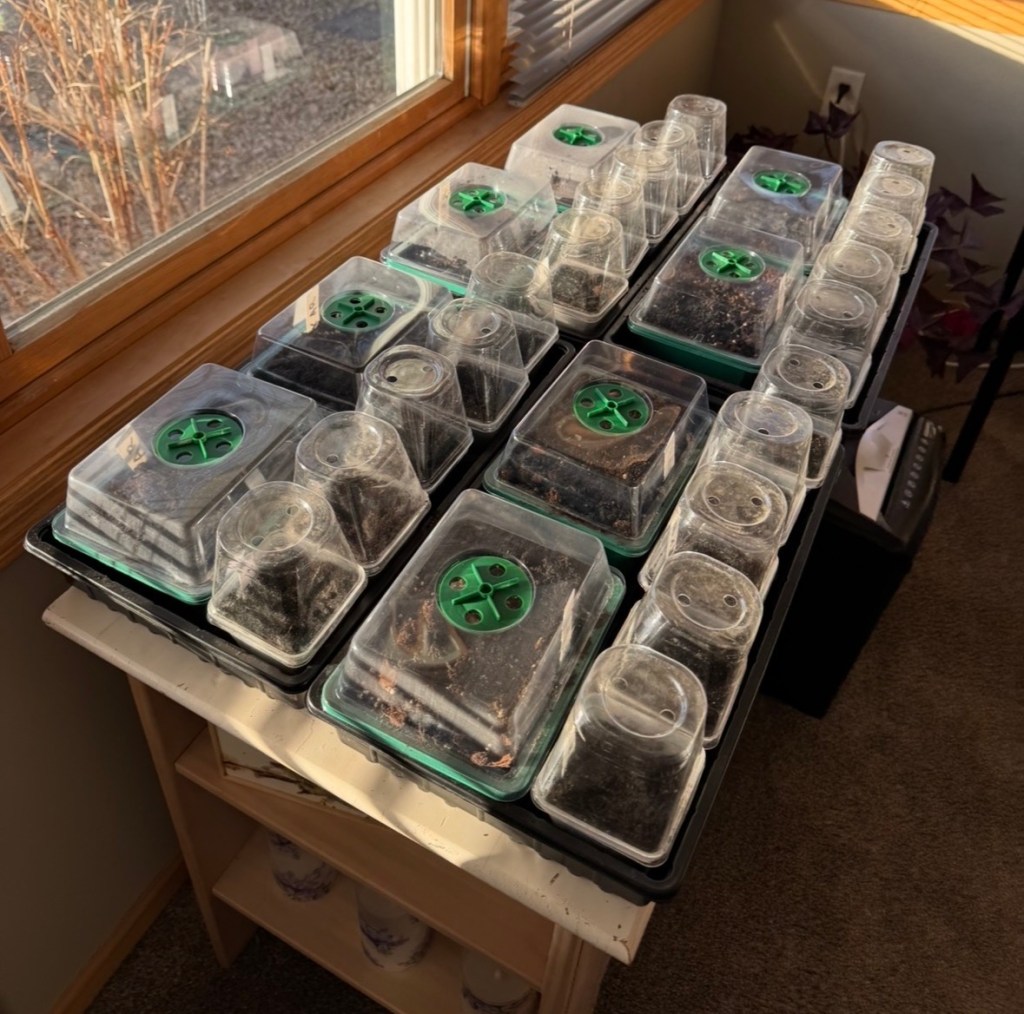
Yep, that outline is where one of the new MDP seedling boxes was until this morning. The seedlings are ALL planted, including the Mahala Felton daylily seedlings, which are now planted at the historic cemetery. And replanted, due to a wee bit of suspected quadruped activity. We think. One never knows for sure 😉
With all the seedlings planted, all that is left in the seedling boxes is the dirt pots with seed that did not germinate. I won’t call those a bust until the end of September.
Sooooo – why did I move the seedling box? Because … a girl can change her mind … The South Seas self-seed seedlings did so well this year, and there are so many more that are at the 1-3 year stage, that I … decided they get their own wave. A nod to the red wave out front and a form of continuance. And to do that, I needed to move the seedling box. Doing that is a bit of a trust factor. Hopefully they will be fine along the border re: grass fertilizing … but I am going to do that test because the upside could be worth it.
You may also wonder where the wood seedling box went. That is a very sad report. After four years of sitting on concrete at least six months of the year, it is in need of repairs.
It will get fixed up and painted “up north green” to hopefully stall the rot a bit, and then it will live up north. Probably sans its rotting floor, and perhaps a great protection from Mr. and Mrs. Deer, as it has the framed screen cover. I would add Mr. and Mrs. Rabbit, but I think our resident Bard owls have made many a meal of them and their friends. The circle of life.
It has been a bit since my last blog. The daylily blooms have all wrapped up, except Hello Yellow, which is re-blooming. As I watch the bees, the hummingbirds, and the butterflies enjoying their journey through the hosta blooms in the garden, it occurs to me I ought to be doing the same thing – enjoying the late summer garden.
Yes, I miss the daylily blooms, but the beautiful hosta blooms and the very start of the Autumn Joy sedum color is also now on.
Since I last blogged, I have planted all of the seedlings except the seedlings that will go to the historic cemetery. The gardens are a sea of pods, very fall-ish. There are 55 pods maturing. Well, 53 as of yesterday when I harvested 2. I expect we will not have any true need to buy daylilies – for the townhome, for the historic cemetery, for anywhere – go forward. I may buy one here and there that I want for crossing, but even that is to be determined. When I was looking at my wish list from spring, I went ahead and deleted it because everything on that list was very similar to what I saw come up in our self-seed seedlings this year. I think I am good for now.
Full disclosure, another part of my decision to delete my buy list is because, sadly, a good portion of the daylilies and daffodils I bought and planted last year did not come up at all this year. It was a much worse scenario at the historic cemetery, but even in the townhome gardens I had a few “no shows”. That is very unusual for me. But so is losing 18 hostas this spring. It remains a mystery. We may never know for sure what the reason(s) were. But, I am re-doing the look of the townhome gardens due to the unplanned changes, and we are moving on. It might have been meant to be.
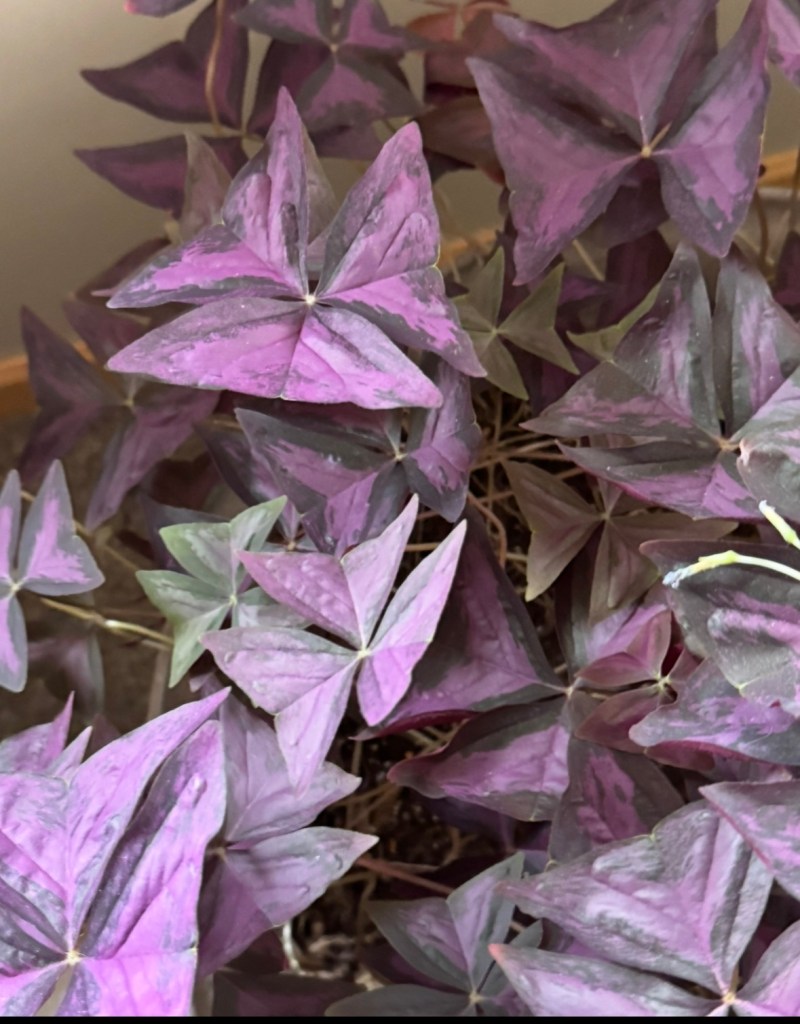
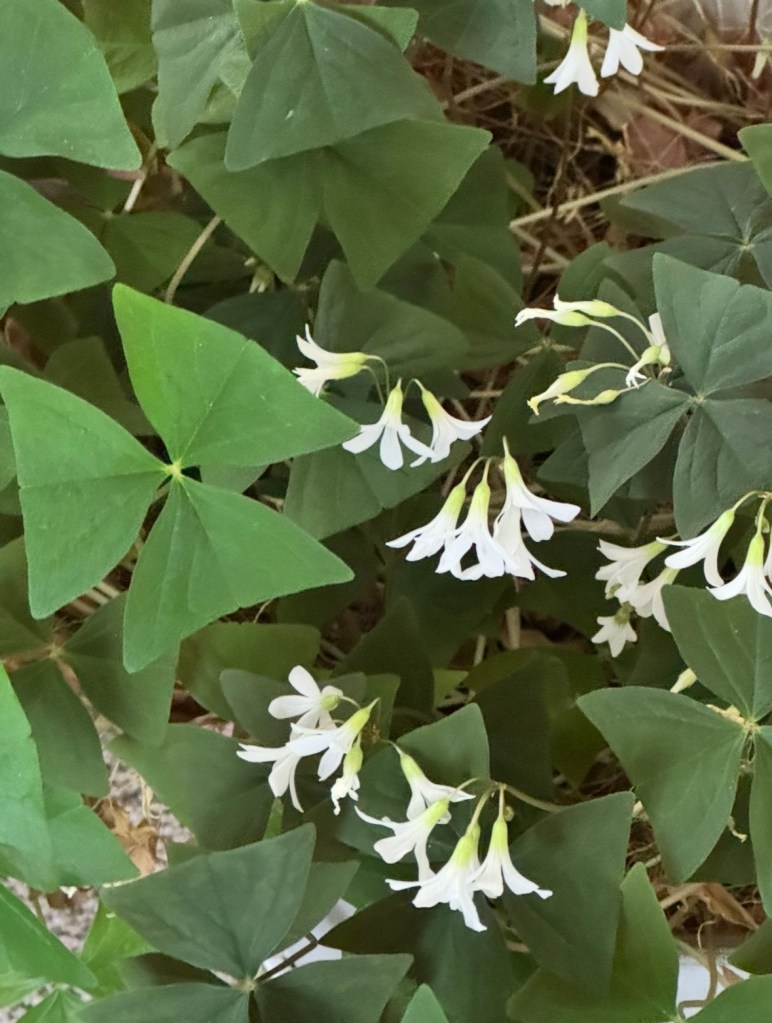
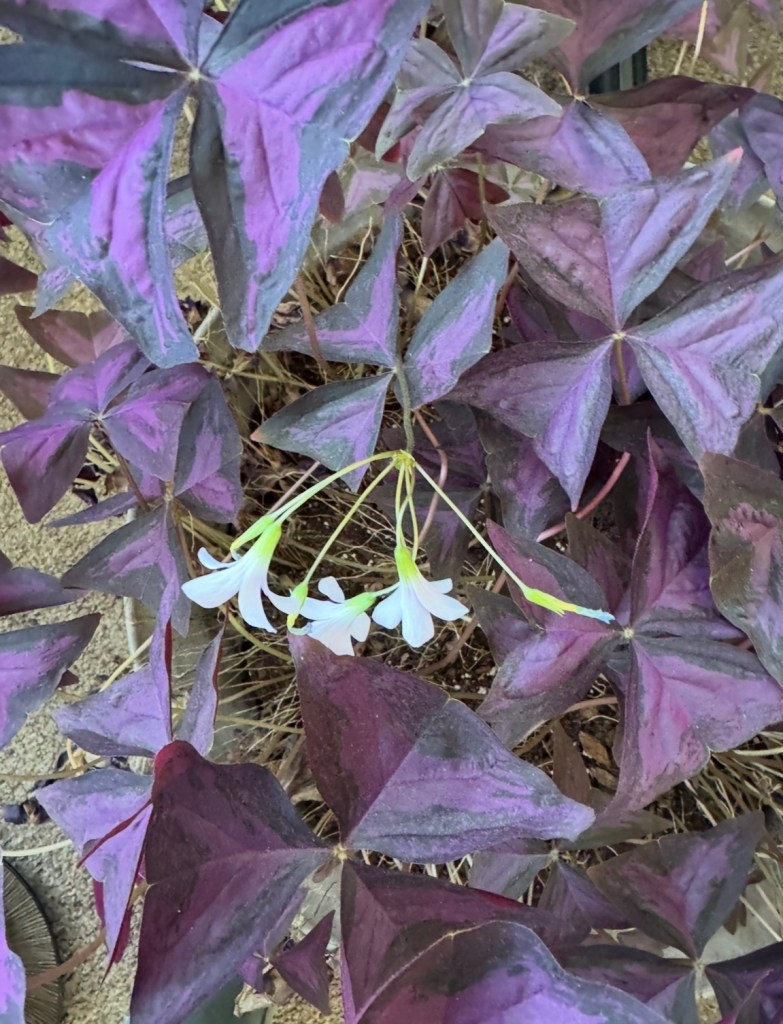
The new garden “look” includes continuing to transplant the Blue Mouse Ears hostas. I dug, divided, and transplanted a large clump of those hostas into their new spots, and I really like it. If there is time, I have one more clump of Blue Mouse Ears to move, but if I don’t, it can stay as is until next year. I also am seeing some purple shamrocks come up from this spring’s, shall we say, squirrel curiosity, ahem.
See purple shamrocks in the front
There are also a few daylily moves in scope. “Unknown Yellow Daylily Freebie with Order” out front does not like her current location and has only bloomed one out of the past three years. I have a spot for her out back. Yellow is not a large part of the front daylily palate, so moving it is a good decision on the color scheme, as well.
Which brings me to the Bluebells clematis out front – it is re-blooming. The hummingbirds and butterflies are loving it. I am very glad I saved the Bluebells clematis volunteers this spring and planted them out back. They are doing very well there, and I am guessing by next year the hummingbird will find those blooms too. The bees already did.
Which leads me to the changing color scheme out back.
This year with the “surprise!” of the red daylily seedling out back, I had some considering to do. I have thought a lot this year about the color scheme going forward – about what I primarily see from my favorite rocking chair on the patio, about how different times of the day are spent on the patio, and about what I want to head towards with future years of daylily crosses. These past two years of so much success with crossing the reds has been fun, and some of those, when they mature, will even be moved up front, but it was this year’s self-seed colors, and form, that was on my mind for the future of the gardens out back. The self-seed seedlings were tall, many were trumpet shaped, substantial, and I really like the colors of the ones with South Seas lineage. The front landscaping has a wave of red, but it has been on my mind to find a transition color from the front to the back gardens, where I want minimal red. I knew that one red daylily seedling surprise was part of the story. I just wasn’t coming up with the answer.
Then one recent night I was relaxing out in the back, for a while – sitting on my favorite rocker, watching the dragonflies, and a bunny, and the sunset, hearing the crickets and the tree frogs start up, and seeing the bats come for the mosquitos (farther out from the patio 🙂 ) while watching all the fireflies close to the ground. The word “quiet” popped in my head. Not the hearing sort of quiet, as the crickets and the tree frogs were singing themselves (and me) very happy. The “quiet” was a feeling. After I came in for the night, I looked up quiet gardens. Indeed, there was some good stuff, but not really a match for what was floating around in my mind – quiet color.
Over the next couple days it occurred to me – lavender is the transition color from front to back. It will soften the red impact. We have some lavender already, as part of different daylilies, and we have the Purple D’Oros that we can let self-seed again. The forget-me-nots and the Blue Mouse Ears both have the blue early on, but mid-July that color starts to fade. We need a touch of lavender that will transition the red in front, past the Marque Moons to the South Seas line out back. And with that, a lot of other decisions are now made as to where I want to go with crosses going forward.
For now, last night I harvested the first two seed pods. They were opening up quickly, and I am guessing I lost a few into the ground before I noticed. It’s OK. They are the reds, and crossed with Naomi Ruth, which did not germinate this year from last year’s seeds. I am guessing these won’t either as the seeds are only 34 days. Yes, it’s a bummer and yes, I will plant them next spring and see what happens, but decision made – next year I will trim down the number of crosses I do. I don’t need to cross the few reds out back. I already do red crosses out front. South Seas will be the dominant line out back, with both crosses and self-seed. Pink Tirzah will be the secondary line, and where I expect the lavender to come from, but we shall see. And if I just so happen to come across a Paul Voth, I might add it. Just one. I had one at the little house up north, and they draw the eye, for sure. But it would be my delight to do a cross that results in lavender.
So, what’s next, besides seed collection, enjoying the late season hosta blooms, and the Autumn Joy sedum colors? After Labor Day (US), I will plant the Mahala Felton daylily seedlings over at the historic cemetery and watch them for a week or so for water need. After that I will begin the seasonal cleanup there.